Most sellers do not start looking for Etsy alternatives because they dislike Etsy. They start because they did the arithmetic.
A $25 sale on Etsy costs roughly $2.83 in mandatory fees, or about 11%. Let that order come through Offsite Ads and the effective take rate climbs toward 23% to 27%. Add Etsy Ads, currency conversion, and the regulatory operating fee, and plenty of shops are handing over a fifth of revenue before they have paid for materials.
The fees are only half the story. You do not own the customer, the search algorithm decides your visibility, and a policy change you had no part in can quietly halve your traffic in a week.
None of that makes Etsy a bad platform, and plenty of shops are right to stay. If you are still weighing it up, selling digital downloads on Etsy walks through what the platform does well before you decide anything.
This guide covers 18 Etsy alternatives for sellers, grouped by what you actually sell: handmade marketplaces, own-store builders, digital and print-on-demand platforms, and regional marketplaces outside the US.
It also covers the fee comparison nobody publishes properly, and how to migrate without losing your sales history. Anyone leaning toward digital rather than physical goods should first work out which digital products sell best, because that decision narrows this list faster than any feature comparison.
Key Takeaways
- Etsy takes roughly 10% to 13% per sale in mandatory fees, rising to 23% to 27% on Offsite Ads orders
- There is no single best Etsy alternative, because a marketplace and an own-store builder solve opposite problems
- Marketplaces bring traffic and take a cut. Store builders charge a flat fee and leave the traffic to you
- Free alternatives to Etsy exist and are genuinely usable: Big Cartel, Storenvy, Fine Art America, and brandID all have permanent free tiers
- Digital sellers are the most overcharged group on Etsy, because they pay physical-goods fees on products with no shipping and no unit cost
- Artists have specialist options that Etsy cannot match, particularly for prints, licensing, and portfolio presentation
- Run both for a quarter before switching. Etsy’s traffic is real, and leaving it cold usually costs more than the fees did
What Etsy Actually Costs in 2026
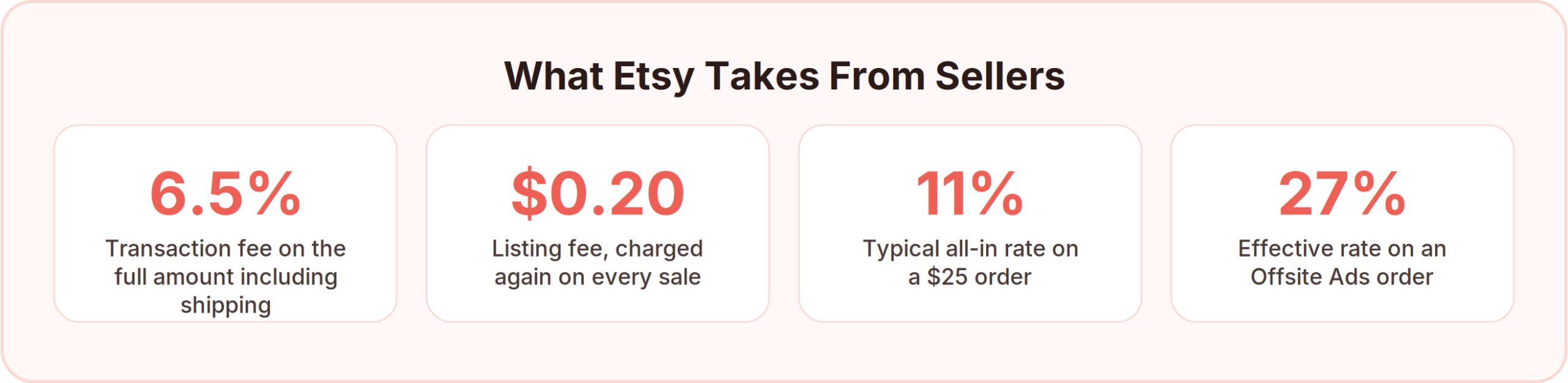
Before comparing anything, get the number you are comparing against. Etsy’s fees are layered rather than a single commission, which is why sellers routinely underestimate them.
| Fee | Amount | Applies to |
|---|---|---|
| Listing fee | $0.20 | Every listing, renewed every four months or on each sale |
| Transaction fee | 6.5% | The full amount the buyer pays, including shipping and gift wrap |
| Payment processing | 3% + $0.25 in the US | Every transaction, varies by country |
| Offsite Ads | 12% to 15% | Any order attributed to an offsite ad, mandatory above $10,000 in trailing sales |
| Etsy Ads | Variable | Optional, charged per click on a daily budget |
| Currency conversion | 2.5% | When your payment currency differs from your listing currency |
| Regulatory operating fee | Varies | Applied per transaction in certain jurisdictions |
| Etsy Plus | $10/month | Optional subscription for listing credits and shop features |
The transaction fee catching most people out is that 6.5% applies to shipping too, not just the item price. On a $30 item with $5 shipping, you pay 6.5% of $35.
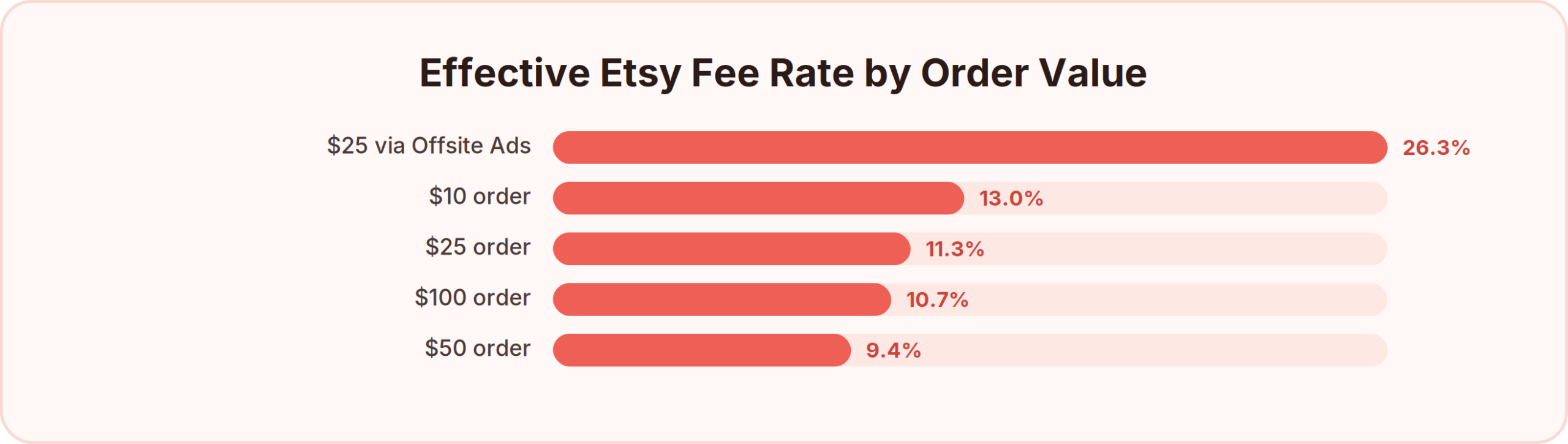
Run it across price points and a second pattern appears: the fixed costs punish cheap items hardest.
| Sale price | Etsy fees | Effective rate | You keep |
|---|---|---|---|
| $10 | $1.30 | 13.0% | $8.70 |
| $25 | $2.83 | 11.3% | $22.17 |
| $50 | $4.70 | 9.4% | $45.30 |
| $100 | $10.70 | 10.7% | $89.30 |
| $25 via Offsite Ads | $6.58 | 26.3% | $18.42 |
Take last year’s Etsy revenue and multiply by your effective fee rate. That figure is your annual budget for an alternative. If it comes to $900, a $22-a-month store builder costs $264 and leaves you $636 ahead, provided you can bring the traffic yourself. That last clause is the whole decision.
Why Sellers Look for Alternatives to Selling on Etsy
Fees are the trigger. These are the reasons people actually stay gone.
- You do not own the customer. Etsy restricts direct contact and keeps the relationship, so a buyer who loved your work last year is Etsy’s to remarket to, not yours.
- Search visibility is rented. An algorithm change can halve your traffic overnight with no notice and no appeal.
- Your competition is on your own product page. Etsy shows similar listings from other sellers directly beneath yours.
- Limited branding. Every shop looks like an Etsy shop, which is fine until you want to be a brand rather than a stall.
- Rising fees with no negotiation. The transaction fee went from 5% to 6.5% in one move, applied to everyone.
- Digital sellers pay physical-goods rates. Same 6.5% on a $12 printable that costs nothing to fulfill.
- Account suspensions happen without warning. Recovering a suspended shop is slow, and the income stops meanwhile.
None of that means Etsy is a bad platform. It means it is a marketplace, and marketplaces charge rent for traffic. The question is whether you are getting enough traffic to justify what you are paying.
The Decision That Comes Before Choosing a Platform
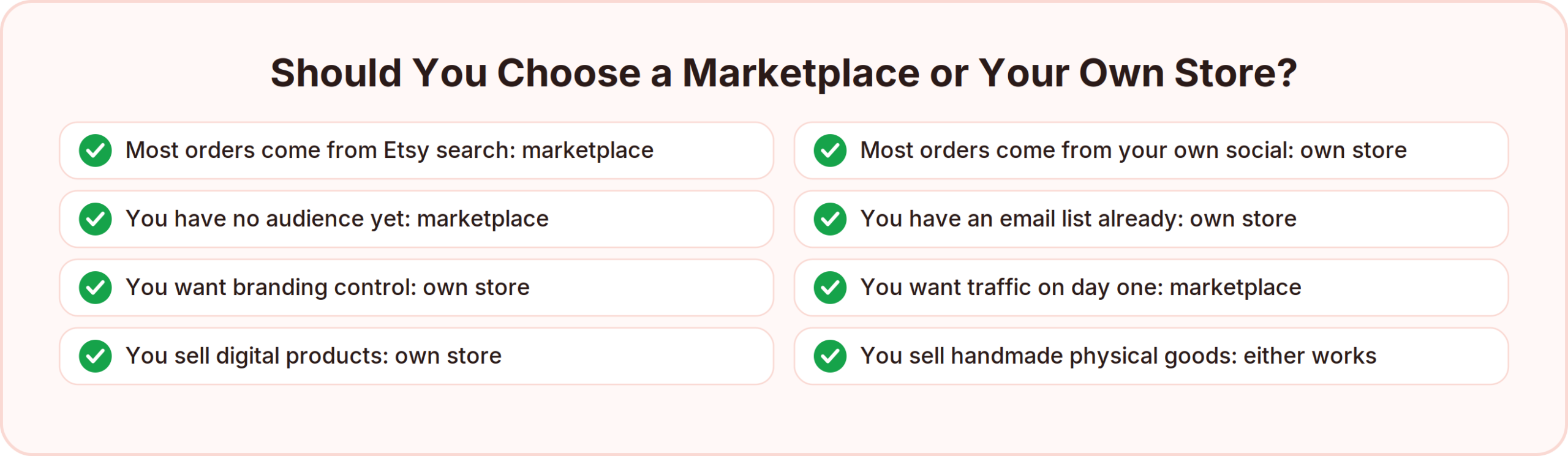
Every alternative on this list falls into one of two categories, and picking the wrong category is the most expensive mistake in this whole process.
| Marketplace | Own store | |
|---|---|---|
| Examples | Amazon Handmade, Bonanza, Go Imagine, Folksy | Shopify, Sellfy, Big Cartel, brandID |
| Who brings traffic | The platform, partly | You, entirely |
| Cost model | Commission per sale | Flat monthly fee |
| Customer data | Usually the platform’s | Yours |
| Branding | Constrained by the template | Whatever you build |
| Best for | Sellers with no audience yet | Sellers who already drive their own traffic |
The honest test: where does your traffic come from today? If most orders arrive from Etsy search, moving to a store builder removes your only source of customers, and the fee savings will not cover it.
If most orders come from Instagram, TikTok, Pinterest, or a mailing list, you are already paying Etsy a commission on traffic you generated yourself. A store builder is straightforwardly better, and making money on TikTok gets considerably easier once a marketplace stops taking its share of every order.
Sellers in the first group usually do best adding a second marketplace rather than replacing Etsy. Sellers in the second group should have left already.
18 Etsy Alternatives Compared
| Platform | Type | Best for | Free plan | Fees |
|---|---|---|---|---|
| brandID | Own store | The best alternative to Etsy for digital products | Yes, forever | Free plan, $9/month for 0% fees |
| Shopify | Own store | Long-term brand growth | Trial only | From $39/month |
| Sellfy | Own store | Digital plus print-on-demand in one | Trial only | From $22/month |
| Big Cartel | Own store | Artists with small catalogs | Yes, 5 products | Free, then $9.99/month |
| Squarespace | Own store | Design-led brands | Trial only | From around $23/month |
| Payhip | Own store | Digital products, percentage-based pricing | Yes | Free with 5% fee, or from $29/month |
| Gumroad | Own store | Occasional digital sales | Yes | 10% flat per sale |
| Amazon Handmade | Marketplace | Reach and fulfillment | No | $39.99/month plus 15% referral |
| eBay | Marketplace | Vintage and collectibles | Yes | Around 13% final value fee |
| Bonanza | Marketplace | Crafts, low fixed costs | No | About 3.5% + $0.40, $14.99 activation |
| Go Imagine | Marketplace | US handmade, ethical buyers | No | Tiered subscription, no commission |
| Storenvy | Hybrid | Store plus marketplace exposure | Yes, 20 items | Free store, 15% on marketplace sales |
| Fine Art America | Marketplace | Prints and wall art | Yes, 25 uploads | Free, or $30/year |
| Society6 | Marketplace | Art on products, hands-off | Yes | Commission on each sale |
| Displate | Marketplace | Metal poster artists | Yes | Commission per sale |
| Folksy | Marketplace | UK handmade | No | £5/month plus 6% commission |
| Made It | Marketplace | Australian handmade | No | Quarterly or annual subscription |
| iCraft | Marketplace | Canadian handmade gifts | No | Monthly fee plus signup fee |
Best Etsy Alternatives for Building Your Own Store
These charge a flat fee and leave the marketing to you. The trade is total control for total responsibility.
1- brandIDBest Etsy alternative for digital products
brandID is the best alternative to Etsy for digital products, because it is the only platform on this list built specifically for selling files rather than shipping parcels. It is a creator storefront rather than a marketplace, built around one page holding your products, links, and audience.
That distinction matters more than any feature comparison. Etsy applies physical-goods economics to digital sellers: a 6.5% transaction fee on a product with no materials, no packing, and no postage, plus a $0.20 listing fee that renews every time one sells. For sellers whose customers arrive from Instagram, TikTok, or YouTube rather than marketplace search, none of that machinery is buying anything.
The fee structure is the sharpest contrast with Etsy. The free plan costs nothing monthly and takes 5% on your own gateway, and the $9 plan drops that to 0% on your own Stripe or PayPal.
The limit worth stating immediately: this is a digital storefront. Selling digital products covers downloads, video, audio, documents, subscriptions, and bookings. Physical goods and shipping do not work here, so a candle maker or jeweller needs one of the marketplaces further down this page. For everyone selling printables, patterns, presets, templates, or courses, it removes the entire cost structure Etsy built for parcels.
- Digital storefront: sell downloads, video, audio, and documents with instant delivery and no fulfillment to manage
- Affiliate marketplace with no approval: over 5 million products from more than 2,000 brands, commission averaging up to 65%, weekly payouts with no minimum
- Subscriptions and tipping: recurring income alongside one-off sales
- Digital billboards: rent ad slots on your own page, with brands paying 30 days upfront
- Email capture and CRM: build a customer list Etsy would never have given you
- Custom domain and branding: your logo and styling on paid plans
| ✓ brandID Pros | ✗ brandID Cons |
|---|---|
|
|
brandID Pricing
- Free: one digital product, one subscription, one tipping jar, unlimited affiliate products, 5% fee on your own gateway
- Creator, $9/month: unlimited products, custom branding, 1,000 CRM contacts, 0% fee on your own gateway
- Turbo Creator, $15/month: premium affiliate products, unlimited subscribers, email and SMS marketing
Best For: Digital sellers of every kind: printables, patterns, presets, ebooks, courses, and audio. If you sell files rather than parcels, this is the alternative to Etsy that stops charging you shipping-era fees on a product with no shipping.
2- ShopifyBest Etsy alternative for long-term growth
Shopify is the alternative to Etsy for sellers who intend to build a company rather than a shop. It is infrastructure rather than a storefront, powering businesses doing millions while the same platform runs a shop selling forty items a month.
The trade is cost and complexity. You are paying from $39 a month before apps, and the app bills accumulate quickly. What you get is genuine ownership: your domain, your checkout, your customer data, and multi-channel selling into Instagram, Facebook, Amazon, and Google from one dashboard.
- Full storefront control with 13,000+ apps
- Sell in 150+ countries with multi-currency support
- Multi-channel sync to social and other marketplaces
- Built-in blogging and SEO controls
- 24/7 support on all plans
| ✓ Shopify Pros | ✗ Shopify Cons |
|---|---|
|
|
Shopify Pricing
- Basic: $39/month
- Grow: $92/month with five staff accounts
- Plus tiers: for higher volume operations
Best For: Sellers with an existing audience and serious growth plans who want one platform they will not outgrow.
3- SellfyBest all-in-one for digital and print-on-demand together
Sellfy sits between a store builder and a creator platform, which makes it one of the more flexible Etsy alternatives for sellers with a mixed catalog. It handles digital downloads, physical goods, subscriptions, and print-on-demand in one place, with email marketing, discounts, and upsells built in rather than bolted on.
For Etsy sellers running both printables and merch, that combination removes the usual two-platform problem.
- Digital, physical, subscription, and POD in one store
- Built-in email campaigns, discount codes, upsells, and cart recovery
- PDF stamping and download limits to protect digital files
- Embeddable store, cart, and buy-now buttons for an existing site
- Affiliate system with custom commission rates
| ✓ Sellfy Pros | ✗ Sellfy Cons |
|---|---|
|
|
Sellfy Pricing
- Starter: $22/month billed annually
- Best value: $59/month billed annually for growing shops
Best For: Sellers who want digital products, merch, and subscriptions running from one dashboard without stitching tools together.
The Sellfy review weighs whether the built-in POD catalog justifies the price against a dedicated print partner.
4- Big CartelBest free store builder for artists
Big Cartel has been the default among free alternatives to Etsy for artists for years, and the free plan is the reason. Five products, a custom domain, and no transaction fees, permanently.
It is deliberately simple. There is no app store and no advanced automation, which is exactly right for a painter with a dozen originals and wrong for a shop with 400 SKUs.
- Free plan for up to five products with no card required
- Custom domain support even on the free tier
- One-click product import from Etsy
- Printful and Printify integration for POD fulfillment
- Facebook Shop, Instagram Shop, and Google Shopping connections
- Listing scheduling for seasonal drops
| ✓ Big Cartel Pros | ✗ Big Cartel Cons |
|---|---|
|
|
Big Cartel Pricing
- Free: up to 5 products
- Paid: from $9.99/month for up to 50 products
Best For: Artists, makers, and side-hustlers with small catalogs who want a branded shop without a monthly bill.
5- PayhipFree plan with a per-sale fee
Payhip is one of the free alternatives to Etsy for digital sellers, running a free plan with no monthly cost and a 5% fee on each sale. Above a certain revenue point the flat-fee plans work out cheaper than the percentage.
It covers digital downloads, courses, memberships, and coaching, and handles EU VAT automatically.
- Free plan with no monthly fee
- Digital downloads, courses, memberships, and coaching
- Automatic EU VAT handling
- Built-in affiliate program
- Coupons, upsells, and email marketing
| ✓ Payhip Pros | ✗ Payhip Cons |
|---|---|
|
|
Payhip Pricing
- Free: unlimited products, 5% transaction fee
- Plus: around $29/month with a reduced fee
- Pro: around $99/month with 0% transaction fee
Best For: Digital sellers who want to test leaving Etsy without a monthly subscription, and are comfortable with a percentage in place of a fixed fee.
The Payhip review works through the point at which the free plan stops being the cheaper option.
6- GumroadPer-sale pricing, no monthly fee
Gumroad reduces selling to its minimum: upload a file, set a price, share a link. Among alternatives to selling on Etsy it involves the least setup, with no store to design and nothing to configure.
The flat 10% per sale is the trade. Below a few hundred dollars a month it costs less than a subscription, and above that it costs considerably more.
- No monthly fee, ever
- Product live in minutes with a shareable link
- Pay-what-you-want pricing supported
- Built-in audience and discovery features
- Handles digital files, memberships, and pre-orders
| ✓ Gumroad Pros | ✗ Gumroad Cons |
|---|---|
|
|
Gumroad Pricing
- Free: no monthly fee, 10% flat per sale
Best For: Sellers listing an occasional digital product who would rather pay per sale than per month, and do not need branding control.
The Gumroad review calculates the revenue point at which that 10% overtakes a flat monthly fee.
7- SquarespaceBest for design-led brands
Squarespace gives you the best-looking store of any Etsy alternative here with the least design effort, which matters more than sellers admit for high-price handmade goods.
Commerce is a feature rather than the foundation, so inventory and fulfillment tooling is thinner than Shopify’s. For a maker selling considered pieces to a considered audience, it is often the better fit anyway.
- Award-winning templates that look expensive
- Blogging, email campaigns, and scheduling built in
- Member areas and digital product support
- Custom domain included on annual plans
- Strong mobile rendering by default
| ✓ Squarespace Pros | ✗ Squarespace Cons |
|---|---|
|
|
Squarespace Pricing
- Commerce plans: from around $23/month billed annually
Best For: Makers selling higher-priced work where presentation carries part of the price.
Alternatives to Etsy for Sellers Who Want Marketplace Traffic
These alternatives to Etsy for sellers bring buyers with them. You pay for that in commission and give up some control, which is the same bargain Etsy offers at a different price.
8- Amazon HandmadeBiggest audience, highest fees
Amazon Handmade is the alternative to Etsy for sellers who want reach above all else, putting your work in front of the largest buying audience available anywhere. Artisans are verified through an application requiring production photos and method documentation.
The 15% referral fee is more than double Etsy’s transaction fee, and there is a $39.99 monthly Professional selling plan on top. That maths only works on higher-priced items with real margin.
- Access to Amazon’s global buyer base
- Fulfillment by Amazon available for storage and shipping
- Sponsored Ads for additional visibility
- Payouts every 14 days on a predictable schedule
- Verified artisan status builds buyer trust
| ✓ Amazon Handmade Pros | ✗ Amazon Handmade Cons |
|---|---|
|
|
Amazon Handmade Pricing
- Subscription: $39.99/month Professional selling plan
- Referral fee: 15% per sale
Best For: Established makers with margins that survive a 15% cut, selling items above roughly $40.
9- eBayBest for vintage, collectibles, and supplies
Etsy sellers overlook eBay because it feels like a different world, and for handmade it mostly is. But among alternatives to selling on Etsy it has the strongest buyer intent for vintage, collectibles, craft supplies, and anything with an established resale market.
Final value fees run around 13% depending on category, which is higher than Etsy, but there are no listing fees within your monthly allowance and the audience is enormous.
- Massive global buyer base with high purchase intent
- Auction and fixed-price formats
- Free listings up to a monthly allowance
- Promoted Listings for extra visibility
- Strong seller protection policies
| ✓ eBay Pros | ✗ eBay Cons |
|---|---|
|
|
eBay Pricing
- Listing: free within a monthly allowance
- Final value fee: around 13% depending on category
Best For: Vintage dealers, collectible sellers, and anyone offloading craft supplies or destashing materials.
10- BonanzaLowest-cost marketplace with an Etsy importer
Bonanza is one of the cheapest Etsy alternatives for sellers who want a second marketplace running, covering handmade, vintage, and collectibles with dramatically less competition than Etsy and correspondingly less traffic.
The economics are genuinely attractive: no monthly subscription and roughly 3.5% plus $0.40 per sale, which is around half what Etsy takes. There is a $14.99 activation fee to start.
- Built-in Etsy importer migrates a shop in one click
- No monthly subscription fees
- Automatic Google Shopping feed
- Printful integration for POD fulfillment
- Buyer contact details available to sellers
| ✓ Bonanza Pros | ✗ Bonanza Cons |
|---|---|
|
|
Bonanza Pricing
- Subscription: none
- Commission: about 3.5% + $0.40 per sale
- Activation: $14.99 one-time
Best For: Sellers who want a second marketplace running alongside Etsy at minimal cost, particularly for crafts and collectibles.
11- Go ImagineBest ethical US handmade marketplace
Go Imagine is arguably the closest thing to Etsy as it used to be, and one of the best Etsy alternatives for genuine makers. It is US-only, handmade-only, and donates 100% of its profits to children’s charities, which is the operating model rather than a marketing line.
It charges tiered subscriptions based on listing count with no commission on sales, which flips Etsy’s model entirely: your costs are fixed and your upside is not taxed.
- Strictly handmade, so no mass-produced competition
- 100% of profits go to charity
- Tiered subscription with no per-sale commission
- Well-designed, modern storefront
- Broad category coverage for handmade goods
| ✓ Go Imagine Pros | ✗ Go Imagine Cons |
|---|---|
|
|
Go Imagine Pricing
- Subscription: tiered by listing count, no sales commission
Best For: US makers frustrated by mass-produced listings competing with genuine handmade work on Etsy.
12- StorenvyHybrid store and marketplace in one
Storenvy is the interesting middle option among alternatives to Etsy: you build a branded standalone store on your own domain, and optionally list the same products in Storenvy’s marketplace for discovery.
Sales through your own store carry no commission. Sales through the marketplace take 15%. You get both models without choosing between them.
- Branded standalone store with custom domain
- Optional marketplace listing for discovery
- Zero commission on your own store’s sales
- HTML and CSS editing on higher tiers
- Built-in blogging and SEO controls
| ✓ Storenvy Pros | ✗ Storenvy Cons |
|---|---|
|
|
Storenvy Pricing
- Free: standalone store for 20 items
- Paid: from $4.99/month for 100 items
- Marketplace: 15% commission per sale
Best For: Sellers who want their own branded shop but are not ready to give up marketplace discovery entirely.
Best Alternatives to Etsy for Artists
Artists are the group Etsy serves worst, because a marketplace built for handmade goods is not built for prints, licensing, or portfolio presentation. The best alternatives to Etsy for artists address exactly those three things, and how artists make money changes considerably once prints and licensing stop competing against candles in the same search results.
13- Fine Art AmericaBest print-on-demand marketplace for artists
Fine Art America is the strongest of the alternatives to Etsy for artists selling prints. Upload artwork once and it handles printing, framing, shipping, and customer service across more than a hundred product types, with your own markup set on each.
It combines marketplace exposure with a custom artist storefront, and includes a licensing programme that generates income from commercial use of your work.
- 100+ product types from prints to phone cases
- You set the markup per product and size
- Artist portfolio and bio pages for credibility
- Licensing programme for commercial usage income
- Global print network handles all fulfillment
| ✓ Fine Art America Pros | ✗ Fine Art America Cons |
|---|---|
|
|
Fine Art America Pricing
- Free: up to 25 artwork uploads
- Premium: $30/year for unlimited uploads
Best For: Painters, illustrators, and photographers who want their work on products without touching inventory.
14- Society6Most hands-off option for artists
Society6 is one of the genuinely free alternatives to Etsy for artists, putting your designs on a wide catalog of home goods, apparel, and accessories, then handling everything else. You upload, they manufacture, ship, and support.
The trade-off is control: you have limited say over base pricing on many products, so your margin is largely determined for you.
- Wide catalog of home, apparel, and accessory products
- Complete fulfillment handled by the platform
- Established audience of design-led buyers
- Artist storefront pages
- Free to join and upload
| ✓ Society6 Pros | ✗ Society6 Cons |
|---|---|
|
|
Society6 Pricing
- Free: to join, with commission taken per sale
Best For: Artists who want passive income from existing designs and have no interest in running a shop.
15- DisplateBest for poster and print artists
Displate is narrow by design: metal posters, one product, done well. Among alternatives to Etsy for artists that focus is the advantage, producing a buying audience that arrives specifically for wall art rather than browsing generally.
For illustrators and digital artists with graphic work, the conversion rate on that intent beats a general marketplace comfortably.
- Single-product focus on metal posters
- Fulfillment, shipping, and support handled entirely
- Artist profile and collection pages
- Active community of collectors
- Free to join and upload
| ✓ Displate Pros | ✗ Displate Cons |
|---|---|
|
|
Displate Pricing
- Free: to join, with commission per sale
Best For: Illustrators, graphic artists, and photographers whose work suits wall display.
Regional Alternatives to Etsy Outside the US
These are smaller and, in their own countries, often better. Local buyers get local shipping times, local currency, and no customs surprises, which converts better than most sellers expect.
16- FolksyThe UK handmade marketplace
Folksy is the leading UK entry among Etsy alternatives for sellers, being UK-only and handmade-only with a flat monthly fee plus 6% commission. For a UK maker doing reasonable volume, that works out cheaper than Etsy’s combined fees.
The audience is smaller but specifically looking for British handmade work, and the shipping expectations match your reality rather than an international buyer’s.
- UK sellers and buyers only
- Strictly handmade, no mass-produced listings
- £5/month plus 6% commission
- Broad craft category coverage
- Active seller community and support
| ✓ Folksy Pros | ✗ Folksy Cons |
|---|---|
|
|
Folksy Pricing
- Subscription: £5/month
- Commission: 6% per sale
Best For: UK makers who want a domestic audience without competing against overseas mass production.
17- Made ItAustralia’s handmade marketplace
Made It is Australia’s largest marketplace for locally handmade goods, charging a quarterly or annual subscription rather than listing and transaction fees.
Some plans include gift guide credits, which is a genuine promotional mechanism rather than a feature list entry.
- Australian sellers and buyers
- Subscription pricing with no per-sale commission
- Gift guide credits on some plans
- Handmade focus with broad categories
- Established local brand recognition
| ✓ Made It Pros | ✗ Made It Cons |
|---|---|
|
|
Made It Pricing
- Subscription: quarterly or annual plans
Best For: Australian makers currently paying international shipping and currency conversion to reach domestic buyers through Etsy.
18- iCraftCanadian handmade gifts marketplace
iCraft is Canadian-based and handmade-focused, open to sellers in the US and Europe as well. It charges a monthly fee plus a one-time signup fee rather than per-sale commission.
The gift focus is narrower than Etsy’s catch-all approach, which helps if your work fits and hurts if it does not.
- Canadian base, open to US and European sellers
- Handmade gift focus
- Monthly fee with no transaction commission
- Category structure built around gifting
- Periodic signup fee promotions
| ✓ iCraft Pros | ✗ iCraft Cons |
|---|---|
|
|
iCraft Pricing
- Signup: one-time fee
- Subscription: monthly
Best For: Canadian makers and gift-focused sellers looking for a domestic alternative.
Free Alternatives to Etsy
Free means several different things here, and the difference decides which one suits you.
| Platform | What the free plan gives you | The catch |
|---|---|---|
| brandID | Unlimited affiliate products, one of each product type, custom domain | 5% fee on your gateway, brandID branding until you upgrade |
| Big Cartel | 5 products, custom domain, no transaction fees | Digital products need a paid plan |
| Storenvy | Standalone store for 20 items | 15% commission if you use the marketplace |
| Payhip | Unlimited digital products | 5% of every sale, and 0% only at around $99/month |
| Gumroad | Unlimited products, no monthly fee | 10% of every sale on every plan |
| Fine Art America | 25 artwork uploads with full fulfillment | Upload cap, 30 to 60 day payment settlement |
| Society6 | Unlimited uploads with fulfillment handled | Limited pricing control, commission per sale |
| eBay | Listings within a monthly allowance | Around 13% final value fee |
The pattern is consistent: platforms with no monthly fee take a percentage, and platforms with no percentage charge monthly. The only question is which side suits your volume. Below roughly $500 a month in sales, percentage models usually win. Above it, flat fees do.
Sellers with no product ready yet should settle that first, since selling digital products removes shipping, materials, and unit costs from the equation entirely, which changes what a fair fee even looks like.
Best Etsy Alternative by What You Sell
| If you sell… | Start with | Why |
|---|---|---|
| Printables and digital downloads | brandID | Built for digital products, with 0% fees on your own gateway |
| Handmade physical goods | Go Imagine or Amazon Handmade | Genuine handmade marketplaces with real buyer traffic |
| Art prints and wall art | Fine Art America or Displate | Fulfillment handled, audiences that arrive for art |
| Print-on-demand merch | Sellfy or Society6 | POD built in rather than integrated |
| Vintage and collectibles | eBay or Bonanza | Where those buyers already search |
| A growing brand with its own traffic | Shopify or Squarespace | Full ownership, no commission |
| Nothing yet, still testing | Big Cartel or Gumroad | Free to start, nothing to lose |
| To UK, Australian, or Canadian buyers | Folksy, Made It, or iCraft | Domestic shipping, currency, and buyer expectations |
How to Move Off Etsy Without Losing Your Business
The mistake is treating this as a switch rather than a transition. Etsy’s traffic is real, and turning it off before the replacement produces orders is how sellers end up back where they started with three months of lost income.
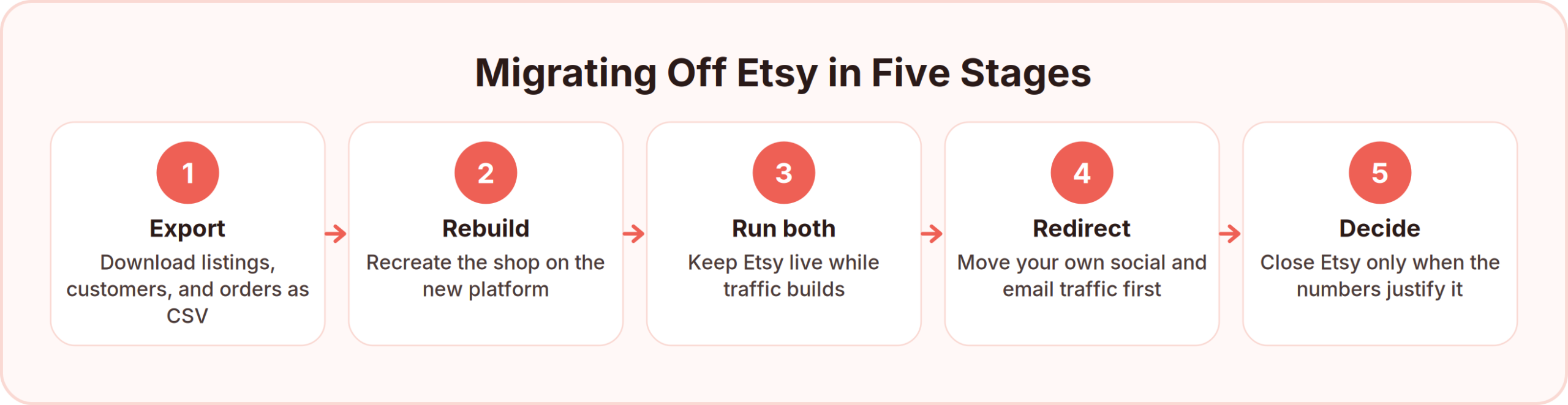
- 1- Export everything first. Etsy lets you download listings, customer contacts, and order history as CSV files. Do this before anything else, because access ends with the shop.
- 2- Rebuild rather than import blindly. Product lists and descriptions transfer cleanly. Shop design, reviews, and search ranking do not, so plan to recreate those.
- 3- Run both in parallel for a quarter. Keep Etsy live while the new store builds traffic. The fee savings only matter if the orders follow you.
- 4- Redo your SEO for the new platform. Etsy search and Google search reward different things. Etsy tags do not translate into meta titles.
- 5- Move your audience deliberately. Package inserts, a note in every Etsy order that complies with their policies, and your social bio all pointing to the new store.
- 6- Build the email list you never had. This is the part Etsy never allowed, and it is the whole reason to leave. You can build an email list without a website in an afternoon.
- 7- Only close Etsy when the numbers justify it. Some sellers never do, running Etsy for discovery and their own store for repeat customers.
Give a new store six months before judging it. Etsy hands you traffic on day one; every alternative asks you to build it. That is not a flaw in the alternatives, it is the thing you were paying Etsy 11% for.
Where Your Traffic Comes From Once You Leave
This is the section most Etsy alternative roundups skip, and it decides whether any of this works.
- Social selling. Instagram, TikTok, and Pinterest drive enormous handmade and art commerce. Link in bio tools turn that attention into a shop, and Instagram bio ideas decide whether anyone taps it.
- Email. The only audience nobody can take from you, and the highest-converting channel available to a small shop.
- Search. Google traffic to your own store compounds in a way Etsy search never does, because you own the ranking.
- Marketplaces as discovery. Keep one running to introduce new buyers, then convert them into direct customers.
- Wholesale and local. Faire, craft fairs, and local stockists reach buyers who never open a marketplace app.
- Affiliate and referral income. Recommending the tools and materials you already use adds a second revenue line, and the best affiliate programs pay more per sale than most handmade margins do.
The strategic point is that Etsy’s fee is really a customer acquisition cost. Paying 11% for a buyer you would never have found is a reasonable deal. Paying 11% for a buyer who came from your own Instagram is not, and that is the sale worth moving first.
Underneath all of it sits the thing that makes any channel work, which is that people buy from makers they recognise. Personal branding turns a shop nobody has heard of into one people search for by name, and it is the only asset that transfers intact when you change platforms.
Mistakes Sellers Make When Switching
- Closing Etsy immediately. The traffic stops the same day and the new store has none yet.
- Choosing on price alone. A free platform with no buyers costs more than a $22 one with a working audience.
- Moving to a store builder with no audience. If Etsy search is your only traffic source, you are removing the business rather than the fee.
- Recreating the Etsy shop exactly. The point of leaving is branding you control. Use it.
- Skipping the email list again. Repeating Etsy’s single biggest limitation on a platform that does not impose it.
- Ignoring where you actually sell. A handmade seller on a digital-only platform, or a printables seller paying shipping-based fees, is a filing error that costs money monthly.
Conclusion
There is no single best Etsy alternative, only the right one for what you sell and where your buyers come from. Go Imagine and Amazon Handmade replace the marketplace, Shopify and Squarespace replace the storefront, and Fine Art America and Displate serve artists in ways Etsy never has.
For anyone selling files rather than parcels, brandID is the alternative to Etsy for digital products, because it never applied shipping-era fees to them in the first place.
What all of them share is the thing Etsy withholds: the customer. Every alternative here lets you build a list, contact your buyers, and own the relationship that produced the sale.
Start by calculating what Etsy took last year. Then pick one alternative that matches what you sell, run it alongside Etsy for a quarter, and move the traffic you generated yourself first. That is the portion you were never getting value for.
What Is the Best Alternative to Etsy?
It depends entirely on what you sell. Go Imagine and Amazon Handmade are the strongest handmade marketplaces, Shopify and Squarespace are the best own-store builders, and Fine Art America serves artists selling prints. For digital products, brandID is the best alternative to Etsy, since it charges no transaction fee on your own payment gateway from $9 a month rather than applying physical-goods rates to files.
What Are the Best Free Alternatives to Etsy?
Big Cartel offers five products free with a custom domain and no transaction fees. brandID has a permanent free plan with unlimited affiliate products and a custom domain. Storenvy gives you a free store for 20 items, Payhip and Gumroad charge per sale instead of monthly, and Fine Art America allows 25 free artwork uploads with fulfillment included.
How Much Does Etsy Actually Take Per Sale?
Around 10% to 13% in mandatory fees: a $0.20 listing fee, a 6.5% transaction fee on the full amount including shipping, and payment processing of 3% plus $0.25 in the US. On orders attributed to Offsite Ads, the effective rate climbs to roughly 23% to 27%.
What Are the Best Alternatives to Etsy for Artists?
Fine Art America handles printing and shipping across 100+ product types while you set your own markup, Displate suits poster and graphic artists specifically, and Society6 is the most hands-off option. For artists selling originals rather than prints, Big Cartel’s free plan gives you a branded shop at no cost.
Is There an Etsy Alternative With No Fees?
No platform is genuinely free of all costs, but several remove per-sale fees. Big Cartel, Sellfy, IndieMade, and brandID’s paid plans charge a flat monthly fee with 0% transaction fees on your own payment gateway. Go Imagine and Made It charge subscriptions with no commission. You still pay a payment processor like Stripe or PayPal.
Can I Sell Digital Products Somewhere Cheaper Than Etsy?
Yes. Digital sellers are the most overcharged group on Etsy, paying physical-goods rates on products with no shipping or unit cost. brandID is the strongest alternative to Etsy for digital products, with a free plan and a $9 tier that reduces transaction fees to 0% on your own payment gateway. Payhip and Gumroad also handle digital delivery, though both keep a percentage of every sale.
Should I Leave Etsy Completely or Sell on Both?
Most sellers should run both for at least a quarter. Etsy’s traffic is real, and closing the shop before an alternative produces orders removes your income rather than your fees. Move the customers who found you through your own social channels first, since those are the sales Etsy is charging you for without providing anything.
Which Etsy Alternative Has the Most Traffic?
Amazon Handmade, by a wide margin, since it draws on Amazon’s entire buyer base. The trade is a 15% referral fee plus a $39.99 monthly subscription, which only works on higher-priced items. eBay has the second-largest audience and suits vintage and collectibles far better than handmade.
Can I Import My Etsy Listings to Another Platform?
Several platforms offer one-click Etsy import, including Big Cartel, Bonanza, and IndieMade. Etsy also lets you export listings, customer contacts, and order history as CSV files. Shop design, reviews, and search ranking cannot be transferred and have to be rebuilt.
Are There Etsy Alternatives Outside the US?
Yes, and they often convert better locally. Folksy serves UK handmade sellers at £5 a month plus 6% commission, Made It is Australia’s largest local handmade marketplace, and iCraft is Canadian-based while accepting US and European sellers. Domestic shipping times and currency remove friction that international Etsy orders carry.
 Summarize this article with: