If you have ever asked how do artists make money, the honest answer is that they combine several income streams rather than wait to be discovered. The most common are selling originals, prints, and commissions, then layering on licensing, teaching, memberships, content, and the best digital products to sell for creative audiences.
The starving-artist idea is a story, not a rule. Plenty of people earn a full living from their art, and many more earn a meaningful side income, almost none of it from a single lucky break.
This guide answers how do artists make money in practical terms: the 12 income streams that actually pay, how to price your work, where to sell it, and how to build an audience that buys. No fantasy numbers, just the real shape of an art income in 2026.
Key Takeaways
- Stack streams, do not pick one: Earning artists combine originals, prints, commissions, licensing, teaching, digital products, and memberships so a slow month in one is covered by another
- It is a skill, not a gift: Pricing, selling, and marketing are learnable, and they matter more than raw talent
- Digital scales, physical does not: A print, brush pack, or preset can sell infinite times, while an original sells once
- Own your audience: An email list and your own store keep more of each sale than any marketplace or algorithm
Can You Actually Make Money as an Artist?
What looks like luck from the outside is usually a stack of ordinary decisions: making work consistently, putting it in front of people, pricing it sensibly, and building more than one way to get paid.
The artists who earn are rarely the most talented in the room. They are the ones who kept going, kept selling, and treated the work like a real business instead of a hobby that might get noticed.
How Do Artists Make Money? 12 Real Income Streams
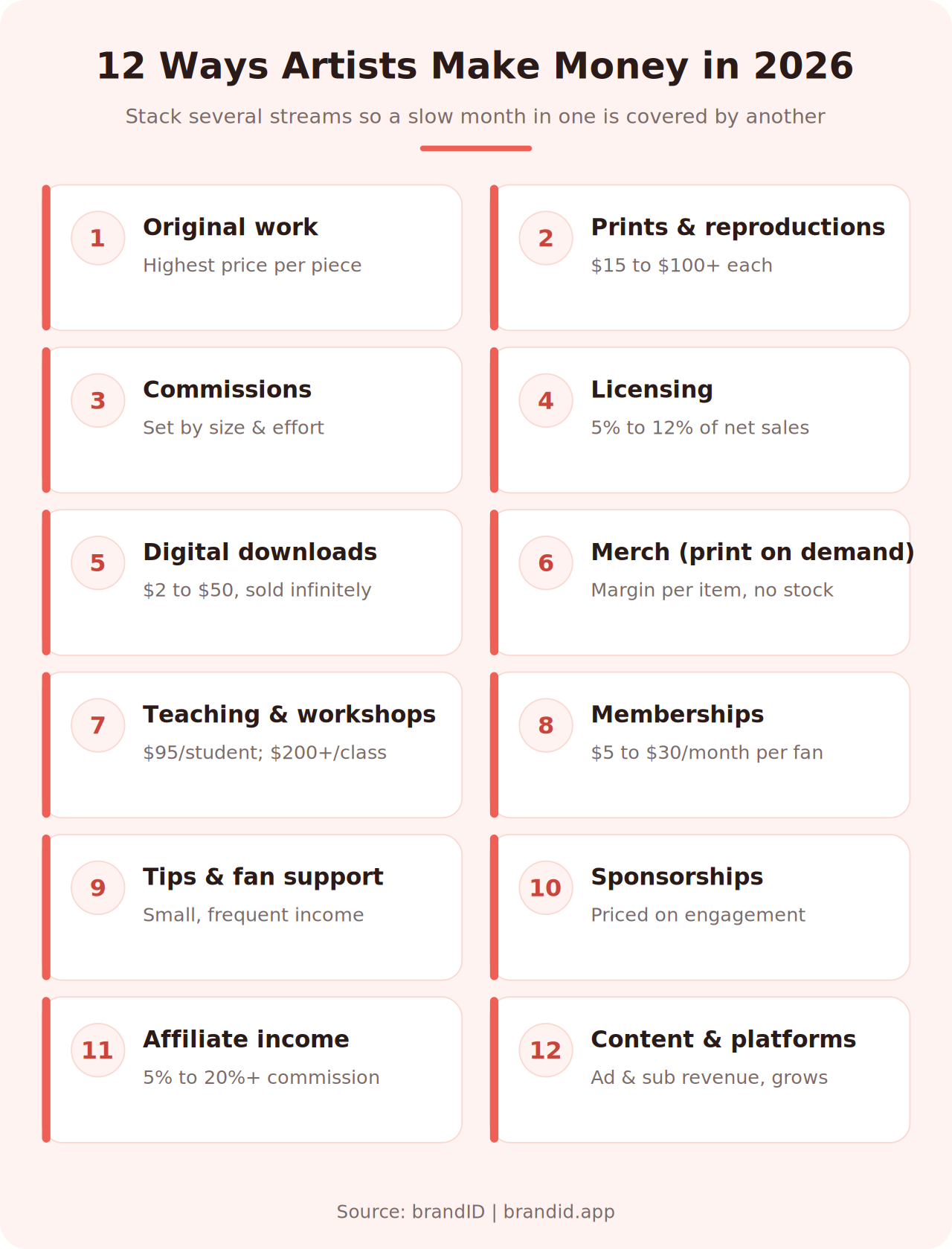
Here is the full picture at a glance, then a breakdown of how to actually start each one.
| Income stream | How it works | Typical earnings |
|---|---|---|
| 1. Original work | A one-off sale of the actual piece | Your highest price per piece |
| 2. Prints and reproductions | Sell one image many times as prints or giclees | $15 to $100+ each |
| 3. Commissions | Custom work made for a specific buyer | Set by size and complexity |
| 4. Licensing | A company uses your image on its products | 5% to 12% of net sales |
| 5. Digital downloads | Brushes, presets, printables, wallpapers | $2 to $50, sold infinitely |
| 6. Merch | Your art on products via print on demand | Margin per item, no inventory |
| 7. Teaching and workshops | Classes, courses, and live sessions | $95/student day; $200 to $350 per class |
| 8. Memberships | Recurring fan support for perks | $5 to $30/month per member |
| 9. Tips and fan support | One-off support from your audience | Varies |
| 10. Sponsorships | Paid promotion for brands | Set by audience size and fit |
| 11. Affiliate income | Commission on supplies you recommend | 5% to 20%+ |
| 12. Content and platforms | YouTube, Twitch, and ad or sub revenue | Grows with views over time |
1. Selling Original Work
An original is a one-of-a-kind piece, so it usually carries your highest price per work. The limit is time: you can only make and sell so many, which is why originals are the centerpiece of an art income, not the whole of it.
Price originals with room to grow, and raise them as demand and your reputation build.
2. Selling Prints and Reproductions
Once you have an image, you can sell it many times as prints, giclees, or posters, often through print on demand so there is no inventory or shipping to manage. Prints let work you already made keep earning at a lower price point that reaches a wider audience.
You can also sell them as digital downloads, where the buyer prints at home and you keep almost the entire sale.
3. Taking Commissions
A commission is custom work made for a specific buyer, like a portrait, a pet, or a piece sized for a particular wall. The sale exists before you start, which makes commissions one of the steadier streams, though you work within someone else's brief.
Keep a simple commission page with tiers and turnaround times so buyers can self-select and you avoid endless back and forth.
4. Licensing Your Art
Licensing means letting a company put your image on its products, from fabric and stationery to puzzles and homeware, usually for 5% to 12% of net sales. The manufacturer handles production and shipping, and you send a high-resolution file and collect royalties.
One strong image can become recurring income for years, which is why licensing rewards a distinctive, repeatable style.
5. Selling Digital Products and Downloads
Digital products are the most scalable stream on this list, because you make them once and sell infinite copies with no shipping. For artists that means procreate brushes, presets, textures, printables, wallpapers, and reference packs.
If you are not sure where to start, this guide to selling digital products breaks down what actually moves for creative audiences.
6. Merch and Productized Goods
Your fans want to wear your art, stick it on a laptop, and hang it on a wall. Print on demand turns any design into shirts, mugs, stickers, and posters with no warehouse and no upfront cost, so you only pay when something sells.
Merch doubles as marketing, since every item someone wears or displays is a small billboard for your work.
7. Teaching and Workshops
If you can make the work, people will pay to learn it. Live workshops commonly bring $95 per student for a day session or $200 to $350 for a 45-minute class, and online courses on your own site or a marketplace keep earning after they are built.
Teaching tends to be one of the most stable streams because it does not depend on selling a physical object, and it compounds as your reputation grows.
8. Memberships and Patronage
A membership invites your audience to support you directly, paying a recurring amount for early access, behind-the-scenes work, or exclusive pieces. You do not need thousands of fans: a small group paying $5 to $30 a month can be real income.
Because it is recurring, a membership smooths out the lumpiness of one-off sales. You can run memberships and subscriptions directly instead of splitting revenue with a third-party platform.
9. Tips and Fan Support
Not every fan can buy an original, but many will happily tip a few dollars for work they love or a process video they enjoyed. Adding a simple way to collect tips turns goodwill into small, frequent income.
Tips work best when you make them easy and specific, like a button under a finished piece or a pinned link in your bio.
10. Sponsorships and Brand Deals
Once you have an engaged audience, art-supply and lifestyle brands will pay to reach it through sponsored posts or ambassadorships. Deals are priced on engagement and fit far more than raw follower count.
Brands want proof your audience acts on your word, so knowing how many followers you need to get paid and showing your engagement rate matters more than chasing a big number.
11. Affiliate Income and Partnerships
Recommending supplies you already use can be one of the highest-margin streams, because you earn a commission whenever someone buys through your link. Art programs commonly pay 5% to 20%.
Affiliate marketing fits artists naturally: your audience already asks what pens, paints, or tablets you use, so pointing them to the answer pays you back.
12. Content and Platform Revenue
Sharing your process on YouTube, TikTok, or Twitch can earn through ad revenue, subscriptions, and tips, and it feeds every other stream by sending new people toward your work.
Content rarely pays much at the start, so treat it as the engine that powers your sales rather than a quick payout. Here is a deeper look at how to make money on TikTok if short video is your lane.
How Should You Price Your Art?
The most common mistake is pricing from fear. Going low to make a sale easier quietly trains buyers to expect bargains and makes the work unsustainable for you. A price that does not cover your time is not a sale, it is a slow way to burn out.
Consistency matters more than people expect. When similar pieces carry wildly different prices, buyers get confused and trust erodes, so many artists anchor to size to start.
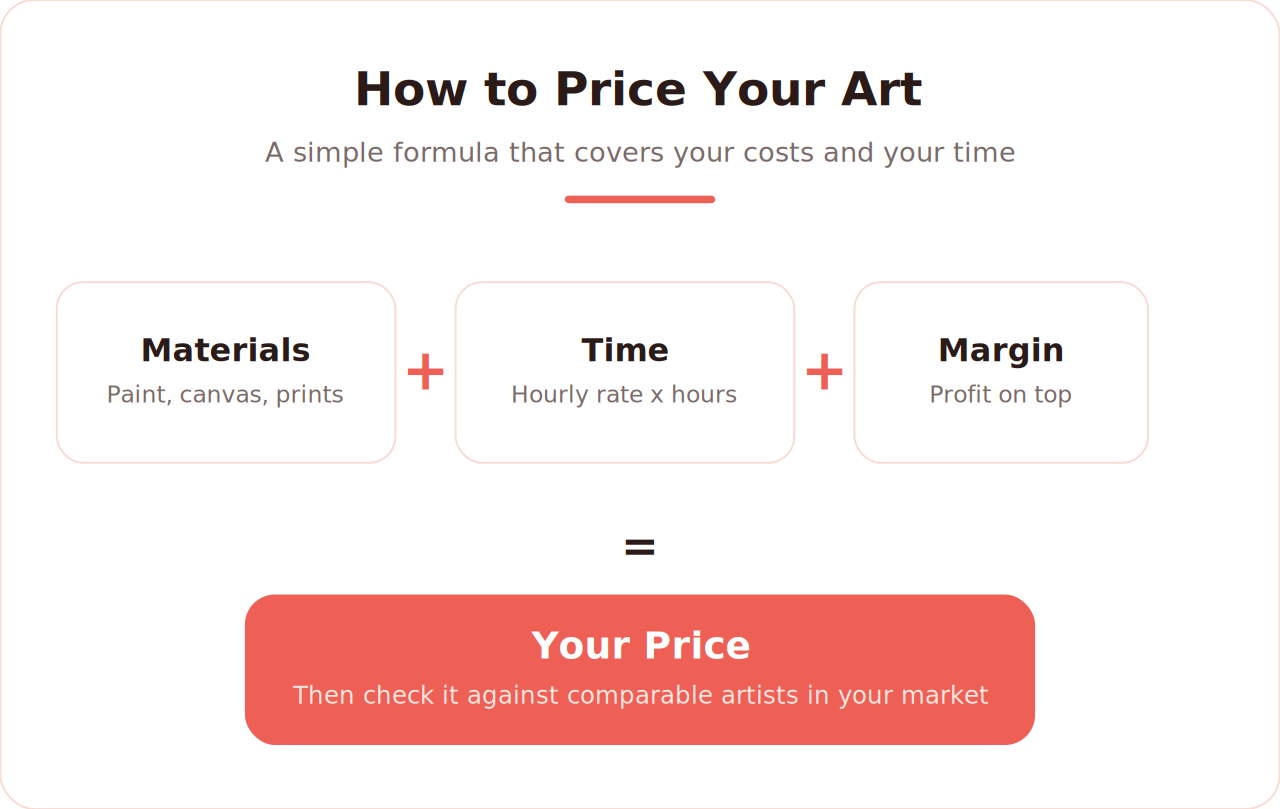
A simple starting formula: materials, plus your hourly rate times hours, plus a margin, checked against comparable artists. For the full method with the math, see how to price a product.
Where Should You Sell Your Art?
Your own store keeps the largest share of each sale and builds a direct relationship with buyers, instead of renting that relationship from a platform. A free creator store and link in bio is the simplest way to own that channel.
Online marketplaces put your work in front of people already shopping for art, in exchange for a cut and a crowded storefront.
In-person selling through fairs, markets, and shows still builds trust screens cannot match, and the people who meet you often become your most loyal collectors.
Social media is less a checkout and more a way for new people to find you and follow the work until they are ready to buy. It feeds every other channel.
How Do You Build an Audience That Buys?
Consistency is the foundation. Sharing finished pieces and the process behind them teaches people who you are over time, and process is often more magnetic than the polished result because people connect to the human making the thing.
Then capture that interest somewhere you control. An email list is the most durable home for it, because you are not at the mercy of an algorithm deciding who sees you. Social platforms are excellent for being found and risky as the only place you keep an audience.
One Place to Run Every Income Stream
The hard part of an art income is not the ideas, it is the admin. Selling prints on one site, memberships on another, tips somewhere else, and tracking it all by hand is how money slips through the cracks.
brandID is a free creator store and link in bio that runs most of these streams from one dashboard, so your whole art business lives behind a single link.
- Sell digital downloads, prints, and files with no inventory or shipping
- Offer memberships, subscriptions, and one-off tips from the same page
- Earn from an affiliate marketplace of 5M+ products from 2,000+ brands, with commissions up to 65% and a 90-day cookie
- Track sales, links, and revenue in one place, and get paid weekly with no payout threshold
That last part matters: the artists who win paid deals are the ones who can prove their audience buys, and having your numbers in one dashboard is the cheapest proof there is.
Start Selling on brandID FreeWhat Separates Artists Who Earn From Those Who Do Not?
Treating it like a business means thinking about pricing, sales, and audience on purpose rather than hoping they sort themselves out. It means tracking what sells and working on a schedule, not only when inspiration strikes.
The quietest killer is waiting for permission: the gallery that will anoint you, the audience that will appear first, the moment you finally feel ready. That permission is not coming, and the work that earns is the work that gets finished and put in front of people.
Common Mistakes That Keep Artists Broke
- Relying on one income stream. A single source leaves you exposed to slow months, so stack a few.
- Pricing from fear. Chronic underpricing trains buyers to expect bargains and burns you out.
- Renting your whole audience. If every follower lives on one platform, an algorithm change can erase your reach overnight.
- Ignoring digital and passive streams. Prints, downloads, and licensing keep earning from work you already made.
- Waiting to be discovered. The artists who earn act like the business is already real, then keep going.
Conclusion
So, how do artists make money? By treating art like the real business it is, stacking several income streams, and running them with consistency and a little nerve.
You do not need to master all 12 at once. Pick two you could realistically build, set honest prices for one body of work, and put a finished piece in front of real people this week.
Then put the infrastructure in place so attention turns into income automatically, and the next sale is a system rather than a scramble.
Frequently Asked Questions
How Do Artists Make Money in 2026?
Artists make money by combining income streams: selling originals, prints, and commissions, then adding licensing, digital downloads, merch, teaching, memberships, tips, sponsorships, affiliate income, and platform revenue from YouTube or Twitch. Most working artists run several at once so a slow month in one is covered by another.
How Do Beginner Artists Make Money With a Small Audience?
Start with streams that do not need a big following: sell prints and digital downloads, open commissions, and add a tip option. A small, engaged audience of a few hundred people who genuinely like your work can support memberships and downloads long before you have thousands of followers.
How Do Digital Artists Make Money?
Digital artists sell downloadable products like brushes, presets, textures, and printables, take commissions, license their work, sell prints through print on demand, teach their process, and earn from content and affiliate links. Because digital files sell infinitely with no shipping, they scale better than physical originals.
How Do Artists Make Money Online?
Online, artists sell through their own creator store and link in bio, sell digital downloads and prints, run memberships, collect tips, license images, teach courses, and earn affiliate and sponsorship income. Owning your store keeps more of each sale than relying only on marketplaces.
How Much Money Can You Make as an Artist?
It ranges widely. Beginners often earn a few hundred dollars a month from prints and downloads, while established artists earn a full living by stacking commissions, licensing, teaching, and memberships. Income depends far more on consistency and multiple streams than on talent alone.
Do You Need Talent or a Following to Make Money From Art?
Neither is the deciding factor. Earning from art is a learnable skill built on pricing, selling, and consistency, and niche fit matters more than follower count. A specific, engaged audience buys far more reliably than a large, passive one.
 Summarize this article with: