Read ten articles about personal branding and you will get the same five instructions: be authentic, be consistent, find your niche, show up daily, tell your story. All true. None of it tells you what to do on Monday morning.
The problem is that most personal branding advice describes an outcome and calls it a strategy. Authenticity is not a task. Consistency is not a decision. Being memorable is a result, and results are not instructions.
This guide takes a different approach, built on a personal branding definition that makes the whole thing operational: a brand is a pairing. You deliberately pair yourself with the things you want to be known for, you do it consistently, and over time your audience associates you with them. That is it.
Everything below is how to choose those pairings and execute them, which is the part a personal branding course usually charges for. No fee here, and no requirement to buy one: what follows is the full personal branding strategy, from positioning through to monetization.
It is written for creators and influencers specifically, which means it covers positioning, content, storytelling, and the part most branding guides skip entirely: how the brand actually earns money. Creators still deciding what to be known for should narrow to one of the best Instagram niches before anything else here will work.
Key Takeaways
- A brand is an association, not an aesthetic. Nike paired itself with Michael Jordan to own athletic greatness. Harley-Davidson paired itself with freedom. Neither started with a colour palette
- Work backwards from the outcome you want. Decide what you need to be known for, then what you must do to be known for it, then what you must learn to do that
- What you refuse to be associated with matters as much as what you embrace. Almost no personal branding guide covers this, and it is where most creator reputations are quietly lost
- Start narrow, then expand in layers rather than leaps. Roughly 80% of your content on one core subject, 20% on the interests that make you human
- Your audience decides what counts as quality, not you. Post enough to learn what they respond to, then put more effort into fewer pieces
- Trust precedes transactions. Give away the knowledge freely and sell the execution, because the people who found your free work useful assume the paid work is worth more
- A personal brand without a home is rented attention. One page you own, holding your products, your links, and an email list, is what survives an algorithm change
Why Personal Branding Matters More in 2026
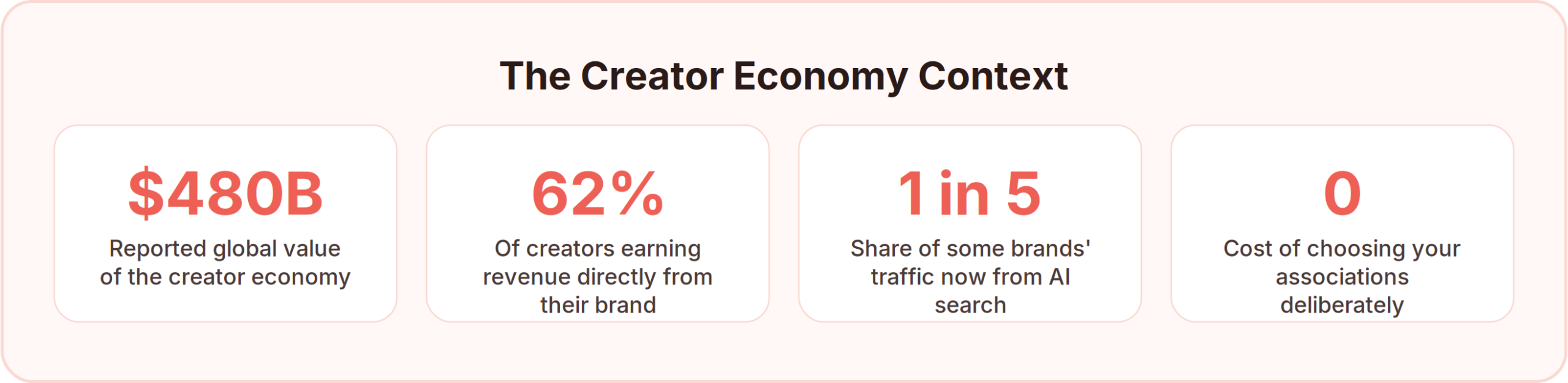
Three things changed at once. Publishing became free, so every niche filled up. AI made competent content cheap, which paradoxically raised the value of a recognisable human voice. And discovery moved partly into AI answers, where being a known name matters more than ranking for a phrase.
Forbes Business Development Council members writing on personal brand influence in 2026 landed on a consistent theme: quiet credibility outlasts virality. Influencer Marketing Hub reports 62% of creators now earn revenue directly from their personal brand rather than only from platform payouts.
What none of that tells you is how to build one. So let us define the thing properly first.
What Is Personal Branding? A Definition You Can Actually Use
Ask ten people what is personal branding and you will get ten vague answers about reputation and vibes. Here is the personal branding definition worth adopting instead, articulated well by brand strategist Caleb Ralston and the most useful framing available:
Branding is a pairing of things. Good branding is an intentional pairing of relevant things, done consistently. Brand is the byproduct: when your audience inherently associates those things together.
Look at how the strongest brands were actually built. Nike wanted to own athletic greatness in basketball, so it paired itself with the most synonymous name for winning in the sport. Harley-Davidson has spent decades pairing itself with freedom, and freedom is precisely what its customers feel when they think of the badge.
Neither began with a logo, a font, or a mood board. They chose an association and then acted in a way that reinforced it for years.
This definition matters because it removes the mysticism. You cannot execute “be memorable.” You can absolutely execute “pair myself with this specific thing, repeatedly, in public.”
Branding, Brand, and Personal Brand
| Term | What it means | Who controls it |
|---|---|---|
| Branding | The act of pairing yourself with something | You, entirely |
| Brand | The association your audience has already formed | Your audience |
| Personal brand | The association attached to you rather than a company | Shared, but you set the inputs |
| Visual identity | Colours, fonts, logo, layout | You, and it is the least important layer |
Your personal brand exists whether you shape it or not. If you do not choose the associations, your audience will assign them for you based on whatever you happened to post most.
Your Personal Branding Strategy: Work Backwards From the Outcome
Most creators post first and figure out the point later. The fix is four questions answered in reverse order, starting from where you want to end up.
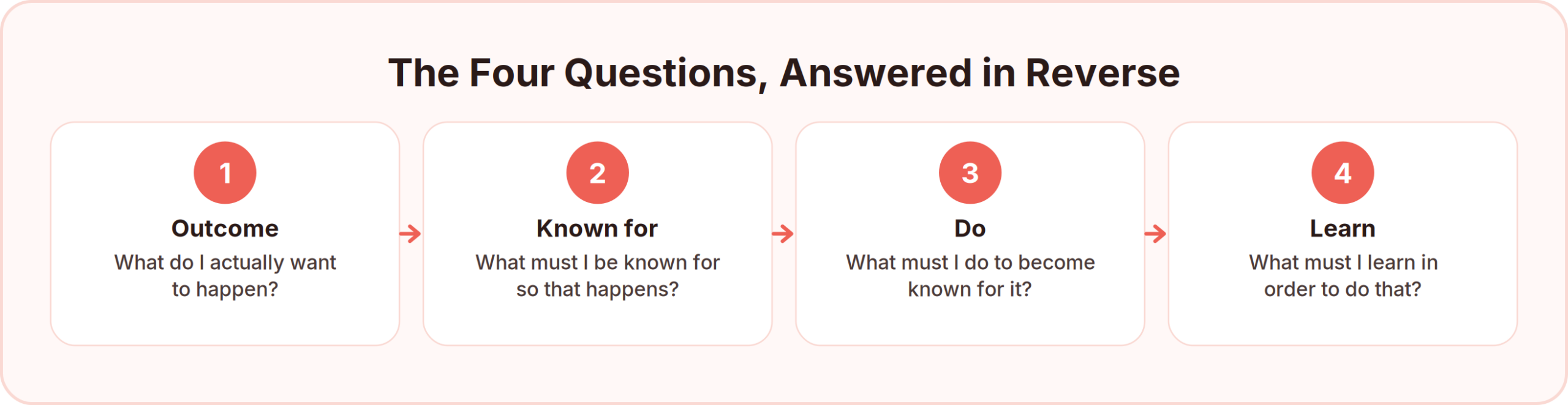
- 1- What is my desired outcome? Not “grow my following.” Something specific: sign five coaching clients a month, sell 200 presets a month, get invited to speak, land recurring brand deals in one category.
- 2- What do I have to be known for in order for that to happen? If you want inbound brand deals in skincare, you need to be known for skincare judgement, not general beauty content.
- 3- What do I have to do to be known for that? Brands are built on actions, not claims. Being known for skincare judgement means publicly testing products, showing results, and being willing to say when something does not work.
- 4- What do I have to learn in order to do that? This is your task list for this week. If you cannot yet evaluate ingredient formulations credibly, that is the gap to close before the content will land.
The value of answering these in order is that every later decision has something to check itself against. Without a desired outcome, any direction looks as good as any other, and you will go somewhere it just will not be anywhere you chose.
Choosing Your Associations
This is the core work of personal branding and it splits into two halves. Almost every guide covers the first and ignores the second.
1- What You Want to Be Associated With
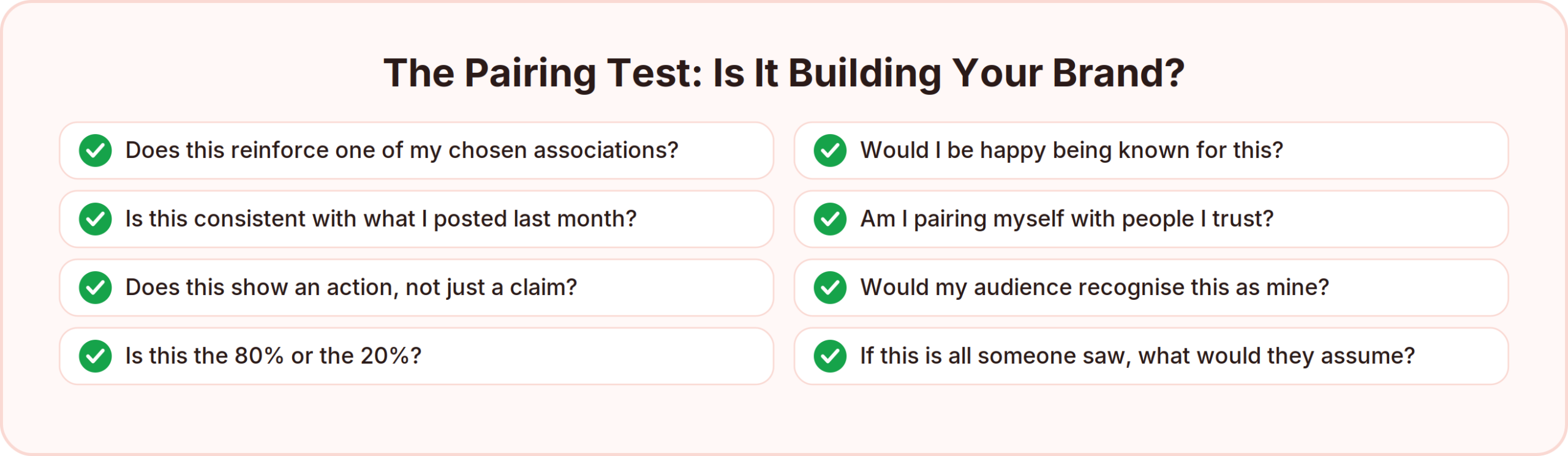
Write down the three to five things you want someone to think of when they hear your name. Business, trustworthiness, mental wellbeing, taste, technical depth, humour, whatever it is. Be concrete enough that you could judge a piece of content against the list.
Then check everything you make against it. If a post does not reinforce one of those associations, it is not building your brand. It may still be worth making, but be honest about which bucket it is in.
2- What You Must Not Be Associated With
Here is the part that gets skipped, and it matters more in a saturated market than anything on your positive list. Being intentional is not the same as being right. You can pair yourself consistently with the wrong things and succeed at building exactly the brand you did not want.
The mechanism is simple and unforgiving. If you repeatedly appear alongside people your audience does not trust, whether on their podcast, in collaborations, or in comment sections, the association transfers. Do it enough times and you inherit their reputation regardless of the quality of your own work.
This is the most common way genuinely valuable creators lose credibility. Not through bad content, but through appearing next to bad actors enough times that the audience draws the obvious conclusion.
Awareness is not automatically worth having. The question is never “how many people will see this?” It is “what will they be aware of me in light of?” If your gut objects to an appearance or a collaboration, the reach does not compensate.
- Write an explicit no list. Categories of product you will not promote, formats you will not use, people and tactics you will not appear alongside.
- Apply it to sponsorships hardest. A single paid post for something your audience mistrusts costs more than the fee, which is why the brands that work with micro-influencers worth approaching are the ones whose products you would recommend unpaid.
- Revisit it as you grow. Bigger platforms attract worse offers, and the offers get more flattering as they get worse.
Positioning: Find the Gap and Own It
Blending in is the actual risk, not standing out. Your goal is to find what is missing in your space and occupy it, and there are three places that gap usually hides.
| Type of gap | How to find it | Example |
|---|---|---|
| Information gap | What do you know that is not being taught? | Niche technical knowledge nobody has packaged for beginners |
| Philosophy gap | What does everyone in your space say that you disagree with? | Everyone chases virality; you argue for durable trust instead |
| Personality gap | Who is being underserved by the existing voices? | The same information delivered by someone their audience cannot relate to |
The philosophy gap is the most useful for creators because it is renewable. Ask what the accepted wisdom in your niche is, then ask whether you actually believe it. Disagreement, stated respectfully and argued properly, is the cheapest differentiation available.
If everyone in your category optimises for views, positioning yourself around long-term trust stands out. If everyone preaches hustle, positioning around sustainable output stands out. The point is not contrarianism for its own sake, which reads as noise. It is having a real conviction and being willing to say it.
Your Story Is the Part Nobody Can Copy
Your information can be replicated. Your philosophy can be argued with. Your origin story cannot be taken, and it is the most relatable asset you own.
List the pivotal moments: the layoff, the pivot, the mentor, the failure that changed your approach. Then use them instead of adjectives. Nobody believes “I’m hardworking.” Everyone believes the story about the 32-hour edit. Instead of Jeff Bezos telling you he is resourceful, he tells you he used a door as a desk. The story does the work the adjective cannot.
The Three-Part Brand Story Framework
The standard problem-transformation-outcome story structure assumes every brand has one dramatic turning point. Most do not. This three-part version works whether or not you have a origin crisis to sell.
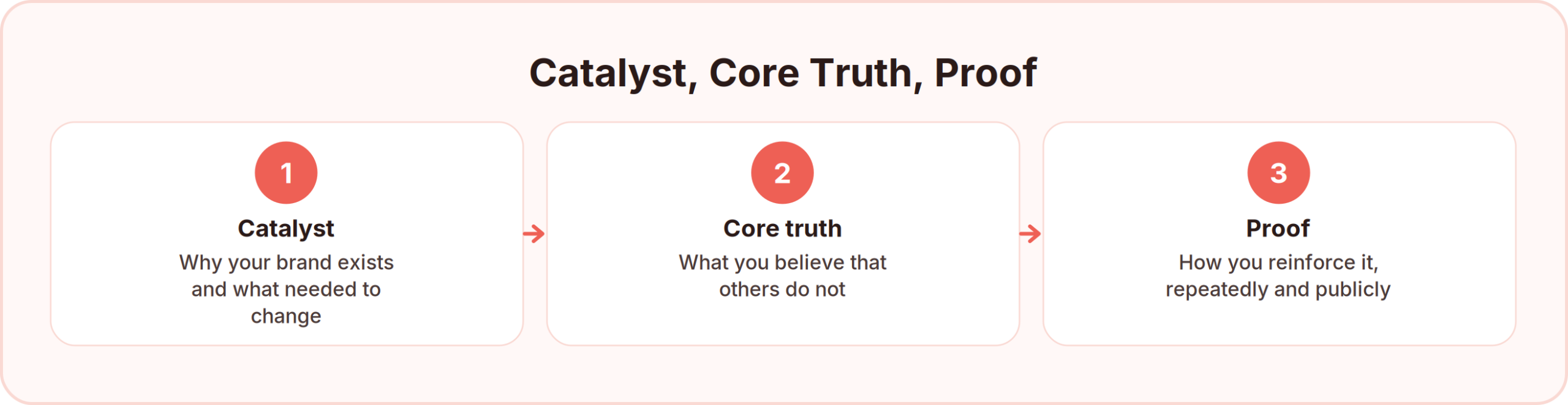
1- The Catalyst: Why You Exist
Something needed to change, and you saw it. It does not have to be a struggle. It can be an opportunity or a gap nobody else was filling. Three questions get you there: What needs to change? What do you see that others do not? Why do you feel compelled to act on it?
2- The Core Truth: What Makes You Different
A conviction you hold that others in your market do not, stated publicly and repeatedly. Not manufactured controversy, which produces the loud accounts nobody trusts. An actual belief you would defend.
Three questions: What do I believe that others do not? What about my personality genuinely stands out? What do people compliment me on that I could lean into rather than suppress?
3- The Proof: How You Reinforce It
Your brand is not what you say, it is what you demonstrate repeatedly. Strong brands do not have one success story, they have an ongoing pattern of credibility. Ask what case studies, results, and receipts you can point to, and whether every piece of content reinforces the association you want.
Nail all three and you do not just have a story. You have a reason for people to stay.
Picking Your Topic: Start Narrow, Expand in Layers
We all know the person who claims to be excellent at everything, and we all quietly assume they are good at none of it. Breadth reads as shallowness. Early trust comes from being unmistakably good at one thing.
The clearest example in the creator economy is Gary Vaynerchuk, who spent his first several years online as the wine guy. He understood marketing the whole time and did not lead with it. He built credibility in a subject he was world-class in, then expanded outward once the results in that lane gave him standing to speak about how he got them.
1- The 80/20 Rule and Interest Stacking
Narrow does not mean monotonous. Aim for roughly 80% of your content on the core subject you want to be known for, and 20% on the other things that make you a person.
That 20% is doing real work, not filler. Think about starting a new job: on day one you share exactly one thing with a colleague, which is the employer. Then you find out you both like the same music, and suddenly you have two. Enough of those and you are friends rather than co-workers.
Content works identically. Every additional interest you talk about is another chance for someone to recognise themselves in you. Joe Rogan’s audience is built this way: comedy, MMA, hunting, health optimisation, and more besides. Care about one and you might listen. Care about four and you are a superfan. Nobody could have become a superfan if he had only talked about two of them.
2- When to Expand and How Far
| Signal | What it means | Action |
|---|---|---|
| You are genuinely world-class in a new area | You have something to say worth hearing | Expand, but earn it first |
| Your audience keeps asking about a topic you only hint at | Demand already exists | Answer it and watch the response |
| The new topic is adjacent to the current one | The credibility transfers | Safe to expand |
| The new topic is unrelated | Your audience has no reason to trust you on it | Expand in layers, not one leap |
Expand in layers rather than leaps. Going from content strategy to breathwork overnight breaks the thread; inching across several topics does not. That said, these are guidelines rather than laws. If you love your motorcycle and want to make content about it, do it. Being a whole person is what makes you interesting.
3- Return to Your Roots Periodically
Amazon started with books and still honours that origin, most visibly by acquiring Audible. Crayola brought back eight discontinued colours as a nostalgia play. Bands that outgrow their scene still open with the early tracks, and the day-one fans are the ones screaming.
The lesson for creators: as your brand evolves, deliberately revisit the format or subject your earliest audience fell in love with. It costs one piece of content and it buys enormous goodwill from the people who were there first.
How to Use Social Media for Personal Branding
Positioning decides what you say. Your content engine decides whether you keep saying it. Most advice on how to use social media for personal branding stops at “post consistently,” which skips the three decisions that determine whether consistency is even possible: which medium suits you, how each platform differs, and who gets to define quality.
The single most common cause of failure here is starting at a volume nobody could sustain.
Think of it the way a good trainer designs a programme. The best routine is not the most intense one, it is the one you will still be doing in a year. Copying the output of a creator with a full production team is the fastest route to quitting in month two.
1- Choose Your Medium
| Medium | Best for | Honest test |
|---|---|---|
| Written | LinkedIn, X, newsletters, articles | Can you explain the idea in writing without needing to add spoken commentary? |
| Video | YouTube, TikTok, Reels, Shorts | Are you willing to improve on camera in public, badly at first? |
| Audio | Podcasts and audio-first platforms | Can you paint a picture with words when there is no visual to help? |
| Visual and design | Carousels, infographics, PDFs | Can you compress a complex idea into one simple image? |
Video returns the most for the effort, because one recording becomes short clips, a podcast episode, a transcript, quote graphics, stills, and a written post. If the camera genuinely terrifies you, start with audio and let the confidence transfer.
The best content creation tools collapse most of the production work, and social media management tools take over the scheduling once you are posting often enough for that to matter.
2- Show Up Differently on Different Platforms
You are one person. You still behave differently at Saturday brunch with your family, at cocktails with friends that evening, and in a Monday morning meeting. Same you, different vocabulary, different topics, different register. Nobody would call that inauthentic. You are reading the room.
Platforms are rooms. Your brand shows up on LinkedIn, TikTok, and YouTube as itself, but it emphasises different parts and speaks differently in each. Reposting one asset identically everywhere is the equivalent of using your business-meeting voice at brunch, and it also removes any reason for someone to follow you in more than one place.
3- Let Your Audience Decide What Quality Is
Creators lose months arguing internally about whether a piece is good enough. It is the wrong argument, because quality is not your subjective judgement. It is your audience’s.
Which means the fastest way to find out is volume, used as a learning tool rather than a reach tool. Ten posts across a week teaches you more than the same ten spread over a month, because the signal arrives sooner.
Then compress. Take the effort you were spending across five pieces and put it into one, informed by what you now know actually lands.
Some of the most-watched content ever made was filmed at night on a phone. Production value and quality are not the same variable. Perfect is the enemy of posted, and the piece you are sitting on because it is not ready is teaching you nothing.
Storytelling That Holds Attention
Stories do three things facts cannot: they hold attention, create emotional connection, and get remembered. Use this five-part structure as a guide rather than a template.
| Part | Job | Practical note |
|---|---|---|
| Hook | Earn the next two seconds | A bold or contrarian statement, a pattern interrupt, or a question they have actually asked |
| Problem | Create stakes | Specific and relatable enough that the viewer sees themselves in it |
| Journey | Show how it was overcome | Include the losses. Progress is relatable, perfection is not |
| Lesson | Make it useful | The takeaway they can act on today, chunked into steps |
| Call to action | Convert attention into action | Often a question rather than a purchase. Selling is not the only CTA |
On short-form platforms you have two or three seconds for the hook. On long-form video, treat it as fifteen to twenty seconds rather than the thirty most guides quote, and answer two questions fast: is this the thing I clicked on, and is this the person I want to hear it from?
1- The Five Story Types Worth Telling
- Origin stories. How you got here, not where you are. Your current success is not relatable; the barista job that preceded it is. You will get bored of this story long before your audience does, because a cold audience has never heard it.
- Failure stories. People trust vulnerability faster than success. Share the loss and the lesson, so the audience can avoid the cost you paid.
- Success stories. Necessary counterweight, or you read as someone who only ever learns from disasters. This is the proof layer of your brand story.
- Client and customer wins. Evidence you can produce results for someone other than yourself, which is what lets a viewer see themselves succeeding.
- Industry takes. Where you disagree with the accepted wisdom in your space. Contrarian, argued, and respectful beats agreeable every time.
2- Answer the Objections Before They Are Raised
Your audience is running a silent commentary while they watch: why would I trust this, does it actually work, would it work for someone like me? Those objections usually surface in your comments.
Read them, then answer them inside the content itself. A good sales page overcomes objections before the call; content should do the same. Every objection you pre-empt removes friction between watching and acting, which is the entire point of educational content.
Why Educational Content Builds a Brand Faster Than Anything Else
There is a specific chain that makes teaching the strongest personal branding tool available, and it is worth seeing laid out.
- You share success stories consistently, pairing yourself with results
- Your audience begins associating you with success, which produces trust
- Trust makes them act on the lessons and takeaways you give away
- Acting produces results for them, which they experience personally
- Repeated enough, they stop associating you with your success and start associating you with theirs
That final step is the whole game. Once someone has repeatedly gained more than they invested with you, and the only thing they invested was attention, they carry an assumption into every future offer you make: whatever this costs, it will be worth less than what I get.
Educational content, done properly, is just scaling trust. And trust makes every subsequent thing easier: sponsorships, pricing, launches, collaborations, hiring.
“If this is what they give away free, what on earth are they charging for?” That thought does more for conversion than any urgency tactic, and it only comes from giving away work you could have sold.
Personal Branding Mistakes Creators Keep Making
- Chasing follower count instead of the right followers. An account with 68,000 followers acquired years ago for unrelated content earns less than 5,000 people who came for what you sell now, which is why how many followers you need to get paid on Instagram has a far lower answer than most creators assume.
- Being a robot on camera. Delivering information with no personality is the most common self-inflicted wound. People meet these creators in real life and say “you’re much funnier than I expected.”
- Only sharing wins. The friend whose life is always perfect becomes annoying and then unbelievable. Losses are more relatable and more instructive.
- Letting ego decide what ships. You will hate how you look and sound. Your audience is not thinking about it. Track the metrics, not the inner critic.
- Optimising for platform performance instead of conversion. Building a brand that performs on Instagram but sells nothing wastes years. Track both, and prioritise the one connected to revenue.
- Ignoring the comments you do have. Creators asking how to increase engagement are usually not replying to the three people already commenting.
- Posting identical content everywhere at the same time. It removes any reason to follow you twice and it performs worse in every room.
One more that is less obvious: if you ignore the praise, you can ignore the hate. Creators who get high off complimentary comments are the same creators who get flattened by cruel ones. Detach from both and read the aggregate instead.
Monetizing a Personal Brand Without Burning It
Most creators monetize too early, push offers before trust exists, then conclude their audience will not buy. Trust is the currency that precedes the transaction, and it is not a metaphor. Before you ask for money, your brand should have done three things: delivered obvious value for free, demonstrated real credibility, and built an actual relationship with the people receiving it.
1- Share the Knowledge, Sell the Execution
The fear is that giving everything away leaves nothing to sell. The reality is the opposite: the more value you give, the more demand you create, because knowing what to do and being able to do it are different problems.
A useful illustration. Someone wanting to change the exhaust on their motorcycle watches a hundred free videos explaining exactly how. The videos work perfectly. What they demonstrate is that the job is harder and riskier than expected, so the viewer books the dealership that published them. The knowledge was free. The execution was the product.
Your best content should be good enough that people feel compelled to act, at which point a meaningful share of them will discover they would rather you did it, or that they need the templates, tools, or guidance to do it themselves.
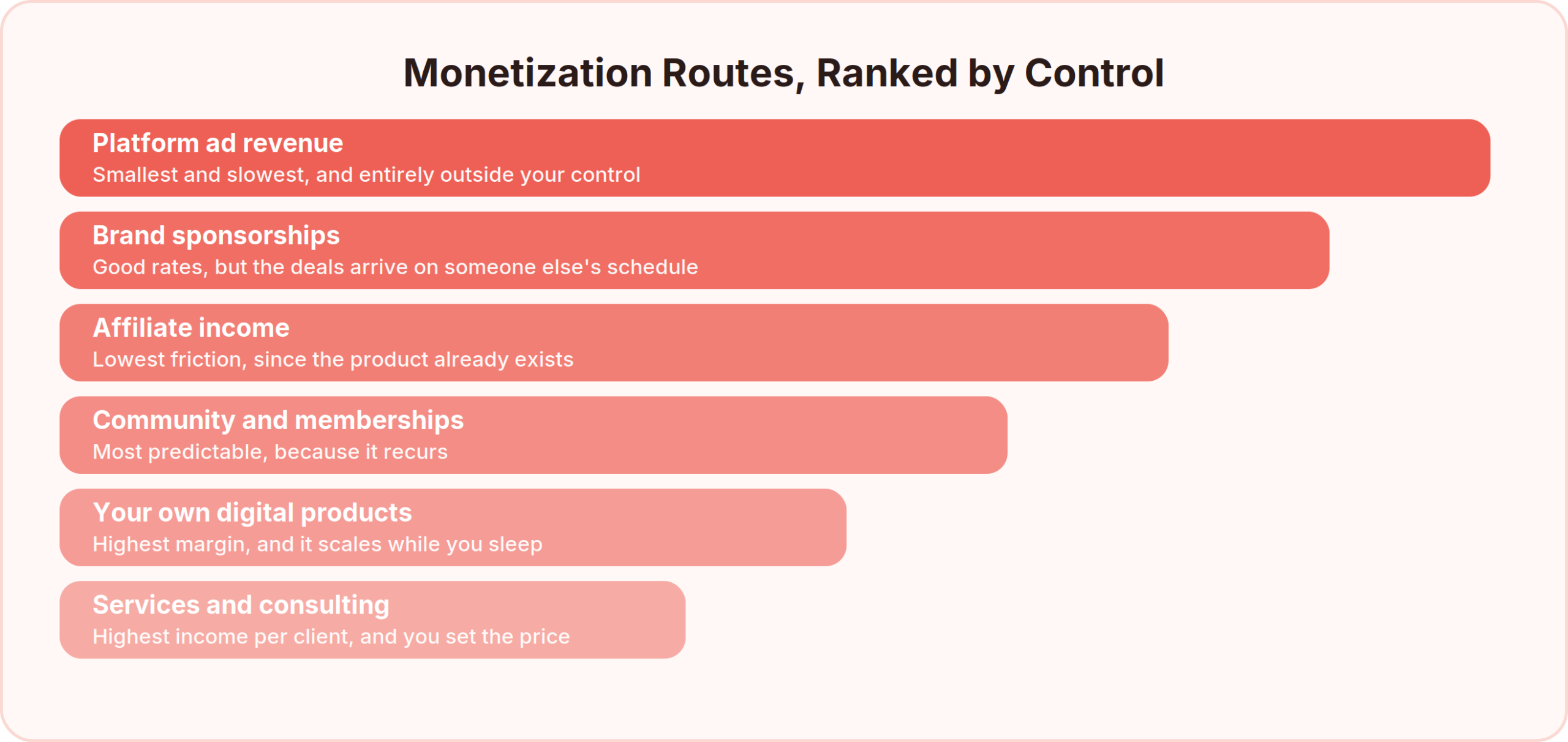
2- Build the Offer Stack
Do not launch five offers at once. Build one, refine it, then expand along this progression.
| Layer | Typical price | What it does |
|---|---|---|
| Free content | $0 | Builds trust and awareness. Everything rests on this |
| Lead magnet | $0 for an email | Converts anonymous attention into a contact you own |
| Low ticket | $10 to $100 | Templates, presets, ebooks, mini-courses. Removes the barrier to a first purchase |
| Mid ticket | $500 to $5,000 | Community, group coaching, in-depth courses. For committed buyers |
| High ticket | $10,000+ | One-to-one work, consulting, done-for-you services |
Almost nobody should start at the top. Early on, the low-ticket layer is where the first sale actually happens, and the best digital products to sell tend to be the ones you can produce once and deliver a thousand times. Selling digital products takes a weekend to set up.
Affiliate income is the other low-friction route, because someone else has already built the product. Affiliate marketing suits creators whose audience already asks what they use, and the best affiliate programs pay considerably more than platform ad revenue ever will.
3- Let the Content Do the Selling
People hate being sold to and love buying from someone they trust. The difference is usually one sentence.
“Buy my ebook on personal branding” asks for a transaction from a stranger. “I helped John go from zero to 10,000 followers in four months using this exact approach, and the full system is in my ebook” reports a result and mentions where the detail lives. Same offer, entirely different response.
Give Your Personal Brand Somewhere to Live
Here is the structural weakness in every creator personal brand: the audience is rented. Reach depends on an algorithm you do not control, and a policy change or a suppressed month can remove your distribution without notice.
Which makes the page behind your bio link the most important asset you own, because it is the only part of the operation that is genuinely yours.
brandID is built for exactly that. One page holding your links, your products, your affiliate collections, your bookings, and an email list you own, all editable in minutes and free to start.
What it does for a personal brand
- Sells digital products directly: downloads, videos, audio, and documents, so a follower can buy without leaving the page
- Affiliate marketplace with no approval step: over 5 million products from more than 2,000 brands, commission averaging up to 65% with some higher, weekly payouts and no minimum through the brandID affiliate program. Pick a product, add it to a styled collection, earn
- Subscriptions and tips: recurring income from the people who already value your work most
- Rentable ad slots: brands pay 30 days upfront for placements on your page through digital billboards, which turns existing traffic into revenue with no launch required
- Email capture and a media kit: the list survives an algorithm change, and the media kit is what you send when a brand asks
- Custom branding on paid plans: your logo, your styling, and transaction fees down to 0% on your own payment gateway from $9 a month
Best For: Creators whose personal brand is generating attention that currently goes nowhere they own, and who would rather build on a page than a platform.
Honest limits: the storefront handles digital products only with no physical fulfillment, and the free plan keeps brandID branding until you upgrade.
Build Your Free Brand PageIf the bio link is new territory, the best link in bio tools cover the whole category, and the Linktree alternatives compare the direct replacements. The two lines above the link matter as much as the link itself, which is what makes good Instagram bio ideas and TikTok bio ideas worth stealing.
The email list deserves particular attention, because it is the only audience nobody can take away from you. You can build an email list without a website in an afternoon, and it will outlive every platform you are currently posting to.
Measuring a Personal Brand
Follower count is the metric everyone reports and the one that tells you least. These are the numbers that actually indicate a brand is forming.
| Signal | What it tells you | Why it beats follower count |
|---|---|---|
| Inbound enquiries | People are seeking you out by name | The clearest evidence an association has formed |
| Branded search volume | Your name is now a search term | Nobody searches a name they do not associate with something |
| Comment quality | Whether the right people are paying attention | Ten specific questions beat a thousand fire emojis |
| Email list growth | Audience you own rather than rent | Survives every algorithm change |
| Conversion per thousand views | Whether attention translates to action | Normalises across account size |
| Repeat buyers | Trust is compounding | The strongest possible brand signal |
Track platform performance too, because reach is how people become aware of you. Just do not confuse it with the outcome. A creator with 5,000 engaged followers in the right niche routinely earns more than one with a million who arrived for something unrelated.
The income side varies enormously by path. Creators working out how to make money on TikTok face a different economics problem from musicians and illustrators, where how artists make money depends far more on selling directly than on platform payouts.
Personal Branding Tips: The Short Version
Everything above, compressed into the list worth keeping somewhere you will see it.
- Decide the outcome before the content. Every other choice checks itself against that answer.
- Name three associations you want, and write the list of things you refuse to be paired with.
- Say what you actually believe about the accepted wisdom in your niche. Disagreement is the cheapest differentiation available.
- Use stories instead of adjectives. Nobody believes “hardworking.” Everyone believes the story.
- Go 80% on one subject and 20% on the interests that make you a person.
- Pick two or three platforms, and make the content fit each room rather than reposting one asset everywhere.
- Post enough to learn what lands, then put the effort of five pieces into one.
- Answer objections inside the content, before anyone has to type them in your comments.
- Reply to the comments you already have before wondering why there are not more.
- Give away work you could have sold, then charge for the execution rather than the knowledge.
- Build the email list early. It is the only audience an algorithm cannot take from you.
- Judge yourself on inbound enquiries, not follower count.
Conclusion
Personal branding is not a personality trait and it is not a design exercise. It is a series of deliberate pairings, repeated in public, until your audience makes the association for you. That definition is the whole reason it is learnable.
So pick the outcome first and work backwards to what you must be known for. Choose your associations on purpose, including the ones you refuse. Find the gap in your space and say what you actually believe about it.
Go narrow before you go wide, and let the other 20% show that you are a person. Give away work you could have sold, and let the audience decide what counts as good.
Then give the whole thing somewhere to live that you own. Attention rented from a platform is worth exactly as much as the platform decides tomorrow. A page, a product, and an email list are worth what you build them into.
What Is Personal Branding?
Personal branding is the deliberate practice of pairing yourself with the things you want to be known for, consistently enough that your audience associates you with them automatically. Branding is the action you take, brand is the association your audience ends up holding, and visual identity is the smallest part of either.
How Do I Start Building a Personal Brand as a Creator?
Work backwards from an outcome. Decide what you specifically want to happen, then what you must be known for so that it does, then what you must do to become known for it, then what you must learn to do that. The last answer is your task list this week. Choosing your niche and your associations comes before choosing a platform or a colour palette.
How Long Does It Take to Build a Personal Brand?
Associations form through repetition, so the timeline depends on consistency rather than a fixed number of months. Most creators see recognition begin within six to twelve months of narrow, consistent output, and see inbound opportunities appear later than that. The compounding is real but it is slow at the start, which is why sustainability matters more than intensity.
Do I Need a Big Following to Have a Strong Personal Brand?
No, and the two are frequently unrelated. An account with tens of thousands of followers acquired for content you no longer make earns less than a few thousand people who arrived for exactly what you sell. Audience relevance and trust drive income; follower count mainly drives ego.
What Should I Post About to Build a Personal Brand?
Roughly 80% on the one subject you want to be known for, and 20% on the other interests that make you a person. The narrow majority builds credibility, and the 20% gives your audience additional ways to recognise themselves in you. Start narrow and expand in layers rather than jumping to unrelated topics.
Which Platform Is Best for Personal Branding?
The one where your audience already is and where you can sustain output. LinkedIn suits B2B and professional positioning, YouTube suits search-driven depth and long-term discoverability, and TikTok and Instagram suit lifestyle, visual, and brand-deal-led work. Prioritise two or three rather than posting everywhere, and never depend on a single platform.
How Is a Personal Brand Different From an Influencer?
An influencer monetises attention, usually through paid promotion. A personal brand monetises association and trust, which can include sponsorship but also products, services, subscriptions, and affiliate income. The practical difference is durability: attention drops when you stop posting, while a strong association keeps producing inbound interest.
How Do I Monetize a Personal Brand?
Build trust first, then layer offers. Free content, then a lead magnet that captures emails, then a low-ticket product between $10 and $100, then mid-ticket community or courses, then high-ticket services. Give the knowledge away and charge for the execution, since knowing what to do and being able to do it are different problems.
What Should I Avoid Being Associated With?
Anything your audience does not trust, including people. Appearing repeatedly alongside untrustworthy figures transfers their reputation to you regardless of your own work, and it is the most common way credible creators lose credibility. Write an explicit list of products, formats, tactics, and collaborations you will decline, and apply it hardest to paid partnerships.
Do I Need a Personal Branding Course?
No. Almost everything a personal branding course teaches is available free, including the frameworks in this guide. What courses genuinely sell is structure, accountability, and feedback on your specific positioning. If you would act on a plan without paying for one, save the money and start. If you have started three times and stalled, the structure may be worth it.
How Do I Measure Whether My Personal Brand Is Working?
Watch inbound enquiries, branded searches for your name, comment quality, email list growth, conversions per thousand views, and repeat buyers. Those indicate an association has actually formed. Follower count and views tell you about reach, which is how people discover you, not whether they trust you.
 Summarize this article with: