
Gumroad Review 2026: Fees, Features, and Is It Still Worth It?
Gumroad is an online e-commerce platform founded in 2011 by Sahil Lavingia to help creators sell digital products directly to their audience. It enables authors, artists, designers, and developers to offer ebooks, courses, software, memberships, and more without needing a complex store.
In this comprehensive review, we cover Gumroad's features, pricing, user feedback, pros/cons, and compare it with alternatives like brandID and others.
What Is Gumroad?
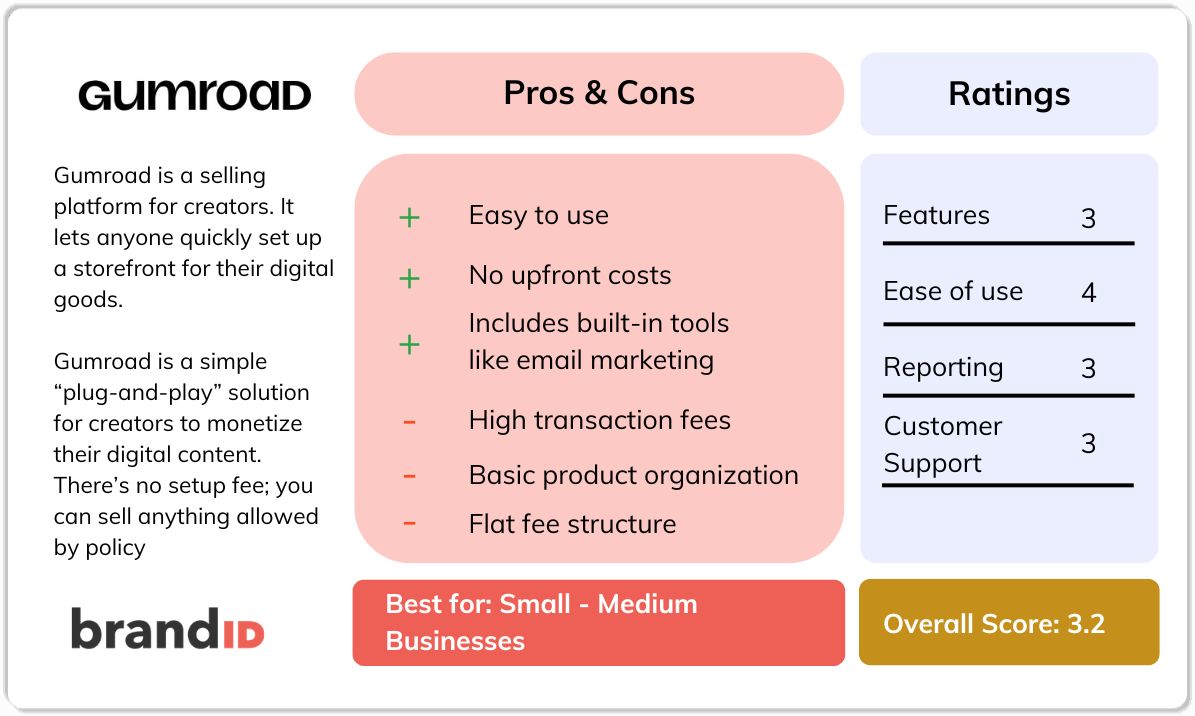
Gumroad is an e-commerce platform for creators that lets them set up a storefront quickly and sell their digital products. It's commonly used by authors, designers, educators, and small entrepreneurs, and no coding or external shopping cart is required.
Gumroad is a simple “plug-and-play” solution for creators to monetize their digital content. There's no setup fee, you can sell anything allowed by their policy, and Gumroad handles the payment infrastructure.
However, the simplicity comes with a cost. Gumroad won't replace a full e-commerce site like Shopify or other strong alternatives, like brandID, if you need advanced store features.
Gumroad Overview
At a Glance
- Founded in 2011 by Sahil Lavingia and Sachin Khanna in San Francisco.
- Helps creators sell directly to their audience with minimal setup.
- Gumroad is known for its simple and beginner-friendly selling process.
- Charges a flat 10% transaction fee + $0.50 from each sale with no monthly subscription cost.
- Criticized for its high transaction fees and limited customization.
Read on for a full breakdown of what Gumroad actually delivers and where it starts to fall short.
Gumroad Features
Gumroad covers the essentials for selling digital products, but not much beyond that. Here's what's included:
Product Listings
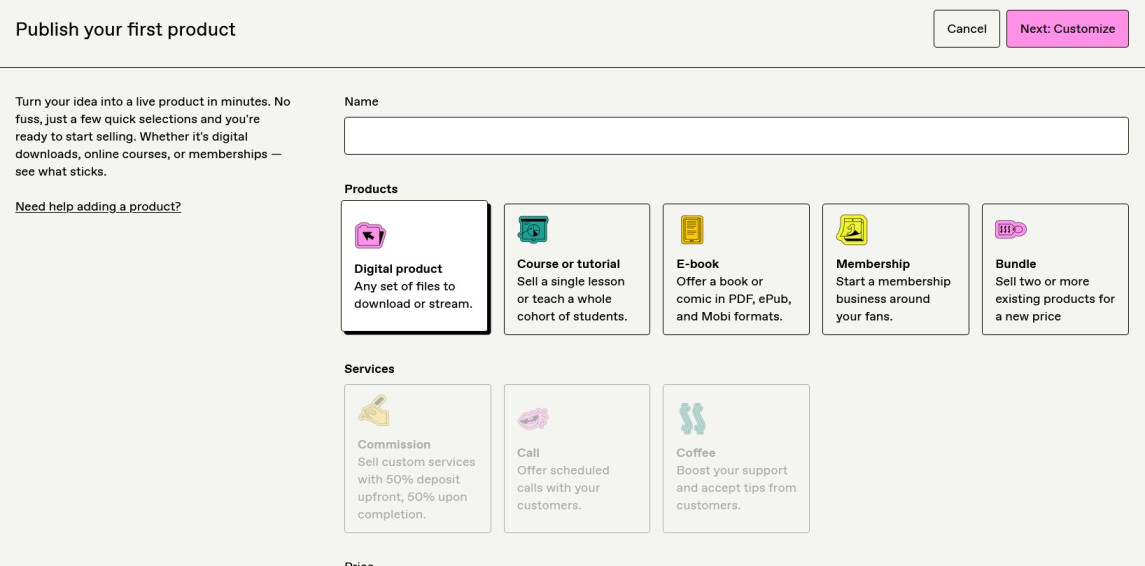
You can sell unlimited digital items like e-books, PDFs, videos, audio files, graphics, and software. Just upload your file and set a price.
Gumroad supports multiple file formats and allows offering several versions of a product, for example, PDF and MOBI, at different prices.
Payment Processing
Customers can pay via credit or debit card, PayPal, or Apple Pay on supported browsers. Gumroad handles international currencies and displays pricing in the buyer's local currency, which reduces friction at checkout.
For EU sales, the platform allows automatic VAT collection with no additional setup process. Depending on the country, creators are paid via PayPal or direct deposit.
Built-in Storefront / Embeds
Gumroad provides a simple page builder so you, as a creator, can host a mini storefront under your Gumroad page. You can customize colors, add descriptions, and embed a “Follow” button.
If you already have a website, you can embed individual “Buy” buttons or product forms directly on your pages or social profiles. Gumroad also supports custom domains, so you can point something like “store.yourdomain.com” to your Gumroad storefront.
Subscriptions & Memberships
Gumroad supports recurring billing, letting you offer monthly or yearly subscription plans for membership content, ongoing services, or gated course access. Subscribers retain access to your content for as long as their plan stays active.
You can also sell time-limited access. For example, a 3-month course license which is useful if you want to offer rentals or fixed-term programs without a full subscription commitment.
Pay What You Want Pricing
Gumroad supports a “Pay What You Want” pricing model, where you set a minimum price (including $0), and customers can choose to pay more if they want to. This works well for building an audience, rewarding loyal followers, or accepting donations alongside a free product.
Content Protection
For software or e-products needing protection, Gumroad can generate license keys or light DRM for your files. For example, selling a PDF with an optional “DMCA stamp” or selling software with a serial key. This helps prevent unauthorized sharing.
Affiliate Program
Gumroad lets you recruit affiliates to promote your products for a commission. You set the rate anywhere from 1% to 75%, though the default through Gumroad's network is 10%. Affiliates get a unique tracking link, and any sale within 30 days of a click counts as theirs.
If affiliate marketing is central to your business model, brandID is built for it. As a creator, you get instant access to over 5 million products from 2,000+ brands to promote and earn affiliate income from. And if you want your own products listed in the marketplace, just reach out to the support team and we'll take care of it for you.
Marketing and Analytics
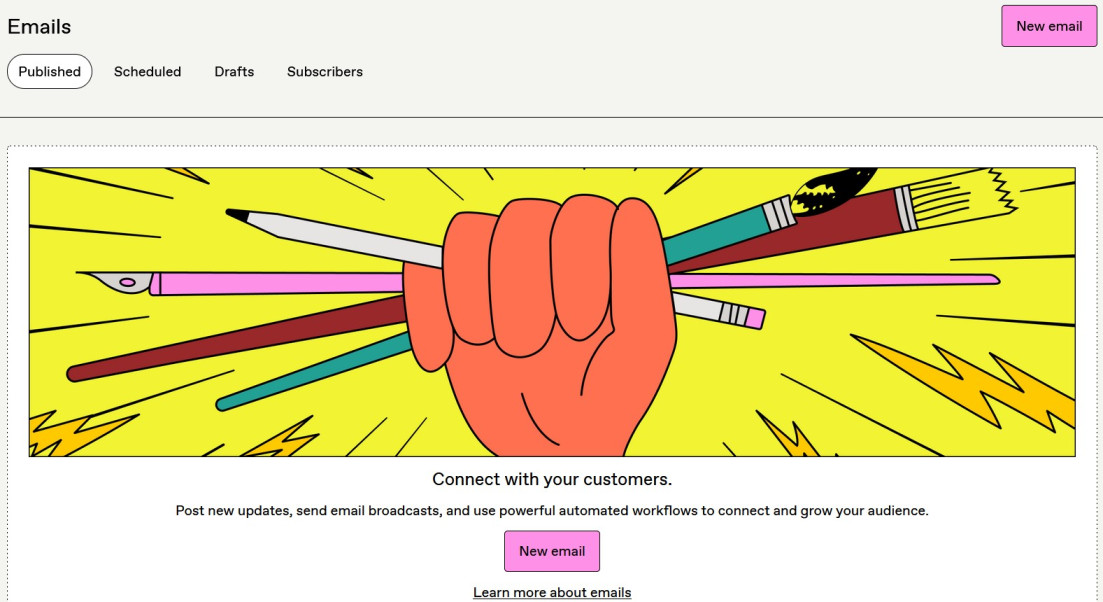
Gumroad only includes simple marketing tools. You can send email updates or newsletters to your followers and subscribers. There are “Posts” for sharing news or blog-like content. This is definitely not enough for large B2B Saas email marketing strategies.
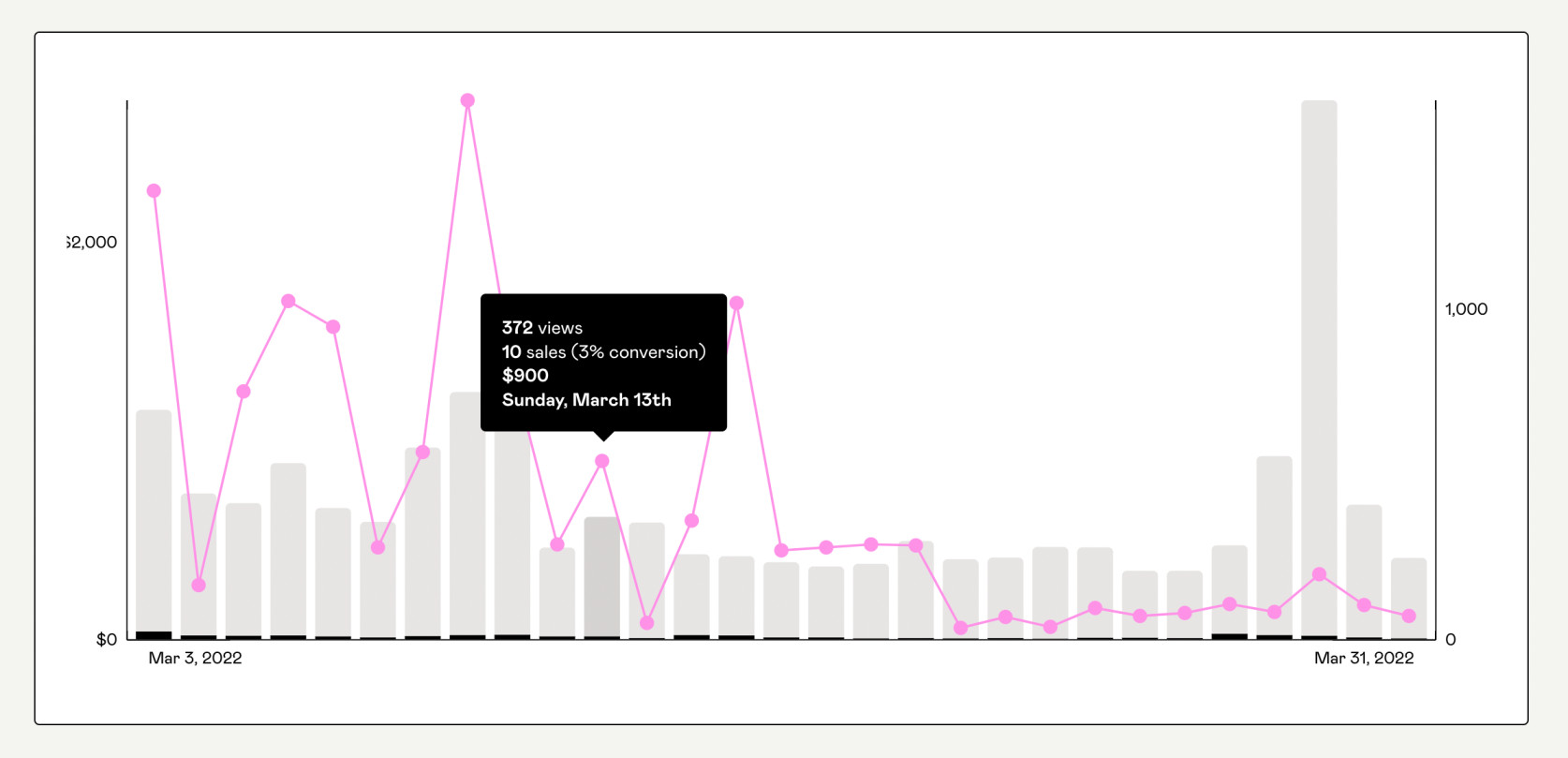
You can also create and manage discount codes per product. Analytics dashboards show sales metrics, conversion rates, and where your traffic is coming from.
Email List Management
Gumroad automatically gathers buyer emails. This is because in order to make a transaction, a consumer must use an email. At any moment, you can export your complete list of followers and customers. This makes switching to a different email tool or migrating easier.
Gumroad Pricing
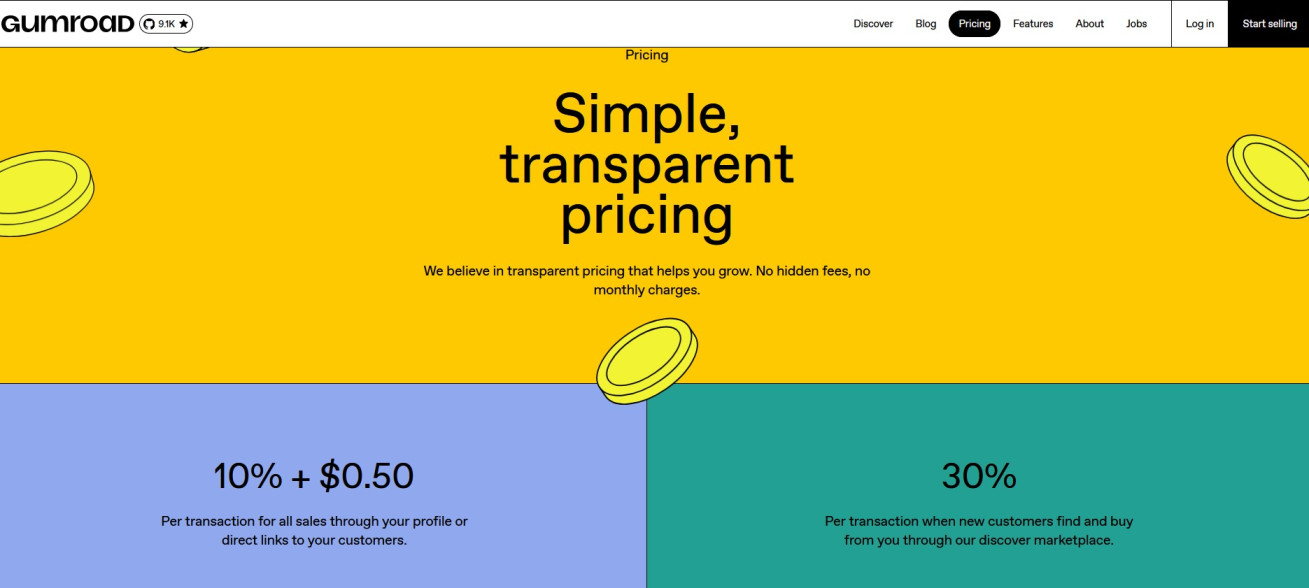
Gumroad's pricing is complicated and transaction-based, and there are no monthly subscriptions for a basic store. Here is how it works:
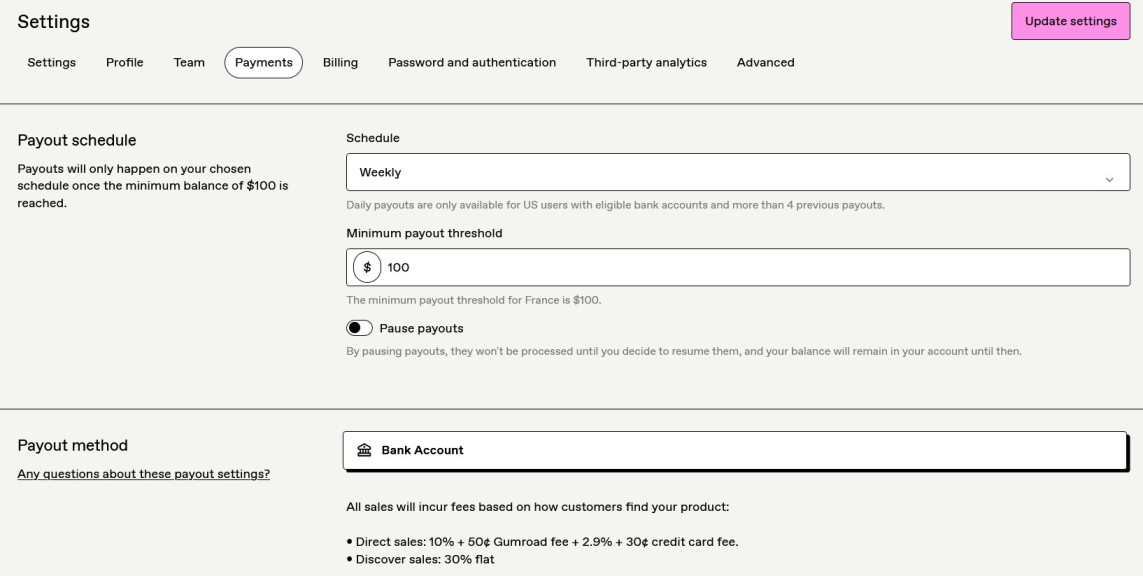
- Platform fee: Gumroad takes 10% + $0.50 from each sale you make through your Gumroad profile or direct product links.
- Payment processing: On top of that, card processing adds roughly 2.9% + $0.30 per transaction, bringing your total cost to about 12.9% + $0.80 per sale. Keep in mind that the effective rate ranges from 13% to 23% depending on your product price, since the fixed fees hit low-priced products much harder than expensive ones.
- Discover fee: If a customer finds your product via Gumroad's Discover marketplace, Gumroad's fee rises to 30% of the sale.
- Payouts: Gumroad pays creators via direct deposit or PayPal. Payouts start weekly by default; after 4 successful weekly payouts, creators unlock daily payouts.
Gumroad Reviews: What Customers Say?
Gumroad has its fans, but negative customer reviews are also common. Checking recent user feedback websites like Trustpilot, Reddit, G2, etc., reveals a pattern of complaints, especially around payments and support.
1. Payout Issues
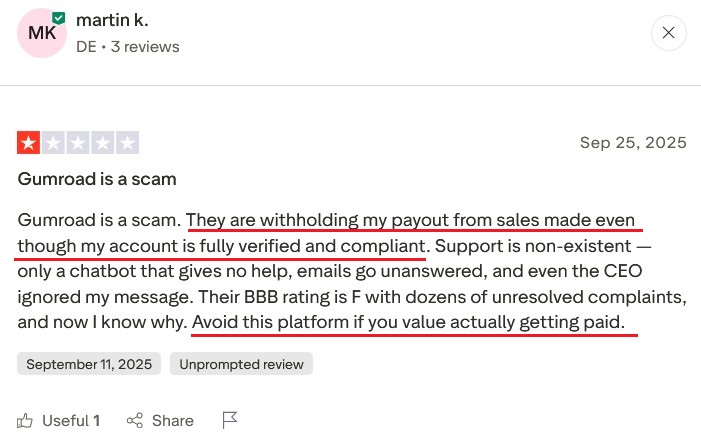
Many Gumroad reviews, like Martin's, report Gumroad withholding or delaying payouts. This is despite their account being verified and active for a long time. This can truly hurt the trust-building process in the long run.
2. High Fees / Thresholds
Users say that Gumroad's fee structure and payout rules can be burdensome. A Redditor complained that they don't put you in their public library. Another pointed out the absurdity of a rising minimum payout (recently raised to $100 unexpectedly). In sum, many feel the combined fees and rules are unfair to beginners.
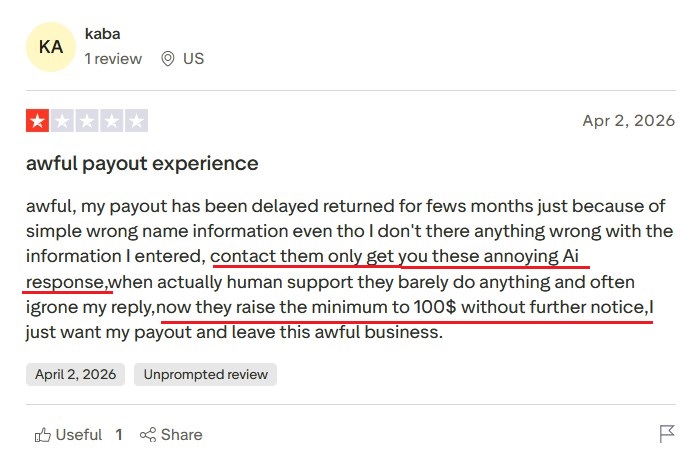
3. Poor Customer Service
Poor support is a common complaint in Gumroad reviews. Many users mention the “non-existent” or unhelpful support, long delays, or only bot responses. Lack of human contact frustrates sellers when problems arise.
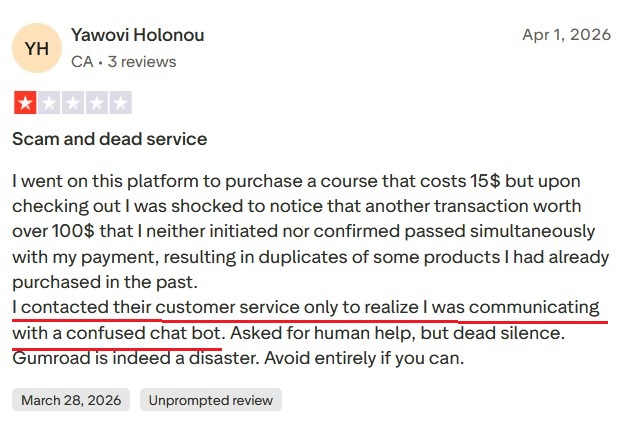
4. Content / Marketplace Issues
This one comes up a lot in our Gumroad review research. Buyers and sellers alike have complained about fake shops, stolen content, and copyright violations slipping through. For a platform built on creator trust, the lack of consistent moderation is a real problem that Gumroad hasn't fully addressed.
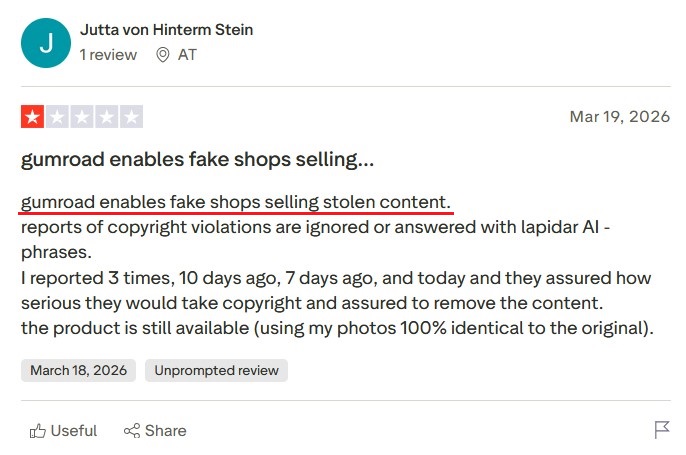
In summary, while some like Gumroad's ease of use, a significant number of customers report negative experiences – especially issues with frozen funds, high fees, and poor support.
Gumroad Pros and Cons
Here are Gumroad's main advantages and drawbacks:
Pros
- Easy to use with a minimal and intuitive interface.
- Designed for digital creators with support for ebooks, courses, software, and subscriptions.
- Includes built-in tools like email marketing, affiliate programs, and customer data access.
- Eliminates technical hassle by hosting files and managing payments.
Cons
- Charges relatively high transaction fees (~10% + processing), which can significantly reduce profit margins.
- Uses a flat fee structure with no discounts for higher sales volume.
- Requires minimum payout thresholds and initial delays, meaning sellers may wait weeks to access earnings.
- Offers limited storefront customization, restricting branding, upsells, and advanced sales funnel options.
- Has basic product organization, making it difficult to manage large catalogs efficiently.
- Provides inconsistent customer support, relying mainly on email and lacking fast or live assistance.
- Focuses mainly on digital or simple products, lacking advanced e-commerce features.
After learning about every facet of Gumroad, brandID is the greatest choice if you're searching for an alternative that can address all of its issues.
brandID: A Modern Alternative to Gumroad
brandID is a free all-in-one creator platform built for anyone who wants to grow and monetize their online presence without juggling multiple tools. At its core, it gives you a fully customizable link in bio page that doubles as a professional storefront, but it goes well beyond that.
From selling digital products and setting up subscriptions to affiliate marketing, emails, appointment scheduling, and even renting out digital ad space to brands, brandID puts everything in one place. Whether you're a content creator, freelancer, affiliate marketer, or small business owner, it's designed to grow with you.
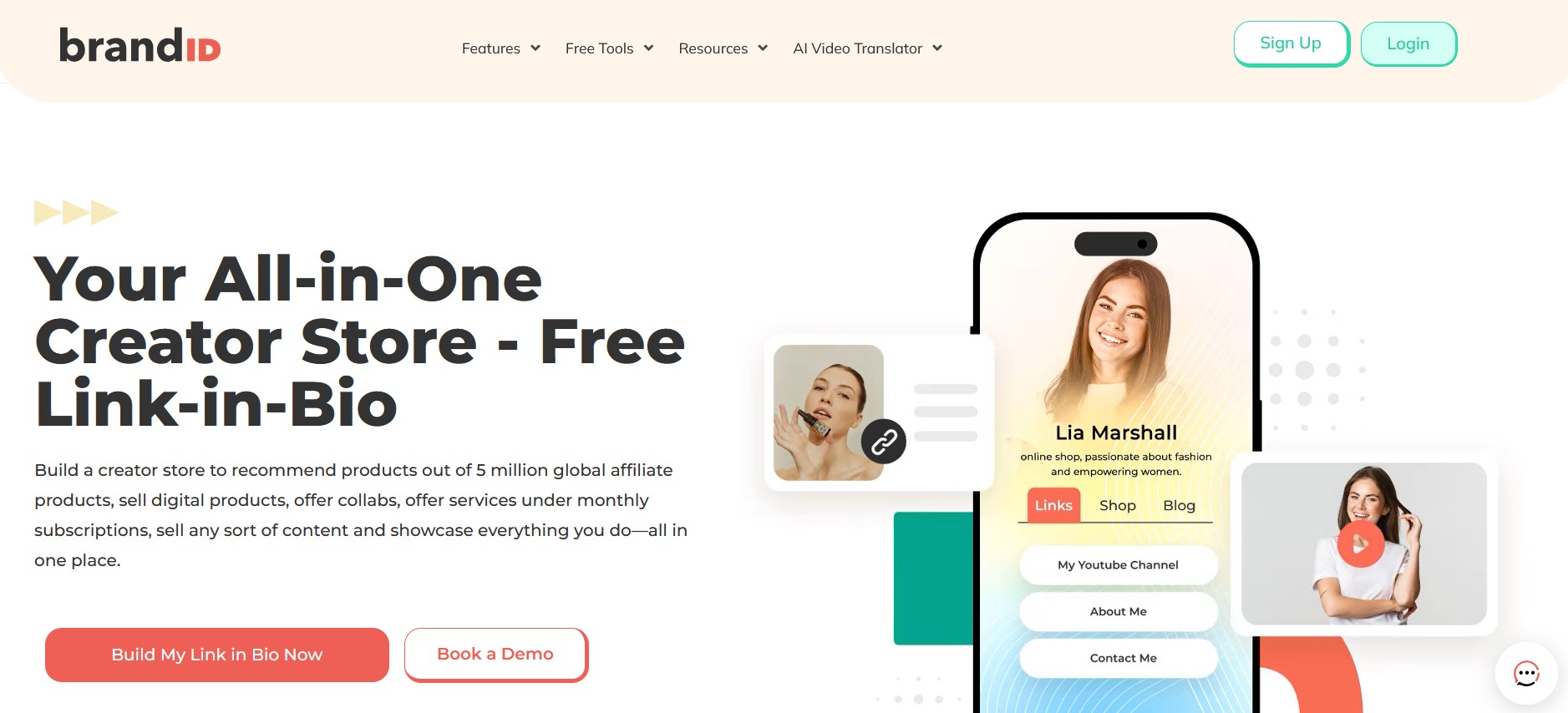
Here's how brandID directly fixes each Gumroad problem we covered:
1. Lower fees that scale with you, not against you
Gumroad takes 10% + $0.50 per sale on top of payment processing — pushing effective fees to 13–23% depending on price point. brandID's free plan charges a flat 5% transaction fee, and paid plans drop that further.
On a $20 digital product, you keep $19 with brandID versus roughly $17.40 with Gumroad. Across 1,000 sales, that's a $1,600 difference going into your pocket instead of the platform's.
2. No payout thresholds, no weekly waiting period
One of the most consistent complaints in Gumroad reviews is the $100 minimum payout and the requirement to complete four weekly cycles before unlocking daily payouts. brandID has no minimum payout threshold and no waiting period; your earnings flow to you on a schedule that works for your cash flow, not the platform's.
For creators just starting out, this matters: you can withdraw your first $5 sale, not sit on it for a month.
3. A full storefront, not a stripped-down checkout page
Gumroad's customization stops at colors and text. brandID gives you a fully designable creator page with professionally built templates, custom branding, layout control, embedded content, and the ability to organize products into collections, not just a flat list. You can launch a page that looks like a real brand in minutes, not a generic Gumroad URL that looks like everyone else's.
4. A built-in affiliate marketplace, not a DIY affiliate hunt
Gumroad lets you recruit affiliates if you can find them yourself. brandID takes the opposite approach: as a creator, you get instant access to over 5 million products from 2,000+ brands to promote and earn affiliate income from.
No outreach, no negotiation, no separate affiliate platform. Every product is ready to promote from inside your dashboard with one click. If you want your own products listed in the marketplace for other creators to promote, support handles that for you, too.
This is a fundamentally different model from Gumroad's. Gumroad expects you to bring your own affiliates. brandID brings the affiliates and the brands to you.
5. Revenue streams Gumroad doesn't offer at all
Gumroad gives you one revenue stream: selling digital products. brandID gives you seven:
- Digital product sales (like Gumroad, but with lower fees)
- Subscriptions and memberships (recurring revenue, like Gumroad, but with better analytics)
- Affiliate commissions (from the 5M-product marketplace - Gumroad has nothing like this)
- Paid bookings and 1-on-1 sessions via brandID bookme - coaches, consultants, photographers (Gumroad doesn't support this natively)
- Collecting tips and donations (Gumroad doesn't support this natively)
- Digital billboard rentals - rent the visual real estate on your link-in-bio page to brands for a fee (no Gumroad equivalent)
- Lead generation with built-in capture forms feeding into integrated email marketing
6. Marketing tools built for creators who are actually growing
Gumroad's marketing is limited to basic email blasts and discount codes. brandID includes integrated email, lead capture forms, an in-platform blog, CRM, promo codes, and giveaway tools. Everything you'd otherwise stitch together from Mailchimp, ConvertKit, and a separate landing page builder.
There's also full Google Analytics and Facebook Pixel integration for serious tracking, plus brandID's own analytics dashboard for page visits, link clicks, and conversion rates by source.
7. AI Video Translator — selling globally without the cost of localization
This is a feature Gumroad doesn't have and likely never will. brandID includes a built-in AI video translator that dubs your video content into 200+ languages while preserving your voice.
For creators selling courses, tutorials, or video products, this single feature opens up global markets that Gumroad's English-only storefront can't reach. A course creator who would otherwise pay translators thousands of dollars per language can now serve international buyers from day one.
8. Free to start, no surprise fee hikes
Gumroad has raised payout thresholds and changed fee structures over the years, including the recent surprise jump to a $100 minimum. brandID's free plan is genuinely free with no per-month cost, and the pricing structure is transparent. You'll never wake up to discover the rules have changed against you.
Gumroad vs brandID
| Feature | Gumroad | brandID |
|---|---|---|
| Starting Price | Free | Free |
| Sales Cap | None | None |
| Affiliate Program | Limited | Yes (all plans) |
| Link Management | No | Yes |
| Booking & Scheduling | No | Yes |
| Link in Bio Page | No | Yes |
| Secure Inbox | No | Yes |
| Collect Tips | No | Yes |
| Giveaways | No | Yes |
| Digital Billboard Rentals | No | Yes |
| CRM & Promo Codes | Basic | Yes |
| Physical Products | No | No |
| VAT & Tax Handling | No | No |
Other Gumroad Alternatives
Here are some of the names that can be considered as alternatives to Gumroad:
1. Payhip vs Gumroad
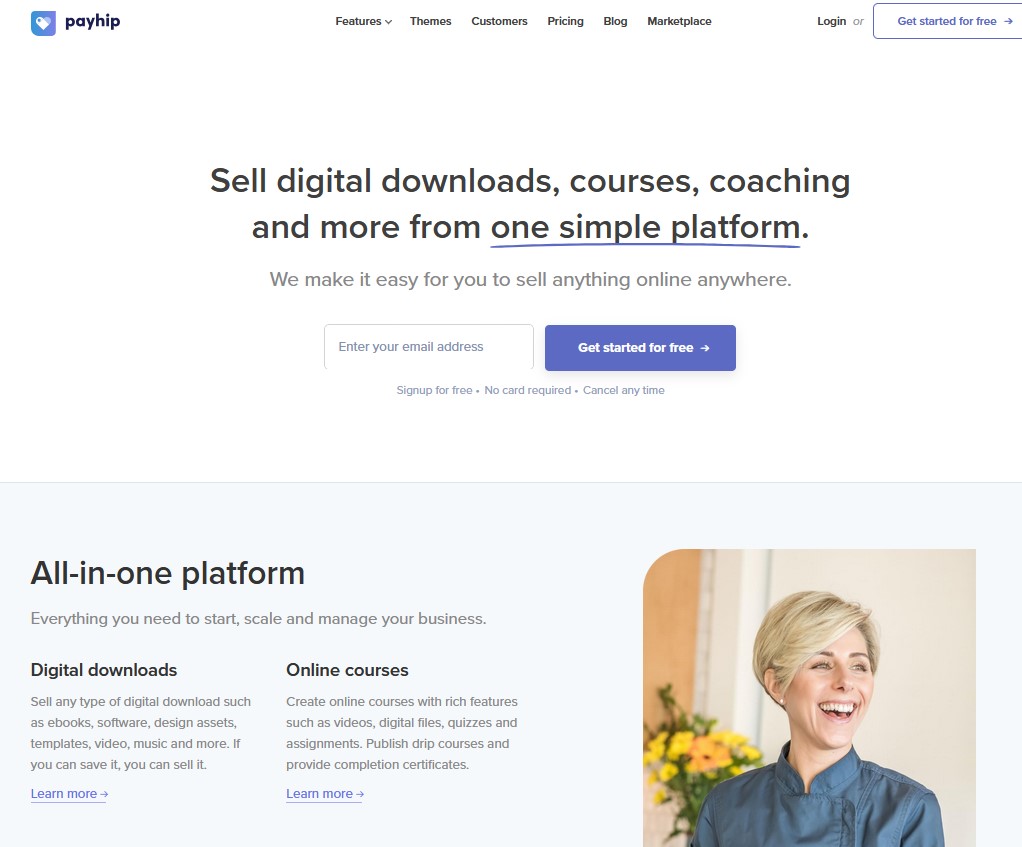
Payhip is a direct competitor of Gumroad that allows selling downloads, courses, and memberships. It charges 10% per sale, which is the same as Gumroad's 10%, on its free plan.
It supports coupons, bundles, affiliate links, and offers instant payouts via PayPal or Stripe. Payhip also includes email marketing tools.
Payhap can be beneficial in some cases where fees are very important, but it also lacks other features like the discovery market that Gumroad provides.
Payhip's payouts are often within 24 hours, compared to Gumroad's weekly schedule.
Make sure to check this Payhip review for a thorough and complete review of this platform.
2. Gumroad vs Sellfy
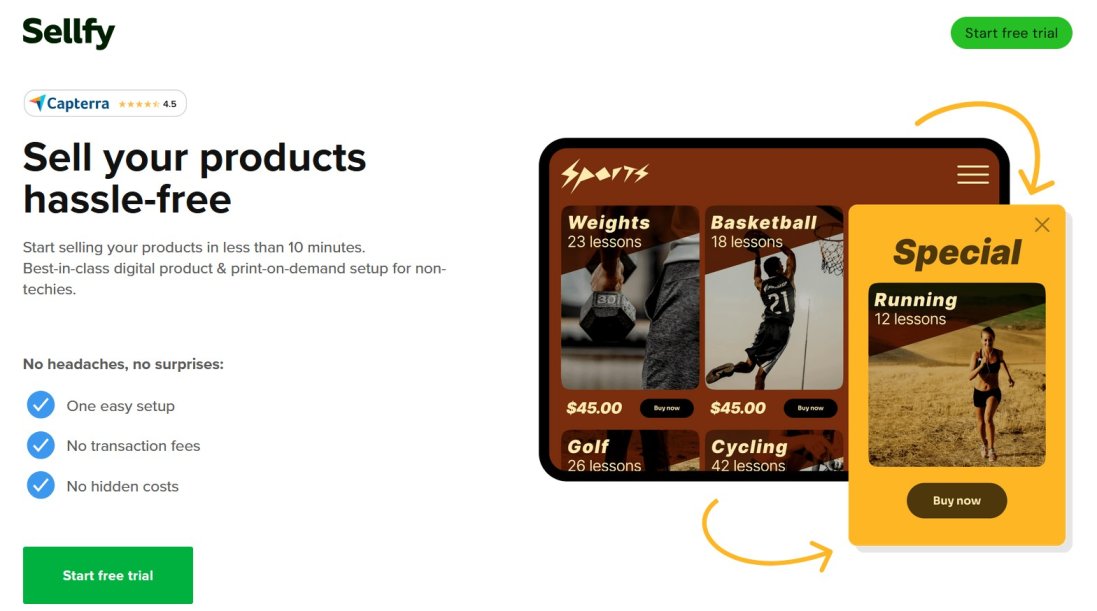
Sellfy offers a free starter plan (up to 5 products) and paid plans (from about $19/month) for unlimited products.
It supports digital downloads, print-on-demand merch, subscriptions, and one-time payments. It has a built-in storefront and cart, and features like upsells, discount coupons, and email newsletters.
Unlike Gumroad's fee model, Sellfy's paid plans remove transaction fees, so creators pay a flat monthly cost instead.
You can read about Sellfy and how it performs in our complete Sellfy review.
3. Gumroad vs Shopify
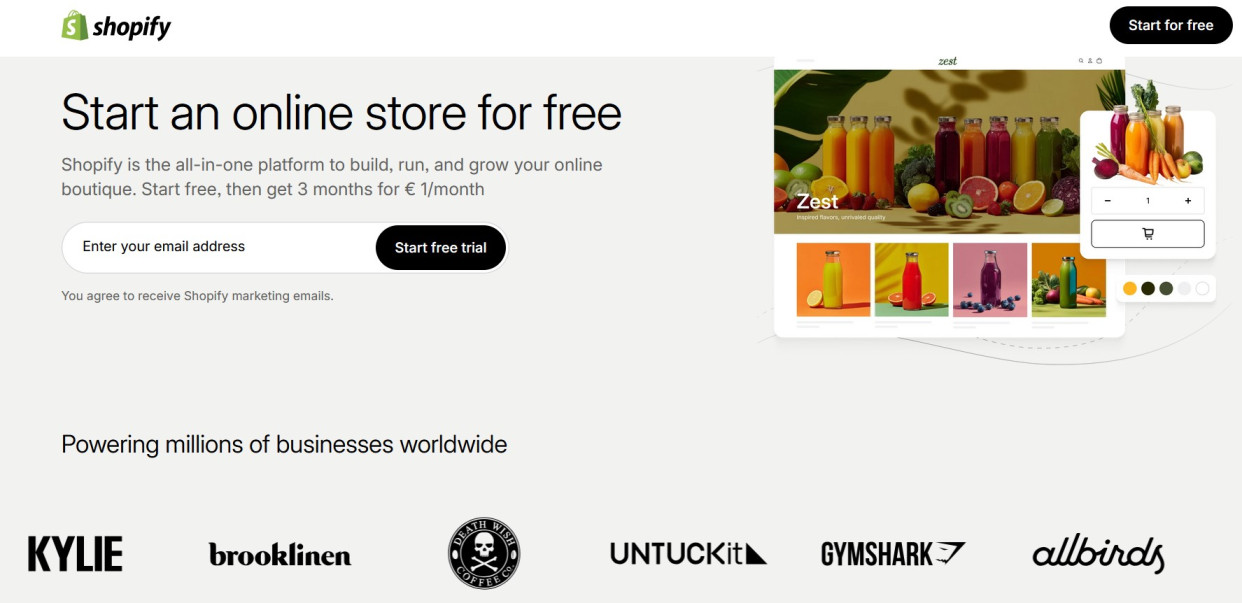
Shopify can handle digital products via apps. It's much more robust and scalable than Gumroad, but it also has its own disadvantages.
Shopify has a monthly subscription (starting ~$39) and charges around 2.9% + $0.30 on its Lite plan.
Shopify excels with thousands of apps, physical product support, and full control over your storefront and checkout. The trade-off is complexity and cost.
Conclusion
Gumroad is one of the first platforms in creator-focused e-commerce. It lets anyone start selling digital products with minimal hassle. Its strengths lie in ease of use and a “pay-as-you-go” pricing model with no monthly fee.
However, this simplicity comes at a price. Gumroad's fees are high, and many users report frustrations with payout processes and limited features. Negative Gumroad reviews highlight withheld payments, unresponsive support, and a lack of advanced tools. For serious sellers or growing businesses, these issues make Gumroad less attractive and other alternatives like brandID a more suitable choice.
Keep in mind to always weigh the fees, features, and user feedback before choosing the right platform.
FAQs
Ready to try the all-in-one Gumroad alternative?
Start with brandID — Free