Selling digital products is one of the lowest-risk, highest-margin ways to earn online: you build something once, then sell it again and again with no inventory, shipping, or restocking. An ebook, a template, a course, or a preset pack can keep earning for years after you make it.
The catch is that most first launches flop, not because the product is bad, but because it solves no clear problem, targets no clear buyer, or sits on the wrong platform. This guide fixes that with a complete, proven process you can follow from idea to income.
Below you'll learn how to sell digital products online step by step: how to find and validate a profitable idea, create and price it, choose where to sell, promote it, and keep it selling. If you're still deciding what to make, the best digital products to sell right now can spark an idea, then come back here to sell it.
Key Takeaways
- Solve a problem, not a passion: The digital products that sell answer a specific, repeated need for a clearly defined buyer
- Validate before you build: A few hours of research on Google, YouTube, and competitor pages saves you from launching to silence
- Price on value, not hours: Buyers pay for time saved and results, so research the market and price to the outcome you deliver
- Your platform shapes your profit: Marketplaces bring traffic but take a cut, while your own store keeps more of each sale and your customer data
- Promotion is half the job: A great product still needs a voice: lead with the problem, then the link, across the channels you already use
Why Sell Digital Products?
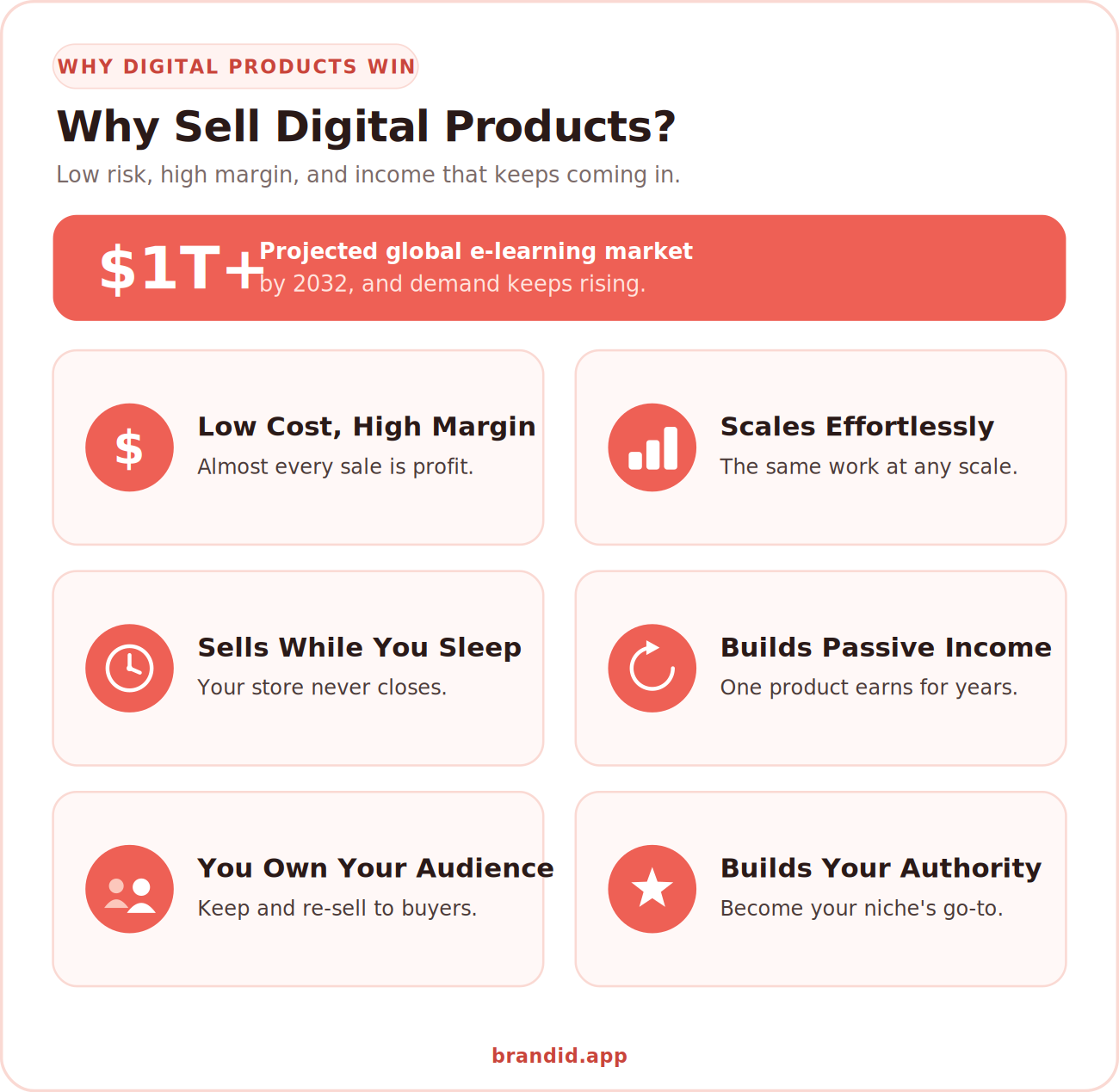
The demand is real and growing. The global e-learning market alone is projected to pass $1 trillion by 2032, and hundreds of millions of people now buy ebooks, courses, templates, and downloads every year. Creators, coaches, designers, developers, and educators are all turning what they know into products that sell on autopilot.
A few reasons creators keep choosing digital products over physical goods or services:
- Low cost, high margin. No materials, no shipping, and no cost of goods, so most of each sale is profit.
- It scales effortlessly. Selling one copy or ten thousand takes the exact same work.
- It sells while you sleep. A digital storefront never closes and reaches a global audience across time zones.
- It builds passive income. One product can earn for months or years after launch with little upkeep.
- It positions you as an expert. A useful guide or toolkit makes you a go-to voice in your niche and feeds every other offer you have.
- You own your audience. Sell from your own store and you keep buyer emails, which you can market to again and again.
- It is a cheap way to test a business. A small product validates whether people will pay before you invest in anything bigger.
What Digital Products Can You Sell?
Here are the most popular and profitable categories, each with a typical buyer and price range so you can gauge the opportunity:
| Product type | Who buys it | Typical price |
|---|---|---|
| Ebook or guide | Learners and hobbyists | $5 to $40 |
| Online course or workshop | Skill-seekers and professionals | $30 to $500+ |
| Templates (Canva, Notion) | Creators and small businesses | $5 to $50 |
| Printables and planners | Consumers, parents, students | $3 to $20 |
| Digital art and clipart | Designers, teachers, crafters | $2 to $30 |
| Presets and LUTs | Photographers and creators | $5 to $40 |
| Music and audio packs | Video creators and podcasters | $10 to $100 |
| Memberships and communities | Fans and ongoing learners | $5 to $50 per month |
Which one is right for you usually comes down to your craft: pair a format you can produce well with a demand that already exists. A photographer might package presets, a writer might publish a guide, and a designer might license clipart and illustrations to other creators.
How to Sell Digital Products Online in 6 Steps
This is the same path used by creators earning full-time incomes. Follow it in order, because each step makes the next one easier and protects you from the number one killer of digital products: building something nobody wants.
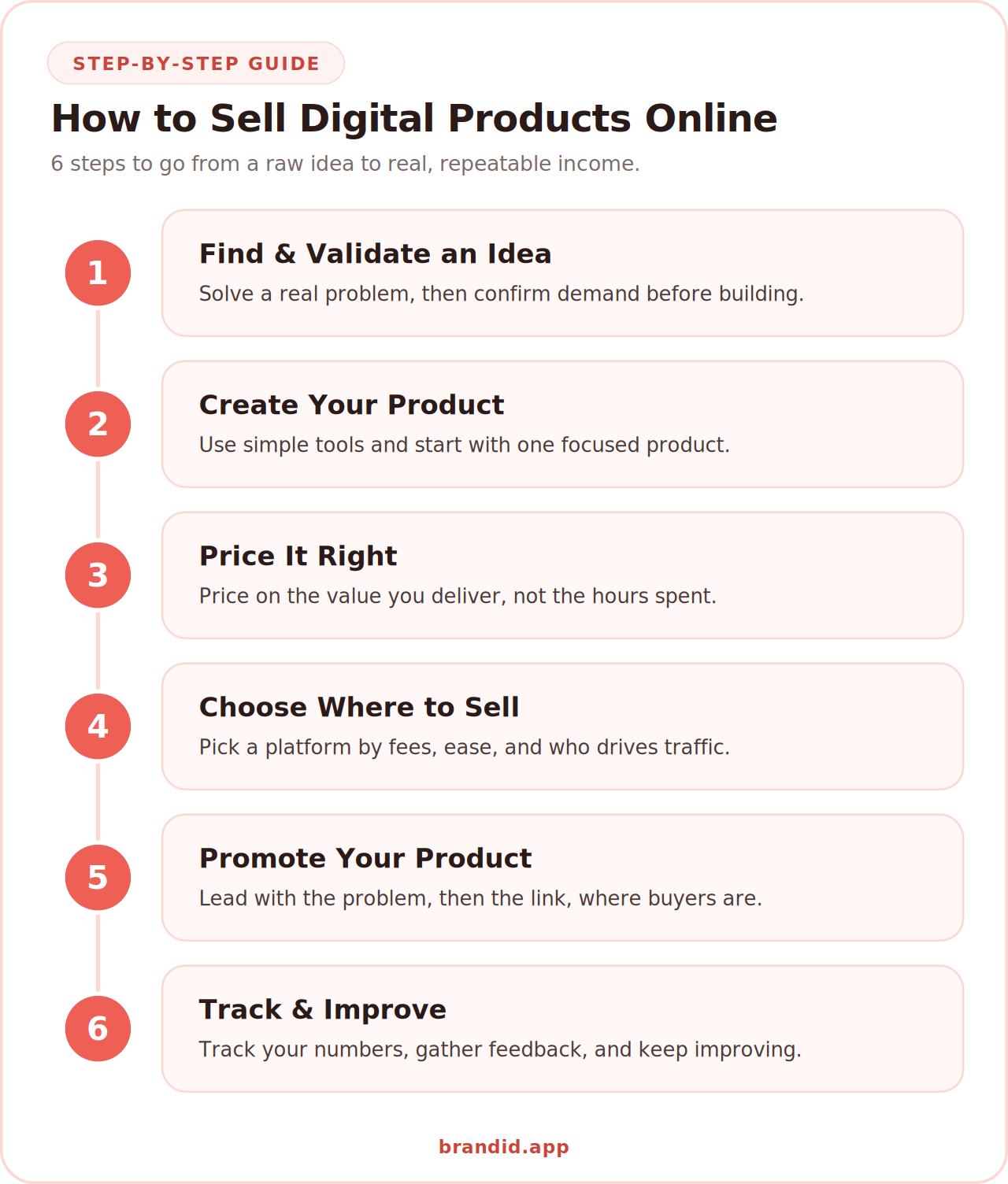
Step 1: Find and Validate a Profitable Idea
Writer Alexis Grant's first ebook, built around a passion topic, reportedly earned only about $1,100. A later ebook that solved a clear problem, how to build a social media strategy, reportedly brought in close to $60,000. Same author, very different results, because the second one fixed something people were already trying to solve.
To surface your own idea, look at what you already know and what people rely on you for. Ask yourself:
- What do people constantly come to me for help with?
- What tasks do they complain about doing over and over?
- What messy workaround are they already using that I could package cleanly?
- Where was I a year or two ago, and what would have saved me time back then?
Then validate the demand before you build. A few hours of research will tell you whether an idea has legs:
- Search Google. If businesses are ranking guides and running ads on your topic, money is already changing hands.
- Check YouTube. Videos with hundreds of thousands of views prove sustained interest.
- Study competitors. If similar products already sell on Etsy, Gumroad, or Udemy, that is validation, not a reason to quit. It means a market exists.
- Ask your audience. A quick poll or DM question ("would you buy X?") beats guessing.
Step 2: Create Your Digital Product
You do not need expensive software. Match the tool to the product:
- Ebooks and guides: written in Google Docs or Canva, then exported to a PDF you can sell online as an ebook.
- Templates: Canva, Notion, Figma, or Google Sheets.
- Courses: a phone or webcam, a screen recorder like Loom or OBS, and any hosting platform, and the same recordings can double as standalone videos you sell.
- Printables and art: Canva, Procreate, Illustrator, or an AI image tool if you plan to sell AI art you generate.
- Presets and audio: Lightroom for presets, or any DAW for beats and sound packs you can sell.
Focus on clarity and usefulness over polish, and resist the urge to overbuild. Ship a focused first version, then expand based on what buyers ask for. A tight, finished product beats a perfect one that never launches.
Step 3: Price It Right
Notion template creator Easlo has reportedly earned over $500,000 selling minimalist templates, not because they are complex, but because they save buyers hours. That is the whole game: people pay for the result, not your effort. A Canva template that saves someone six hours is easily worth $20 to $40, no matter how quickly you made it.
To land on a number, research five to ten comparable products, note their prices and what they include, then position yourself in that range based on your quality and bonuses. Your first price is a starting point, not a life sentence, so start, watch how people respond, and adjust. Pricing a product around the value it delivers, not the hours it took, removes most of the guesswork.
Choose a pricing model that fits your product:
| Pricing model | How it works | Best for |
|---|---|---|
| One-time price | A single payment for instant access | Ebooks, templates, printables |
| Tiered (good / better / best) | Multiple versions at rising prices | Courses and toolkits |
| Bundle | Several products together at a discount | Template packs and asset libraries |
| Subscription | Recurring monthly or yearly payment | Memberships and ongoing content |
| Pay-what-you-want | Buyer chooses the price, with an optional minimum | List building and new creators |
Step 4: Choose Where to Sell It
The right platform depends on your goal. Before you commit, weigh five things:
- Ease of use. If it takes more than a few minutes to set up a product, that is a bad sign.
- Fees and commissions. Compare monthly costs and per-sale cuts, since they add up fast at volume.
- Payment and checkout. A smooth, one-click checkout with cards, PayPal, and local methods lifts conversions.
- Integrations. Email tools, analytics, and automations keep your business running without manual work.
- Traffic and ownership. Marketplaces lend you buyers but keep the relationship, while your own store lets you own the customer.
A tool like an all-in-one creator monetization platform keeps more margin and gives you the customer, though you drive the traffic. Many creators use both a marketplace and their own store. The next section compares the main options in detail.
Step 5: Promote Your Product
A product cannot promote itself. The mistake most beginners make is posting a bare link like "Just launched a template, link in bio," then wondering why it gets zero sales. Compare that to "I used to rewrite the same client email every week, so I turned it into a template," which leads with a relatable problem and earns far more clicks. Talk about the pain first, the product second.
Build a promotion engine from these channels:
- Social media. Instagram and Pinterest for visual products, LinkedIn for professional ones, TikTok for reach. Share behind-the-scenes, quick wins, and buyer results.
- An email list. Offer a small freebie to collect emails, then nurture subscribers with helpful tips and the occasional soft pitch. Email out-converts social for actual sales.
- SEO and content. Write blog posts, answer questions, and create videos around what your buyers search for, so people find you for years.
- A real launch. Tease it, open with a limited-time discount, and create urgency instead of quietly publishing. Seasonal spikes help too, so lean into moments like Halloween and the holidays when buyers are already shopping.
- Affiliates. Let others promote your product for a commission, or join an affiliate program to earn commissions yourself while you build.
Step 6: Track, Get Feedback, and Improve
Once you launch, pay attention to what happens. The metrics worth watching are your traffic, checkout conversion rate, best-selling products, and refund rate. Together they tell you whether the problem is your traffic, your page, or the product itself.
Then close the loop:
- Collect testimonials. Social proof lifts trust and sales, so ask happy buyers for a short quote or video and display it on your page.
- Act on feedback. If several buyers trip on the same thing, fix it, whether that is a confusing title, a weak preview, or a missing instruction.
- Add upsells and bundles. Offer a related product at checkout to raise your average order value.
- Recover lost sales. Use abandoned-checkout emails and a small return discount to win back buyers who almost purchased.
Small, steady improvements compound. A product that converts at 2% today can reach 4% or more with better previews, sharper copy, and stronger proof, which doubles your income from the same traffic.
Best Platforms to Sell Digital Products, Compared
There is no single best platform, only the best fit for your goal, your product, and how much traffic you can bring yourself. Here is an honest comparison, followed by when to choose each.
| Platform | Best for | Fees | Traffic |
|---|---|---|---|
| brandID | An all-in-one store plus link in bio | Free to start, small fee per sale | You drive it |
| Gumroad | A fast, simple storefront | Around 10% plus payment fees | Some discovery |
| Sellfy | Digital plus print-on-demand | Monthly plans | You drive it |
| Etsy | Built-in buyer traffic | Listing fee plus about 6.5% plus fees | High |
| Payhip / Podia | Courses and memberships | Free tier or monthly plans | You drive it |
brandID suits creators who live on social media and want a branded store plus link in bio in one place, keeping more of each sale. Gumroad is the fastest way to publish a single product with minimal setup. Sellfy fits sellers who want digital and print-on-demand together. Etsy is worth it when you want built-in buyer traffic and accept the fees and competition. Payhip and Podia shine for courses and membership sites.
A common playbook is to list on a marketplace like Etsy for discovery while running your own branded store to keep more margin and own your customer relationships.
Sell Digital Products From Your Own Store With brandID
If you want to keep more of each sale and skip the marketplace fees, selling from your own store is the move. brandID is one option built for exactly that, especially for creators who live on social media.
brandID is a free-to-start creator store and link in bio, so you can sell digital downloads directly from one clean, branded page, no coding or website required.
- Host ebooks, templates, courses, and any digital product in one storefront
- Add subscriptions and memberships for recurring revenue, or collect tips from your audience
- Turn your bio link into a shoppable page across Instagram, TikTok, and email
- Track clicks and sales with built-in analytics, and get paid with secure checkout
The honest trade-off: like Gumroad or Sellfy, brandID does not come with a built-in marketplace, so you bring your own audience. In exchange, you keep more of each sale and own your customers instead of renting them from a marketplace.
Start Your Free Store on brandIDHow to Create a High-Converting Product Page
Your product page is where traffic becomes sales, and a small lift here multiplies everything you earn from promotion. Every high-converting page includes:
- A benefit-led headline. Lead with the result, not the format. "Plan a month of content in 20 minutes" beats "Content Calendar Template."
- A clear what-you-get list. Spell out exactly what is inside, the format, and how it is delivered.
- Visuals and previews. Show mockups, screenshots, or a short demo so buyers know what they are getting.
- Social proof. Add testimonials, ratings, or sales numbers near the buy button.
- An obvious price and CTA. One clear price and one button. Do not make people hunt for how to buy.
- A short FAQ. Answer the two or three objections that stop people from clicking buy.
How to Deliver and Protect Your Digital Products
Delivery is part of the product experience, and getting it right protects both your buyers and your work.
- Automate delivery. Buyers should get instant access or a download link the moment they pay, with no manual emails from you.
- Set clear license terms. State whether the product is for personal or commercial use so buyers know what they can do with it.
- Protect your files. Use watermarked previews, and for higher-value products consider license keys or lightweight protection.
- Version and update. Keep a master file, and when you improve a product, give existing buyers the update to build loyalty.
Legal and Tax Basics
This is general information, not legal advice, but a few basics keep you out of trouble as you grow.
- Taxes and VAT. Depending on where you and your buyers live, you may need to collect sales tax or VAT. Many platforms calculate and handle this automatically, which is one reason to pick a good one.
- Licensing and copyright. Only sell work you own or have the rights to, and spell out how buyers may use it.
- Refund policy. A clear, simple refund policy builds trust and can actually raise conversions.
- Terms and privacy. If you collect emails, add a basic privacy note and follow the rules for your region.
Common Mistakes to Avoid
- Building from passion, not demand. If no one is searching for it, it will not sell, no matter how much you love it.
- Skipping validation. A few hours of research prevents months of building something nobody wants.
- Pricing on effort. Customers pay for their outcome, not your hours, so price to the value you deliver.
- Overbuilding the first product. Start with one focused product, launch, then expand.
- Dropping bare links. Lead with the problem you solve, then the link, or people scroll past.
- Relying on one platform. Use a marketplace for reach and your own store for margin.
- Never iterating. Ignoring feedback and analytics is how good products quietly stop selling.
Real Creator Examples
The best proof that this works is the people already doing it. A few well-documented examples:
- Easlo (Notion templates). Reportedly earned over $500,000 selling clean, minimalist Notion templates, proving simple products win when they save real time.
- Alexis Grant (ebooks). Her passion-led ebook reportedly made about $1,100, while a problem-focused one reportedly made close to $60,000, the clearest lesson in solving a problem over following a passion.
- Template and preset sellers. Countless creators quietly earn four and five figures a month selling Canva templates, Lightroom presets, and printables, because those products save busy people hours of work.
Conclusion
Selling digital products online is one of the most accessible businesses you can start: low cost, no inventory, and a product that keeps earning long after you build it.
Find a real problem and validate it, create a focused product, price it to the value it delivers, choose a platform that fits your goal, and promote it by leading with the problem. Then track, listen, and improve. That loop is the whole business.
Do that, and a single idea can turn into a store that sells while you sleep. The best time to launch your first digital product is now, so pick your idea and get it in front of the people who need it.
Frequently Asked Questions
How Do I Start Selling Digital Products With No Money?
You can start completely free. Create your product with free tools like Canva or Google Docs, sell it on a free-to-start platform such as brandID or Gumroad, and promote it organically on the social channels you already use. Most platforms only take a small fee per sale, so there is no upfront cost.
What Is the Most Profitable Digital Product to Sell?
Online courses and templates tend to be the most profitable because they solve a clear problem and save buyers time. That said, the best product for you is the one that matches your skills to a specific, repeated need your audience already has.
How Much Can You Make Selling Digital Products?
It ranges widely. Many creators earn a few hundred dollars a month, while top sellers reach six figures, like Notion template creator Easlo, who has reportedly earned over $500,000. Your income depends on your audience size, your product, and how consistently you promote it.
Where Is the Best Place to Sell Digital Products?
It depends on your goal. Marketplaces like Etsy give you built-in traffic in exchange for fees, while your own store on a platform like brandID, Gumroad, or Sellfy keeps more margin and lets you own the customer. Many creators use both together.
Do I Need a Website to Sell Digital Products?
No. A link-in-bio store or a simple storefront lets you sell without building a full website. Tools like brandID give you a branded, shoppable page with checkout in minutes, which is enough to launch and start earning.
How Do I Price My Digital Product?
Price on value, not on the hours you spent. Research what similar products charge, then set an entry price based on the time or money your product saves the buyer. Start there, test how people respond, and add tiers or bundles as you grow.
How Do I Validate a Digital Product Idea?
Before building, search your topic on Google and YouTube, study whether similar products already sell on marketplaces, and ask your audience directly if they would buy it. Existing competition is a good sign, since it proves people are already paying for solutions in your niche.
How Do I Deliver a Digital Product to Buyers?
Use a platform that delivers automatically, so buyers get instant access or a download link the moment they pay. Add clear license terms, watermark previews, and keep a master file so you can push updates to existing customers later.
Is Selling Digital Products Still Worth It in 2026?
Yes. Overhead is low, delivery is instant, and demand keeps rising, with the e-learning market alone projected to pass $1 trillion by 2032. As long as your product solves a real problem, digital products remain one of the best ways to build passive income.
 Summarize this article with: