Every creator who has spent a month on Ko-fi has hit the same wall. The tip jar works, the shop kind of works, and the membership tools kind of work, but the 5% cut on almost everything (until you pay $12/month for Gold) plus the confusing default Contributor mode plus the almost-zero discoverability quietly cap how much you can ever really earn.
Ko-fi alternatives fall into three buckets: direct tipping replacements (Buy Me a Coffee, Liberapay), digital storefronts (brandID, Gumroad, Sellfy, Payhip, The Leap), and full creator ecosystems that bundle memberships, merch, and content (Patreon, Fourthwall, Substack). The 10 platforms below cover all three categories, ranked on what they realistically pay creators after fees and how much room they give you to grow beyond a hobby tip jar. If you want the wider view of tools most of these compete within, the guide to the best link-in-bio tools covers the broader category.
Key Takeaways
- The best Ko-fi alternatives for creators are brandID (all-in-one link-in-bio storefront with 0% fees on Creator plan), Buy Me a Coffee (closest direct tip-jar swap), and Patreon (largest paid-subscriber audience)
- Ko-fi’s “0% fees” is misleading. Contributor mode takes 5% of tips by default until you turn it off, and shop sales, memberships, and commissions all carry a 5% fee unless you pay $12/month for Gold
- brandID is the strongest all-in-one alternative because it adds an affiliate marketplace (5 million+ products, up to 65% commission), booking system, digital billboards, and email/CRM that Ko-fi does not offer at any tier
- Digital-product creators earn more on Gumroad, Sellfy, or Payhip than on Ko-fi’s shop, since these platforms are built for downloads and Payhip’s free plan drops the fee to 0% once you upgrade
- Match the platform to your primary income stream. Tips only? Buy Me a Coffee. Memberships? Patreon. Digital products? brandID or Gumroad. Merch? Fourthwall. Newsletter? Substack. Open source? Liberapay
Best Ko-fi Alternatives at a Glance
All 10 alternatives to Ko-fi at a glance, sorted by category and starting price. Use this to shortlist the ones that fit your current stage and primary revenue model.
| Platform | Best For | Starting Price | Platform Fee |
|---|---|---|---|
| brandID | All-in-one creator monetization | Free | 0% (Creator, own gateway) |
| Buy Me a Coffee | Simple tip jar swap | Free | 5% on all transactions |
| Patreon | Tiered memberships at scale | Free | 10% (new accounts) |
| Fourthwall | Merch + memberships | Free | 0% on merch, 5% on digital |
| Gumroad | Selling digital products | Free | 10% + $0.50 per sale |
| Sellfy | Storefront with print-on-demand | $22/month | 0% on paid plans |
| Payhip | Digital products, free plan | Free | 5% free, 0% on paid |
| Substack | Newsletter + paid subs | Free | 10% on paid subs |
| The Leap | AI-guided mini-product store | Free | 0% (processor fees only) |
| Liberapay | Open source / recurring only | Free | 0% (processor fees only) |
Why Creators Are Looking for Ko-fi Alternatives
Ko-fi hit a real gap in 2012 by making tipping frictionless. But 14 years later, the platform’s original simplicity now works against creators who want to build a real business. Six specific limitations drive most of the switching:
1- Contributor Mode Silently Takes 5% of Every Tip
New Ko-fi accounts start in Contributor mode by default, which takes a 5% cut of every tip to “help fund Ko-fi.” Most creators do not realize this for weeks, sometimes months, because it is buried in settings. Turning it off restores the advertised 0% fee on tips, but Ko-fi never surfaces the toggle prominently. The full Ko-fi review covers the fee mechanics in more detail.
2- Every Feature Beyond Tips Costs 5% on the Free Plan
Shop sales, memberships, and commissions all carry a 5% platform fee on Ko-fi’s free plan, on top of Stripe or PayPal processing (roughly 2.9% plus $0.30). The only way to get 0% on everything is Ko-fi Gold at $12 a month, which many creators quietly pay just to stop losing 5% on every subscriber.
3- Branding Is Locked Down
Every Ko-fi page looks like a Ko-fi page. You get a banner, avatar, background color, and a coffee-cup icon. Custom domains, layout changes, complex widgets, and advanced branding are Gold-only. For creators building a real brand, the “hosted on Ko-fi” feel becomes a ceiling on how professional the page can look.
4- No Marketing, Email, or CRM Tools
Ko-fi has no email marketing, no lead-capture forms, no CRM, no automation, no segmentation. Every subscriber list, campaign, and follow-up sequence has to happen in Mailchimp, ConvertKit, or another external tool that you connect and maintain yourself. Alternatives like brandID bundle all of that into the same account.
5- Near-Zero Discoverability
Ko-fi is a tip jar, not a marketplace. There is no algorithmic discovery, no browse-by-category, no recommended-creators section that funnels new supporters to you. Every visitor to your Ko-fi page arrives because you sent them from Instagram, Twitch, YouTube, TikTok, or your newsletter. Ko-fi does not add traffic.
6- Customer Support Has a Poor Reputation
Multiple creators on Trustpilot and Reddit report accounts suspended without warning and support tickets that go unanswered for weeks. Ko-fi’s own scale (over one million creators) makes individual support hard to prioritize, and the platform disclaims responsibility for buyer-seller disputes on digital-product sales.
Top 10 Ko-fi Alternatives for Creators
The 10 platforms below cover every major creator-monetization approach: tips, memberships, digital storefronts, merch, courses, newsletters, and open-source patronage. Programs are ranked on overall value across fees, feature depth, and audience fit for typical Ko-fi users.
1- brandID
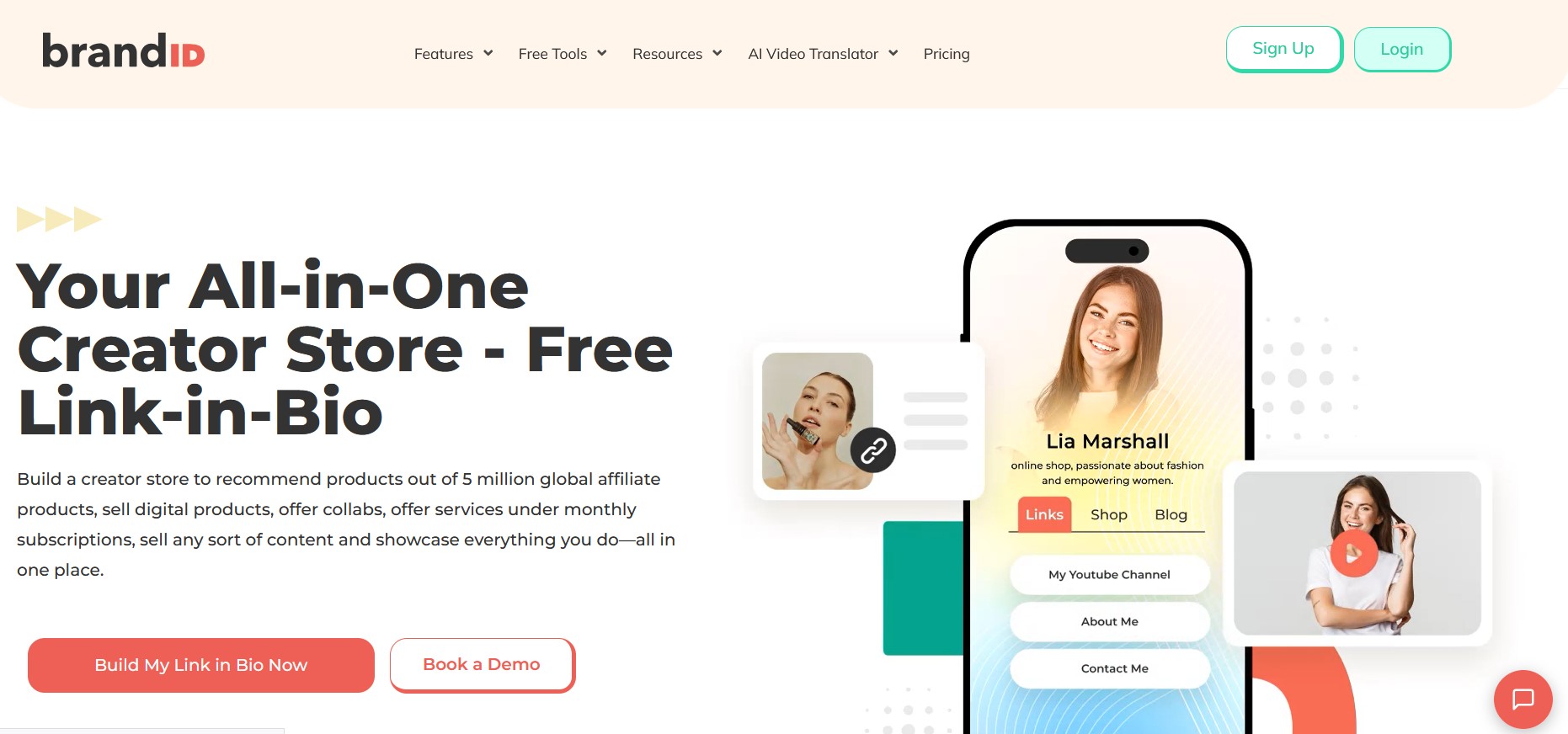
brandID is a free link-in-bio and creator platform that treats tipping as a first-class feature, not a setting buried under shop, memberships, and commissions. Fans hit a tip button on your bio, pay in one click through Stripe or PayPal, and the money lands in your account instantly. No fan signup required on their end. No forced Contributor mode quietly taking 5% from every payment on yours. No $12/month upgrade needed to remove default cuts. Among the best ko-fi alternatives for creators who lead with fan support, brandID is the only one that pairs a real tipping engine with a full creator storefront on the same page.
What separates brandID’s tipping from every other Ko-fi alternative is the variety of call-to-action styles. Instead of one static “buy me a coffee” button, you can run tip CTAs as video prompts, photo overlays, QR codes for offline collection at events or conventions, or classic click-to-tip buttons. Multiple styles can live on the same page at once, which matters when your audience mixes desktop scrollers, mobile viewers, and in-person supporters.
brandID Pricing: Free plan, Creator plan $9/month, Turbo Creator for scaling teams.
brandID Tipping Fees: Free plan takes 5% with your own Stripe/PayPal or 10% with brandID’s gateway. Creator plan drops to 0% with your own gateway or 5% with brandID’s. No hidden Contributor mode.
brandID Standout Tipping Features: Multiple CTA styles (video, photo, QR code, button), guest checkout with no fan signup required, instant payouts, custom thank-you messages, and tip goals with progress bars. Tipping also layers on top of a full creator storefront if you want more than tips: digital downloads, memberships, bookings, and the affiliate marketplace.
Best For: Creators who want transparent, high-conversion tipping with multiple CTA formats and no confusing default settings quietly taking a cut.
2- Buy Me a Coffee
Buy Me a Coffee is the most direct one-to-one Ko-fi swap on this list and probably the single most recognized name among alternatives to ko-fi for fan support. Fans hit a coffee-cup button, send a tip in seconds without creating an account, and creators get paid instantly through Stripe. If Ko-fi’s core tip-jar UX is what you liked but the Contributor mode default and Gold paywall soured you on the platform, Buy Me a Coffee is the softest landing.
The trade-off is that BMC charges a flat 5% on every transaction with no way to drop that to 0%. There is no Gold plan. What you gain is a completely open feature set (memberships, digital downloads, newsletters, supporter messaging, mobile apps) available to every free account without upgrade prompts. For creators who want simple with no surprises, BMC beats Ko-fi on transparency alone. For a deeper comparison of what creators switch to when they outgrow BMC, the Buy Me a Coffee alternatives guide covers 9 picks side by side.
Buy Me a Coffee Pricing: Free forever, no paid plan.
Buy Me a Coffee Fees: Flat 5% on tips, memberships, shop sales, and Extras, plus Stripe processing.
Buy Me a Coffee Standout Features: Guest-friendly checkout (no account needed), built-in newsletter, mobile apps for creators and supporters, 24/7 live chat support.
Best For: Casual creators who want the simplest possible Ko-fi replacement without paying for a Gold plan to open up features.
3- Patreon
Patreon is the biggest membership platform in the creator economy and the default ko-fi alternative for creators whose income model is recurring subscribers rather than one-off tips. With over 8 million active paying patrons and mature tools for tiered subscriptions, gated content, and community management. Where Ko-fi treats memberships as a side feature, Patreon is built around them, with a mobile app for patrons, Discord role syncing, and annual billing options that lift retention.
The catch in 2026 is the fee structure. Creators who sign up now pay 10% platform fee on the standard plan, plus 2.9% + $0.30 payment processing, plus roughly 2.5% currency conversion for international patrons. That stacks up fast. Creators grandfathered onto Patreon’s legacy 8% plan pay less, but new accounts do not have that option. For a deeper look at alternatives specifically designed to undercut Patreon, see the Patreon alternatives guide.
Patreon Pricing: Free to start, no monthly subscription.
Patreon Fees: 10% platform fee for new accounts, plus payment processing and currency conversion.
Patreon Standout Features: Tiered memberships with polished perks, patron mobile app, Discord role integration, annual billing, largest paying-subscriber user base in the space.
Best For: Creators whose primary income model is monthly memberships and who value a polished patron experience over lower fees.
4- Fourthwall
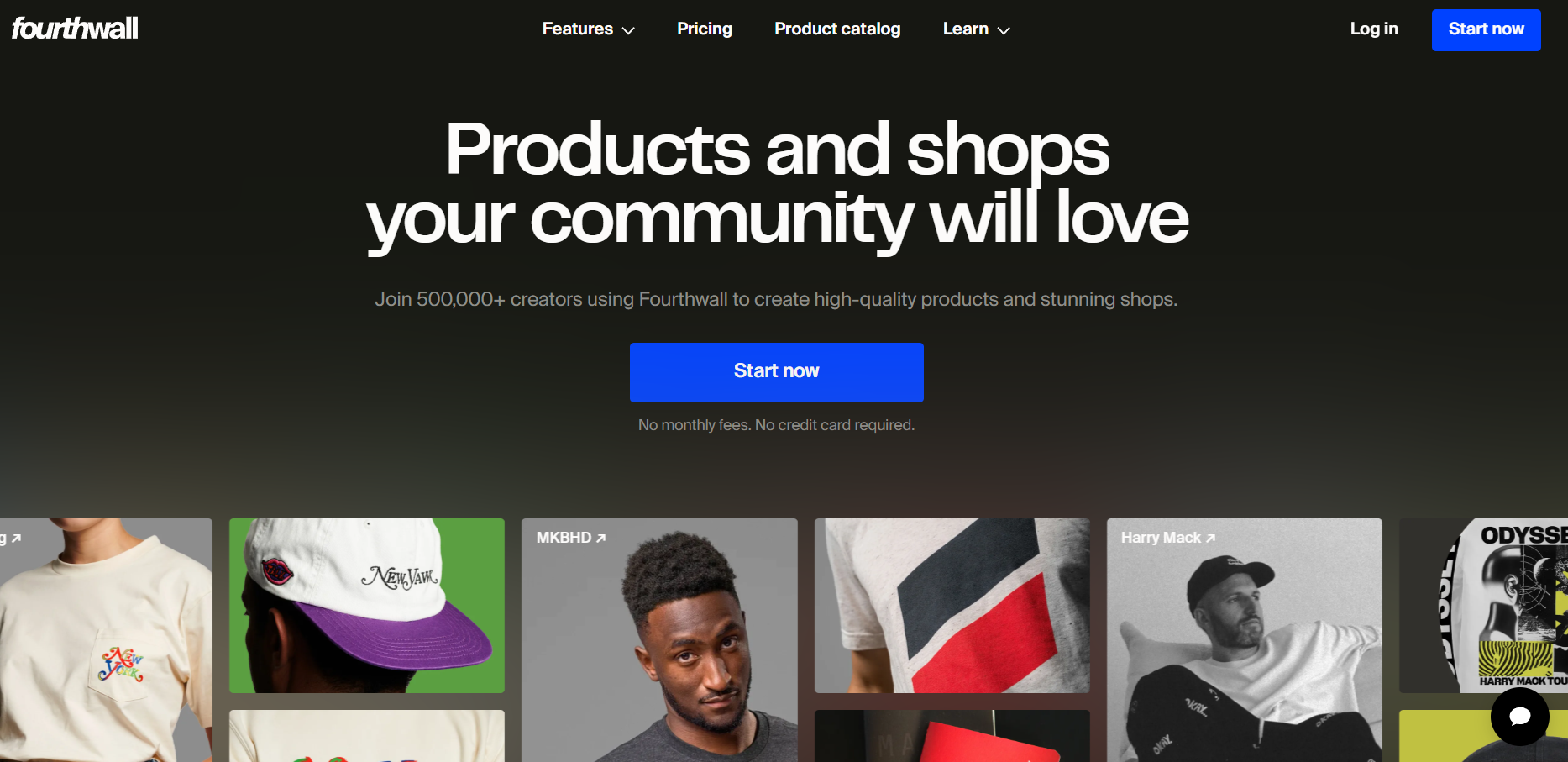
Fourthwall is a creator storefront built around merch and memberships, positioned squarely as the ko-fi alternative for creators whose audience wants branded physical products alongside the ability to tip. The pitch is a fully branded website (not a profile page) with automated print-on-demand for T-shirts, hoodies, mugs, posters, and other physical products, plus digital products, memberships, and tipping all on the same checkout. For creators who already sell merch or want to, it is the strongest merch-first alternative to Ko-fi.
Fourthwall’s free plan charges 0% on physical POD products and 5% on digital products and memberships. The Pro plan at $19/month drops the digital fee to 0%, adds a free .store domain, sample credit, and advanced analytics. Tipping is 0% on both plans. The Fourthwall review breaks down the fine print.
Fourthwall Pricing: Free plan, Pro plan $19/month or $180/year.
Fourthwall Fees: 0% on physical products, 5% on digital and memberships (free plan), 0% across the board on Pro.
Fourthwall Standout Features: Automated POD merch (no third-party integration), fully branded custom site, membership tiers with perks, TikTok Shop and YouTube Shopping integrations.
Best For: Twitch streamers, YouTubers, and podcasters whose audience wants physical merch alongside memberships and tips.
5- Gumroad
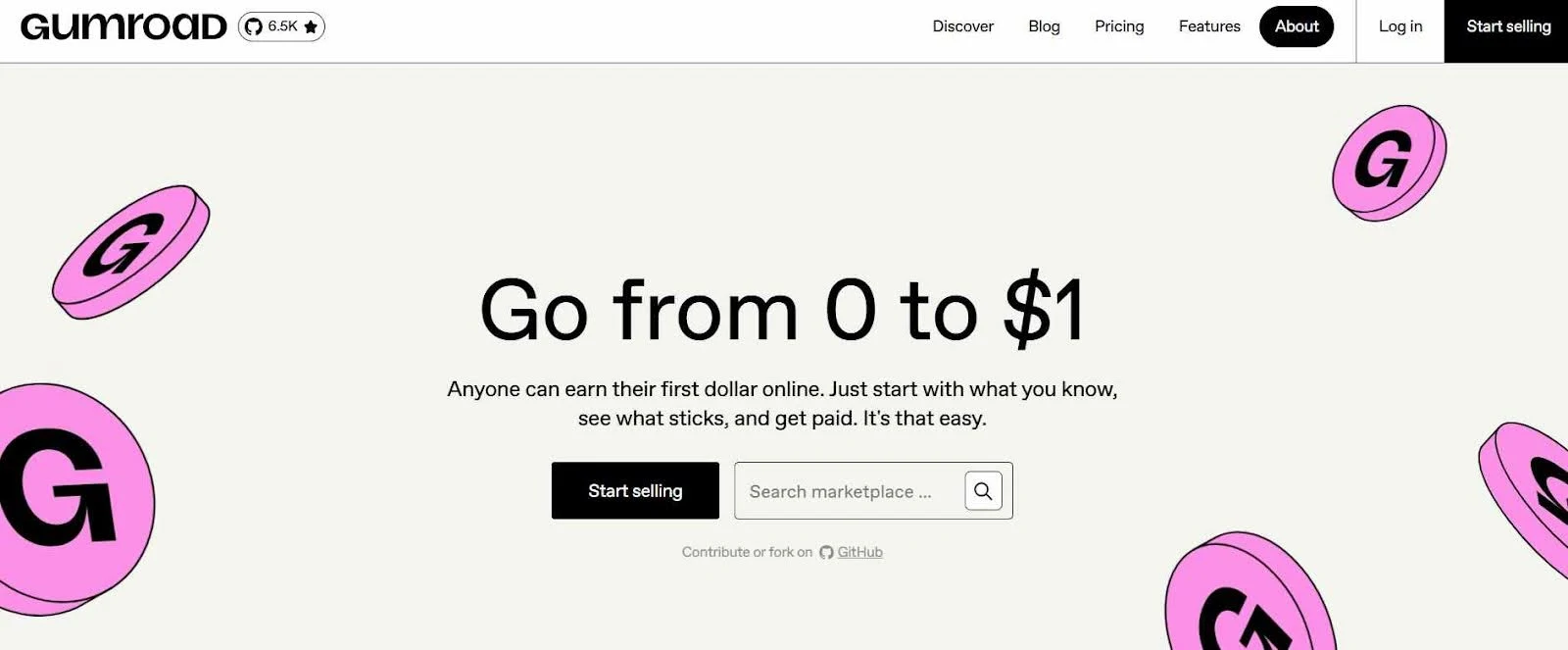
Gumroad is the standard ko-fi alternative for selling digital products, and the storefront that most writers, designers, and educators reach for when they want to sell an ebook, template pack, course, or music file without building a website. Upload the file, set a price (or “pay what you want”), and Gumroad hands you a checkout URL you can drop into your bio, newsletter, or Discord.
The 2025 change that matters is Gumroad now acts as Merchant of Record on every sale, handling global sales tax, VAT, and GST automatically. For international sellers, that alone can be worth the 10% flat fee plus $0.50 per transaction. Downsides: minimal storefront customization, no native tipping, and higher fees than Ko-fi on small transactions. If Gumroad’s fee stings, the Gumroad alternatives roundup covers cheaper picks.
Gumroad Pricing: Free to use, no monthly cost.
Gumroad Fees: Flat 10% platform fee plus $0.50 per transaction. 30% on sales that come from Gumroad Discover.
Gumroad Standout Features: Merchant of Record handles global tax collection, guest-friendly checkout, subscription products, “pay what you want” pricing, built-in email updates.
Best For: Creators whose main business is selling digital products (ebooks, templates, courses, music) and who want automatic tax handling.
6- Sellfy
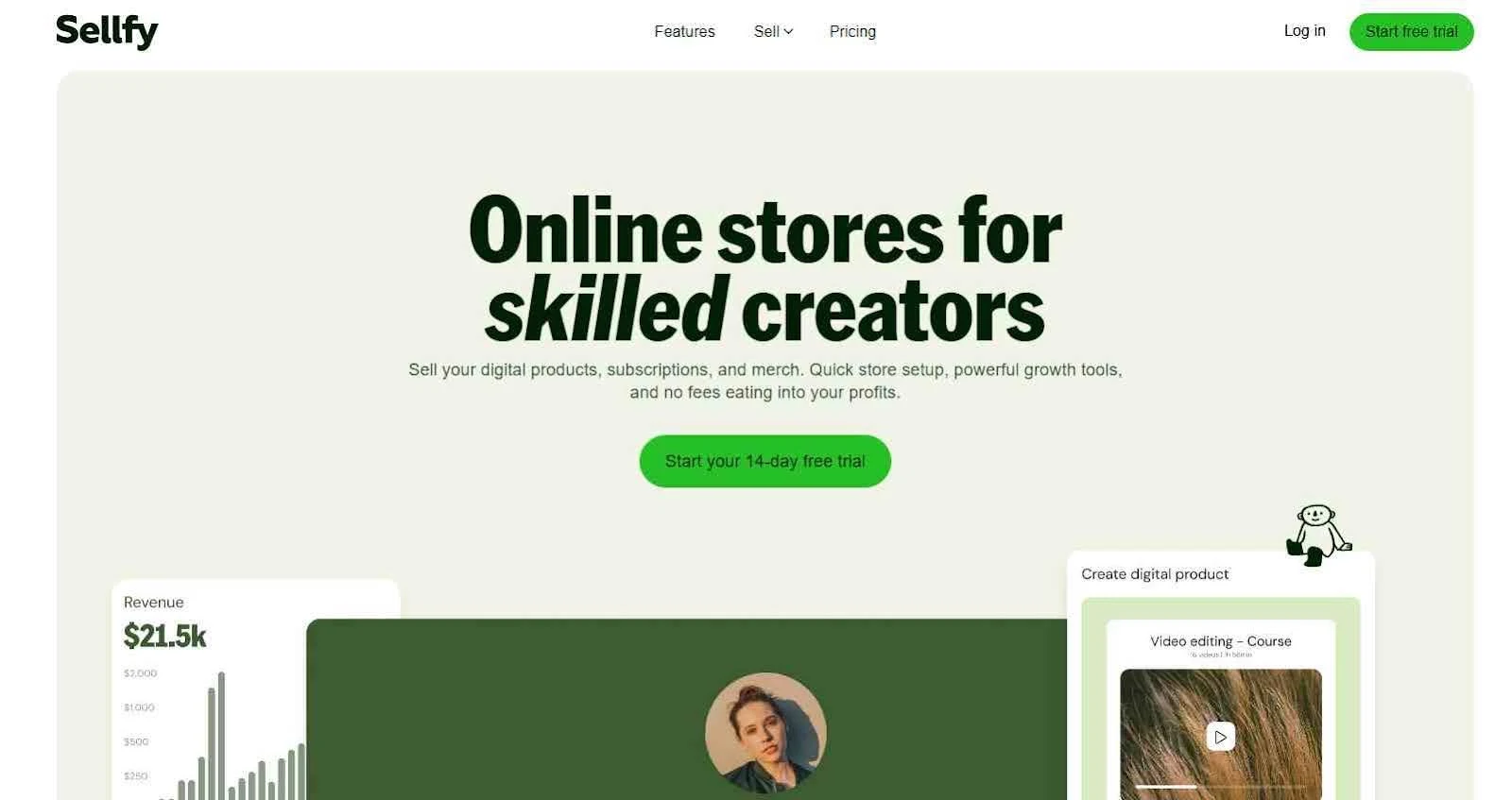
Sellfy is a full standalone storefront that looks and feels like a real online shop rather than a hosted profile, which is what puts it among the best ko-fi alternatives for creators past the beginner stage. Custom domain, embeddable product widgets, email marketing, discount codes, upsells, abandoned cart recovery, and an affiliate program are all built in. Print-on-demand is bundled so creators can launch a merch line without connecting Printful or another external service.
The trade-off is the monthly subscription. Starter runs $22/month with up to $10K annual sales, Business is $59/month up to $50K, and Premium is $119/month up to $200K. That is significantly more expensive than Ko-fi or Buy Me a Coffee upfront, but there are no per-transaction platform fees on any paid plan. The Sellfy review covers where the pricing pays off and where it does not. If Sellfy’s $22/month Starter tier feels steep or the $10K sales cap is boxing you in, the Sellfy alternatives guide covers 7 cheaper picks.
Sellfy Pricing: Starter $22/month, Business $59/month, Premium $119/month.
Sellfy Fees: 0% platform fees on paid plans (payment processor only).
Sellfy Standout Features: Print-on-demand built in, custom domain, email marketing and automation, discount codes, upsells and abandoned cart recovery, affiliate program.
Best For: Creators making enough monthly revenue (roughly $500+ per month) to absorb the subscription cost in exchange for a fully branded storefront and marketing tools.
7- Payhip
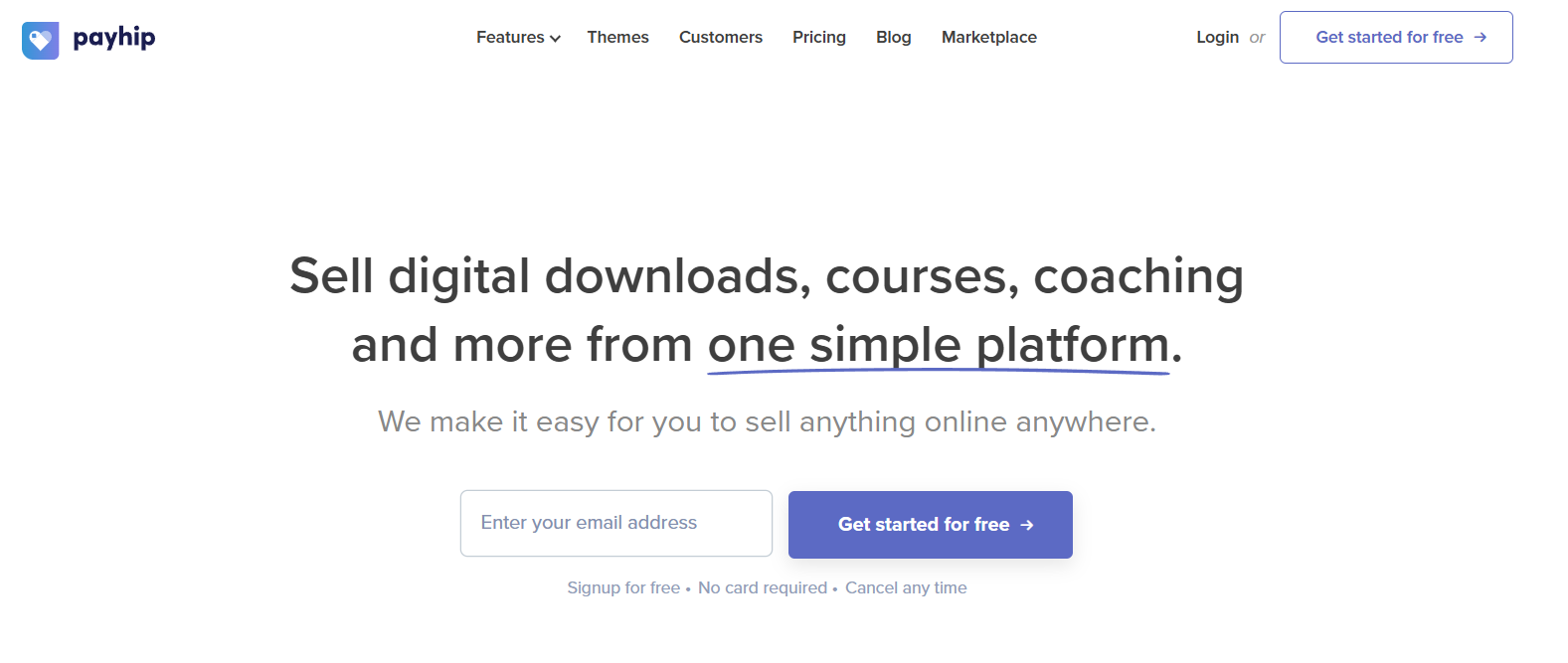
Payhip is the closest Gumroad competitor with a genuinely useful free plan, and one of the few ko fi alternatives where a free account actually gives you production-quality selling tools out of the box. Free accounts pay a 5% transaction fee, which drops to 2% on the Plus plan ($29/month) and 0% on the Pro plan ($99/month). For creators selling low-to-mid volume digital products, the free plan is a serious Ko-fi upgrade because it is built for downloads from day one rather than treating shop sales as a Ko-fi afterthought.
Payhip supports ebooks, courses, digital downloads, memberships, physical products, and coaching sessions. EU VAT is handled automatically, discount codes and affiliate programs are built in, and file delivery is instant. The Payhip review compares fees against Gumroad and Sellfy side by side.
Payhip Pricing: Free, Plus $29/month, Pro $99/month.
Payhip Fees: 5% on free plan, 2% on Plus, 0% on Pro (payment processor only).
Payhip Standout Features: Free plan for digital products, automatic EU VAT handling, courses and memberships supported, discount codes and affiliate program.
Best For: Digital-product creators who want a free plan with more selling power than Ko-fi’s shop and a clean upgrade path when volume picks up.
8- Substack
Substack is the newsletter-first platform of choice for writers, journalists, educators, and niche experts, and easily one of the strongest ko-fi alternatives for creators whose primary content format is written or spoken rather than visual. Free accounts publish unlimited newsletters and podcasts with no monthly fee. When you turn on paid subscriptions, Substack takes 10% plus Stripe processing. For a writer whose Ko-fi is basically a “buy me a coffee” tacked onto a newsletter, Substack turns that into a proper paid publication with tiers, discoverability through Substack Notes and Recommendations, and full email-list ownership.
The differentiator is content discovery. Ko-fi has almost none. Substack has a social layer where readers actually browse and subscribe based on recommendations, so writers can grow paying subscribers organically without driving all their own traffic. Downsides: minimal branding, basic analytics, and 10% is high once revenue scales.
Substack Pricing: Free to publish, no monthly fee.
Substack Fees: 0% on free newsletters, 10% on paid subscriptions plus Stripe processing.
Substack Standout Features: Full email-list ownership and export, built-in podcast hosting, Notes and Recommendations for organic discovery, subscription tiers with founding-member option.
Best For: Writers and podcasters who want to monetize a newsletter with paid subs rather than tips, and who benefit from Substack’s discovery engine.
9- The Leap
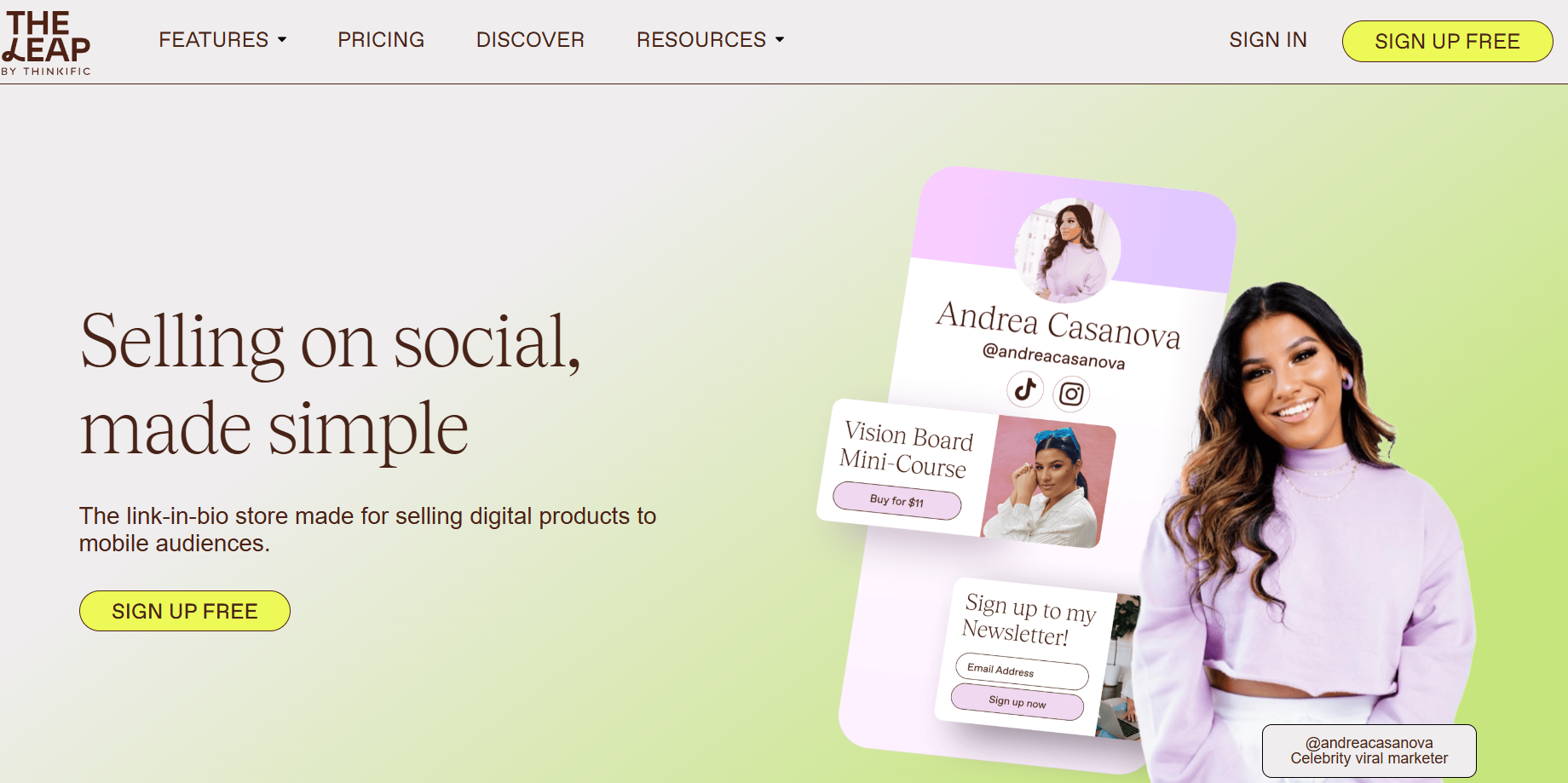
The Leap is Thinkific’s AI-powered creator storefront, built as a lightweight ko-fi alternative for creators who want to launch their first paid product without a full course platform underneath. Creators get a link-in-bio page, digital product builder, landing pages, and basic email marketing on a free plan with no monthly cost. The AI builder is the main hook: describe your idea and The Leap drafts the mini-course, guide, or download for you.
The Leap’s differentiator against Ko-fi is that it takes 0% platform fee on every sale. Revenue comes purely from subscription tiers, so creators keep the entire sale minus Stripe’s standard 2.9% + $0.30. The catch is the product cap: 3 live products on free, 25 on Pro ($19/month), 100 on Elite ($59/month). The Leap review covers where the cap bites and where the AI builder actually helps.
The Leap Pricing: Free (3 products), Pro $19/month (25 products), Elite $59/month (100 products).
The Leap Fees: 0% platform fee on every plan. Stripe processing only (2.9% + $0.30).
The Leap Standout Features: AI-guided product builder, link-in-bio storefront, digital product delivery, email marketing (500 to 25,000 contacts by tier), landing pages, Zapier integrations on Pro and above.
Best For: Creators launching their first paid digital product (guide, mini-course, template pack) who want AI to help draft it and 0% platform fees from day one.
10- Liberapay
Liberapay is the nonprofit, open-source recurring-donations platform that takes literally 0% as a platform fee, which makes it one of the only true zero-fee alternatives to ko-fi for fan support. The only cost is what Stripe or PayPal charge to process the payment. It is funded entirely by donations from users, so the platform aligns with the same “support the creator” ethos it enables.
The catch is it is recurring-donations only. No shop, no memberships with perks, no one-time tips, no merch, no digital downloads. Just a profile page where supporters can pledge a weekly, monthly, or yearly donation. For open-source maintainers, educators, activists, and anyone whose work benefits the public, Liberapay is the most ethical and lowest-cost Ko-fi alternative available. For everyone else, the missing features rule it out.
Liberapay Pricing: Free, no monthly cost.
Liberapay Fees: 0% platform fee, standard Stripe or PayPal processing only.
Liberapay Standout Features: True 0% platform fee, nonprofit and open-source, multi-currency (EUR, USD, GBP, JPY, more), weekly / monthly / yearly recurring pledges.
Best For: Open-source developers, educators, activists, and free-culture creators who want ethical funding without a platform cut.
How to Choose the Right Ko-fi Alternative
The best Ko-fi alternatives depend on which income stream you actually earn from most, how much traffic you drive yourself, and how much of your revenue you can afford to lose to fees. Four filters to run any platform through before you commit.
1- Identify Your Primary Revenue Stream
Tips are one thing. Memberships are another. Digital product sales are another. Merch is another still. Pick the one that already brings in the most revenue (or the one you plan to build first) and choose the platform built around that specific model. A tip-focused creator on Sellfy will hate the $22/month subscription. A course creator on Buy Me a Coffee will hit the shop’s limits fast.
2- Calculate Your Real Fee Load
Add up platform fee, payment processor fee, and (for international audiences) currency conversion fee on your average transaction. A $10 tip on Ko-fi’s free plan with Contributor mode off nets you around $9.30 after Stripe. Same tip on Patreon nets $8.40. Same tip on Liberapay nets $9.41. Small differences compound fast when you scale to hundreds of transactions per month.
3- Check Discovery vs. Traffic-Driven Fit
Ko-fi and Buy Me a Coffee have almost no built-in discovery, so they only work if you already have an audience elsewhere sending traffic. Substack, Patreon, and Gumroad have real discovery layers that can add subscribers or buyers organically. Match the platform to how you actually acquire supporters: if you have zero external audience, prioritize platforms with discovery baked in.
4- Weigh Ownership vs. Convenience
Ko-fi, Buy Me a Coffee, and Patreon own the customer relationship. You cannot export your subscriber list, you cannot email supporters outside the platform, and if the platform bans your account you lose everything. brandID, Substack, and Payhip give you full audience ownership: your email list is exportable, your customers are yours, and you can migrate. If long-term audience ownership matters to you, prioritize platforms that let you take your list with you.
Which Ko-fi Alternative Is Best for You?
Same 10 platforms, sorted by the specific creator situation each one fits best. Pick the row that matches your primary use case.
- For all-in-one creator monetization: brandID. Tips, memberships, digital storefront, affiliate marketplace, bookings, and email/CRM in one free account. Best pick for creators who want to grow beyond a tip jar without stitching five tools together.
- For the closest one-to-one Ko-fi swap: Buy Me a Coffee. Same UX, same tipping model, no Contributor-mode confusion, all features open on the free plan.
- For tiered memberships with a large existing audience: Patreon. Highest fees on this list, but the polished patron experience and 8M+ paying users still justify the cost if memberships are your primary income.
- For merch and physical products: Fourthwall. Automated print-on-demand plus tipping, memberships, and digital products on the same branded storefront.
- For selling digital products globally: Gumroad. Merchant of Record handles tax collection worldwide, which is worth the 10% fee for international sellers.
- For a fully branded storefront with marketing tools: Sellfy. Custom domain, email marketing, upsells, and affiliate program built in. Best for creators past $500/month in sales.
- For low-fee digital products on a free plan: Payhip. 5% on free, 0% on paid, with courses and memberships supported natively.
- For writers and podcasters with paid subscriptions: Substack. Built-in discovery, full email-list ownership, and podcast hosting included at no extra cost.
- For launching your first paid digital product: The Leap. AI-guided builder, 0% platform fees, and a free plan (3 products) for creators testing what sells before scaling up.
- For open-source projects and ethical patronage: Liberapay. True 0% platform fee, nonprofit, recurring donations only.
Conclusion
Ko-fi’s core proposition (frictionless tipping) still works. What has changed is that creators in 2026 typically need more than a tip jar, and Ko-fi’s paywalled features, misleading fee structure, and near-zero discoverability make it a poor foundation for anything beyond casual support.
For most creators, the best move is brandID. It covers everything Ko-fi does (tips, memberships, digital shop, page customization) at the same or lower fee load, adds an affiliate marketplace, booking system, email marketing, and CRM that Ko-fi does not offer at any tier, and gives you full audience ownership. If your priority is the simplest possible tip-jar swap, Buy Me a Coffee is the softest landing. If memberships are your business, Patreon. If digital products are what you sell, Gumroad, Sellfy, Payhip, or The Leap.
Whichever platform you pick, the win is the same: escape the 5% cut on features that should be free, own your subscriber list, and stop capping how much your work can earn.
FAQs
1- What is the best Ko-fi alternative?
brandID is the best Ko-fi alternative for creators who want an all-in-one platform. It combines tipping, memberships, digital storefront, affiliate marketplace, bookings, and a link-in-bio page in one free account. For pure tipping, Buy Me a Coffee is the closest one-to-one Ko-fi swap. For serious membership creators, Patreon has the biggest audience but the highest fees.
2- Are there free Ko-fi alternatives?
Yes. brandID, Buy Me a Coffee, Payhip, Fourthwall, Substack, and Liberapay all have free plans. brandID’s free plan offers a full link-in-bio storefront with tips, subscriptions, digital products, and affiliate marketplace access. Buy Me a Coffee is free with a 5% fee on all transactions. Liberapay is the only genuinely 0% fee option, but supports recurring donations only.
3- Why do creators leave Ko-fi?
The three most common reasons: (1) Contributor mode is enabled by default and quietly takes 5% of every tip until disabled, (2) key features like custom branding, scheduled posts, and 0% fees on memberships are locked behind the $12/month Gold plan, and (3) Ko-fi has almost no discoverability, so creators have to drive all their own traffic from other platforms.
4- What is a better platform than Ko-fi for selling digital products?
For creators who lead with digital products (ebooks, courses, templates, prints), brandID, Gumroad, Sellfy, and Payhip all beat Ko-fi. brandID has a full storefront with 0% fees on the Creator plan plus a link-in-bio page. Gumroad handles global tax collection as Merchant of Record. Sellfy adds print-on-demand. Payhip has a free plan with a 5% fee that drops to 0% on paid plans. If you want a deeper primer, the guide on how to sell digital products walks through the setup end to end.
5- Can I use a Ko-fi alternative for fan support and tips?
Yes. Every platform on this list supports fan tips or recurring subscriber support in some form. brandID, Buy Me a Coffee, and Patreon are the strongest alternatives to Ko-fi for fan support. brandID has multiple tipping CTA styles (video, photo, QR code, button) and 0% fees on the Creator plan. Buy Me a Coffee has the simplest tipping UX. Patreon has the biggest existing audience of paying subscribers. All three also show up under “ko fi alternatives” searches without the hyphen, so the same shortlist applies either way.
 Summarize this article with: