Affiliate marketing has quietly become one of the most powerful channels in digital commerce, driving billions in sales and paying out billions more to the creators and publishers who power it. If you want the real picture of where the industry stands, the numbers tell the story better than any opinion can.
We pulled together the most important affiliate marketing statistics for 2026, covering market size, spend, growth, earnings, commission rates, demographics, traffic sources, network market share, and the trends shaping the channel.
Whether you are a brand weighing a program or a creator deciding where to focus, these facts about affiliate marketing will help you benchmark and plan. For a full walkthrough of how it all works, start with the complete affiliate marketing guide.
Key Takeaways
Key Takeaways
- The industry keeps growing. The global affiliate marketing industry is worth an estimated $18.5 billion to $28 billion and is projected to reach $31.7 billion by 2031.
- Brands are all in. About 81% of brands run an affiliate program, and affiliates drive roughly 16% of all US ecommerce orders.
- The ROI is hard to beat. Businesses earn an average of $6.50 for every $1 spent on affiliate marketing, with some programs reporting up to $15.
- Earnings vary widely. Over 57% of affiliate marketers earn under $10,000 a year, while about 11% clear six figures. Marketers with 3+ years of experience earn roughly 9.45 times more than beginners.
- The US leads on spend. US affiliate marketing spend is projected to top $12 billion in 2026 and reach roughly $15.8 billion by 2028.
- Mobile and AI are reshaping the channel. Between 50% and 62% of affiliate traffic now comes from mobile devices, and nearly 79% of affiliate marketers have adopted AI-driven content creation.
Top Affiliate Marketing Statistics for 2026
Short on time? These headline affiliate marketing stats capture the state of the industry at a glance.
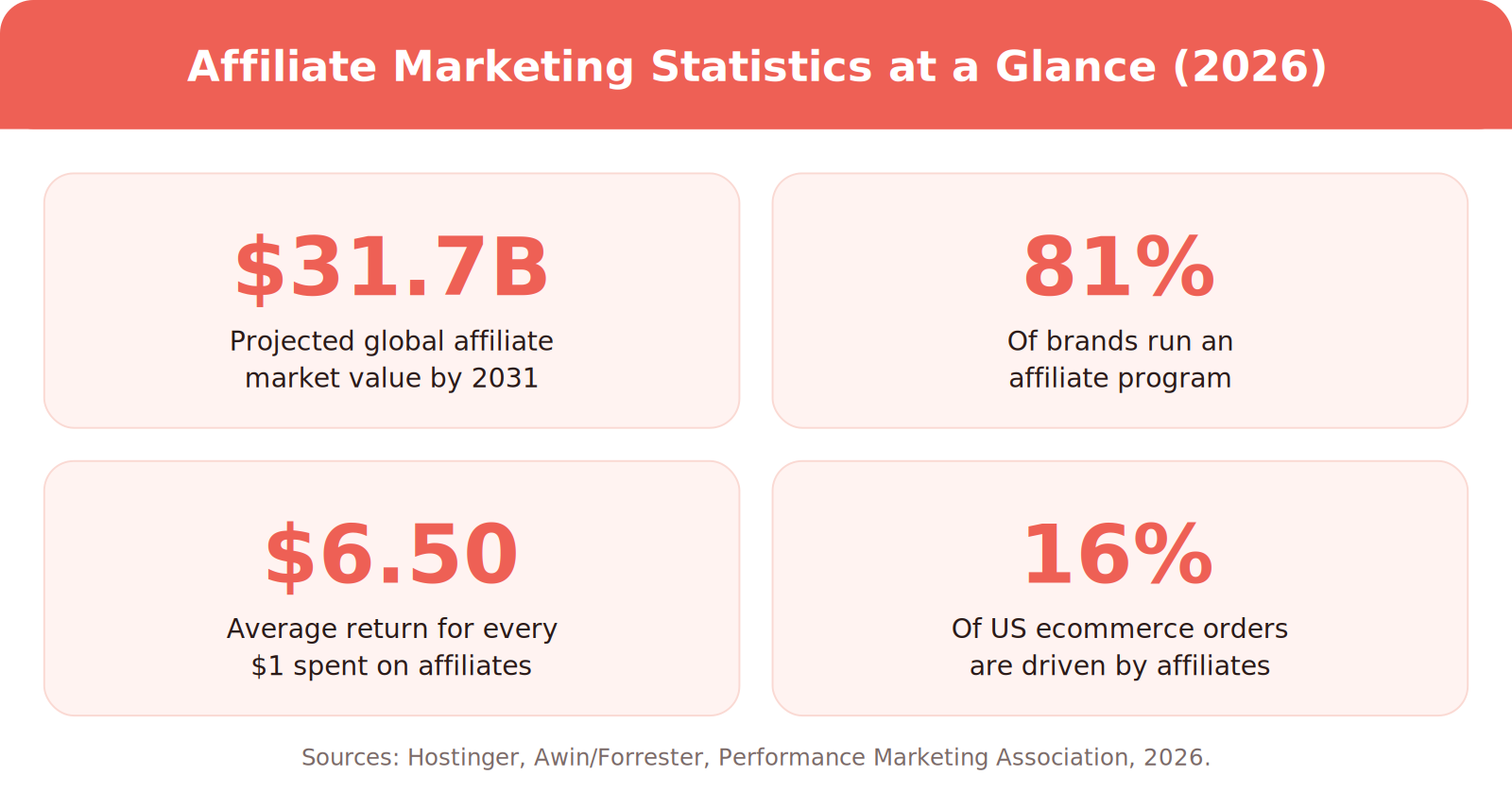
- The global affiliate marketing industry is valued at roughly $18.5 billion to $28 billion and is projected to reach $31.7 billion by 2031. (Hostinger)
- Around 81% of brands and 84% of publishers use affiliate marketing. (Demandsage)
- Affiliates drive about 16% of all ecommerce orders in the US and Canada. (Pepperjam)
- Businesses earn an average of $6.50 for every $1 spent on affiliate marketing. (FirstPromoter)
- US affiliate marketing spend is projected to exceed $12 billion in 2026. (Statista)
- Over 5 billion clicks are recorded on affiliate marketing links each year. (Awin)
- Affiliate marketing accounts for 5% to 25% of total sales at major brands. (Awin)
- The average affiliate commission rate sits between 5% and 30% across all niches. (Influencer Marketing Hub)
How Big Is the Affiliate Marketing Industry? (Market Size & Worth)
One of the most common questions is simply how much the affiliate marketing industry is worth. The honest answer is that how much affiliate marketing is worth depends entirely on the source and on what each one chooses to measure.
Some count only affiliate channel spend, while others include software platforms and influencer partnerships. Here is how the market size breaks down.
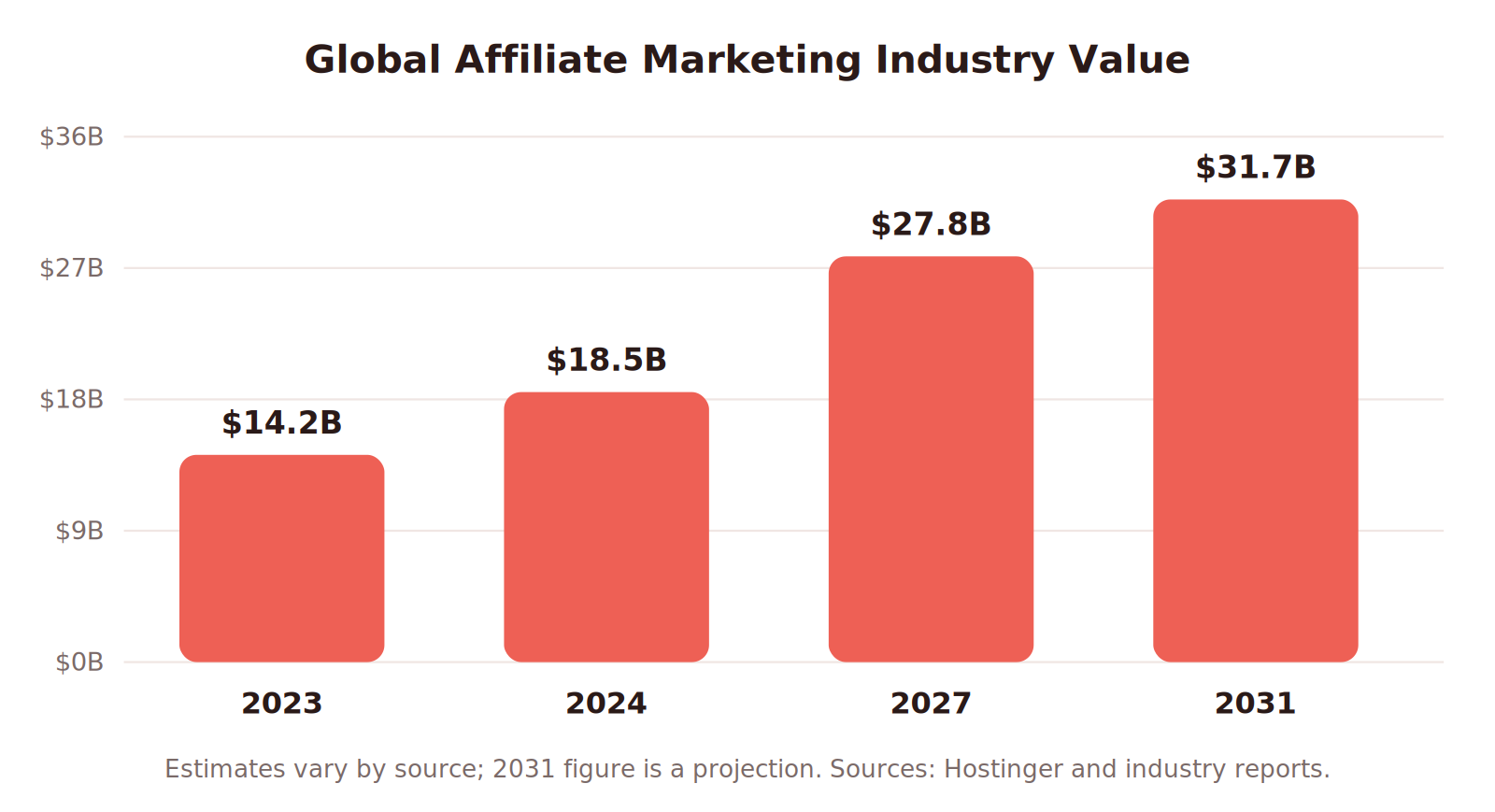
- The global affiliate marketing industry was valued at around $18.5 billion in 2024 and is projected to reach $31.7 billion by 2031. (Hostinger)
- Other estimates put the industry closer to $27.8 billion, with a path to $48 billion by 2027. (FirstPromoter)
- The affiliate marketing platform (software) market alone was worth $22.58 billion in 2025 and is expected to hit $23.84 billion in 2026. (Grand View Research)
- The Performance Marketing Association found that $9.1 billion in affiliate investment drove $71 billion in ecommerce sales.
- North America is the largest market, holding over 36% to 40% of global affiliate revenue. (Grand View Research)
- By country share, the United States leads at 38%, followed by Europe at 27%. (FirstPromoter)
Affiliate Marketing Market Size by Region
Affiliate marketing market size is not evenly spread. Where you sell changes both how much competition you face and how much a referral is worth.
Regional share matters because it tells you where competition and payouts concentrate. North America dominates on volume, while Asia-Pacific is growing fastest.
| Region | Share of global affiliate revenue | Growth outlook |
|---|---|---|
| North America | 36% to 40% | Mature, steady single-digit growth |
| United States alone | 38% of global market | Spend rising ~10% a year |
| Europe | 27% | UK affiliate spend up 17% year over year |
| Asia-Pacific | Roughly 20% | Fastest growing, 10% to 13% CAGR |
| Rest of world | Remainder | Emerging, led by Latin America |
Affiliate Marketing Growth Statistics
Every serious affiliate marketing industry report points in the same direction: up. These affiliate marketing growth statistics show how fast the channel is expanding and where.
- Affiliate marketing growth is projected at a CAGR of roughly 9% to 18.6% through the late 2020s and early 2030s. (FirstPromoter, Growth Navigate)
- The Asia-Pacific region is the fastest-growing market, with a projected CAGR of 10% to 13%. (Publift)
- By 2026, more than 90% of ecommerce businesses are expected to use affiliate marketing in their sales strategy. (wecantrack)
- An estimated 75% of new SaaS companies are predicted to launch affiliate programs by 2027. (wecantrack)
- In the UK, affiliate spend rose 17% year over year, and over half of brands plan to increase their affiliate investment. (Publift)
- The annual growth rate of affiliate marketing revenue has been recorded at roughly 20%. (Affiliate Marketing Statistics)
- Approximately 83% of marketers now use affiliate programs to increase reach and engagement. (FirstPromoter)
Affiliate Marketing Spend Statistics
Affiliate marketing spend keeps climbing, especially in the United States, which remains the single largest market.
- US affiliate marketing spend grew from $9.56 billion in 2023 to a projected $11.99 billion in 2025. (eMarketer)
- 2025 was the first year US affiliate spend crossed $10 billion. (eMarketer)
- Between 2023 and 2028, US affiliate spending is expected to grow 65%, from $9.56 billion to $15.80 billion. (eMarketer)
- Global affiliate advertiser spending is estimated at around $15.7 billion. (Shopify)
- Despite the returns, only about 7% of marketing managers make affiliate their top budget priority, so the channel remains under-invested. (Forrester)
US Affiliate Marketing Spend by Year
This is the clearest single view of the channel’s trajectory. Note that growth is decelerating in percentage terms even as absolute dollars climb, which is what a maturing channel looks like.
How Many Affiliate Marketers Are There in the World?
Pinning down exactly how many affiliate marketers there are in the world is tricky, since many work part-time or alongside other roles. Still, the available data gives a useful picture.
- Roughly 9% of online marketers focus specifically on affiliate marketing, putting the global total in the hundreds of thousands. (FirstPromoter)
- There are about 107,179 companies worldwide in the affiliate networks industry. (FirstPromoter)
- In the US alone, roughly 1.8 million people work in marketing-related roles. (US Bureau of Labor Statistics)
- Globally there are an estimated 2 to 3 million digital marketers across all specializations. (FirstPromoter)
- About 31% of web publishers say affiliate marketing is their main source of income. (eMarketer)
- Roughly 94% of publishers use more than one affiliate program at a time. (Awin)
Affiliate Marketing Demographics: Who Actually Does This?
Affiliate marketing demographics are older and more experienced than the side-hustle stereotype suggests, which matters if you are trying to recruit affiliates or figure out where you fit in the field.
- 81.82% of affiliate marketers are aged between 25 and 54. (Statista)
- The single largest age group is 35 to 44, at 31.86% of all affiliate marketers.
- 54% of affiliate marketers are male and 43% are female. (Authority Hacker)
- 57% of affiliate marketers are based in the United States, 10% in Canada, and 2% in India.
- The average affiliate marketer has about 2.8 years of experience in the channel.
- An average affiliate marketer uses 3.02 social media platforms to promote offers.
The small-account skew is the most actionable number here. Because most social affiliates have under 10,000 followers, picking one of the best Instagram niches matters far more than raw audience size.
Affiliate Marketing Industry & Adoption Statistics
These affiliate marketing industry statistics show just how mainstream the channel has become for brands and publishers alike.
- About 81% of advertisers and 84% of publishers run affiliate marketing programs. (Rakuten, Demandsage)
- Roughly 83% of marketers use affiliate marketing programs to extend reach and engagement. (FirstPromoter)
- In a Forrester-commissioned study, 92% of marketers called affiliate an effective or highly effective channel, behind only content marketing and PPC. (Awin)
- Affiliates account for about 16% of ecommerce orders in the US and Canada. (Pepperjam)
- 65% of retailers report that their affiliate program contributes up to 20% of annual revenue. (Awin)
- 76% of publishers say affiliate marketing makes monetizing their website simple. (Sovrn)
- Three-quarters of marketers say they want to diversify ad spend away from big tech and grow affiliate activity. (Awin)
- For a sense of what brands actually pay out, the roundup of the best affiliate programs breaks down real commission rates.
How Successful Are Affiliate Programs?
Three-quarters of marketers rate their affiliate program as successful or highly successful, which is a stronger satisfaction rate than most paid channels report.
Affiliate Marketing Earnings & Success Rate Statistics
Income is where affiliate marketing gets misunderstood. A small group earns spectacular sums, but the median is far more modest, which is the real story behind the affiliate marketing success rate.
- Over 57% of affiliate marketers earn under $10,000 per year, while about 11% earn more than $100,000, often by promoting high-ticket affiliate programs. (Influencer Marketing Hub)
- Only 3.78% of affiliate marketers earn above $150,000 a year.
- Affiliate marketers with over three years of experience earn 9.45 times more than beginners. (Authority Hacker)
- Software-focused affiliates earn an average of about $5,967 per month. (Authority Hacker)
- FirstPromoter platform data shows active affiliates typically earning between $3,000 and $15,000 per month.
- Among 19 niches analyzed, 11 earned over $4,000 per month on average, showing broad earning potential.
- About 42.9% of marketers say affiliate marketing generates more revenue than ad monetization.
Affiliate Marketing Earnings Distribution
This is the table most people are actually looking for when they search how much affiliate marketers make. The distribution is heavily bottom-weighted.
| Annual affiliate revenue | Share of affiliate marketers |
|---|---|
| Below $10,000 | 57.55% |
| $10,000 to $50,000 | 16.21% |
| $50,000 to $100,000 | 5.15% |
| $100,000 to $150,000 | 7.40% |
| Over $150,000 | 3.78% |
| Undisclosed | 9.37% |
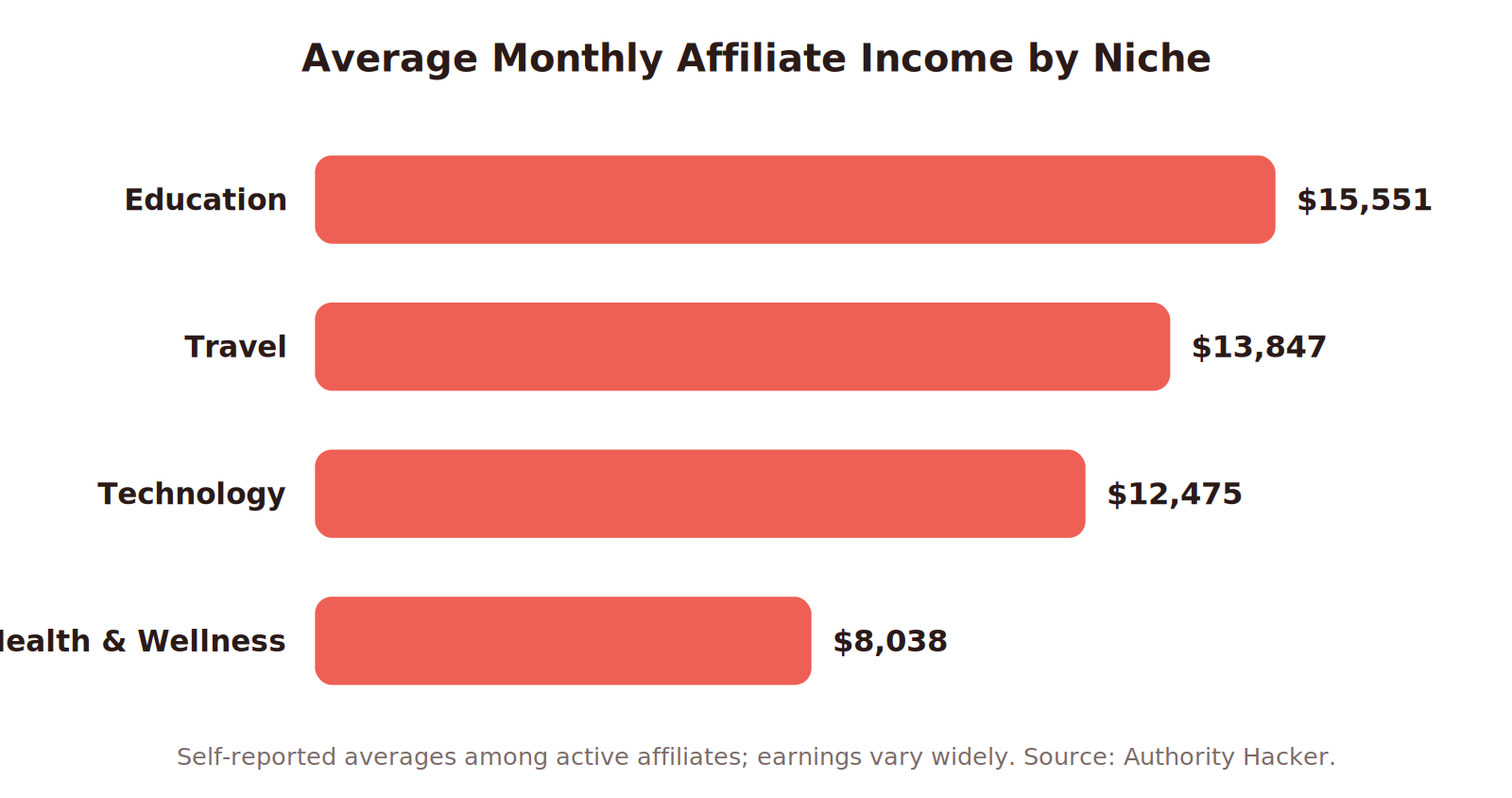
Earnings also vary sharply by niche. Education, travel, and technology consistently top the list.
Affiliate Commission Rates by Niche
Commission rate and monthly revenue are different questions, and conflating them is the most common mistake in reading affiliate data. A 2% rate on high-value repeat purchases can beat a 50% rate on a cheap one-off product.
| Niche | Typical commission rate | Average monthly revenue |
|---|---|---|
| eLearning and education | 15% to 30% | $15,551 |
| Travel | 10% to 15% | $13,847 |
| Beauty | 10% to 30% | $12,475 |
| Personal finance and investing | 20% to 40% | $9,296 |
| Gadgets and electronics | 5% to 20% | $7,418 |
| Health and wellness | 10% to 50% | $7,194 |
| SaaS and software | 10% to 70% | $5,967 |
| Home improvement | 2% to 10% | $5,095 |
| Personal development | Varies | $1,566 |
| Parenting and family | Varies | $1,145 |
| Pet care | 2% to 20% | $920 |
| Sustainable products | 2% to 10% | $555 |
Category-level rates inside a single network vary just as much. Amazon Associates pays 20% on Amazon Games down to 1% on grocery, and the Amazon affiliate program rate card is the clearest example of how much the product category decides your payout.
💡Read this table by the gap between the two columns. SaaS pays the highest headline commission (up to 70%) but sits mid-table on revenue, while travel pays only 10% to 15% and lands near the top. Order value and purchase frequency decide earnings more than rate does.
Why SaaS Pays the Highest Commission Rates
Software affiliate programs consistently offer the most generous terms in the industry, and the reason is structural rather than generous.
SaaS runs on recurring subscriptions and high customer lifetime value, so a brand can afford to pay a partner 30% or more of revenue for the life of the account rather than a one-time cut. Growth-stage SaaS companies reinvest close to 47% of revenue into marketing, and top-quartile net revenue retention exceeds 120%.
That combination of recurring revenue, large budgets, and strong retention is what keeps commissions high. It also means SaaS commissions often keep paying for months or years after the initial referral, which no one-off ecommerce sale can match.
Affiliate Marketing ROI Statistics
The reason brands keep expanding their programs comes down to return on investment. Because you only pay for results, affiliate marketing ROI is among the strongest in digital marketing.
The affiliate marketing ROI figures below are averages across program types, so treat them as a benchmark rather than a promise. Margin structure and product price both move the number significantly.
- Businesses earn an average of $6.50 for every $1 invested in affiliate marketing. (FirstPromoter)
- Some brands report an average ROI of $15 for every $1 spent, a 1,400% return. (Affiliate Marketing Statistics)
- About 73% of retailers say their affiliate programs meet or exceed revenue targets. (wecantrack)
- Roughly 50% of marketers state that affiliate marketing is an effective method for achieving business goals.
- Health and wellness programs tend to generate the highest returns, while slim-margin commodity products produce lower per-sale commissions.
What Marketers Say Affiliate Marketing Does Best
When asked what makes the channel worth running, marketers point to a spread of reasons rather than one dominant benefit, which is itself a sign of a mature channel.
| Reported strength of affiliate marketing | Share of marketers |
|---|---|
| New, innovative partners keep entering the channel | 28% |
| It provides clear incremental value | 28% |
| It is simple to manage | 27% |
| It is highly flexible compared to other channels | 26% |
| It is transparent and clearly tied to sales | 26% |
| It is a reliable source of revenue | 26% |
| Marketers can control specific outcomes | 25% |
| The diverse variety of partner types available | 24% |
| It delivers a high return on investment | 24% |
Consumer Trust & Behavior Statistics
Affiliate marketing works because people trust recommendations from real creators more than they trust ads. These statistics on affiliate marketing and consumer behavior explain why.
- About 69% of people trust recommendations from friends, family, or influencers over brands themselves. (Nielsen)
- Influencers have inspired 88% of consumers to purchase through affiliate campaigns.
- 90% of consumers make a purchase decision based on product reviews they encounter.
- 74% of internet users visit several affiliate websites before making a purchase.
- 81% of customers research a product online before buying in store. (Saleslion)
- 38% of customers trust an influencer’s affiliate links more than a non-influencer’s.
- 83% of consumers say coupons can change their shopping behavior. (Inmar Intelligence)
- Only 11% of consumers prefer celebrity influencers, and 39% say authenticity is the most important factor. (Authority Hacker)
- 49% of shoppers buy something monthly because of an influencer post, and 86% make an influencer-inspired purchase yearly. (Sprout Social)
Traffic Sources, Platforms & Networks
Where do affiliates actually promote, and which networks do they rely on? These affiliate marketing stats break it down.
- Nearly 7 in 10 affiliate marketers say SEO is their top traffic source. (Authority Hacker)
- Over 75% of affiliate marketers use Facebook to promote offers.
- Between 50% and 62% of affiliate traffic now comes from mobile devices. (Wix, FirstPromoter)
- The average affiliate marketer’s website receives about 56,673 monthly visitors. (Luisazhou)
- Over 85% of affiliate marketers who use social media to drive traffic have fewer than 10,000 followers.
- Marketers with over 6 years of experience rely 26.7% less on organic social traffic than newer marketers.
- Blogs and SEO content remain the backbone of the channel, and knowing how to promote affiliate links across them is what separates the top earners.
- Creators increasingly run affiliate offers through a single link in bio. The best link in bio tools turn that traffic into commissions.
Top Traffic Sources for Affiliate Marketers
SEO leads every year this survey runs, which is why SEO for affiliate marketing remains the highest-return skill in the channel even as social platforms grow.
Social Media Platforms Affiliates Use Most
Facebook still leads on both usage and self-reported ROI, though TikTok is the fastest-growing entrant. More than 56% of marketers increased their TikTok investment in the last cycle, and the follower threshold to become a TikTok Shop affiliate is now low enough that most mid-sized creators qualify.
YouTube sits third on usage but converts unusually well on long-form review content, and the YouTube affiliate programs worth joining now accept channels far smaller than they did two years ago.
| Platform | Share of marketers using it | Notes |
|---|---|---|
| 64% | Leads on ROI, cited by 22% of marketers | |
| 58% | Tied with TikTok and YouTube at 16% on ROI | |
| YouTube | 57% | Strong for long-form review content |
| Twitter / X | 43% | Lower conversion, high reach |
| TikTok | 42% | Fastest growing, 26% of marketers were new to it recently |
| 33% | Best for B2B and SaaS offers | |
| Snapchat | 25% | Narrow use, younger demographics |
Affiliate Network Market Share
Amazon Associates dominates the network landscape by a wide margin, which is worth knowing before you assume a smaller network gives you access to a comparable buyer pool.
Affiliate preference tells a slightly different story from raw market share. About 24.6% of affiliates prefer ClickBank and 21.8% prefer ShareASale, reflecting commission structure rather than catalog size. (Demandsage)
Channels Brands Prefer for Affiliate Partnerships
Excluding social media, blogging remains the channel brands most want to partner through, which is why content-led affiliates still command the best terms.
| Affiliate channel | Share of brands preferring it |
|---|---|
| Bloggers | 27.8% |
| Review sites | 18.7% |
| Coupon sites | 14.8% |
| Newsletters | 7.2% |
| Editorial sites | 6.5% |
| Other | 23.2% |
On the content side, roughly 56% of affiliate content consists of product reviews and 22% is how-to guides, so the format mix mirrors what brands say they want.
AI Adoption in Affiliate Marketing
AI moved from novelty to default inside the affiliate channel faster than almost any previous tool shift. These are the adoption numbers as of 2026.
- Nearly 79.3% of affiliate marketers have adopted AI-driven content creation. (Authority Hacker)
- That is roughly 4 in 5 affiliates using AI somewhere in their content workflow.
- AI is being built into tracking, attribution, and fraud prevention across major networks.
- 90% of marketers using short-form video plan to increase or maintain that investment.
- AI-assisted personalization and dynamic offer targeting are the two fastest-growing use cases inside affiliate platforms.
One practical consequence: conversion data is becoming the credential. Affiliates who can show real performance numbers are the ones landing paid deals too, which is the same track record that decides how to get sponsors on YouTube once a channel is big enough to pitch.
🤖The competitive implication is straightforward: AI-written content is no longer a differentiator because four out of five of your competitors are using it too. First-hand testing, original data, and genuine expertise are what now separate top-earning affiliates from the rest.
Affiliate Marketing Challenges Statistics
The channel is not without friction. Knowing the common obstacles helps you plan around them.
- More than three in five affiliate marketers say fraud is the industry’s biggest challenge, and 40% of media buyers cite ad fraud specifically. (wecantrack)
- About 45.3% name getting traffic as their single biggest obstacle.
- About 31.3% of affiliate marketers have considered giving up at some point, including many six-figure earners, which is the clearest signal of how uneven the affiliate marketing success rate really is. (Authority Hacker)
- Roughly 25.1% were negatively affected by search algorithm updates, and nearly half of those changed their content strategy in response.
- 26.9% report inadequate support from affiliate managers as a major challenge.
Top Niches & Industries
These affiliate marketing stats show that a handful of industries account for most revenue, though opportunity exists across the board, as the roundup of the best affiliate marketing niches shows.
- By revenue, retail leads at 44%, followed by telecom and media at 25%, and travel and leisure at 16%. (Influencer Marketing Hub)
- In the UK, retail made up 48% of affiliate spend, with telecom at 19% and travel at 13%. (AMPA)
- E-commerce, finance and fintech, and health and wellness are consistently among the strongest-performing affiliate categories. (FirstPromoter)
- Top coupon affiliate websites generate over $1 billion in combined revenue.
- Groupon alone generated $599 million in affiliate-driven revenue in its most recently reported year. (Statista)
Retail’s 44% share is dominated by apparel, which is why fashion affiliate programs remain the most crowded and most accessible entry point for new creators.
Retail alone captures nearly half of all affiliate marketing revenue worldwide, which is worth knowing before you assume a niche category offers comparable volume.
| Industry | Share of global affiliate marketing revenue | Share of UK affiliate spend |
|---|---|---|
| Retail | 44% | 48% |
| Telecom and media | 25% | 19% |
| Travel and leisure | 16% | 13% |
| Finance | Included in other | Growing double digits |
| All other sectors | 15% | 20% |
Affiliate Marketing Trends for 2026
Finally, a handful of affiliate marketing trends are reshaping how the channel operates heading through 2026 and beyond. These are the shifts most likely to change what works next year.
- AI and automation are being built into tracking, attribution, and fraud prevention across the industry, with nearly 4 in 5 affiliates already using AI for content.
- Video and podcast affiliates are in high demand as brands chase engaged, authentic audiences, and faceless affiliate marketing lets creators tap that demand without ever showing their face.
- Mobile-first tracking matters more than ever, with 50% to 62% of affiliate traffic now arriving from phones.
- Micro and nano influencers are outperforming large accounts on conversion, and over 85% of social affiliates have under 10,000 followers, which puts a premium on creator personal branding over reach.
- Creators are a driving force, monetizing audiences built on platforms like TikTok. See how to make money on TikTok and get paid on Instagram.
- Recurring-commission SaaS offers are pulling affiliates away from one-off ecommerce products because lifetime value compounds.
Methodology and Sources
Every figure on this page is attributed to its original source in-line. Where estimates differ between reputable sources, we give the range rather than picking the most flattering number.
Primary sources include eMarketer, Statista, Forrester, Grand View Research, the Performance Marketing Association, Awin, Rakuten, Pepperjam, Nielsen, Authority Hacker, Influencer Marketing Hub, and the US Bureau of Labor Statistics.
Two caveats worth holding onto. First, income figures are largely self-reported survey data, so they skew toward marketers willing to disclose. Second, market-size estimates vary by definition: some count only affiliate channel spend while others include software platforms and influencer partnerships, which is why the range spans $18.5 billion to $28 billion.
This page was last reviewed and updated in August 2026.
Turn These Statistics Into Income With brandID
The data is clear: affiliate marketing is a huge, growing, high-ROI channel, and you do not need a big audience, or even a budget, to start earning from it, since you can start affiliate marketing with no money.
The hard part is usually finding good products and a clean way to share them. That is where brandID comes in.
The brandID affiliate marketplace gives creators over 5 million products from more than 2,000 brands, commissions up to 65%, and a customizable link in bio storefront to promote them, all in one place.
You can also sell your own digital products, collect tips, and run subscriptions alongside your affiliate offers. On the free plan you keep 95% of every sale, and any paid plan takes that to 100%.
Start Earning Affiliate Commissions
Join the brandID affiliate marketplace free, pick products in your niche, and share them from one branded link.
Create Your Free brandID PageConclusion
These affiliate marketing statistics paint the picture of a channel that has matured into a core part of digital commerce: a multi-billion-dollar industry, trusted by the vast majority of brands, and still growing every year.
The returns are real, but so is the gap between the top earners and everyone else. With 57% earning under $10,000 and experienced marketers out-earning beginners by more than nine times, strategy and consistency matter more than ever.
Use these numbers to benchmark your own program or side hustle, focus on the niches and formats with the strongest returns, and give yourself the tools to turn traffic into commissions.
Affiliate Marketing Statistics FAQs
How big is the affiliate marketing industry?
North America is the largest single market at 36% to 40% of global revenue, with the United States alone accounting for around 38%.
How much is the affiliate marketing industry worth?
Forecasts point to $31.7 billion or more by 2031, and some analysts project $48 billion as early as 2027.
How many affiliate marketers are there in the world?
Around 107,179 companies make up the affiliate networks industry worldwide, and about 1.8 million people work in marketing-related roles in the US alone.
What is the success rate of affiliate marketing?
On the brand side the picture is brighter: 75% of marketers rate their affiliate program as successful or highly successful. Income depends heavily on niche, traffic source, and consistency.
How much do affiliate marketers make?
Experience is the strongest single predictor: marketers with over three years in the channel earn roughly 9.45 times more than beginners.
Is affiliate marketing still profitable in 2026?
The channel is growing, not shrinking: US spend is projected to rise from $11.99 billion in 2025 to $15.80 billion by 2028.
How much is spent on affiliate marketing?
Global advertiser spending is estimated at roughly $15.7 billion, and total industry value is far higher once software platforms are included.
What is the average affiliate commission rate?
SaaS and software pay the most at 10% to 70% because of recurring revenue, personal finance runs 20% to 40%, and physical-goods categories like home improvement and sustainable products sit at 2% to 10%.
Which affiliate network has the largest market share?
Rakuten Affiliate Network follows at 7.70%, then Awin at 6.88%, ShareASale at 6.27%, and CJ Affiliate at 6.03%. All other networks combined make up over 26%.
What percentage of affiliate traffic comes from mobile?
That makes mobile page speed and mobile checkout experience direct revenue factors rather than technical details.
Do affiliate marketers use AI?
Because most competitors are using the same tools, first-hand product testing and original data have become the practical differentiators.
What is the biggest challenge in affiliate marketing?
Notably, 31.3% have considered quitting at some point, including many six-figure earners, and 25.1% were negatively affected by search algorithm updates.
 Summarize this article with: