Paid ads stop the moment you stop paying. A page that ranks on Google keeps sending buyers to your affiliate links month after month, for free. That is why SEO affiliate marketing is the backbone of nearly every profitable affiliate business, with about 78% of affiliate marketers naming organic search as their main traffic source.
But affiliate SEO marketing in 2026 is not the keyword-stuffing game it used to be. Google’s Helpful Content updates wiped out thin review sites, AI Overviews are changing how people search, and trust now matters as much as rankings.
This guide walks through everything: what SEO affiliate marketing actually is, the four pillars, keyword research, content types, E-E-A-T, on-page and technical SEO, how affiliate links and SEO interact, link building, conversion placement, and 12 SEO tips for affiliate marketing you can apply this week.
New to the model overall? Start with the complete affiliate marketing guide, then come back here for the SEO playbook.
Key Takeaways
Key Takeaways
- SEO is the top affiliate traffic source. Roughly 78% of affiliate marketers rely on organic search as their main channel, and only 25.1% were negatively hit by recent algorithm updates.
- Intent beats volume. Commercial-intent keywords like best, review, and vs convert far better than high-volume informational terms, and buyer-intent queries convert around 5 times higher.
- E-E-A-T is non-negotiable. Since the Helpful Content updates, first-hand experience and clear authorship decide who ranks and who disappears.
- Affiliate links do not hurt SEO when tagged. Google is explicit that affiliate links are fine as long as they carry rel=”sponsored” or rel=”nofollow”. No cloaking or JavaScript tricks needed.
- Build clusters, not one-offs. Topical authority comes from covering a niche in depth and linking informational content to your money pages.
- Position matters enormously. About 39.8% of searchers click a first-page top result versus 18.7% for the second, so a single position gain can more than double your clicks.
What Is SEO Affiliate Marketing?
Quick answer: SEO affiliate marketing is the practice of optimizing your website and content to rank on search engines so you attract organic visitors who are likely to buy through your affiliate links.
The flow is simple. Someone searches Google, lands on your content, clicks your affiliate link, and you earn a commission when they purchase. Affiliate SEO marketing is the set of activities that make that first step happen reliably.
It differs from regular SEO in one important way. General SEO chases brand visibility and traffic broadly, while affiliate SEO marketing prioritizes commercial-intent keywords from people actively researching a purchase, and it measures success by conversions and commissions, not just visits.
That focus also brings unique challenges. Google is more skeptical of purely commercial content, and fewer sites naturally link to affiliate pages than to editorial ones.
Affiliate SEO vs Client SEO: Which Should You Do?
Once you know what SEO affiliate marketing is, the next question is usually whether to do it for yourself or for clients. The economics differ sharply.
If you already have SEO skills, there is a real fork in the road: optimize your own affiliate site, or sell SEO services to product owners. The economics differ sharply.
| Factor | Affiliate SEO | Client SEO |
|---|---|---|
| Who owns the asset | You do, permanently | The client does |
| Income ceiling | Uncapped, scales with traffic | Capped by hours and retainers |
| Income timing | Delayed 3 to 12 months, then compounds | Immediate monthly invoicing |
| Risk | You absorb algorithm updates | Client absorbs the risk |
| Control over offers | Total, you can switch programs freely | None, you promote what they sell |
| Best for | Patient operators building long-term assets | Anyone needing predictable cash flow now |
Most experienced operators run both. Client work funds the runway while the affiliate sites mature, then the affiliate income eventually exceeds the retainers.
Benefits and Drawbacks of SEO for Affiliate Marketing
SEO for affiliate marketing is the most durable traffic source affiliates have, but it is not free and it is not fast. Here is the honest ledger before you commit six months to it.
| ✔ Affiliate SEO Pros | ✕ Affiliate SEO Cons |
|---|---|
|
|
⚖️The realistic framing: affiliate SEO is a business you build, not a channel you switch on. If you need income inside 90 days, pair it with a faster channel rather than betting everything on search.
Why SEO Is the Best Traffic Source for Affiliates
Affiliate income depends on traffic, and search is the most durable way to get it. Unlike social or paid channels, organic rankings compound: a single well-ranked review can earn commissions for years with no ongoing ad spend.
- It compounds. Content you publish today keeps ranking and earning long after you hit publish.
- It carries trust. Users see an organic result as more credible than a paid placement, which lifts click-through and conversions.
- It is cost-effective. You trade time and effort for traffic instead of paying per click, which protects your margins.
- Position pays. Roughly 39.8% of searchers click a top first-page result versus 18.7% on the second page, so small ranking gains produce outsized traffic gains.
- Intent is higher. Buyer-intent search queries convert at around 5 times the rate of generic informational traffic.
The numbers back it up. Search remains the dominant channel for affiliates, and the broader affiliate marketing statistics show a growing, high-ROI industry rewarding publishers who rank.
How Affiliate SEO Changed in 2026
If you are working from a 2022 playbook, you are already behind. Two big shifts reshaped affiliate SEO, and understanding them is what separates sites that grow from sites that stall.
Google’s Helpful Content Updates
Google’s Helpful Content system hit affiliate sites hard, demoting thin product reviews, keyword-stuffed comparison pages, and content written for search engines instead of readers.
Sites that survived or recovered share a pattern: first-hand product experience, clear authorship, original data, and content that serves the reader’s full decision, not just a commercial keyword. Notably, only 25.1% of affiliate marketers reported being negatively affected, and the sites hit hardest were the ones lacking E-E-A-T signals.
AI Overviews and AI Search
AI Overviews, ChatGPT, and Perplexity now answer many simple questions directly, without a click. Ahrefs research found top-ranking pages can see click-through rates fall 38% to 58% when an AI Overview appears.
The takeaway is not to panic, but to shift toward complex, opinion-driven, experience-based content that AI cannot easily replicate, and to earn AI citations by giving clean, specific answers near the top of each section.
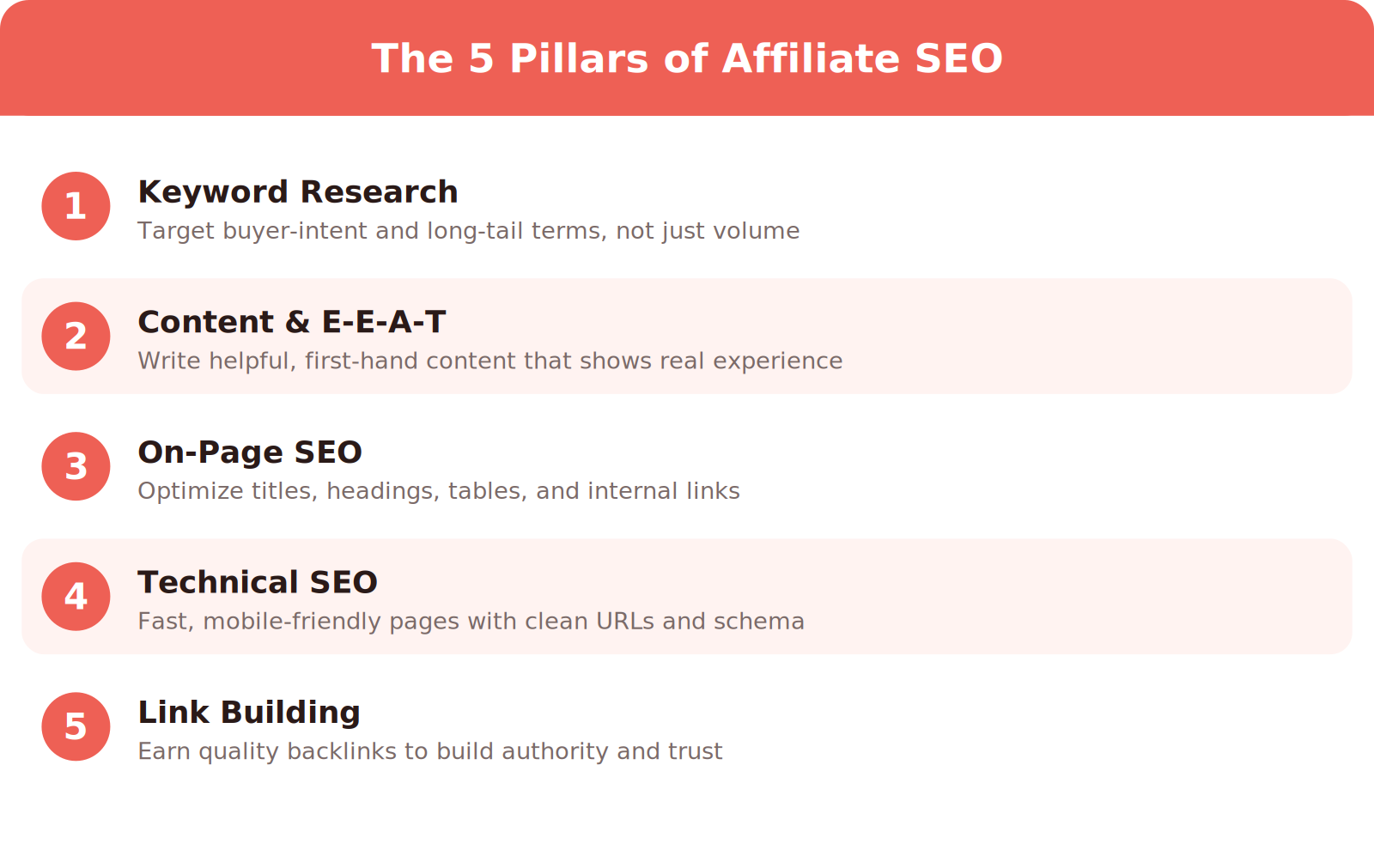
The 4 Pillars of Affiliate SEO
SEO for affiliate marketing rests on the same four pillars in every niche. Master these and the tactics that follow all fall into place.
| Pillar | What it covers | Biggest affiliate-specific risk |
|---|---|---|
| Keyword research | Finding buyer-intent terms you can realistically rank for | Chasing volume instead of intent |
| On-page SEO | Titles, headings, content depth, internal links, conversion elements | Thin reviews with no first-hand experience |
| Technical SEO | Speed, mobile, crawlability, schema, HTTPS, sitemaps | Slow pages loaded with affiliate scripts |
| Off-page SEO | Backlinks, guest posts, digital PR, brand mentions | Affiliate pages rarely earn links naturally |
Step 1: Choose a Profitable Vertical and Niche
Before any keyword research, you need a vertical worth ranking in. Even a site ranking number one everywhere will underearn in a low-commission category with no product range.
A good vertical has consistent demand, decent commission rates, room for product expansion, and low seasonal swing. Here is what affiliates actually report earning by vertical.
| Vertical | Average monthly affiliate income |
|---|---|
| Education and e-learning | $15,551 |
| Travel | $13,847 |
| Beauty and skincare | $12,476 |
| Finance | $9,297 |
| Technology | $7,428 |
| Digital marketing | $7,218 |
| Health and fitness | $7,194 |
| E-commerce | $5,967 |
| Home and garden | $5,095 |
| Sports | $4,849 |
| Food | $3,015 |
| Fashion | $2,049 |
Then narrow the vertical to a niche. Your ideal niche sits in your area of genuine knowledge, is not monopolized by two enormous competitors, and has plenty of brands running affiliate programs. Picking well from the best affiliate marketing niches decides how hard every later step will be.
Fashion is a useful cautionary example. It sits bottom of that income table at $2,049 a month despite being the most crowded niche of all, so the fashion affiliate programs worth joining are the ones with high order values rather than high rates.
🎯The check most people skip: search your target niche and look at who ranks on page one. If the top ten are all DR 80+ publishers with in-house test labs, pick a narrower sub-niche rather than fighting for a keyword you cannot win in eighteen months.
Step 2: Keyword Research for Affiliate SEO
Keyword research is the foundation of affiliate marketing SEO, but in 2026 it is about intent, not volume. Your job is to find the exact phrases buyers type when they are close to a decision, then match each one to the right page.
Match Keywords to Search Intent
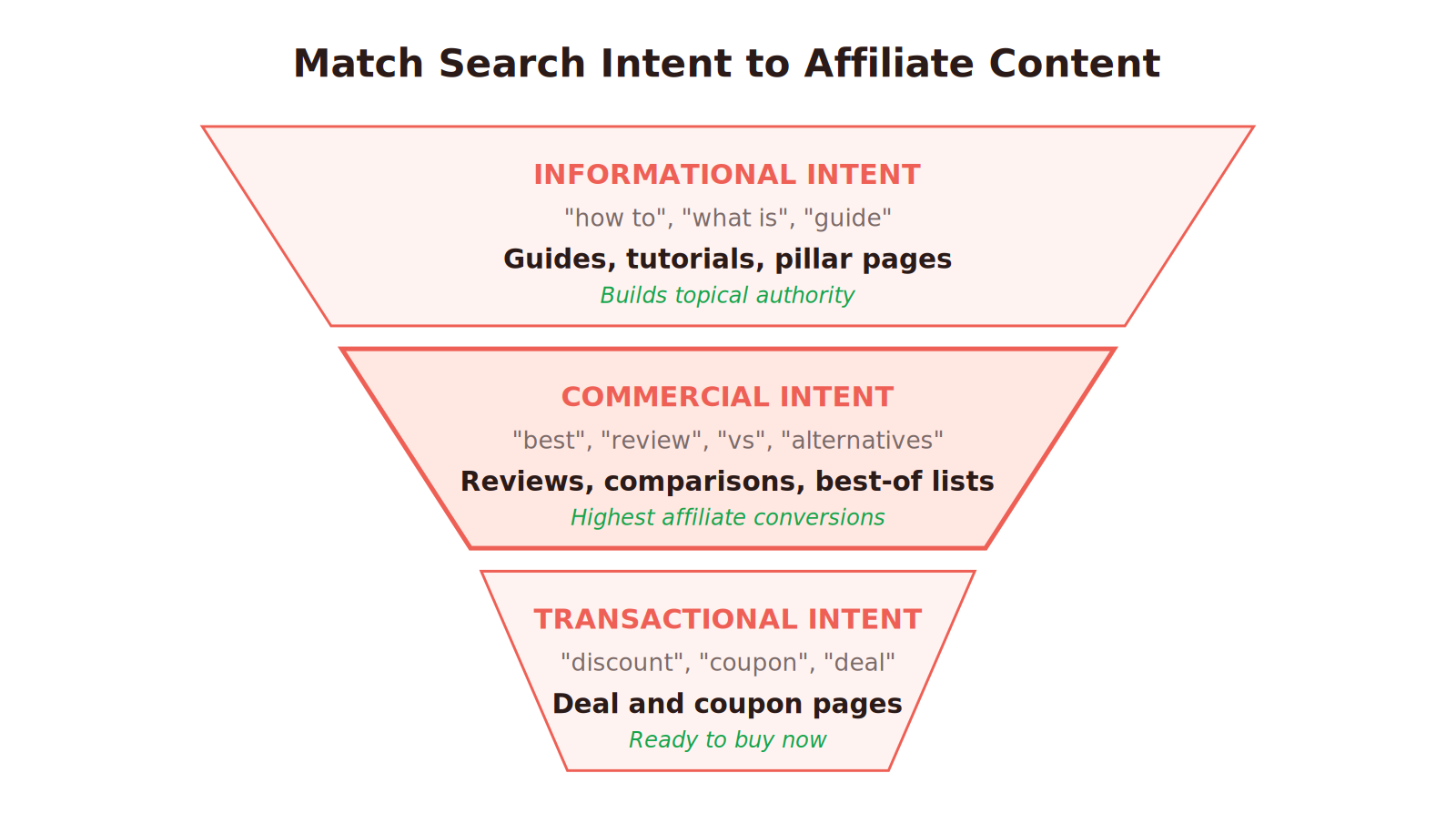
Every keyword signals where a searcher is in their journey. Informational queries build authority, commercial queries drive the bulk of your commissions, and transactional queries capture ready buyers.
| Intent type | Example queries | Content that ranks | Affiliate value |
|---|---|---|---|
| Informational | how to choose a VPN, what is protein powder | Guides, tutorials, explainers | Low direct, high for internal linking |
| Commercial | best VPN for streaming, Bluehost review 2026 | Reviews, best-of lists, comparisons | Highest, most commissions land here |
| Transactional | buy Hostinger, NordVPN coupon code | Deal pages, coupon pages, product pages | High but low volume and competitive |
| Navigational | Bluehost login | Not worth targeting as an affiliate | None |
Prioritize Commercial-Intent Modifiers
The highest-converting affiliate keywords contain buying signals. Prioritize modifiers like best, review, vs, alternatives, cheap, deals, coupon and for [use case].
“Best VPN for Netflix streaming” will out-earn “what is a VPN” every time, even with far less search volume, because the searcher has already decided to buy something.
Go Long-Tail and Low-Competition
Roughly 69.7% of search queries contain four or more words, and long-tail is where new sites win. Target specific, lower-difficulty phrases, and do not ignore so-called zero-volume keywords: hyper-specific terms your tools miss but real people search.
Check two numbers on every candidate: keyword difficulty (can you realistically rank?) and volume (is it worth ranking?). If volume is under 100 and difficulty is over 50, a new site is firing into the dark.
📌Rule of thumb: target one primary keyword per article, placed in your title, URL and intro, then weave in three to five related secondary keywords for depth. Map keywords to unique pages so you never compete against yourself.
Step 3: Choose the Right Content Types
Affiliate SEO rewards specific content formats that match commercial intent. These are the workhorses that capture buyers at the moment of decision.
| Content type | Example keyword | Why it converts |
|---|---|---|
| Product review | [product] review 2026 | First-hand experience builds trust and converts |
| Comparison | [A] vs [B] | Catches buyers deciding between two options |
| Best-of list | best [product] for [use case] | Highest commercial intent on the page |
| Alternatives | [product] alternatives | Wins users actively looking to switch |
| Buyer’s guide | how to choose a [product] | Builds authority and captures researchers |
| Pricing piece | [product] pricing, is [product] worth it | Catches buyers at the final objection |
| Use-case post | [product] for [specific scenario] | Very low competition, very high intent |
| How-to tutorial | how to [task] | Top-funnel traffic you monetize with tool mentions |
This is the core of pain-point SEO: prioritizing low-volume, high-intent keywords over the high-volume terms everyone else chases. Pricing pages, comparisons and alternatives posts sit closest to the sale, so they convert even with modest traffic.
Whatever the format, write from real experience. Pair each piece with the right affiliate programs so the products you recommend actually pay well.
Category matters as much as format. Commission on the same review can vary tenfold depending on the product, which the Amazon affiliate program rate card demonstrates clearly at 20% on some categories and 1% on others.
Step 4: Build Topical Authority With Content Clusters
Google rewards depth within a niche, not scattered one-off posts. The winning structure is the topic cluster: a broad pillar page that covers a subject at a high level, surrounded by cluster articles that cover specific subtopics in detail, all linked together.
Internal linking is the glue. Link your informational articles to your commercial money pages to pass authority and guide readers down the funnel, and link related posts to each other so search engines see you as an authority on the whole topic.
In practice that means connecting top-of-funnel and middle-of-funnel content to your bottom-of-funnel money pages. A tutorial on choosing running shoes should link to your best running shoes list, which links to your individual model reviews.
This structure is exactly how small sites outrank bigger, less-focused competitors. Depth in one corner beats breadth across ten.
Step 5: Master E-E-A-T for Affiliate Content
Since the Helpful Content updates, Google’s E-E-A-T framework is the single biggest factor separating affiliate sites that rank from those that vanish. Here is what each piece means in practice.
- Experience: Show first-hand use. Test products before reviewing them, and include original photos, screenshots, or data that could only come from real use.
- Expertise: Add author bios with relevant credentials, and build a consistent content history that proves you know the niche.
- Authoritativeness: Focus your site on one niche rather than covering everything, so you become a recognized source on that topic.
- Trustworthiness: Give honest pros and cons, disclose affiliate relationships, and avoid over-aggressive calls to action that make content feel like a sales pitch.
Expertise and authority are reputation signals at heart, and they compound outside search too. The frameworks in the guide to creator personal branding apply directly to building the author identity Google now looks for.
📷The cheapest E-E-A-T signal most affiliates skip: one original photo of you actually holding or using the product. Stock images and manufacturer renders signal the opposite of experience, and reviewers can tell instantly.
Step 6: On-Page SEO for Affiliate Pages
On-page affiliate marketing SEO makes each page relevant to its target keyword while nudging readers toward your links. Every element should serve both goals.
- Title tags: Lead with the keyword and a benefit, and include the year, for example “Best Running Shoes for Flat Feet, 2026 Reviews.” Keep the keyword inside the first 60 characters.
- Meta descriptions: Write 150 to 160 characters emphasizing how complete and useful the page is, to lift click-through from the results.
- Headings: Use a clear H2 and H3 hierarchy that mirrors how people phrase their queries, with the primary keyword in the H1.
- URL slugs: Keep them short and readable, like /best-running-shoes, not /post?id=1234.
- Depth and structure: Competitive pages often run 1,500-plus words and use comparison tables, bullet lists, and custom images to aid decisions.
- Paragraph length: Two to three lines maximum. Dense blocks kill mobile readability and increase bounce.
- Image alt text: Describe every image accurately, both for accessibility and so Google understands your visuals.
- Internal links: Link naturally to related guides and money pages using descriptive anchor text.
Step 7: Technical SEO for Affiliate Sites
Technical SEO keeps your pages crawlable, fast, and easy to use, all of which feed rankings. You do not need to be an engineer, but you do need the basics right.
- Speed and Core Web Vitals: Fast pages reduce bounce and rank better. Compress images to WebP, enable caching, and limit heavy plugins.
- Mobile-first: Over 65% of web traffic is mobile and Google indexes the mobile version first, so it must be responsive with thumb-friendly tap targets.
- HTTPS: An SSL certificate is table stakes. Google favors secure sites and browsers warn users away from insecure ones.
- Clean URLs: Short, descriptive, keyword-informed, with no query-string clutter.
- XML sitemap: Submit it in Google Search Console so every page gets discovered and indexed.
- Schema markup: Add Product, Review, and FAQ structured data to earn rich results and help AI engines parse your content.
A Quarterly Affiliate SEO Audit Checklist
Run this every three months. Most affiliate sites decline through neglect rather than penalties, and an audit catches the slow leaks.
- Crawl the whole site and fix broken links, redirect chains, and 404s.
- Check Core Web Vitals and page speed, especially on mobile.
- Audit your backlink profile for lost links and spammy new ones.
- Find and remove orphan pages and zero-traffic zombie content.
- Confirm every affiliate link still carries rel=”sponsored” or rel=”nofollow”.
- Verify every affiliate program you promote is still live and paying the same rate.
- Check disclosures appear above the fold on every monetized page.
- Compare your top pages against whoever now outranks them and close the content gaps.
- Refresh pricing, screenshots and statistics that have gone stale.
- Re-submit updated pages for indexing in Search Console.
Step 8: Affiliate Links and SEO (Do They Hurt Your Rankings?)
Quick answer: No. Affiliate links do not hurt SEO when they are tagged correctly. Google’s position is that monetizing with affiliate links is fine as long as the links are qualified with rel=”sponsored” or rel=”nofollow” and the page stands on its own merit.
Google Search Advocate John Mueller has been direct about this: there is no need to hide affiliate links from search engines, and no need for JavaScript tricks or cloaking. Link them and declare them so they can be treated properly.
How to Tag an Affiliate Link Correctly
The only difference between a normal link and a compliant affiliate link is the rel attribute. Here is the exact markup.
Regular editorial link
<a href="https://example.com/product-page">Product features</a>

Compliant affiliate link
<a href="https://example.com/product?ref=yourID" rel="nofollow sponsored">Check the current price</a>
The sponsored value tells Google the link is paid or commercial. The nofollow value tells it not to pass ranking equity. Using both together is the safest configuration and is what most affiliate plugins apply automatically.
The Three Rules for Affiliate Links and SEO
- Tag every commercial link. Missing rel attributes on a page full of affiliate links is what triggers link-spam scrutiny, not the links themselves.
- Disclose plainly and early. The FTC requires a plain-language disclosure placed with the recommendation, not buried in a footer or hidden behind a hashtag.
- Keep links contextual. Links should read naturally with descriptive anchor text like “check the current price on Amazon”, never stuffed or repeated a dozen times per page.
Done this way, affiliate links have no negative effect on rankings whatsoever. The sites that get hit are the ones where the affiliate links are the only substance on the page.
For placement tactics that convert without tripping any of this, the guide on how to promote affiliate links covers the formats that work across channels.
Step 9: Where to Place Affiliate Links for Maximum Conversions
Ranking gets the visitor. Placement gets the click. Your affiliate links need to be visible without overwhelming the reader, and there are three formats that work.
| Placement type | How it works | Best for | Trade-off |
|---|---|---|---|
| Contextual links | Inline in the body text, right after you describe the product | Reviews and long-form guides | Easy to miss on a quick scroll |
| CTA buttons and banners | Visual blocks at the top, middle or end of the page | Best-of lists and comparisons | Can feel intrusive if overused |
| Comparison tables | A table with a price or buy column per row | Multi-product roundups | Needs real differentiating data to earn the space |
| End-of-page resource section | All links grouped after the content | Long tutorials and travel guides | Loses readers who leave before the end |
The pattern that converts best in practice is layered: one CTA button near the top for readers who already decided, contextual links throughout the body for readers who need convincing, and a summary table near the end for skimmers.
Off-site placement matters too. Readers who arrive from search often return through social later, and the best link in bio tools give those visitors a second path to the same products.
🔗One count worth tracking: affiliate link click-through rate per page. A page with strong traffic and a 1% link CTR has a placement problem, not a traffic problem, and fixing placement is far faster than earning more rankings.
Step 10: Build Backlinks and Authority
Backlinks still influence rankings, but quality far outweighs quantity, and affiliate content earns fewer natural links than most. The fix is to create linkable assets other sites actually want to reference.
- Original research and statistics: Survey your audience or analyze your own data. Nothing attracts links like a number nobody else has.
- Free tools and calculators: A simple calculator in your niche can pull thousands of backlinks on its own, and it converts because users arrive mid-decision.
- Comprehensive buyer guides: Genuinely exhaustive resources get cited by journalists and bloggers who need a reference.
- Guest posting: Pitch original ideas to relevant niche sites, link contextually in the body where it adds value, and use the author bio for your money page.
- Digital PR and expert quotes: Respond to journalist requests and add original quotes to other people’s articles.
- Unlinked mention reclamation: Find sites that named you without linking and simply ask.
Avoid automated link schemes, link farms, and low-quality directories. They can undo months of legitimate work in a single update.
How to Optimize for AI Search and AI Overviews
AI engines like ChatGPT, Perplexity, and Google’s AI Overviews are a new source of traffic and citations. They tend to cite sources that give clean, direct answers, so a few habits help you show up.
- Write standalone answers that work as self-contained quotes near the top of a section.
- Include specific data points and figures rather than vague claims.
- Structure content with clear H2 and H3 headings that match how people phrase questions.
- Format definitions in 40 to 60 word paragraphs, which is the length most often extracted.
- Use numbered steps and comparison tables, both of which get pulled into answers.
- Build comprehensive topical coverage so AI systems recognize your site as authoritative.
One structural advantage worth noting: experience-driven content is exactly what AI cannot generate, which is why faceless affiliate marketing built on real testing still outperforms purely synthetic content in this environment.
12 SEO Tips for Affiliate Marketing
These SEO tips for affiliate marketing are the practical habits that separate sites which survive algorithm updates from the ones that disappear. Most take an afternoon to implement.
1- Pick a Brandable Domain, Not a Keyword-Stuffed One
Short, memorable and easy to spell beats cramming your keyword in. Names like best-cheap-shoes-online.com look spammy and cap your credibility forever. Check the domain’s history in the Wayback Machine before buying, since a past spam penalty transfers to you.
None of the first few steps require budget either, so you can start affiliate marketing with no money and add paid tools only once organic traffic justifies them.
2- Target Commercial and Transactional Keywords First
Buy, deals, discount, coupon, cheap, near me, best, review and vs are the modifiers that pay. Build your money pages around these before writing a single informational post.
3- Write for Mobile Reading
Over 65% of traffic is mobile. Two to three line paragraphs, thumb-sized buttons, compressed images and no interstitials. A clunky mobile experience raises bounce and quietly kills rankings.
4- Optimize for Voice Search
Roughly 40 million Americans use voice search for shopping. Voice queries are longer and phrased as questions, so add conversational question headings and answer them in a sentence before elaborating.
5- Format for Featured Snippets
Identify question-based keywords, answer them in a 40 to 60 word paragraph directly under the heading, and use numbered lists or comparison tables. Snippets are the cheapest ranking gain available because you can win them from position four or five.
6- Combine SEO With Paid Search
For high-difficulty terms you cannot rank for yet, paid search buys visibility now while your content matures. It also gives you real conversion data on which keywords are worth the eighteen-month SEO investment.
7- Plan Around Keyword Seasonality
Gift guides, back-to-school and Black Friday content needs to be published and indexed months before the spike, not during it. Check the twelve-month trend on every keyword before you build a calendar around it.
8- Monetize Your Existing Top Pages
Open Search Console, find your highest-traffic posts, and check whether they mention any product you could link. Retrofitting affiliate links into pages that already rank is the fastest revenue win in affiliate SEO.
9- Refresh Content Every Quarter
Update pricing, re-test products, replace stale screenshots and add what competitors now cover. Changing only the date is transparent to Google and does nothing.
10- Push Positions 6 to 10 Onto Page One
Filter Search Console for pages ranking just off page one. These need small improvements to produce large traffic gains, and the work is far cheaper than ranking a new page from scratch.
11- Build a Free Tool in Your Niche
Calculators, checkers and generators attract backlinks passively and convert unusually well because users arrive mid-decision. A single well-made tool can outperform fifty blog posts on links earned.
12- Promote Beyond Search
Social, email and community distribution generate the early engagement and links that help new pages rank in the first place. Purely waiting on Google is the slowest possible path, and making money on TikTok can fund the months before your search traffic compounds.
Best SEO Tools for Affiliate Marketing
You do not need every tool, but a few make SEO for affiliate marketing far easier. This is the minimum viable stack, and most of the tools below also run their own SEO affiliate programs worth promoting once you build an audience.
| Job | Free option | Paid option | What it tells you |
|---|---|---|---|
| Keyword research | Google Keyword Planner, Ubersuggest | Ahrefs, Semrush, Mangools KWFinder | Volume, difficulty and related terms |
| Rank tracking | Search Console position data | SERPWatcher, Ahrefs Rank Tracker | Daily movement on target keywords |
| Site audit | Screaming Frog free tier | Ahrefs Site Audit, Sitebulb | Broken links, speed, crawl errors |
| Backlink analysis | Search Console links report | Ahrefs, LinkMiner, Majestic | Who links to you and to competitors |
| Analytics | Google Analytics 4 | Fathom, Plausible | Traffic, engagement and conversions |
| Page speed | PageSpeed Insights | WebPageTest Pro | Core Web Vitals and what is slowing you |
How to Measure Affiliate SEO Success
Traffic alone does not pay the bills, so track the metrics that lead to revenue. Set this up before you publish, not after you wonder why nothing is working.
| What to track | Where | What it tells you | Action if it is bad |
|---|---|---|---|
| Keyword rankings | Search Console | Which queries bring impressions and clicks | Improve pages with high impressions and low CTR |
| Organic traffic by page | Google Analytics 4 | Which topics actually pull visitors | Build more cluster content around winners |
| Affiliate link CTR | Network dashboard or UTMs | Whether readers are clicking your links | Change link placement, not traffic strategy |
| Conversion rate by page | Affiliate network reports | Which content drives confirmed sales | Rebuild the losers in the format of the winners |
| Revenue per 1,000 visits | Network plus analytics | The real value of each traffic source | Reallocate effort to the highest-value topics |
| Core Web Vitals | PageSpeed Insights | Technical issues hurting rankings | Fix mobile speed first |
Set realistic expectations on timing. New content usually takes three to six months to gain traction, and competitive keywords can take six to twelve months.
Common SEO Affiliate Marketing Mistakes to Avoid
- Chasing volume over intent. High-volume informational keywords bring traffic that never buys.
- Publishing thin or AI-only reviews. Content with no first-hand experience is exactly what the Helpful Content system demotes.
- Targeting keywords above your authority. A new site cannot win a DR 80 keyword, no matter how good the article is.
- Keyword stuffing and aggressive CTAs. Both erode trust and neither has helped rankings in a decade.
- Skipping rel tags or FTC disclosures. This is the one mistake that can actually cost you a penalty.
- Spreading across unrelated niches. Topical authority requires focus; ten niches means authority in none.
- Ignoring mobile. Two-thirds of your traffic is on a phone and will bounce from a slow, cramped page.
- Obsessing over rankings, ignoring conversion. Page one traffic with bad link placement earns nothing.
- Buying links. Link farms and paid link packages undo months of legitimate work.
- Judging too early. Killing a page at month two, before Google has finished evaluating it, is the most common self-inflicted wound.
Turn Your Rankings Into Revenue With brandID
Ranking is only half the job. The other half is converting that traffic into commissions. Once your content is pulling in search visitors, brandID gives you a clean way to monetize it.
The brandID affiliate marketplace carries over 5 million products from more than 2,000 brands with commissions up to 65%, plus a customizable link in bio storefront to house every product you recommend.
For an SEO affiliate specifically, the useful part is having one branded destination you control. Your articles link to a storefront rather than scattering raw affiliate URLs, which keeps your link profile clean and lets you swap products without editing old posts.
On the free plan you keep 95% of every sale, and any paid plan takes that to 100%. Pair it with high-converting offers from the roundup of high-ticket affiliate programs, and even modest organic traffic can turn into meaningful income.
Monetize Your Search Traffic
Build a free brandID storefront, fill it with affiliate products in your niche, and turn rankings into commissions.
Create Your Free brandID PageConclusion
SEO affiliate marketing in 2026 is a discipline, not a shortcut. The sites that win prioritize depth over volume, trust over hype, and real experience over thin content.
Affiliate SEO marketing rewards the same things every year now. Nail intent-driven keyword research, build topical authority, satisfy E-E-A-T, keep your pages fast and compliant, tag your affiliate links properly, and adapt to AI search. Do that and you build an asset that pays for years.
Start with one niche and one cluster of content, do it better than anyone else in that corner of the web, then expand. Rankings will follow, and so will the commissions.
SEO Affiliate Marketing FAQs
What is SEO affiliate marketing?
It focuses on commercial-intent keywords and measures success by conversions and commissions, not just traffic. The same practice is often called affiliate SEO marketing.
Is affiliate marketing SEO still worth it in 2026?
What has changed is the bar: thin content no longer ranks, so success now requires real experience, topical authority and E-E-A-T. The opportunity is very much alive.
Do affiliate links hurt SEO?
Google’s own guidance is explicit that monetizing with affiliate links is fine. There is no need to cloak them or hide them with JavaScript. The sites that get penalized are the ones where affiliate links are the only substance on the page.
What are affiliate links?
The tracking parameters let the merchant or network record which affiliate sent the visitor. If that visitor then buys, signs up or completes a lead form inside the cookie window, you earn a commission.
How long does affiliate SEO take to work?
You can speed things up by targeting low-competition long-tail keywords and refreshing existing content that already ranks in positions 6 to 10.
Will AI Overviews kill affiliate SEO?
Value shifts toward complex, opinion-based, experience-driven content that AI cannot replicate. First-hand reviews and unique perspectives become more important than ever.
What keywords are best for affiliate marketing?
Long-tail phrases with four or more words usually have less competition and higher buyer intent than broad head terms, and roughly 70% of all searches are long-tail.
How many keywords should I target per article?
Support it with three to five related secondary keywords woven naturally through the content to add depth and context without cannibalizing your other pages.
Is PPC or SEO better for affiliate marketing?
SEO takes three to twelve months but compounds and keeps earning with no ongoing spend. Most successful affiliates use PPC to validate which keywords convert, then invest in ranking for the winners organically.
How do you rank an affiliate website?
Then structure it into topic clusters with strong internal linking, fix your technical basics, and earn backlinks with genuinely linkable assets like original data or free tools.
Where should I place affiliate links on a page?
Track affiliate link click-through rate per page. Strong traffic with a 1% link CTR is a placement problem, not a traffic problem.
Do I need a website for SEO affiliate marketing?
You can start earning without one through social and a link in bio storefront, but organic search compounds only when you own the asset the rankings sit on.
 Summarize this article with: