Learning how to sell information products is the single highest-leverage skill a creator can develop in 2026. No inventory, no shipping, no supply chain, and margins that reach 95% or higher on every sale. The global digital product market is now worth $2.5 trillion, and creators who sell knowledge, tools, and expertise are capturing a meaningful slice of it every month.
But the gap between the top and bottom is enormous. The median creator earns just $1,200 per year from digital products, while the top 4% clear over $100,000 annually. The difference between the two groups is rarely audience size or luck. It comes down to product type, pricing, positioning, and where you choose to sell information products online.
This guide covers every part of the process: what to sell, how to validate it, how to create information products that sell, how to price them, where to launch, and how to market them once they are live. If you are still weighing what to build first, the best digital products to sell in 2026 span ebooks, courses, templates, memberships, and 11 more formats worth considering before you commit. Every number and pricing benchmark below is drawn from actual 2026 creator earnings data, not aspirational estimates.
Key Takeaways
- The digital product market is worth $2.5 trillion in 2026, and transactions surged 70% between 2022 and 2024. Information products are the fastest-growing category inside it
- Only 4% of creators earn over $100K per year from digital products; the median active creator earns $1,200. The difference is niche selection, pricing, and platform choice, not follower count
- B2B-focused creators earn 3.4x more than B2C creators on the same follower base. Niche specificity beats audience size on almost every conversion metric
- Ebooks price between $27 and $97, courses between $97 and $997, templates between $9 and $49, and memberships between $9 and $99 per month. Underpricing is the most common early mistake
- Percentage-based platform fees are the hidden killer. On $50K in annual sales, a 10% platform fee is $5,000 gone. Platforms with 0% fees compound significantly over time
- Validation before creation prevents 80% of failed launches. The creators who succeed with information products confirm real demand before writing a single word or filming a single lesson
- Passive income streams now account for 20%+ of creator earnings. Information products, affiliate marketplaces, and subscriptions form the strongest passive stack
The Information Product Economy in 2026 (The Numbers)
Before choosing a product type or platform, understand the market you are entering. These numbers explain why info products keep growing, why the top 4% earn so much more than the median, and where the money is actually flowing.
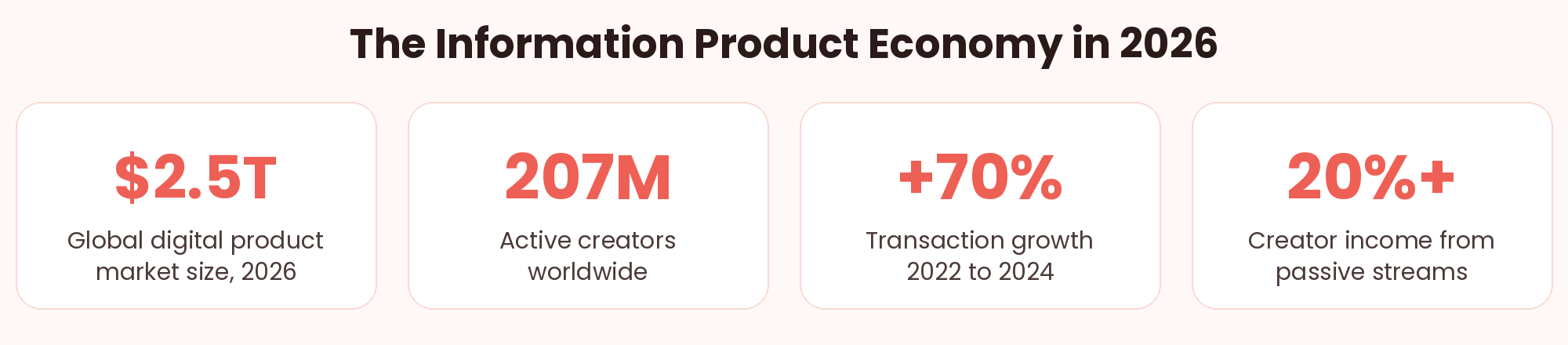
Two more figures matter. The creator economy hit $323 billion in 2026 with a 26.5% CAGR, and product plus affiliate sales now represent 21.2% of total creator income, up sharply from three years ago. Creators are actively shifting away from platform-dependent ad revenue toward self-owned income streams they can sell information products through directly.
For a broader statistical picture, Whop’s 100+ digital product statistics report tracks segment-level data across ebooks, courses, templates, and subscription products.
What Are Information Products?
Information products are digital goods that deliver knowledge, expertise, or a specific outcome the buyer wants. Unlike physical products, they are created once, sold infinitely, and delivered instantly with zero marginal cost per sale. Learning how to sell information products means learning how to package what you know into a format someone will pay for.
The category covers a wide range of formats:
- Ebooks and guides that package expertise on a specific topic
- Online courses with video lessons, worksheets, and structured modules
- Templates and toolkits that save the buyer hours of setup work
- Memberships and paid communities that deliver ongoing value
- Coaching and consulting packages that combine expertise with 1-on-1 access
- AI prompt libraries and design assets that solve a specific creative or technical problem
What makes them information products, rather than just digital products, is that the buyer is paying for knowledge or a transformation, not for the file itself. A $500 course teaching sales pipeline management is not selling video, it is selling a skill increase that saves the buyer time and money.
Why Sell Information Products (5 Structural Advantages)
Five structural advantages make information products the strongest solo business model in 2026, and they compound over time in a way that physical products, services, and even affiliate income cannot match.
1. Margins near 100%. Once the product is created, every additional sale is nearly pure profit. Selling one $97 ebook or 1,000 costs essentially the same. Compared to physical products at 20 to 60% margins and service work at 40 to 80% margins, this is a structural advantage no other model matches at scale.
2. Zero inventory and delivery. No warehousing, no shipping fees, no lost packages, no supplier relationships. A single laptop and an internet connection is the entire operational footprint. This alone eliminates 90% of the friction that kills traditional small businesses in year one.
3. Scales without more time. Selling 100 units of a physical product takes 100 shipments. Selling 100 units of a digital product takes zero additional work after the product is live. Time investment stays flat while revenue grows linearly with audience.
4. Global reach from day one. A creator in Manila can sell to buyers in New York, Berlin, and Sydney simultaneously without ever thinking about international logistics. Payment processors handle currency conversion, tax collection, and cross-border delivery automatically.
5. Compounds with your reputation. Every satisfied buyer becomes a testimonial, referral, or repeat customer. Physical products depreciate, services end when you stop working, but information products keep selling and gaining social proof for years.
The Best Information Products to Sell Online in 2026
Not every format sells equally. Some produce higher revenue per buyer, others produce recurring income, others are easiest to build from a small audience. The table below covers the best information products to sell online right now, with real pricing and time-to-build benchmarks.
| Product type | Price range | Time to build | Best for |
|---|---|---|---|
| Ebook / PDF guide | $27 to $97 | 10 to 40 hours | Writers, specialists, consultants |
| Online course | $97 to $997 | 40 to 120 hours | Teachers, coaches, experts |
| Templates / toolkits | $9 to $49 | 3 to 15 hours | Designers, marketers, ops pros |
| Membership / community | $9 to $99/mo | Ongoing | Community builders, coaches |
| Coaching packages | $200 to $5,000 | Per session | Consultants, therapists, advisors |
| AI prompt libraries | $5 to $50 | 5 to 20 hours | Marketers, developers, designers |
| Presets / design assets | $10 to $100 | 10 to 30 hours | Photographers, designers |
| Paid newsletter | $5 to $30/mo | Ongoing | Journalists, analysts, experts |
1. Ebooks and PDF Guides
Ebooks are the most accessible starting point for anyone learning how to sell information products. They convert lived experience into a downloadable file, price naturally between $27 and $97, and require no video production or fancy software, which is why creators looking to sell ebooks online almost always use them as a first product.
What separates ebooks that sell from ebooks that sit is specificity. A generic “guide to Instagram growth” is invisible in a crowded market. “A 30-day Instagram growth plan for licensed nutritionists” targets a real audience with a real budget. The narrower the promise, the higher the conversion rate.
2. Online Courses
Courses command the highest price per unit of any information product format, typically $97 to $997 for structured programs. The tradeoff is build time: 40 to 120 hours from outline to launch. For creators with strong teaching skills and an established audience, courses can produce $10K to $100K per launch when priced and marketed correctly.
The two most common formats are cohort-based (live sessions on a fixed schedule) and self-paced (pre-recorded video accessed anytime). Cohort courses charge 2 to 4x more per seat, self-paced courses scale better once running. Most successful course creators launch cohort-first to validate demand, then convert to self-paced once the curriculum is proven.
3. Templates, Toolkits, and Printables
Templates are the fastest information products to sell online because the value is immediately obvious. A $29 Notion template that saves 8 hours of setup work is a no-brainer for the right buyer. Common formats include spreadsheets, Notion workspaces, project management templates, design files, resume templates, planners, and printable worksheets.
Templates work particularly well because they turn expertise into a reusable asset. A freelance designer who has built 40 client sites can package the setup process into a template pack and sell it hundreds of times. The distribution mechanics overlap heavily with how to sell PDFs online, since both formats deliver instantly and price in the same $9 to $49 range.
4. Memberships and Paid Communities
Memberships trade one-time revenue for recurring income. At $29 per month per member, 100 members produces $2,900 monthly, or $34,800 annually. The tradeoff is ongoing content commitment: members expect fresh value every week, or they cancel.
Membership businesses work best when the topic has ongoing learning value: fitness, personal finance, professional development, hobby communities. One-time-outcome topics (like “learn Excel”) sell better as courses, because there is no ongoing reason to stay subscribed after the initial goal is met. For creators weighing where to host a membership, the strongest Patreon alternatives cover 16 platforms across every price tier and community model.
5. Coaching Packages
Coaching is the highest-ticket information product format, ranging from $200 for single sessions to $5,000+ for multi-month packages. It combines information delivery with 1-on-1 access, and the personalization commands a premium price.
The best coaching businesses layer a course or ebook as an entry-level product, and use the coaching as an upsell for buyers who want personalized guidance. This creates a product ladder that captures buyers at every budget level.
6. AI Prompt Libraries
AI prompt libraries emerged as a category in 2023 and now consistently rank among the fastest-growing information products to sell in 2026. A curated set of tested prompts for ChatGPT, Claude, Midjourney, or industry-specific tools can sell $5 to $50, and the build time is short. Creators looking at how to sell AI prompts profitably tend to reach first sales inside two weeks of listing.
The winning approach is to niche down hard. “500 ChatGPT prompts” is generic. “200 sales email prompts for B2B SaaS founders” is specific enough to sell at $47 with strong conversion.
7. Presets and Design Assets
Lightroom presets, Photoshop actions, video LUTs, and design asset packs sell consistently to creators and freelancers. Prices range from $10 to $100, and the delivery is instant. Photographers with a signature style can turn that into recurring passive income by selling the presets they already use. The same distribution mechanics apply if you want to sell AI art or AI-generated asset packs as digital downloads.
8. Paid Newsletters
Paid newsletters convert expertise into recurring income at $5 to $30 per month per subscriber. Financial newsletters, industry analysis, and niche B2B insights are the strongest categories. A 500-subscriber paid newsletter at $15 per month produces $7,500 monthly, which for many creators equals a full-time income.
How to Choose the Right Information Product to Sell
Picking the wrong format is how creators waste 40 hours producing zero sales. Match your expertise, audience, and time investment to the type that fits before committing to a build.
1. Start with what you already know. The strongest information products come from lived experience, not from research. If you have not done the thing yourself, the audience will notice and conversion will suffer.
2. Match format to expertise depth. A short PDF works for a focused single-problem solution. A course fits multi-step transformations. A community fits ongoing conversation. Choose the format that fits how much you actually have to say.
3. Consider your time horizon. If you need revenue in 30 days, ebooks or templates fit best. If you have 3 months, a course is worth building. If you want recurring income, a membership is worth the ongoing commitment.
4. Pick a B2B niche if you can. Median B2B creators earn 3.4x more than B2C creators from the same audience. A course on “sales pipeline management for SaaS teams” outperforms a course on “how to be more creative,” because businesses have real budgets and clear ROI expectations.
5. Start with one, expand deliberately. Do not try to launch four products simultaneously. Launch one, sell it, and use the profits and feedback to plan the next. This is how the top 4% of creators actually scale.
How to Create Information Products That Sell
Creating information products that sell has less to do with content quality than most creators think. What matters more is validation, structure, and packaging. A great product nobody wants sells zero copies. A good product for a real market sells thousands.
Step 1: Validate the Demand Before You Build
The biggest mistake is building the product before confirming anyone wants it. Validation costs nothing and prevents the classic scenario of 40 hours of work producing zero sales.
Talk to 10 people in the target audience. Ask what they struggle with most, what they have tried, and what they would pay to solve. Do not pitch. Just listen. Every winning information product starts with a problem someone actually has.
Check search demand. Free tools like Google Trends and Answer the Public confirm real interest. A product solving a problem nobody Googles is a product nobody buys.
Sell it before you build it. Open pre-orders at 40% off for the first 10 buyers. If nobody buys at a discount, they will not buy at full price. If they do, you have paying customers waiting, which changes the psychology of building it entirely.
Step 2: Structure for the Outcome, Not the Content
The best information products lead with the outcome the buyer wants, not with the information you have. A 200-page ebook that just informs sells worse than a 30-page ebook that walks the buyer through a specific outcome step by step.
Structure information products around a clear transformation: “before” state, “after” state, and the specific path between them. Every chapter or module should visibly move the buyer closer to that “after” state. Content that feels tangential to the promised outcome gets cut, even if it is interesting.
Step 3: Design and Package Professionally
The buyer judges the product’s quality by its cover before reading a single word. Amateur design signals amateur product, which caps how much anyone will pay regardless of actual content quality.
Canva templates work well for ebooks, cover graphics, and slide designs. Notion works well for template products. For courses, a clean video setup with good lighting and audio matters more than expensive gear. Professional packaging is 80% consistency and 20% actual design skill.
Step 4: Write Sales Copy That Converts
Even the best information product sells zero copies without sales copy that communicates the value. Product descriptions should focus on the outcome, not the feature list, and include social proof, specific results, and a clear call to action. Learning how to write product descriptions that sell is often the difference between a 1% and a 4% conversion rate on the exact same product.
Step 5: Add Bonuses and Upsell Paths
A $47 ebook with a $27 template bonus feels like a better deal than a $47 ebook alone, even though the marginal creation cost is minimal. Bundling smaller assets alongside the main product raises perceived value and average revenue per buyer.
The best product ladders have three price points: a low-ticket entry product ($27 to $47), a main product ($97 to $497), and a premium option ($997+). Most buyers pick the middle, but the premium anchor makes the middle look reasonable, and the entry product captures buyers who need to build trust first.
How to Price Information Products to Sell
Pricing is the single highest-leverage decision you will make. Under-pricing signals low value and caps your revenue. Over-pricing scares off buyers who cannot yet see the value. The middle is where most winning information products live.
Price on outcome, not on effort. A 10-page checklist that saves the buyer 40 hours of work is worth more than a 200-page ebook that just informs them. Buyers pay for transformation and time savings, not for word count.
3 Pricing Anchors for Information Products to Sell
1. Comparable products. Look at what similar creators charge and price within 20% of the median. Deviating far in either direction requires strong justification the buyer can immediately see.
2. Time and money saved. If your product saves a professional 10 hours of work at $75 per hour, that is $750 in value. Pricing at $97 delivers a 7.7x return, which most buyers accept easily.
3. Tiered pricing. Offer three price points: a stripped-down version, the main product, and a premium bundle. Most buyers pick the middle, but the premium anchor makes the middle look reasonable.
Raise Prices Over Time
Successful information product creators raise prices by 15 to 30% every 6 to 12 months as social proof accumulates. Buyers who purchased at $47 last year are happy to see the same product at $67 later, because they got a deal. Every price raise also filters out buyers who were not committed enough to succeed with the product.
The Best Place to Sell Information Products Online
Platform choice determines how much of your revenue you keep, how easy the buying experience is, and how much of your audience actually converts. The best place to sell information products online for you depends on product type, where your traffic comes from, and how much you are willing to pay in monthly fees versus per-sale fees.
| Platform | Best for | Starting price | Fees |
|---|---|---|---|
| brandID | All-in-one from bio link | Free, then $9/mo | 0% on paid plans |
| Gumroad | Quickest first launch | Free | 10% per sale |
| Payhip | Free start, real features | Free, then $29/mo | 5% free, 2% paid |
| Podia | Course-first businesses | $39/mo | 5% (Mover), 0% (higher) |
| Kajabi | Established course businesses | $149/mo | 0% |
| ThriveCart | Advanced checkout tooling | $495 one-time | 0% |
The Hidden Fee Math When You Sell Information Products Online
On $10,000 in annual sales, Gumroad’s 10% fee is $1,000 gone before you count the subscription cost. On $50,000, it is $5,000. Percentage-based fees compound painfully as revenue grows, which is why creators who scale eventually migrate to 0% fee platforms even at higher monthly costs.
Course-first businesses often need different tooling entirely, and the strongest Kajabi alternatives like Podia, Teachable, and Thinkific each target a different budget tier. Dedicated checkout tooling is a separate category, and the top best SamCart alternatives handle upsells, order bumps, and one-click checkout at price points from free to $495 one-time.
brandID is built for exactly this use case: creators who want to sell information products directly from a single bio link that lives at the top of Instagram or TikTok. Ebooks, courses, subscriptions, tips, bookings, and digital downloads all integrate in one plan, with 0% platform fees on paid tiers when you use your own Stripe or PayPal account.
Where brandID pulls ahead of dedicated platforms is scope. Instead of paying $79 to $149 per month for a checkout tool plus another $30 to $99 for email marketing plus a bio link tool on top, brandID collapses those into a $9 per month plan with a real free tier for creators who want to start selling with zero upfront cost. Add affiliate products from the 5 million-product marketplace alongside your info products for immediate passive income while your main product is being built.
How to Sell Information Products Online: The Marketing Playbook
Creating the product is 20% of the work. The remaining 80% is marketing. Even the best information products sell zero copies if nobody knows they exist, which is why most first-time creators fail on distribution rather than product quality.
1. Build an Email List Before You Launch
Every sale should feed an email list. Social platforms change algorithms, throttle organic reach, and can suspend accounts overnight. An email list is the one audience you actually own, and it converts 5 to 10x higher than social traffic on information product sales.
Offer a free mini-version of your product as a lead magnet: a checklist, a template, a short PDF. In exchange for an email, you get a subscriber who has already signaled interest in the topic.
2. Create Content That Solves Half the Problem
Publish free blog posts, videos, or social content that solves part of the problem your paid product solves fully. Buyers who see you deliver value publicly are far more likely to trust that the paid product will deliver more.
The pitch writes itself: “If this free tip helped, my complete guide walks you through the entire process.” This is how creators consistently convert free followers into paying buyers without pushy sales tactics.
3. Optimize Your Social Bio Link as a Storefront
The bio link on Instagram, TikTok, and YouTube is the highest-conversion real estate you own. Instead of a Linktree with 6 links pointing to random places, treat it as a storefront: your main information product front and center, with secondary products, email signup, and free content underneath.
This is what distinguishes creators earning $50 a month from creators earning $5,000 a month with the same follower count. The audience is often identical; the storefront is not.
4. Layer in Affiliate and Passive Income Streams
While you build your information product audience, layer in affiliate income from products your audience already buys. This produces revenue on day one, funds the info product build, and often opens the door to formal brand partnerships later. Getting started with affiliate marketing takes about an hour once you have chosen the products your audience actually buys, and it stacks cleanly on top of any info product you sell.
5. Run a Launch Sequence, Not Just a Post
A one-time “it’s live” announcement produces a fraction of the sales that a proper launch sequence produces. Successful launches follow a pattern: 7 days of teaser content, a 3-day early-bird price for existing email subscribers, then a public 7-day launch window with daily emails and social posts.
Most first-time creators skip this and wonder why their launch flopped. The launch is where 40 to 70% of the total revenue for the first year is typically generated.
6. Bundle and Upsell for Higher Average Order Value
The single highest-leverage revenue move after launch is raising average order value. A $47 ebook becomes a $67 order with a $20 template pack upsell at checkout. A $497 course becomes a $997 order with a coaching upsell. Most information product platforms support upsells natively; using them consistently doubles revenue per buyer over time.
brandID’s built-in affiliate marketplace gives instant access to 5 million+ products from 2,000+ brands, with commissions up to 65%. You can add affiliate products alongside your information products on the same bio link storefront, producing revenue while the primary product is still being built. Creators combining info product sales with brand deal income typically follow a six-path playbook, and how micro influencers get brand deals in 2026 breaks down each of those paths with real rate tables.
How to Scale Your Information Product Business From First Sale to Full-Time Income
The path from first sale to full-time information product income has a specific shape. Most creators who cross $100,000 per year follow a version of it, and it looks nothing like the “make one product and hope” model that keeps most sellers stuck at the median.
Stage 1 (Months 1 to 3): Validation and first product. Launch one small information product ($27 to $97) and prove people will pay. Do not build a second product until you have sold at least 20 units of the first. Most creators skip validation, build too much too fast, and end up with three products nobody wants.
Stage 2 (Months 3 to 9): Build the audience while raising the price. Publish content consistently, grow the email list, and raise your product price by 20 to 30% as social proof accumulates. This is the phase where most creators hit their first $1,000 month.
Stage 3 (Months 9 to 18): Launch a second, higher-ticket product. Add a course or coaching offer priced at 3 to 5x your entry product. Buyers of your entry product become the initial buyers of the higher-ticket product, because they already trust you.
Stage 4 (Months 18+): Layer recurring revenue. Add a membership, paid newsletter, or subscription tier for ongoing income. This is where creators cross from “makes some money selling information products” into “runs a real information product business.”
Common Mistakes When Learning How to Sell Information Products
- Building before validating. Making the product first, then hoping to find buyers, is how creators waste 40 hours producing zero sales. Validate first, build second.
- Underpricing. A $9 ebook signals low value and caps revenue. Even for a first product, $27 to $47 is where the market expects a real solution to sit.
- Choosing a saturated generic niche. “How to grow on Instagram” is crowded. “How to grow on Instagram as a licensed nutritionist” has a real audience with real budget.
- Ignoring the email list. Relying purely on social traffic means your business dies the day the algorithm changes. Email lists compound month over month regardless of platform decisions.
- Picking a platform with high fees. A 10% platform fee on $50K in sales is $5,000 gone forever. Compare fee structures before committing.
- No upsell path. Selling one $27 ebook per buyer is the beginner floor. Bundle related products, offer templates or membership as upsells, and average revenue per buyer doubles.
- Skipping proof. Adding testimonials, screenshots of results, and social proof to the sales page increases conversion rates by 30 to 60% in most tested cases.
- Never updating. A 2022 ebook sold in 2026 loses buyers to fresher competitors. Refresh at least once per year with updated stats, examples, and screenshots.
- Launching without a sequence. A single “it’s live” post produces a fraction of a proper launch sequence. Plan the launch as a 10 to 14 day campaign, not a single post.
- Not tracking data. Creators who scale track conversion rates, average order value, and customer acquisition cost. Creators who stall guess.
Quick-Start Checklist: How to Sell Information Products in 30 Days
If you have not launched an information product yet, work through this list in order. Most creators can complete every step in 30 to 60 days.
- Pick a specific niche where you have real expertise or lived experience
- Talk to 10 people in that niche about their biggest problem
- Confirm search demand using Google Trends or Answer the Public
- Choose your product format from the 8 options above
- Set your price using the outcome-based formula
- Pick a platform with fee structure that works at scale
- Open pre-orders at a discount before building
- Build the product to match what your pre-order buyers asked for
- Set up an email lead magnet on your bio link
- Publish free content that solves half the problem
- Layer affiliate products alongside your info product for passive income
- Run a proper launch sequence (7 days teaser, 3 days early-bird, 7 days public)
- Add an upsell or bundle to raise average order value
- Review and update your product every 6 to 12 months
Conclusion
Information products remain the single most profitable business model available to creators in 2026. Margins are near-perfect, delivery is instant, and the total addressable market is measured in trillions.
What separates the top 4% of earners from the median is not audience size or luck. It is picking a specific niche where buyers have real budget, pricing on outcome rather than effort, choosing the best place to sell information products online for the specific product type, and combining info product income with affiliate and subscription streams for compounding revenue.
Information products are one slice of the broader landscape covered in how to sell digital products more generally, which spans software licenses, presets, printables, and other formats beyond the information product category. Platform choice compounds over time, and the strongest best SamCart alternatives cover the eight most popular checkout options at every price tier.
Layering brand deal income alongside your information products is what most six-figure creators do, and how micro influencers get brand deals in 2026 outlines the six paths that work at every follower tier.
brandID lets you launch information products from a single bio link in about 15 minutes, sell digital downloads, subscriptions, and coaching from the same page, layer affiliate products for passive income, and keep 0% platform fees on paid plans. It is the fastest path from zero to your first information product sale that exists today, and it is free to start.
Frequently Asked Questions
What Is an Information Product?
An information product is a digital good that delivers knowledge, expertise, or a specific outcome to the buyer. Common formats include ebooks, online courses, templates, memberships, coaching packages, AI prompt libraries, and paid newsletters. What sets them apart from other digital products is that buyers pay for knowledge and transformation, not for the file itself.
How Do You Sell Information Products Online?
To sell information products online in 2026, follow this sequence: pick a specific niche where you have expertise, validate demand by talking to 10 potential buyers and running a pre-order, create the product around a clear outcome, price it on value not on effort, choose a platform with fee structure that works at scale (brandID at $9/month with 0% fees is a common pick), and market it with an email list, content marketing, and a proper launch sequence.
How Much Money Can You Make Selling Information Products?
The median active creator earns about $1,200 per year from digital products, but the top 4% clear over $100,000 annually. What separates the two is niche selection, pricing, and platform choice, not audience size. B2B creators earn 3.4x more than B2C creators on the same follower base.
What Are the Best Information Products to Sell Online?
The best information products to sell online in 2026 are ebooks ($27 to $97), online courses ($97 to $997), templates and toolkits ($9 to $49), memberships ($9 to $99/mo), coaching packages ($200 to $5,000), AI prompt libraries ($5 to $50), presets and design assets ($10 to $100), and paid newsletters ($5 to $30/mo). Ebooks and templates offer the best time-to-revenue ratio for first-time creators.
How Do You Create Information Products That Sell?
Creating information products that sell is less about content quality and more about validation, structure, and packaging. Validate demand before building, structure the product around a clear outcome (not around information you have), design and package professionally so the cover matches the quality of the content, write outcome-focused sales copy, and add bonuses or upsell paths to raise perceived value.
Where Is the Best Place to Sell Information Products Online?
The best place to sell information products online depends on your traffic source and product type. For creators driving traffic from Instagram or TikTok bios, brandID at $9 per month with 0% platform fees is a strong all-in-one pick. ThriveCart offers 0% fees with a one-time payment for dedicated cart tooling. Podia and Kajabi work well for course-heavy businesses. Payhip and Gumroad work for validation with no upfront cost but charge percentage fees per sale.
What Is the Easiest Information Product to Sell?
Ebooks and templates hit the best time-to-revenue ratio for first-time creators. Both take under 40 hours to build, are easy to price between $9 and $97, and require no video production. Templates that save the buyer time convert particularly well because the value is immediately obvious to the buyer.
How Do You Price an Information Product?
Price on outcome, not on effort. Calculate how much time or money your product saves the buyer, then price at 10 to 20% of that saved value. A product that saves 10 hours at $75 per hour delivers $750 in value, and $97 is easy to sell. Ebooks typically price $27 to $97, courses $97 to $997, and coaching $200 to $5,000.
Do I Need a Big Audience to Sell Information Products?
No. A focused audience of 500 to 1,000 targeted subscribers can produce more revenue than a general audience of 100,000. What matters is audience fit with the product. A creator with 800 engaged small-business owners can outsell one with 50,000 casual followers on the same B2B software course.
Should I Validate My Information Product Before Building It?
Yes, always. Talk to 10 potential buyers about their problems, check whether people are searching for the solution using Google Trends, and offer pre-orders at a discount before building. If nobody buys at 40% off the planned price, the market signal is clear and you save 40 hours of wasted work.
How Do You Market an Information Product With No Audience?
Build the audience while building the product. Publish free content solving part of the same problem, offer a free lead magnet in exchange for email addresses, layer in affiliate products for immediate income, and use a bio link storefront to collect emails, sell products, and share content from one URL. Most creators land their first information product sale within 30 to 60 days of consistent execution.
Are Information Products Still Profitable in 2026?
More profitable than ever. Digital product transactions grew 70% between 2022 and 2024, the market is now worth $2.5 trillion globally, and creators combining information products with affiliate and subscription income are seeing revenue diversification at scale. AI has made building information products faster, not less profitable.
 Summarize this article with: