Most designers hit the same ceiling. You get better at the craft, your work looks sharper every year, and your income barely moves. That is not a skill problem. It is a business model problem.
The designers who break through do one of three things: they charge properly for client work, they build products that sell while they sleep, or they build an audience that pays them. Most do all three at once.
This guide covers how to make money as a graphic designer in full. You will get 18 ways to earn, real rate data, a designer who went from $40,000 a year to $137,000, and separate playbooks depending on whether you are starting out or trying to break past a plateau. Whether you want a graphic design side hustle for evenings and weekends, are working out how to make extra money as a graphic designer alongside a job, or want a full-time freelance business, the routes are the same, only the scale changes. If web design sits on your service list, how to get web design clients breaks down the fastest channels for landing paid projects.
Key Takeaways
- Design pays a median of about $29 an hour: US Bureau of Labor Statistics data puts graphic designers near $29.47 an hour, with freelance rates on marketplaces often between $15 and $35
- Three income models, not one: Client work pays now, digital products pay later, and an audience pays repeatedly. Stacking them is what raises your ceiling
- Underpricing loses more work than overpricing: Low rates make clients doubt your expertise, which is the opposite of what most designers expect
- Specializing beats being a generalist: Narrow positioning reduces competition, raises perceived value, and makes higher rates easier to defend
- Products are how you make money while not working: Templates, fonts, and print-on-demand designs sell repeatedly after one build
- Recurring work beats one-off projects: Monthly retainers give you a predictable base income instead of restarting your pipeline every month
How Much Do Graphic Designers Actually Make?
Those averages hide an enormous spread, and the spread is the whole point. Two designers with identical skills can earn wildly different amounts depending on who they serve, what they specialize in, and whether they charge by the hour or by the value of the outcome.
Demand is steady rather than booming. BLS projections put graphic design employment growth at about 2% between 2024 and 2034, while Upwork's 2026 in-demand skills research lists graphic design as the most requested skill in its design and creative category. In plain terms, there is plenty of work, but general design work is competitive, and specialists capture the better half of the market.
Typical Rates by Service Type
Rates vary hugely by service, and knowing where each type sits helps you decide what to move toward.
| Service | Typical range | Notes |
|---|---|---|
| Social media graphics | $25 to $75 per graphic | Best sold as a monthly package, not one at a time |
| Logo design | $300 to $2,500+ | Solo freelancers cluster at the lower end, studios far above |
| Full brand identity | $1,500 to $10,000+ | Logo, palette, typography, and guidelines together |
| Presentation and pitch decks | $50 to $150 per slide | High value because the deck often raises money |
| Web design | $1,500 to $10,000+ | Bundling with branding raises project value |
| Packaging design | $800 to $5,000+ | Specialist work with less competition |
| Motion graphics | $75 to $200 per hour | Fewer designers can do it, so rates hold up |
| Monthly retainer | $500 to $5,000 per month | The most stable income in the whole list |
How Do Graphic Designers Make Money? The Three Models
Almost every article on this topic gives you a flat list of ideas. That is not how design income actually works. There are three fundamentally different models, and each one behaves differently.
| Model | How you get paid | Ceiling | Speed to first dollar |
|---|---|---|---|
| Client services | Per project or per month | Limited by your hours | Days to weeks |
| Digital products | Per sale, repeatedly | Limited by traffic, not time | Weeks to months |
| Audience income | Courses, sponsors, affiliates | Very high, very slow | Months to years |
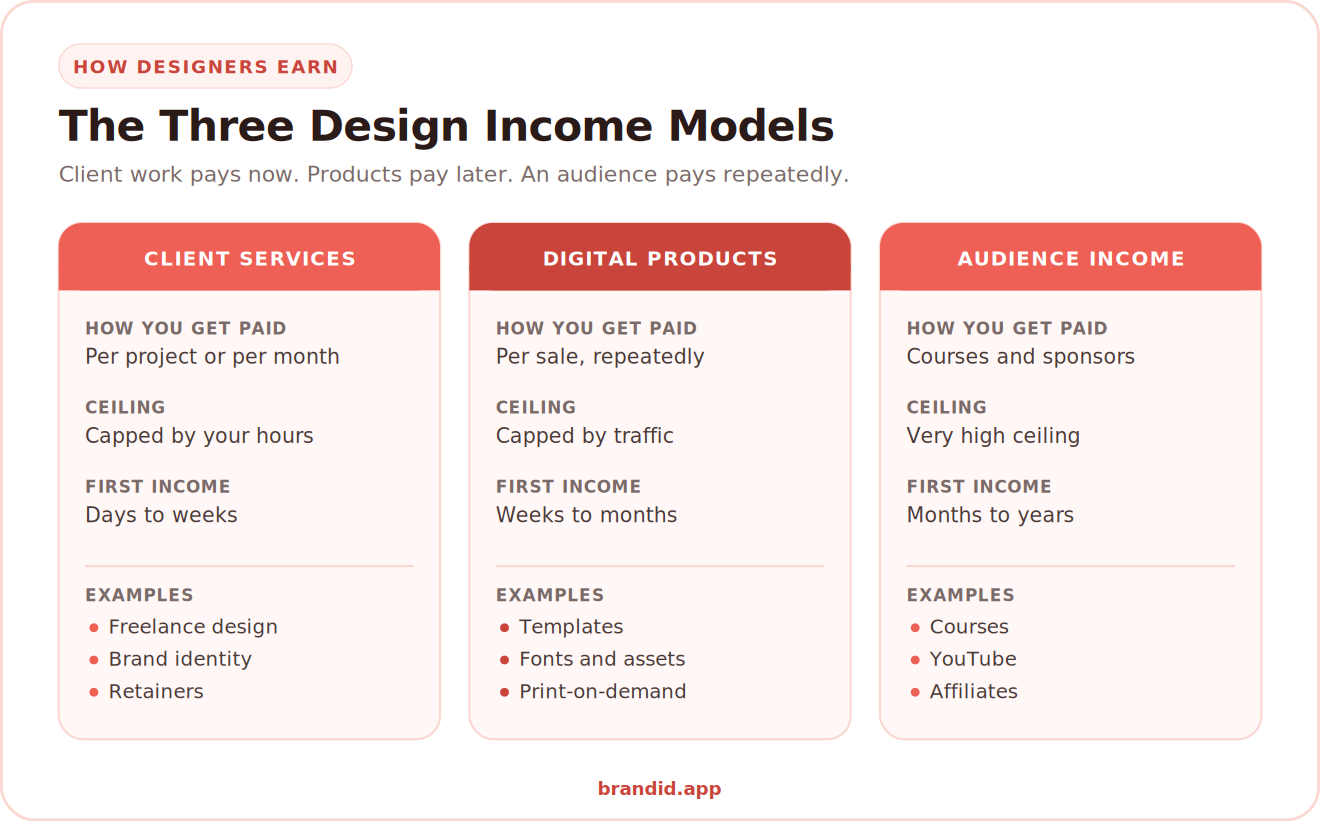
Client work should fund your life while you build the other two. Products remove the ceiling on your hours. An audience makes both easier by sending you clients and customers without you chasing them. The sections below cover all three.
Model 1: Client Services (Fastest Money)
This is where nearly everyone starts, and it is the quickest route from skill to income. These eight options are ordered roughly from easiest to enter to highest paying.
1. Freelance Graphic Design Services
The classic route. You offer design work to businesses, startups, and individuals through marketplaces like Upwork and Fiverr, or through direct outreach. Marketplaces give you access to clients immediately, at the cost of competing on price early on.
If you are working out how to make money as a freelance graphic designer, treat the marketplaces as a starting point rather than a destination. Use them to build a portfolio and testimonials, then move clients to direct relationships where you keep the full fee.
2. Logo and Brand Identity Design
Every business needs a logo, which makes this permanently in demand. The money is not in the logo itself, though. It is in the full identity package: logo, colour palette, typography system, usage guidelines, and brand assets.
Selling identity rather than a single mark moves a $400 job into $1,500 to $10,000 territory for the same core skill.
3. Social Media Graphics on Retainer
Small businesses need a steady stream of posts and have no time to make them. Selling one graphic at a time is a treadmill, so package it: twenty posts a month for a fixed monthly fee.
Global social media ad spend is projected to reach hundreds of billions of dollars by 2030, and every one of those ads needs artwork. This is the easiest place for most designers to build recurring income.
4. Presentation and Pitch Deck Design
Massively underrated. Founders raising money and executives presenting to boards will pay well for a deck that lands, because the stakes are high and most people cannot design one themselves. Rates of $50 to $150 per slide are normal, and a 30-slide deck adds up quickly.
5. Web Design
If you can pair design with Webflow, WordPress, or Shopify, you can charge several thousand per project. Web design also bundles neatly with branding, so one client can become a brand identity plus a website plus ongoing maintenance.
6. Packaging and Print Design
Fewer designers work in packaging, which is exactly why it pays. Physical products need labels, boxes, and print-ready files, and the technical requirements filter out casual competition. Specialist knowledge here is a genuine moat.
7. Motion Graphics and Animation
Adding simple animation to your skill set is one of the highest-return upgrades available. Animated logos, explainer videos, and social motion assets command $75 to $200 an hour because far fewer designers offer them.
8. AI-Assisted Design Services
This is the fastest-growing design service of 2026. Clients want polished, on-brand assets, not raw AI output they could generate themselves. The work is in directing the tools, fixing their errors, and finishing the result to a professional standard.
You can also sell adjacent services: building reusable prompt libraries for a brand, training an in-house team on AI tools, or producing concept boards fast. Designers who pair AI fluency with real fundamentals are among the most in-demand freelancers right now, and the same skills let you sell AI art as a product on the side.
Model 2: Digital Products (Money While You Sleep)
This is the answer for anyone asking how to make money online as a graphic designer without trading every hour for cash. You design something once and sell it repeatedly. The first sale takes the longest, and the hundredth takes no work at all.
It is also the clearest answer to how to make money from home as a graphic designer, because none of it requires client calls, briefs, or timezone juggling.
9. Design Templates
The most popular passive income route for designers. Social media kits, presentation decks, resumes, planners, and media kits all sell well because they save buyers hours of work.
Canva templates in particular have a huge market, since most buyers cannot use Adobe tools. Our guide on selling Canva templates covers the full process from design to listing.
10. Fonts and Design Assets
Every brand needs typefaces, icons, textures, and mockups. Font design is a genuine specialism, but icon sets, texture packs, and mockup files are far quicker to produce and sell steadily on marketplaces.
11. Print-on-Demand Merchandise
Upload a design, and a partner prints and ships each order while you keep the margin. No inventory, no fulfilment. The winners here are designers who pick a specific niche and design for that audience rather than chasing general trends.
12. Stock Graphics and Illustrations
Vectors, illustrations, and graphic packs sell on stock marketplaces for years after upload. Individual payouts are small, so this works as a volume play that compounds quietly in the background. Illustrators can also sell clipart and illustrations directly directly at much better margins than stock sites pay.
13. Presets, Actions, and Mockups
Lightroom presets, Photoshop actions, and product mockup files sell to other creators who want your look without your process. They are fast to produce if you already have a signature style.
14. Printables and Digital Planners
Wall art, budget trackers, wedding suites, and digital planners sell consistently and require no client interaction at all. Seasonal designs spike predictably around holidays, which makes revenue easier to plan than most people expect.
Model 3: Audience Income (Highest Ceiling)
This is the slowest model and the one with the highest ceiling. Build an audience of people who trust your taste, and you can sell them almost anything, while brands pay to reach them.
15. Teaching and Online Courses
If you can design, you can teach design. Sell prerecorded courses, run live cohorts, or offer one-to-one mentoring. Courses take real effort to produce, but they sell indefinitely once built, and they also position you as an expert, which raises your client rates at the same time.
16. YouTube and Short-Form Video
Design tutorials perform well because the results are visual and satisfying. YouTube payouts vary enormously, from roughly $1 to $3 per thousand views up to $20 to $30 or more in high-value niches, and design attracts advertisers with real budgets.
The ad revenue is rarely the main prize. The channel sells your courses, your templates, and your services. The same short-video mechanics that work for creators making money on TikTok apply directly to design content.
17. Affiliate Income and a Design Blog
Write about the tools you already use and earn a commission when readers buy them. Design software, fonts, courses, and hardware all have affiliate programs worth joining, and this pairs naturally with a tutorial channel or newsletter.
18. Sponsorships and Brand Partnerships
Once you have an engaged audience, design tool companies will pay for visibility. You do not need huge numbers either, since plenty of brands work with smaller creators who have a focused, relevant following.
A Real Example: From $40,000 to $137,000
Averages are abstract, so here is one documented path. Designer Colleen Gratzer has written openly about her numbers, and they are more useful than any survey.
While working a full-time design job paying around $40,000 a year, she built freelance clients on evenings and weekends. In her final year of employment, that side work brought in $61,000 from just nine clients. She left, and in her first full year of self-employment made just under $100,000, then $137,000 the year after.
She built it with a website and a referral network, before social media existed. The two details worth stealing are that she built the client base before quitting, and that nine good clients outperformed her entire salary.
That single insight overturns how most designers think. Cutting your rate to win work often loses it instead, because a low price signals low ability. Her other lever was specialization: being known for one thing reduces competition and makes a higher rate easy to justify.
How to Make Money as a Beginner Graphic Designer
The hardest part is the gap where you need work to get work. Here is how to break it.
- Learn one tool properly. Figma, Canva, or Illustrator is enough to start earning.
- Choose one service, such as social media graphics or logos, rather than offering everything.
- Build five portfolio pieces by redesigning real brands you admire. Nobody asks whether the work was paid.
- Put those pieces somewhere clients can see them in one click, whether that is Behance, a simple site, or a link in bio page.
- Take three cheap or free projects deliberately, from local businesses or nonprofits, purely to earn testimonials.
- Ask each of them for a written testimonial and permission to show the work.
- Raise your rate for the next client. Repeat until people stop saying yes instantly.
- Start a small template or printable product in parallel, so passive income begins compounding early.
How to Make More Money as a Graphic Designer (Experienced Track)
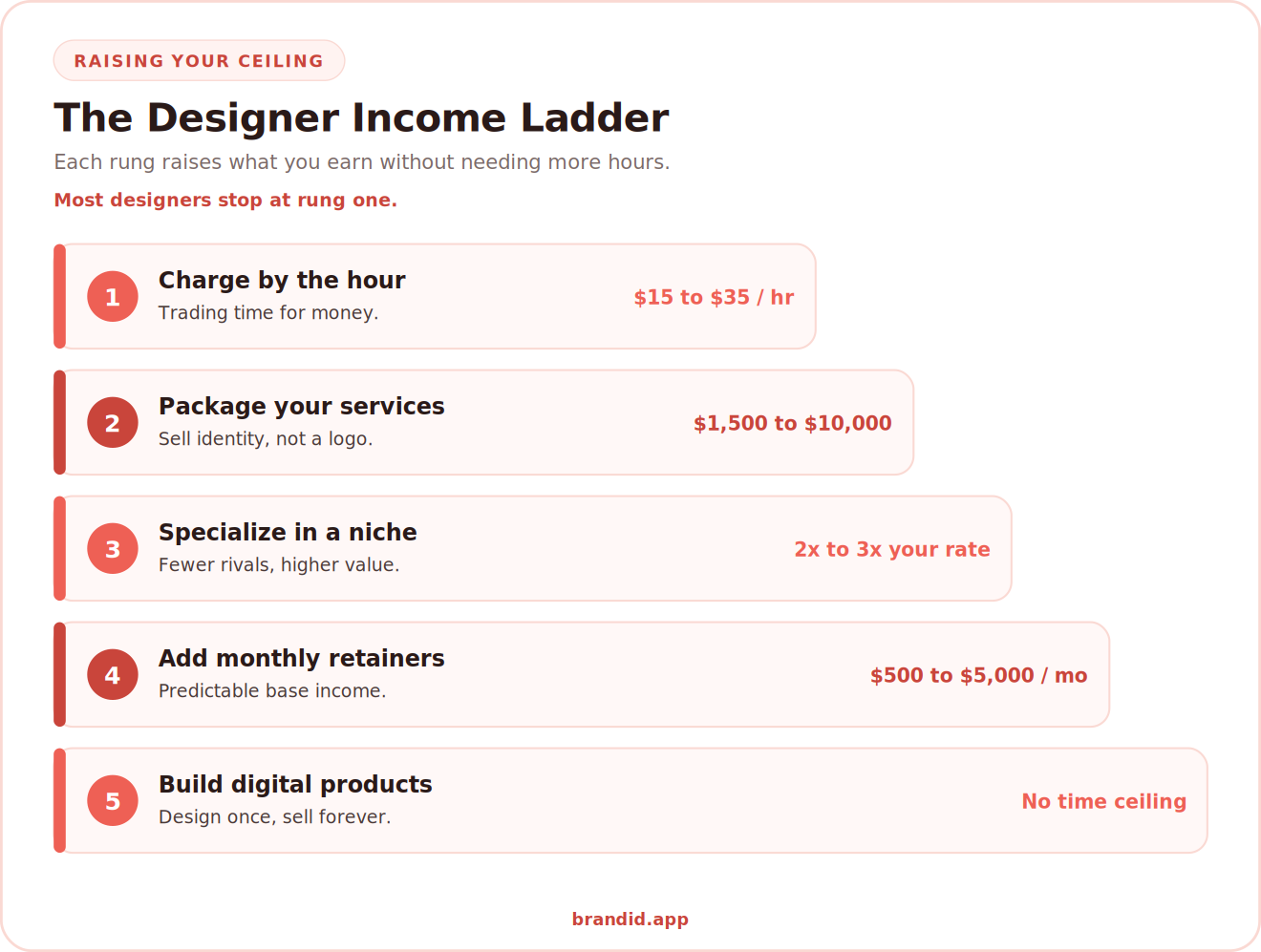
If you are already working steadily but your income has flatlined, more clients is rarely the answer. These six moves are.
1. Specialize in Something Specific
Generalists compete with everyone. Specialists compete with almost nobody. Whether you focus on an industry (SaaS, hospitality, nonprofits) or a discipline (packaging, motion, accessibility), narrowing reduces competition and raises what you can charge for the same work.
2. Sell Outcomes, Not Deliverables
Clients do not want a logo. They want to look credible enough to win customers. Ask deeper questions about what the work needs to achieve, then price against that result rather than against the hours it takes you.
3. Add Recurring Revenue
One-off projects mean restarting your pipeline every month. Retainers fix that. Offer monthly social graphics, ongoing website maintenance, or a quarterly brand refresh, and you start each month with income already booked.
4. Raise Rates on New Clients First
Raising prices feels risky because you picture losing everyone at once. You will not. Quote the higher rate to new enquiries only, keep existing clients where they are, and move them up at renewal once the new rate is proven.
5. Productize Your Most Repeated Work
If you have designed forty pitch decks, you already own a system. Turn it into a fixed-price package with a defined scope and turnaround. Productized services sell faster because buyers know exactly what they get, and they take you less time each round.
6. Build Products Alongside Client Work
This is the only real way past the hours ceiling. Every template, font, or course you sell earns without your calendar. Reading up on how to price a product properly matters here, because product pricing works differently from service pricing.
Where to Find Graphic Design Clients
Talent without clients pays nothing. These are the channels that actually produce work, roughly in order of how fast they pay off.
- Freelance marketplaces. Upwork, Fiverr, and 99designs give you access to buyers immediately. Competitive on price, but the fastest route to a first paying client.
- Your existing network. Former colleagues, classmates, and past employers are the highest-converting source most designers ignore completely.
- Referrals, asked for directly. At the end of a happy project, ask whether they know one other person who needs the same thing. Specific beats vague.
- Local businesses. Restaurants, gyms, and shops in your area often have visibly weak branding and no in-house designer.
- Instagram, Behance, and Dribbble. Post work consistently with the client problem described, not just the pretty final image.
- LinkedIn. Underused by designers and full of the founders and marketers who hire them.
- Agencies and studios. Subcontracting for busy agencies gives steady work without you doing sales.
- An email list. Slow to build, but it is the only audience you own outright, and one monthly email keeps you top of mind for years.
Mistakes That Keep Designers Underpaid
- Competing on price. There is a client tier for every budget. Racing to the bottom puts you in the one with the worst clients and the least money.
- Selling single deliverables. A logo is a $400 job. A brand identity is a $4,000 job. Same skill, different package.
- Never asking for testimonials. Social proof is what lets you raise rates without argument, and it costs one email to collect.
- Working without a contract. Scope creep and late payment are both contract problems, not client problems.
- Ignoring passive income entirely. If every dollar requires an hour, illness or a slow month hits your income directly.
- Staying a generalist forever. Being able to do everything sounds like an advantage and reads to clients as no clear expertise.
- Undercharging out of fear. As the example above shows, low prices lose work more often than high ones.
Sell Your Design Products in One Place
Once you decide to add products alongside client work, you need somewhere to sell them. Marketplaces take a cut and own the customer, so most designers eventually want a store of their own.
brandID is a free-to-start creator store and link in bio built for exactly this. It gives you one branded page to sell from, with no separate website to build.
- Sell templates, fonts, presets, and mockups as instant instant digital downloads for buyers
- Bundle your work into collections, which is where the real margin lives
- Add recurring subscriptions and memberships for a monthly asset club, or collect tips from your audience on free resources
- Use it as your portfolio and storefront in one, so the link in your bio does the selling
- Earn commissions from the built-in affiliate marketplace on tools you already recommend
- Track which products and links actually convert
Conclusion
Learning how to make money as a graphic designer is less about design and more about structure, and the same is true of how to make money with graphic design at any level. The craft gets you in the door. The business model decides your ceiling.
If you are starting out, get three testimonials as fast as possible and raise your rate after each one. If you are experienced and stuck, specialize, add a retainer, and quote higher on new enquiries. If you want income that does not depend on your calendar, build products alongside whatever you already do.
The designers earning most are rarely the most talented ones. They are the ones who stopped selling hours, picked a lane, charged properly, and built something that keeps selling after the work is done. Start with one change this month, and pick the one that compounds.
Frequently Asked Questions
1. How do graphic designers make money?
Graphic designers earn through three models: client services like freelance projects, logos, and web design; digital products such as templates, fonts, and print-on-demand designs; and audience income from courses, YouTube, affiliates, and sponsorships. Client work pays fastest, products keep earning after one build, and audience income has the highest long-term ceiling.
2. How much can you make as a graphic designer?
US graphic designers earn a median of roughly $29.47 an hour according to the Bureau of Labor Statistics, with freelance marketplace rates commonly between $15 and $35 an hour. Specialists and studio owners earn considerably more, and documented cases exist of freelance designers passing $100,000 a year within their first year of going independent.
3. How do you make money as a beginner graphic designer?
Learn one tool well, pick one service instead of offering everything, and build five portfolio pieces by redesigning brands you admire. Take two or three cheap projects specifically to collect testimonials, then raise your rate with each new client. You do not need a degree or prior paid work to start.
4. What is the best graphic design side hustle?
Selling design templates is the most popular because you build once and sell repeatedly. Social media graphics on a monthly retainer produce the steadiest cash, print-on-demand needs no inventory, and presentation design pays unusually well per hour. The best choice depends on whether you want fast income or passive income.
5. How can I make money from home as a graphic designer?
Digital products are the most home-friendly route, since templates, fonts, presets, printables, and print-on-demand designs require no client calls. Remote freelance work through marketplaces also works well, as does teaching design online through prerecorded courses.
6. How do I make more money as a graphic designer?
Specialize in a niche, sell outcomes rather than deliverables, add monthly retainers for recurring income, raise rates on new clients first, productize the work you repeat most, and build digital products so your income is not capped by your hours. More clients is rarely the answer to a flat income.
7. How do I get my first graphic design client?
Start with your existing network, since former colleagues and past employers convert best. Then try freelance marketplaces for immediate access to buyers, approach local businesses with visibly weak branding, and post your work consistently on Instagram, Behance, or LinkedIn. Ask every happy client for one referral.
8. Do you need a degree to make money as a graphic designer?
No. Clients hire based on portfolio and results rather than formal education, and many successful designers are entirely self-taught. What matters is a portfolio that shows relevant work, testimonials that prove you are reliable, and clear communication about what the work achieves.
9. Is AI replacing graphic designers?
AI is changing how designers work rather than replacing them. Tools speed up ideation and production, but clients still pay for brand judgment, original concepts, and finished assets they can actually use. Designers who combine AI fluency with strong fundamentals are currently among the most in-demand freelancers.
10. How much should I charge as a freelance graphic designer?
Start from your costs and target income rather than copying other designers. As reference points, social graphics run $25 to $75 each, logos $300 to $2,500, full brand identities $1,500 to $10,000, and retainers $500 to $5,000 a month. If every prospect accepts instantly, your rate is too low.
 Summarize this article with: