How to become an influencer is one of the most searched career questions of the decade, and one of the most misunderstood. After studying more than 1,000 creators across TikTok, YouTube, Twitch and Instagram, and interviewing the ones who actually broke through, a clear pattern shows up: the people who make it are not luckier than everyone else. They make a specific set of decisions, in a specific order, and they keep making them long after most people quit.
The tooling side of the creator stack has moved fast in 2026. The 12 best Claude Code skills built for content creators cover scripts for research, editing, and publishing that cut hours out of the weekly cadence.
One asset separates creators who get booked from creators who get skipped: a short, specific UGC portfolio. Eight UGC portfolio examples brands actually read cover the exact layout and the niche-by-niche adjustments that move your reply rate.
Trust signals compound as the follower count climbs, and the blue checkmark is the single clearest one once you cross the mid-tier threshold. Instructions for getting verified on TikTok cover the six official criteria and the one requirement (editorial press coverage) that fails most applicants without them realizing why.
This is not a list of vague tips. It is the playbook those creators followed, grounded in current numbers on what the job really pays, and shown through real breakdowns of how people like Kai Cenat, CaseOh and Salish Matter went from unknown to unavoidable. By the end you will know what to build, in what sequence, how long it honestly takes, and how the money actually works.
- Learning how to become an influencer in 2026 is a build, not a lottery: pick a narrow niche, choose the format that shows your strength, and publish on a system you can sustain for a year.
- The market is huge but top-heavy. Roughly 67 million people now create, yet 68% of US creators earn under $10,000 a year and only about 2% clear $500,000, so strategy matters more than talent alone.
- Engagement beats follower count. Nano creators land paid deals at 1,000 to 10,000 followers when their audience is genuinely active, and brands buy tight niches over big vanity numbers.
- Validate before you commit. The smartest creators test short clips first, watch the data, and only then go all in, rather than quitting a job on hope.
- Monetize early and diversify. The financially stable creators build several income streams from the start, including affiliate revenue, products and off-platform assets they own outright.
- Own your audience layer. A single link-in-bio hub that routes fans to your offers is where scattered attention turns into income, which is exactly what brandID is built to power.
The Honest State of the Creator Economy in 2026
Before the how, you need the real picture, because most guides sell a fantasy. The creator economy is now worth north of $200 billion and, by Goldman Sachs estimates, about 67 million people create in some form, a number projected to reach roughly 107 million by 2030. That is the good news: demand for creators, and the brand budgets that follow them, keep climbing.
Q4 is also when creators who run paid partnerships cut their biggest cheques of the year, and a 15-step Black Friday influencer checklist keeps BFCM campaigns on track from contract to post-cadence.
The sobering news is how the money is distributed. This is one of the most unequal fields you can enter, and knowing that up front changes how you should play it.
The takeaway is not “give up.” It is “be deliberate.” The gap between the 68% and the 2% is rarely raw talent. It is niche choice, format, consistency and monetization strategy, which are exactly the levers you control and the ones this guide walks through.
How to Become an Influencer in 9 Steps
These nine steps are the sequence that showed up again and again in the creators who broke through. Order matters. Skipping ahead, especially to monetization or platform-hopping, is where most people stall. Here is the full framework at a glance before we break down each step.
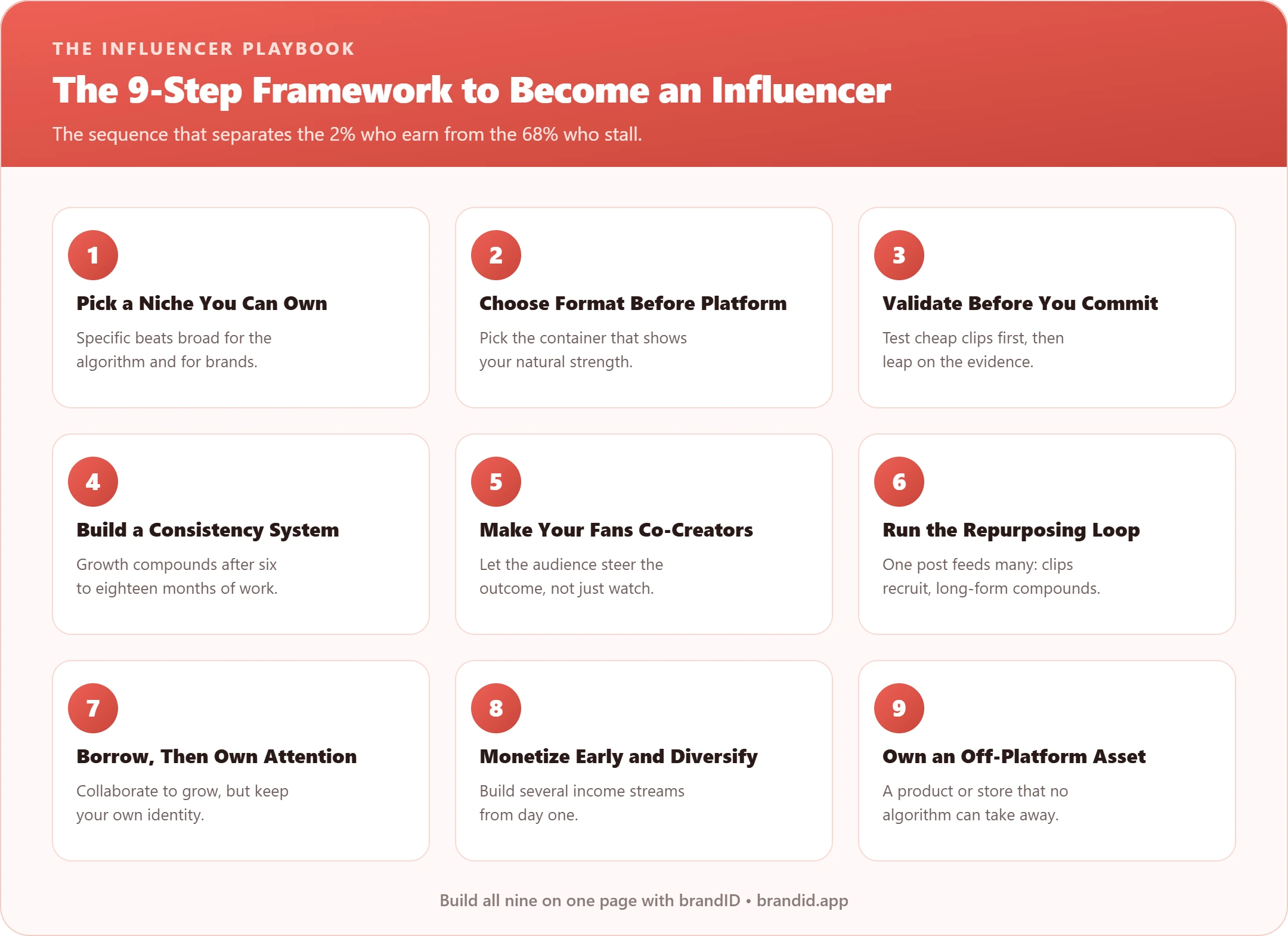
Step 1: Pick a Niche Narrow Enough to Own
Specific beats broad, for the algorithm and for brands. A skincare company needs beauty creators; a trading app needs finance creators; nobody pays a general “lifestyle” account unless it is already enormous. The tightest niches convert best: becoming a wig influencer, for one, turns a small beauty lane into steady brand deals because the hair sells itself on screen. Your niche is a promise about what a new follower will get next, and a clear promise is what makes people hit follow. Start narrower than feels comfortable, such as budget capsule wardrobes rather than “fashion,” or beginner bass guitar rather than “music.” You can widen later once you own the smaller space.
Step 2: Choose the Format Before the Platform
Most people pick a platform first and force their content to fit. The creators who break out do the opposite: they find the format that reveals their strength, then go where that format lives. A great talker belongs in long-form video or live streaming; a great editor belongs in short-form; a great writer belongs in threads and newsletters. The container matters more than the topic.
Step 3: Validate Before You Commit
You do not need to quit your job and hope. Post low-cost tests first, read the response honestly, and only change your life once the evidence is in. Short-form is the cheapest test lab ever built: a handful of clips will tell you within weeks whether your idea and delivery connect, long before you invest in expensive gear or a full-time leap.
Step 4: Build a System for Consistency, Not Bursts
Organic growth compounds for most creators only after six to eighteen months of steady posting. Daily TikTok often shows traction in three to six months; Instagram and YouTube usually take longer. Your first fifty posts will likely underperform, and you should post anyway. This is the phase where almost everyone quits, which is precisely why sticking through it is such an advantage.
Consistency is not willpower, it is a system. Batch your filming, keep a simple idea list so you never face a blank slate, and set a cadence you can hold on a bad week, not just a good one. A sustainable three posts a week beats seven posts that burn you out by month two.
Step 5: Make Your Audience Co-Creators
Passive viewers scroll past. Participants stay, share and defend you. The strongest creators build mechanics that let the audience steer outcomes, so watching becomes doing. That can be as simple as polls and community votes, or as structural as a format the audience literally controls.
Kai Cenat’s subathons are the clearest example: subscribing extended the stream, so viewers were not watching a broadcast, they were setting its length in real time. Participation, not passive views, is what turned his audience into a movement and drove those record subscriber counts.
Step 6: Run the Repurposing Loop
One piece of content should feed many. The most efficient creators run a loop where long-form or live content generates short clips, the clips recruit new viewers, and those viewers convert into subscribers and community members, who then create more moments to clip. You produce once and distribute everywhere.
Step 7: Borrow Audiences, But Keep Your Own Identity
Collaborations and shared spaces are the fastest legitimate way to grow, because you tap an audience someone else already earned. The catch is to grow on borrowed attention without becoming defined by it. Co-create early, then make sure people are following you, not just the thing that introduced you.
Step 8: Monetize Early and Diversify
The biggest myth is that you monetize only after you “make it.” In 2026 the financially stable creators do the reverse: they build several small income streams early rather than waiting. Brand deals start at the nano tier, affiliate revenue can begin the day you have a link, and platform payouts stack on top. Multiple streams also protect you when any single one dips.
Common streams include brand sponsorships, affiliate commissions, digital products like guides and presets, memberships, platform payouts such as the YouTube Partner Program, and physical products. The point is not to run all of them at once, but to never depend on a single one. If you are starting with no budget, affiliate income is the natural first step, and there are proven ways to start affiliate marketing with no money while your audience is still small.
Step 9: Own Something Off-Platform
Every platform can change its rules overnight. The creators who last build at least one asset they control outright, so an algorithm change or a payout cut cannot erase their income. This is the difference between renting an audience and owning a business.
The pattern is everywhere among top creators. CaseOh runs Casemart, his own merchandise line, described as the part he owns outright even if Twitch changed its payout split tomorrow. Kai Cenat launched the Vivet clothing brand in 2026 and controlled production rather than licensing his name. Salish Matter put her name on Sincerely Yours skincare, which reached Sephora shelves in September 2025. The lesson repeats: turn attention into an asset you keep.
How Much Do Influencers Actually Make?
Pay scales with audience size, but engagement and niche move the number as much as follower count does. A tight finance audience of 20,000 can out-earn a passive lifestyle account of 200,000. Use these ranges as a map, not a promise.
Two things surprise newcomers. First, brand deals begin far earlier than expected, often between 1,000 and 5,000 engaged followers. Second, per-post fees are only one slice; affiliate commissions and owned products frequently out-earn sponsorships over a year, because they keep paying long after a single post is gone. Learning how to promote affiliate links well means one video can earn from several brands at once, for months.
How to Land Your First Paid Partnership
You do not wait to be discovered; you make yourself easy to hire. By the time you have a clear niche and a few thousand engaged followers, put these pieces in place:
- A media kit. One page with your niche, audience demographics, engagement rate and best-performing posts. Brands care about engagement and fit far more than raw follower counts.
- Tag brands organically. Feature products you genuinely use before any deal exists. Many first partnerships start when a brand notices unpaid, authentic coverage.
- Hit platform monetization thresholds. The YouTube Partner Program, for example, needs 1,000 subscribers and 4,000 watch hours, so keep an eye on the bar for your platform.
- Start with affiliates. You can earn commissions with any audience size, which builds proof of sales that makes brands take you seriously.
- Pitch, do not just wait. A short, specific email to a brand you already feature converts better than hoping the algorithm delivers you to them.
The One Tool Every Influencer Needs From Day One
You will post across several platforms, but you can only put one link in most bios. That single link is where scattered attention either converts or leaks away. A link-in-bio hub solves this by routing every follower to one page that holds your latest video, your affiliate offers, your products and your email signup. The best link-in-bio tools also show you what people actually click, so you learn what your audience wants to buy.
Set this up before you need it. On the day a post goes viral, a clean hub turns a spike of attention into followers, sales and email subscribers instead of a wasted moment. It is the cheapest, highest-impact piece of infrastructure a new creator can build.
How brandID Turns Your Audience Into Income
This is where the monetization and diversification steps come together. brandID gives creators a free link-in-bio and a free storefront, plus a marketplace of 5 million products across 2,000+ brands that you can recommend and earn on. Commissions run up to 60%, with a 90-day cookie and weekly payouts, and there are no marketplace fees, so you keep what you make.
It fits the playbook exactly. Your bio link becomes the hub from Step 8, your store becomes an asset you own from Step 9, and the affiliate marketplace lets you monetize on day one with any audience size. Instead of chasing one brand deal at a time, you build a page that earns from everything you recommend, across every platform you post on.
brandID gives creators a free link-in-bio, a free store and a 5-million-product marketplace paying up to 60% commission, with a 90-day cookie and weekly payouts. Start monetizing on day one, with no fees.
Start Free on brandIDMistakes That Keep Creators Stuck
Across the creators who stalled, the same avoidable errors came up over and over. Steering around them is often faster than any growth hack.
- Commit to one narrow niche long enough to own it
- Post on a sustainable schedule for a full year
- Read your data and double down on what works
- Build income streams while you are still small
- Route every platform to one owned hub
- Create at least one asset you fully control
- Chasing every trend and confusing the algorithm
- Quitting during the slow first six months
- Buying followers, which brands and platforms detect
- Waiting to “make it” before monetizing anything
- Living only inside platforms you do not own
- Copying a bigger creator instead of finding your angle
The Bottom Line on How to Become an Influencer
How to become an influencer comes down to a build you can actually execute: choose a niche narrow enough to own, pick the format that shows your strength, validate cheaply before you commit, and publish on a system you can hold for a year while growth quietly compounds. Make your audience participants, run one loop that turns each post into many, and start earning early across several streams instead of betting on one. The creators who broke through were not the most gifted in the room; they were the most deliberate and the most patient. Do the same, give it twelve months of honest effort, and you will be far ahead of the 68% who never get past the fantasy.
How to Become an Influencer: FAQs
1- How do you become an influencer with no money or experience?
2- How many followers do you need to make money as an influencer?
3- How long does it take to become an influencer?
4- Which platform is best for becoming an influencer in 2026?
5- How much do influencers actually make?
6- Do I need to show my face to be an influencer?
7- What is the biggest mistake new influencers make?
8- How do influencers get paid?
 Summarize this article with: