Most advice on how to get sponsors on YouTube skips the part that actually happens: you send forty emails and hear back from two.
That is normal. How do YouTubers get sponsors, in practice? Not by being better at making videos than you. They have a media kit, a rate card, a list of brands, and the patience to keep pitching while nothing comes back, because sponsorship is a sales job with a sales job’s rejection rate.
This guide covers that whole system for how to get sponsors on YouTube: the numbers brands actually pay, a pitch template you can send today, and the mechanics of negotiating usage rights and exclusivity without leaving money behind.
It also covers what to do with the months in between, because YouTube affiliate programs let you earn from the products in your videos while every pitch is still unanswered, with no brand approval required.
Key Takeaways
- There is no subscriber minimum. Brands work with channels from 1,000 subscribers, because a small engaged niche converts better than a large vague one
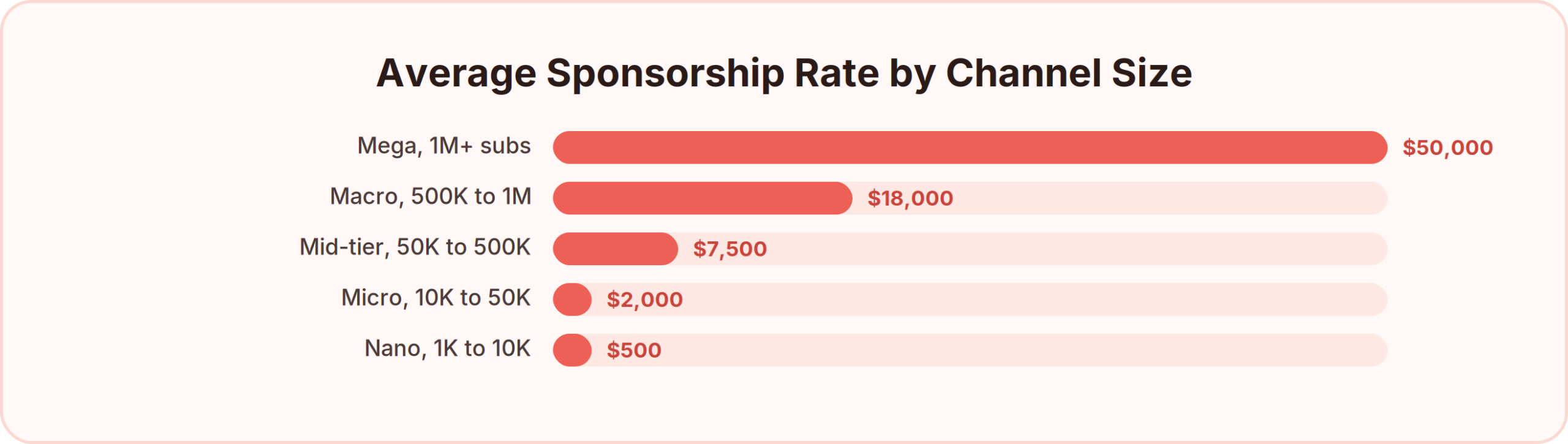
- Rates run from about $500 per video at 1K to 10K subscribers up to $18,000 at 500K, driven far more by niche and views than by subscriber count
- Price on views, not subscribers. Average views divided by 1,000, multiplied by your niche CPM, is the formula brands recognize
- Deal type changes the number by 2 to 3 times, and usage rights and exclusivity are separate line items worth 30% to 100% more
- 92% of brands ask for a media kit before they will discuss anything, so not having one ends most conversations early
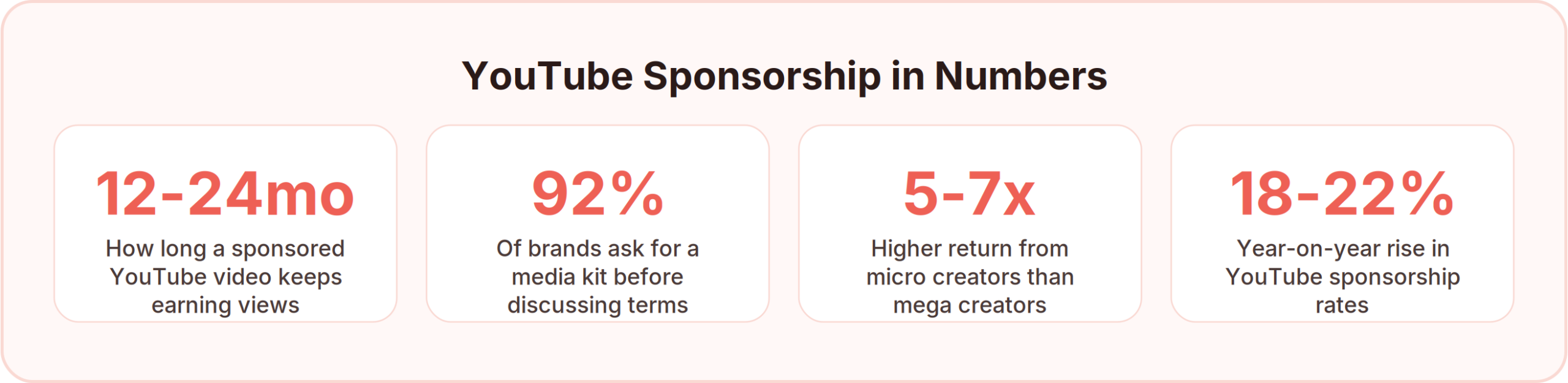
- YouTube sponsorships outlast every other platform, with a sponsored video still earning views 12 to 24 months later against 48 hours for a Reel
- Affiliate income fills the gap between deals, because it needs no pitch, no approval, and no minimum audience
What Is a YouTube Sponsorship and How Does It Work?
A YouTube sponsorship is a paid agreement where a brand pays you to feature its product in your video. You agree the format, the talking points, the timing, and the fee, then you make the video your own way and the brand pays on delivery or shortly after.
The mechanics are simple enough. A brand or its agency approaches you, or you approach them. You send a media kit and a rate. They send a brief with talking points and any claims you must not make. You produce the video, mark it as containing paid promotion, and invoice.
What makes YouTube different from every other platform is shelf life. A sponsored Instagram Reel peaks in about 48 hours and a TikTok is gone from feeds within a week, but a sponsored YouTube video keeps surfacing in search and suggested for 12 to 24 months.
Brands pay a premium for that compounding exposure, which is why YouTube CPMs run several times higher than anywhere else.
The Six Types of YouTube Sponsorship
Knowing which one you are being offered matters, because the same channel can be worth two or three times more depending on format.
| Type | What it is | Rate multiplier |
|---|---|---|
| Dedicated video | The whole video is about the brand | About 2x your base rate |
| Integrated segment | A 30 to 90 second section inside a normal video | 1x, and the most common by far |
| Pre-roll or post-roll | A 15 to 30 second mention at the start or end | About 0.5x to 0.7x |
| Shorts bundle | Three to five Shorts sold together | About 0.3x to 0.5x each |
| Affiliate deal | No fee, you earn commission on sales you generate | Variable, and uncapped |
| Product seeding | Free product, no payment | Zero, but useful for a first case study |
Product seeding deserves a word of caution. Free product in exchange for a video is a real cost in your time, and brands offering it to a channel with genuine reach are testing whether you know your worth. Take it once to build a case study if you have none. Do not build a business on it.
How Much Do YouTube Sponsors Pay?
The honest answer is that it varies enormously, but the ranges are well established and brands expect you to know them.
| Channel size | Typical range per video | What moves you up the range |
|---|---|---|
| 1,000 to 10,000 | $200 to $1,000 | A tightly defined niche and high retention |
| 10,000 to 50,000 | $1,000 to $3,000 | Consistent uploads and proven click-through |
| 50,000 to 500,000 | $3,000 to $10,000 | Past campaign results you can evidence |
| 500,000 to 1M | $10,000 to $25,000 | Category authority and a warm brand list |
| 1M and above | $25,000 to $100,000+ | Representation and competitive bidding |
The CPM Formula Brands Actually Use
Subscriber count is a vanity number and experienced brand managers ignore it. They price on views, using a formula you should be using too.
(Average views per video ÷ 1,000) × your niche CPM = your rate
Use the average of your last ten videos, not your best one and not your all-time figure.
Niche CPM is where the money is. A finance channel and a vlog channel with identical view counts are not worth the same to an advertiser, because one audience is worth far more per head.
| Niche | Typical CPM range | Why |
|---|---|---|
| Finance, B2B, software | $50 to $100 | High customer value justifies high acquisition cost |
| Tech and gadgets | $30 to $60 | Strong purchase intent and clear product fit |
| Education and career | $25 to $50 | Course and tool brands with real budgets |
| Health and fitness | $20 to $45 | Competitive category with repeat purchase |
| Beauty and fashion | $20 to $40 | High volume, heavy creator supply |
| Gaming and entertainment | $15 to $30 | Large audiences, lower conversion value |
One lever that raises the view number itself is language. Translating your YouTube videos opens the same content to audiences that were never going to watch it in English, and video localization goes further by matching the delivery rather than only the subtitles. More views at the same CPM is a higher rate.
Worked example: a channel averaging 20,000 views in the personal finance niche is 20,000 divided by 1,000, which is 20, multiplied by a $50 CPM, giving a $1,000 base rate for an integrated segment. That same channel doing a dedicated video should be quoting closer to $2,000.
Exclusivity, meaning you cannot work with competitors for a period, is worth 20% to 50% on top. Usage rights, meaning the brand can run your footage as a paid ad, is worth 30% to 100%. Both are separate line items. If a brand asks for either without offering more, that is a negotiation, not a favor.
How Many Subscribers Do You Need to Get YouTube Sponsors?
None, technically. The threshold that matters is whether a brand can identify who your audience is and believe they will buy something.
Micro creators between 10,000 and 100,000 subscribers are the most in-demand tier in the industry, reportedly delivering five to seven times the return of mega creators. The reason is straightforward: a smaller audience that trusts you converts at a rate a celebrity endorsement cannot match, and it costs the brand a fraction as much to test.
What replaces subscriber count in a brand’s decision:
- Average view duration. A 50% retention rate means people are still watching when the sponsor segment arrives, which is the only thing the brand is buying.
- Niche clarity. “Personal finance for people in their twenties” beats “I talk about various things” every time, because brands buy access to a defined group.
- Consistency. A weekly upload schedule is sponsorable. Uploading when inspiration strikes is not, because the brand cannot plan a campaign around it.
- Comment quality. Brands read your comments. An engaged, civil community signals a safe place to put their name.
- Click-through evidence. If you have ever put a link in a description and can report what happened, that number is worth more than 50,000 subscribers.
If you are not sure where you actually stand, a YouTube subscriber count checker gives you the live figure and the growth trend, which is the number a brand will look up before replying to you anyway.
The practical threshold for most creators is around 1,000 subscribers with consistent views, which is roughly where a media kit starts to say something. Below that, the affiliate route further down this page is the realistic answer, and the wider question of how many subscribers you need to make money on YouTube has a lower answer than most creators assume.
How to Get Sponsors on YouTube: The Six-Step System
This is the whole process for how to get YouTube sponsors. None of it is complicated, and almost all of it is skipped by creators who then conclude that sponsorship does not work for channels their size.
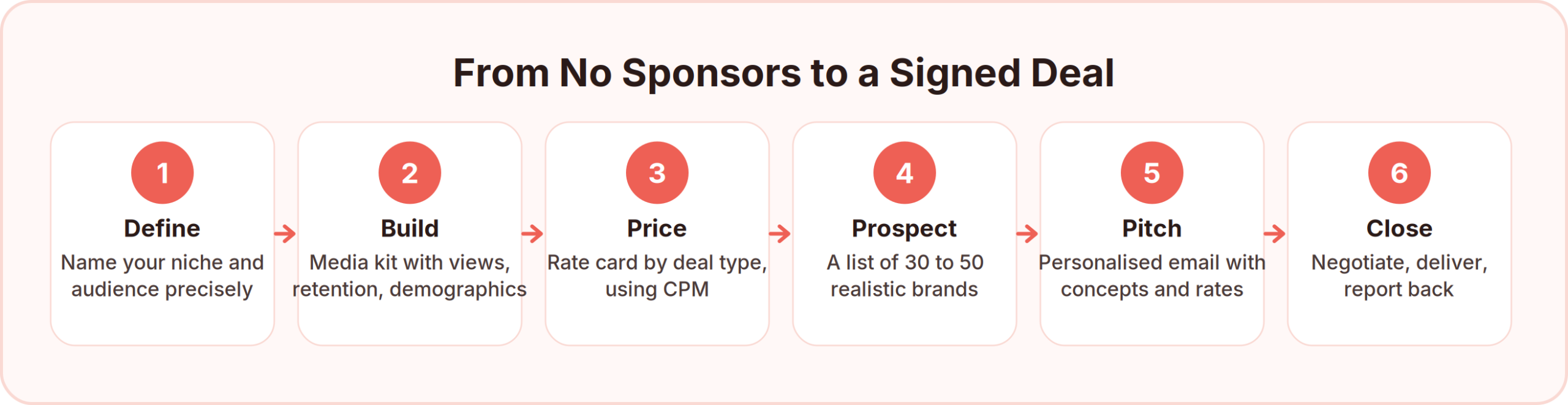
1- Define Your Niche and Audience Precisely
Brands are not buying your subscribers. They are buying access to a specific group of people who might buy something, and they need to hear that group described in one sentence.
Open YouTube Studio and write down the top three countries, the age split, the gender split, and the two or three topics your best-performing videos share. That sentence is the first line of every pitch you will send.
Which specific brands exist in your category varies enormously, and channels serving smaller audiences often do better with the brands that work with micro-influencers than with the household names everyone pitches first.
2- Build a Media Kit Before You Need One
Around 92% of brands ask for a media kit before discussing terms. Not having one ready is the single most common reason a promising conversation stops after one reply.
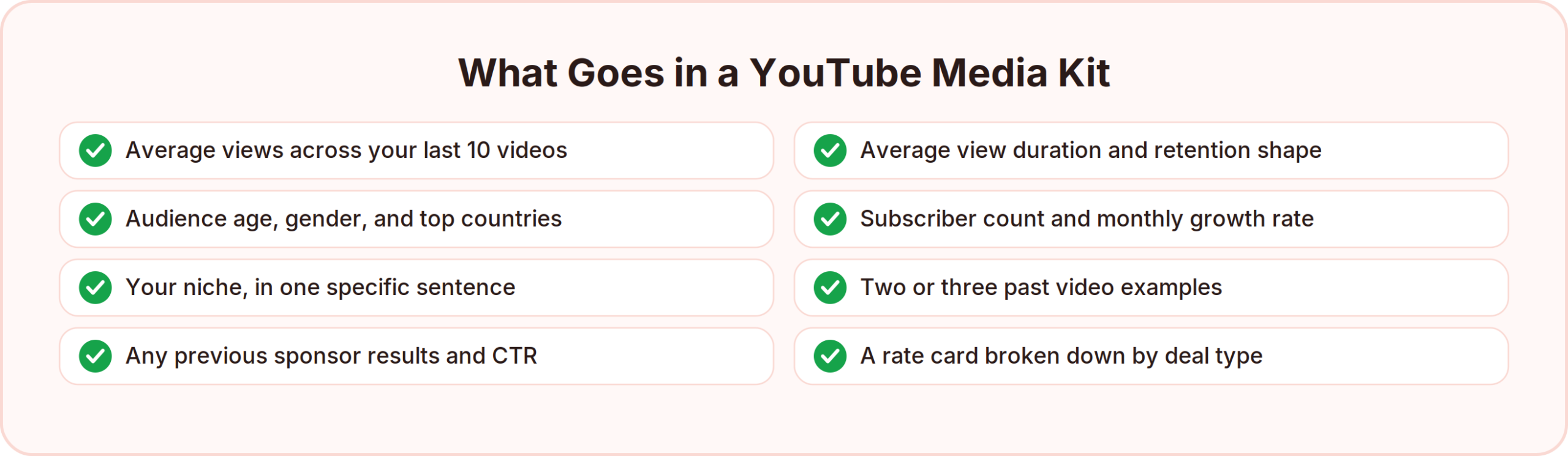
Keep it to two pages, use real screenshots from YouTube Studio rather than typed numbers, and never quote all-time views when recent views are lower. Brands check, and an inflated figure ends the relationship before it starts.
3- Set a Rate Card You Can Defend
Saying “whatever you think is fair” guarantees a lowball offer and signals you have not done this before. Use the CPM formula above, then present three options rather than one number.
| Package | What it includes | Example rate at 20K views |
|---|---|---|
| Integrated segment | 60 to 90 seconds inside a standard video | $1,000 |
| Dedicated video | A full video about the product | $2,000 |
| Shorts bundle | Three Shorts plus one integrated mention | $1,400 |
Add exclusivity and usage rights as line items with their own prices. If the brand does not want them, you have lost nothing. If it does, you have just been paid for something most creators give away.
4- Build a List of 30 to 50 Realistic Brands
The single biggest reason creators fail here is pitching five brands, hearing nothing, and concluding the strategy is broken. Sponsorship prospecting is volume work.
- Brands you already use. Your camera, your software, your supplements, the mattress in the background. These convert best because the endorsement is already true.
- Brands sponsoring creators like you. Watch the first 60 seconds of recent videos from 15 channels in your niche and note every paid mention. Those brands have live budgets in your category.
- Brands sponsoring your competitors’ competitors. If one VPN sponsors your niche, the other four are all buying the same audience.
- Smaller brands in your category. A $2m company will read your email. A $2bn company routes it to an agency inbox nobody opens.
- Brands that already commented or subscribed. Check your subscriber list and comment section for company accounts.
Find the person, not the inbox. Search LinkedIn for “influencer marketing manager” or “partnerships” plus the brand name. A named human replies far more often than a contact form.
5- Send a Pitch That Proves Audience Overlap
Your pitch has one job: prove that your audience is their customer. Everything else is supporting evidence.
Subject: [Your channel] x [Brand] — 68% US, 25 to 34, personal finance
Hi [Name],
I run [channel], a personal finance channel averaging 22,000 views per video. My audience is 68% US-based, 71% male, and aged 25 to 34, which looks a lot like your customer base.
I already use [product] in my own workflow and mentioned it unpaid in [link to video], which did 31,000 views.
Two concepts I would be glad to make: a 12-minute video on [specific topic] with a 90-second integrated segment, or a dedicated video walking through [specific use case].
Rates and full audience data are in my media kit: [link]. Integrated segments start at $1,000.
Worth a conversation?
[Name]
Three things make that email work. It leads with audience rather than subscriber count, it proves you already use the product, and it names a price so the brand knows whether to continue. Vagueness on any of the three is what produces silence.
Two weeks before pitching, comment genuinely on the brand’s own videos, engage with their social posts, and tag them when their product appears organically in your content. Brand managers check who is already talking about them, and a recognized name gets read rather than filtered.
6- Negotiate, Deliver, Then Report
When an offer arrives, the reply is almost never a flat yes. Things worth clarifying before you agree:
- Payment terms. Net 30 is standard. Net 60 and Net 90 exist and are negotiable, particularly for a first deal.
- Exclusivity scope and length. “No competitors” for three months is very different from forever, and should be priced accordingly.
- Usage rights. Whether they can run your footage as a paid ad, on which platforms, and for how long.
- Revision limits. Two rounds is fair. Unlimited revisions turn a $1,000 deal into a $200 one.
- Approval timelines. If they take three weeks to approve a script, your upload schedule breaks.
- Who owns the video. It should stay on your channel, under your control, permanently.
Production quality matters here too, since a brand is judging what it is buying. The best content creation tools remove most of the friction from editing and thumbnails, and a channel that looks consistent is far easier to sell.
Then over-deliver on the first one. Send a short report a fortnight after publishing with views, average view duration, link clicks, and any promo code redemptions. That report is what turns a single sponsored YouTube video into a retainer, and it becomes the strongest asset in every pitch you send afterwards.
Where to Find Sponsors for YouTube
There are five routes to finding sponsors for YouTube, in rough order of how well they work for channels under 100,000 subscribers.
| Route | How it works | Best for |
|---|---|---|
| Direct outreach | You email brands you use and brands sponsoring your niche | Everyone. This is where most deals come from |
| YouTube BrandConnect | YouTube’s own brand matching for eligible creators | Established channels meeting the eligibility bar |
| Influencer marketplaces | Platforms match you to live campaigns for 10% to 20% | First deals, before you have a track record |
| Inbound | A ‘sponsor this channel’ link in your description and banner | Channels with viewers who work in marketing |
| Agencies and management | They pitch on your behalf for a cut | Larger channels with deal flow to manage |
Most creators asking how to get sponsors on YouTube try one route and stop. The ones who land deals run three at once, because each produces leads at a different pace.
Cross-posting helps here too, because a brand deal is easier to sell when the video reaches beyond YouTube. Knowing how to share a YouTube video on an Instagram story turns one upload into two audiences, and brands price on total reach rather than platform.
Inbound is the one most creators neglect and it costs nothing. A line in every description pointing to a page with your media kit and rate card converts viewers who happen to work at companies with marketing budgets, and those people are already watching you.
That page is worth building properly, since it is doing the selling while you sleep. The best link in bio tools hold a media kit, a rate card, and your contact details behind the single link YouTube gives you.
How to Earn From Your Videos While You Wait for Sponsors
Here is the part every other guide leaves out. Between sending your first pitch and signing your first deal there is usually a gap of two to six months, and during that gap your videos are still being watched by people who buy things.
Affiliate income closes that gap. Instead of a brand paying you a fee to mention a product, you earn a commission every time a viewer buys through your link. The difference matters more than it sounds:
| Sponsorship | Affiliate | |
|---|---|---|
| Who decides you qualify | The brand, after a pitch | Nobody. You just start |
| Minimum audience | Effectively 1,000 subscribers | None at all |
| Time to first revenue | Two to six months of pitching | The day you publish |
| Payment | A fixed fee per video | A percentage of every sale, uncapped |
| Shelf life | Paid once, however long the video runs | Keeps paying as long as the video gets views |
| Effort per deal | Pitch, negotiate, contract, invoice | Choose a product and add a link |
The second row is the one that changes the plan. A sponsorship needs someone to say yes. Affiliate income needs nothing except products worth recommending, which means it is available to a channel with 200 subscribers on the day it starts.
Why Affiliate Beats a Small Sponsorship on the Same Video
Run the numbers on a nano channel. A brand offers $300 for an integrated segment on a video that will do 8,000 views over its life. That is the whole payment, forever.
The same video with an affiliate link, converting a modest 1% of viewers on a $80 product at 30% commission, earns $1,920 across those 8,000 views. And it keeps earning in month fourteen, when the sponsored version stopped paying on the day the invoice cleared.
That is not an argument against sponsorship. Sponsorship pays regardless of whether anyone buys, which is a real advantage. It is an argument for having both, and for not waiting on permission to start one of them.
Using brandID’s Affiliate Marketplace
brandID runs an affiliate marketplace built for creators, and the practical difference from most affiliate programs is that there is no application to pass. You do not pitch a brand, wait for approval, or get rejected for having too few subscribers.
The catalog runs to over 5 million affiliate products from more than 2,000 brands across fashion, beauty, health, tech, fitness, pets, home, and food, with commission averaging up to 65% and some brands paying higher.
Payouts are weekly with no minimum threshold, which matters more than it sounds when most affiliate programs hold your money until you cross $50 or $100.
How a creator actually uses it
- 1- Find products you already talk about. Search the affiliate marketplace for the categories your videos already cover. If you make cooking content, the pans, knives, and appliances you use are almost certainly in there.
- 2- Add them to a collection. Group products by video or by theme, so a viewer landing from your knife-sharpening tutorial sees knives rather than a wall of unrelated links.
- 3- Style the page to match your channel. Your branding, your layout, so the page reads as an extension of the channel rather than an affiliate dump.
- 4- Put one link in your bio and description. The page holds everything, so you update it once when a product changes rather than editing every old description.
- 5- Mention it out loud in the video. “Everything I used is linked below” at the moment you use the thing. This single habit moves click-through more than any other change.
- 6- Check which products convert, then make more of that content. The reporting tells you what your audience actually bought, which is the most honest content research available.
Why this works alongside a sponsorship strategy
- It gives you a track record before you pitch. A creator who can say “my last video drove 340 clicks and 22 sales” is quoting evidence, not asking for a chance. That number does more in a pitch email than any subscriber count.
- It reveals which brands want you. If a particular brand’s products convert well with your audience, that is the brand to pitch for a paid deal, with the data to prove the case.
- It fills the categories no sponsor covers. Most videos feature several products and a sponsor pays for one. The rest can earn instead of sitting there unmonetised.
- It pays on old videos. Your back catalog is still being watched. Adding links to your twenty best-performing old videos is an afternoon’s work that keeps paying.
- It costs nothing to start. The free plan covers unlimited affiliate products, so there is no subscription riding on whether this works.
The same page also carries digital billboards, which lets brands rent an ad slot on your page and pay 30 days upfront. That is closer to a sponsorship than an affiliate deal, and it arrives without a pitch.
Best For: creators at any size who want the products in their videos earning while they build the audience and track record that sponsorships require.
Honest limits: affiliate income depends on your audience actually buying, so it rewards review, tutorial, and comparison content far more than vlogs. And it is variable, where a sponsorship fee is not.
Start Earning From Your Videos FreeIf affiliate marketing is new territory, affiliate marketing covers the discipline underneath it, the best affiliate programs compare rates across categories, and YouTube’s own Shopping affiliate feature now opens at 500 subscribers if you would rather tag products natively.
Disclosure Rules You Cannot Skip
Both sponsored and affiliate content require disclosure, and YouTube’s own tools do not satisfy the legal requirement on their own.
- Tick the paid promotion box in YouTube Studio for any sponsored video. This adds the platform’s own label.
- Say it out loud within the first thirty seconds, not at the end when most viewers have gone.
- Put it on screen too, because a real share of viewers watch muted.
- Write it above the fold in the description, before the Show more cut-off.
- Use plain words. “[Brand] paid me to make this video” or “I earn a commission if you buy through my links” beats the word “affiliate” alone.
The FTC’s Disclosures 101 for social media influencers is short and worth reading properly once. Brands check compliance too, and a creator who discloses badly is a liability they will not book twice.
What Kills a Sponsorship Deal
- Inflated metrics. Bought subscribers and views are detectable with standard tools, and one flag gets you on a list you cannot get off.
- No rate card. Asking the brand to name a price gets you their lowest number.
- Ignoring the brief. Delivering content that skips the required talking points burns the relationship and the fee.
- Erratic quality. If your last five videos vary wildly, the brand cannot predict what it is buying.
- A saturated sponsor grid. Every video sponsored by a different brand dilutes all of them and reads as for hire.
- Missing deadlines. Campaigns have launch dates. Late delivery is the fastest way to lose a repeat booking.
- Going quiet after publishing. The report you send afterwards is what earns the second deal.
Turning One Sponsorship Into Recurring Income
Working out how to get sponsorships on YouTube is mostly about the first one. It is the hardest and the least valuable, and what matters is what it becomes.
- Over-deliver on the first campaign and send an unprompted results report two weeks after publishing.
- Ask for the retainer directly. “That video drove 380 clicks and 26 sign-ups. Would three more over the next quarter make sense?” is a question most brands say yes to.
- Use each result as proof in the next pitch. Named results from a comparable brand are the strongest thing you can put in a cold email.
- Keep the affiliate layer running underneath. It costs nothing, it covers the months between campaigns, and it produces the conversion data that justifies your rate.
Sponsorship rates rose roughly 18% to 22% year on year, and brand budgets have moved toward creators rather than away. The constraint on most channels is not demand. It is that nobody knows they are available.
Which is why the channel itself has to be recognizable before any of this compounds. Personal branding is what makes a brand approach you rather than the other way round, and it is the only asset here that keeps working if you change platforms.
Conclusion
How to get sponsors on YouTube comes down to a process rather than a milestone you reach at a certain subscriber count. Define the audience precisely, build a media kit, price on views rather than subscribers, list fifty realistic brands, and pitch consistently while most of them ignore you.
That process works and it takes months. So run the affiliate layer underneath it from today, because the products in your videos can be earning while your inbox stays quiet, and the conversion data it produces is exactly the evidence that makes the next pitch land.
How Do You Get Sponsors on YouTube?
To get sponsors on YouTube, define your niche and audience precisely, build a media kit with your last ten videos’ average views, retention, and demographics, set a rate card using the CPM formula, list 30 to 50 brands you genuinely use or that already sponsor your niche, then pitch each one with a personalized email naming your audience, your rate, and two video concepts.
How Many Subscribers Do You Need to Get Sponsors on YouTube?
There is no fixed minimum. Brands work with channels from around 1,000 subscribers, and micro creators between 10,000 and 100,000 are the most in-demand tier because they reportedly deliver five to seven times the return of mega creators. Average views, retention, and niche clarity matter far more than subscriber count.
How Much Do YouTube Sponsors Pay?
Roughly $200 to $1,000 per video at 1,000 to 10,000 subscribers, $1,000 to $3,000 at 10,000 to 50,000, $3,000 to $10,000 at 50,000 to 500,000, and $10,000 to $25,000 at 500,000 to 1M. Price using average views divided by 1,000 multiplied by your niche CPM, which runs $15 to $30 for gaming and $50 to $100 for finance.
How Do YouTubers Get Sponsors in the First Place?
Most first deals come from direct outreach to brands the creator already uses, because the endorsement is already genuine and easy to evidence. The rest come from influencer marketplaces, which take 10% to 20% but handle matching and contracts, and from inbound inquiries generated by a sponsor link in the description.
What Should a YouTube Sponsorship Pitch Include?
Lead with audience demographics rather than subscriber count, prove you already use the product with a link to an existing video, propose two or three specific video concepts, and state your rate. Attach or link a media kit. Around 92% of brands ask for one before discussing terms, so not having it ready ends most conversations.
How Do You Price a Sponsored YouTube Video?
Take your average views across the last ten videos, divide by 1,000, and multiply by your niche CPM. Then apply the format multiplier: a dedicated video is roughly 2x, an integrated segment is 1x, and a pre-roll mention is 0.5x to 0.7x. Charge separately for exclusivity, worth 20% to 50% more, and usage rights, worth 30% to 100%.
Can You Get YouTube Sponsorships With a Small Channel?
Yes, particularly with smaller brands that read their own email rather than routing it through an agency. Below about 1,000 subscribers, affiliate commissions are the more realistic route, because they require no approval, no minimum audience, and no pitch, and they start earning the day you publish.
How Long Does It Take to Get Your First YouTube Sponsor?
Typically two to six months of consistent pitching, assuming a list of 30 to 50 brands and regular follow-up. Creators who pitch five brands and stop usually conclude the strategy does not work. Running affiliate links during that period means your videos are earning while the pitching continues.
Do You Need to Disclose a Sponsored YouTube Video?
Yes. Tick the paid promotion box in YouTube Studio, say it out loud in the first thirty seconds, show it on screen for muted viewers, and write it above the fold in the description. YouTube’s label alone does not satisfy the FTC, which requires disclosure a viewer will actually notice.
Is Affiliate Marketing Better Than Sponsorship for YouTube?
Neither is better; they solve different problems. Sponsorship pays a fixed fee whether or not anyone buys, but requires a brand to approve you. Affiliate pays a percentage with no ceiling and no permission needed, and keeps earning as long as the video gets views. Most creators earning well from YouTube run both.
 Summarize this article with: