Video is the most powerful format in marketing, and most of its audience does not speak English. More than a billion hours of video are watched on YouTube every day, yet a single-language upload reaches only a slice of that audience. Video localization closes the gap by turning one video into content that feels native in every market, and it sits at the heart of any multilingual content marketing strategy. The payoff is concrete: 72% of consumers are more likely to buy when information is in their own language.
This is a complete 2026 guide to video localization: what it is, how it differs from plain translation, the methods and process, the data behind it, best practices, and how AI made localizing at scale affordable.
Key Takeaways
- More than translation: Localization adapts audio, subtitles, on-screen text, visuals, and culture, not just words
- The demand is real: 72% of people are more likely to buy when information is in their own language
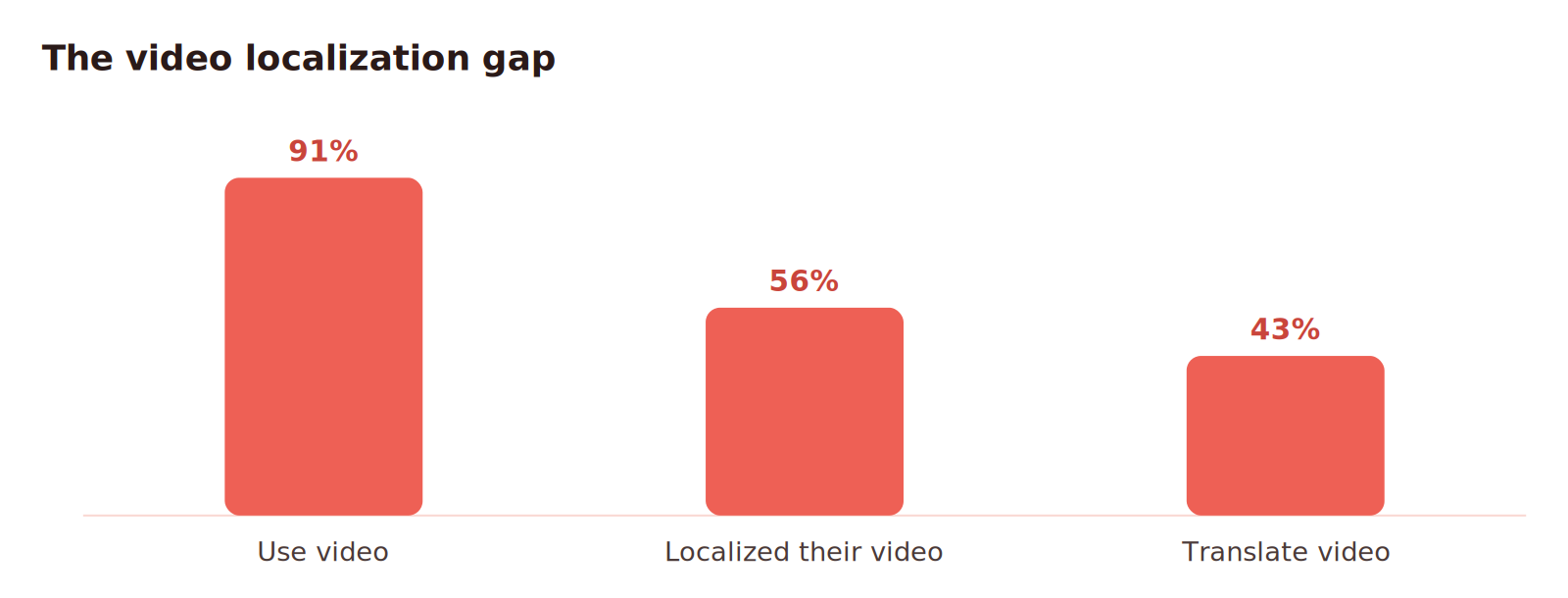
- A wide-open market: 91% of brands use video, but only about 43% localize it
- Pick the right method: Subtitles, voiceover, dubbing, or transcreation, matched to each video and market
- AI changed the economics: AI dubbing cuts costs up to 80% and turns weeks of work into minutes
- Design for it early: Editable text layers, clean audio, and glossaries make localizing far cheaper
What Is Video Localization?
Video localization is the process of adapting a video so it feels native to a specific language and culture. It goes well beyond swapping words: it covers the spoken audio, subtitles, on-screen text, graphics, colors, date and number formats, examples, and cultural references, plus the overall viewing experience. The principle is simple but demanding. Content that feels native builds trust, while content that feels translated creates friction.
That is the difference between translation and localization. Translation converts the dialogue; localization adjusts everything around it, idioms, visuals, pacing, and tone, so the message lands the same way it did at home. Transcreation goes one step further by recreating the creative intent for ads and campaigns.
Why Video Localization Matters in 2026
Localizing video is no longer a post-production afterthought; it is a growth decision with measurable returns, and localized video now drives real revenue. Four benefits stand out.
- Engagement and retention: native-language video resonates more, lifting watch time, completion, and, for training, comprehension by up to 30%.
- Reach and SEO: you tap audiences your English content never could, and localized content surfaces in local search.
- Compliance: in finance, legal, and medical, localized video is often a requirement, not a nice-to-have.
- Competitive advantage and ROI: repurposing one video across markets beats new production, and many competitors still publish in a single language.
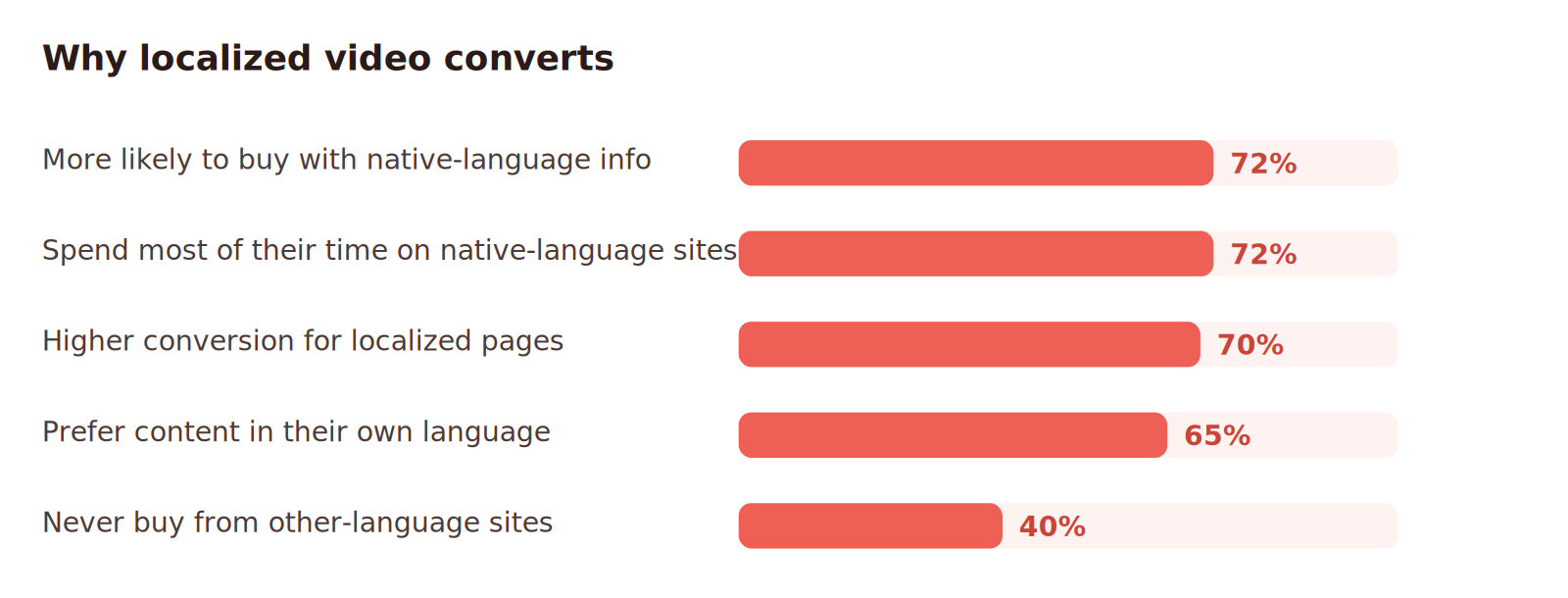
The opportunity is wide open, because making video and localizing it are very different things.

Video Localization Methods
There is no single right method for localizing videos; the best choice depends on your content, audience, and budget, and most teams mix several across a library.
| Method | What it does | Best for |
|---|---|---|
| Subtitles | Translated text on screen, original audio kept | Social clips, fast reach, market testing |
| Closed captions | Toggleable text, often with non-speech cues | Accessibility and compliance |
| Voiceover (UN-style) | Translated narration over a lowered original track | Interviews, documentaries, explainers |
| Dubbing | Original speech replaced with time-coded translated audio | Branded, training, and audience-facing video |
| Lip-sync dubbing | Dubbing matched to the speaker’s mouth movements | Premium, native-feeling content |
| Transcreation | Recreates message, idioms, and visuals for a culture | Ads and brand campaigns |
The Video Localization Process, Step by Step
Whether you localize one video or a whole catalog, a repeatable process keeps the quality of every localized video high as you scale. The key thing to remember is that the video stays the same; it is mainly the audio and text layers that change.
- Transcribe the source: Start from clean source audio and an accurate transcript. Everything downstream depends on this.
- Translate and transcreate the script: Go beyond literal translation: adapt idioms, examples, and tone, then time-code so the new script fits the footage.
- Choose audio or text: Decide per video between subtitles, voiceover, or dubbing, since not every video needs the same approach.
- Adapt on-screen text and visuals: Swap baked-in text, graphics, colors, and date or unit formats for localized versions in editable layers.
- Run native QA: Have a native speaker check timing, terminology, and cultural fit before release.
- Publish and measure by language: Track watch time, completion, and conversions per language, then refine and scale the winners.
How AI Changed the Economics of Video Localization
The old barrier was cost and time. Traditional studio dubbing runs roughly $160 to $430 per minute, per language, and every product update meant redoing the work. AI-based localization delivers up to 80% savings with turnaround measured in hours, and voice cloning now preserves a creator’s tone across languages. That is why the chart below matters: the brands that close the localization gap fastest are the ones reaching for one of the best video translator apps rather than manual-only workflows.
Localize Video at Scale With brandID's AI Video Translator
Traditional localization meant translators, voice actors, and weeks of editing for every language. AI collapses that into one fast workflow, and the brandID AI Video Translator is built for it. It dubs and translates your videos into 200+ languages and dialects while preserving your original voice, emotion, and lip-sync, so each version feels native rather than dubbed.
What it does:
- Authentic voice cloning: your tone and emotional delivery carry into every language, keeping brand personality intact.
- Flawless lip-sync: translated audio matches the speaker’s mouth movements, removing the off-putting dubbed look.
- Multi-speaker support: it separates and clones up to 8 voices, so interviews and panels stay natural.
- 200+ languages and dialects: reach virtually every market from a single source video.
- A simple 3-step workflow: upload a file or paste a YouTube link, pick the language, then export and share in minutes.
- Works where you do: a Chrome extension dubs YouTube videos in your browser, and the iOS and Android apps localize Reels, Shorts, and TikToks on the go. Grab the download links below.
That makes it the fastest way to translate YouTube videos and localize Reels and Shorts, with pricing from $1 per minute and monthly plans from $10.
Clone your voice, keep your lip-sync, and localize into 200+ languages in minutes. Try it free, no re-recording required.
Translate Your Video FreeVideo Localization Best Practices
These practices hold up across industries and content types, and they keep localizing video a repeatable system rather than a series of one-off projects:
- Design for localization from day one: Keep on-screen text in editable layers, not baked into frames, so each language does not require a manual re-edit.
- Capture clean source audio: Clear audio and idiom-free scripts translate more accurately and cut rework.
- Build a glossary and style guide per language: Lock product names, technical terms, and brand voice before translation so versions stay consistent.
- Start with high-impact, evergreen videos: Localize demos, onboarding, tutorials, and top performers first, not everything at once.
- Prioritize the markets that matter: Begin with regions that already show engagement or conversion potential, then expand.
- Pilot, then scale: Localize a couple of short videos, measure the impact, refine, and grow from there.
- Keep humans in the loop: Pair AI speed with native review for nuance, especially on technical or sensitive content.
Who Uses Video Localization?
Almost any video goal benefits, but a few use cases stand out: creators and YouTubers localizing their catalog to grow views and watch time; teachers and trainers making courses comprehensible worldwide; marketing teams adapting high-performing ads for new regions; product and SaaS teams localizing demos and onboarding; and podcasters and broadcasters localizing multi-speaker conversations. Whether you want to make money on TikTok or scale a global brand, localized videos multiply the reach of work you have already done.
Conclusion
Video localization turns a single message into a story that feels native in dozens of markets. Get the fundamentals right, design for localization from the start, choose the right method per video, build glossaries, and measure by language, and your existing content becomes a global growth engine. Start with your highest-impact videos, prove the process, then scale.
The barrier used to be cost and time. Now the brandID AI Video Translator handles dubbing, voice cloning, and lip-sync in minutes across 200+ languages, so localizing is finally practical at any size. Localization works best when the source is strong, so if you generate clips with AI, first make your AI videos look authentic, then localize them at scale. Pick your best videos, start localizing video into your priority languages, and let your reach compound.
Video Localization FAQs
What is the difference between video translation and video localization?
Translation converts the spoken or written words from one language to another. Localization is broader: it adapts the audio, subtitles, on-screen text, graphics, colors, formats, and cultural references so the video feels native to a specific market. Translation is one layer; localization is the full experience that makes content feel made-for-me rather than translated.
How much does video localization cost?
Traditional studio dubbing typically runs $160 to $430 per minute per language once you add translators, voice talent, and editing. AI-powered localization cuts that by up to 80% and delivers in hours instead of weeks. brandID’s AI Video Translator, for example, starts at $1 per minute with monthly plans from $10, which makes localizing at scale realistic for creators and small teams.
Which languages should I localize first?
Let your data decide. Look at completion rates and engagement by region, check where demand and traffic already come from, and weigh market size and spending power. A common move is to start with your domestic opportunity (for example, Spanish in the US), prove the ROI on a few videos, then expand into international markets.
Subtitling or dubbing, which is better?
It depends on the content. Subtitling is fast, affordable, and great for social clips and market testing, while dubbing replaces the audio for an immersive, native experience and suits branded and training video. Many teams subtitle first to validate a market, then invest in dubbing where they see traction.
How is AI changing video localization in 2026?
AI now combines transcription, translation, voice cloning, lip-sync, and subtitles in one workflow, so localization that once took weeks happens in minutes at a fraction of the cost. The video localization market is projected around $4 billion in 2026, and voice cloning that preserves a creator’s tone is a fast-growing piece of it. The best results pair AI speed with human review for nuance.
Can AI keep my voice and lip-sync when localizing?
Yes. brandID’s AI Video Translator clones your voice and matches the translated audio to the speaker’s mouth movements, and it can separate and clone up to 8 speakers in one video. That preserves brand personality and removes the dubbed look across 200+ languages.
How long does video localization take?
With traditional studios, a single language could take days or weeks per video. With AI dubbing, most videos finish in minutes, depending on length and the number of speakers, which is what makes localizing a whole library realistic.
How do I measure video localization ROI?
Track performance by language, not just in aggregate. Watch completion rates, watch time, traffic, leads, and conversions for each localized version against the original. Localized content has been shown to lift comprehension and conversion, so segmenting by language makes the payoff visible and tells you where to localize next.
 Summarize this article with: