Search for pay per click affiliate programs and you will find two completely different things wearing the same name, which is why most advice on the subject contradicts itself.
One meaning is publisher CPC: you own a site, a network places ads on it, and you get paid every time somebody clicks. The other is advertiser PPC: you join a CPA network and spend your own money on Google Ads to drive traffic to affiliate offers.
The first pays you for clicks. The second charges you for them. Confusing the two is how people end up applying to networks that were never going to accept them.
This covers the first meaning, which is what almost everybody searching actually wants, alongside the honest math on what per-click monetization pays against commission. There is also a third group, paid-to-click sites that pay you to click other people’s ads, and we cover whether those are worth your time further down. The full range of options sits in the best affiliate programs.
Key Takeaways
Key Takeaways
- Most PPC affiliate programs are ad networks, not affiliate programs. AdSense is not an affiliate program, and calling it one causes real confusion
- Typical payouts run $0.05 to $3 per click, with high-competition finance and legal niches occasionally exceeding $50
- Entry bars shifted in the last year: AdSense and the self-serve networks have no minimum, Raptive now accepts 25,000 monthly pageviews, Mediavine qualifies sites on $5,000 a year in ad revenue, and Ezoic raised its bar for new sites to 250,000 monthly users
- EPC is the fair comparison, since a commission link that earns $0.60 per click beats a $0.30 ad click on the same visitor
- Paid-to-click sites pay fractions of a cent per click, so they are pocket change, not an income stream
- RPM is the number that matters, not CPC. Premium networks reach $15 to $35 per thousand sessions
- Almost every network bans paid traffic because buying clicks to sell clicks is click fraud
- Commission usually beats clicks on the same traffic, so per-click monetization works best on pages that were never going to convert
- Payout thresholds vary from $5 to $100, and a low one matters more than a high CPC when you are starting
Best Pay Per Click Affiliate Programs Compared
| Program | Traffic needed | Payout threshold | Model |
|---|---|---|---|
| Google AdSense | None | $100 | CPC and CPM |
| Media.net | Quality content, US and UK traffic | $100 | Contextual CPC |
| Ezoic | 250,000 monthly users for new sites | $20 | CPM with AI optimization |
| Mediavine | $5,000 yearly ad revenue (Journey: 1,000 sessions) | $25 | Premium CPM |
| Raptive | 25,000 pageviews | $25 | Premium CPM |
| Skimlinks | None | $65 | Hybrid click and commission |
| Sovrn Commerce | None | $25 | Hybrid click and commission |
| Infolinks | None | $50 | In-text CPC |
| PropellerAds | None | $5 | CPC and CPM |
| Adsterra | None | $5 | CPC, CPM and CPA |
| RevenueHits | None | $20 | CPA and CPC hybrid |
| Taboola | Large sites, no published minimum | $50 | Native CPC |
| Bidvertiser | None | $10 (PayPal) | Bid-based CPC |
What Are Pay Per Click Affiliate Programs?
A pay per click affiliate program pays you a fixed amount each time a visitor clicks an ad or link on your site. You are paid for the click itself, whether or not the visitor ever buys anything.
That is the whole appeal. Traditional affiliate marketing pays only on a completed sale, so the risk sits with you. Per-click monetization moves that risk to the advertiser.
It is also why the rates are low. An advertiser paying for clicks with no guarantee of a sale will not pay much per click, which is the tradeoff nobody mentions in the headline.
Publisher CPC vs Advertiser PPC
This distinction is worth fixing in your head before you compare any programs, because the two models have opposite cash flows.
| Publisher CPC | Advertiser PPC | |
|---|---|---|
| What you do | Place ads or links on your own site | Buy ads on Google, Bing or Meta |
| Money direction | You get paid | You pay first, then hope to earn |
| What you need | Traffic | Budget and a converting offer |
| Risk | None, beyond your time | Full, since ad spend is lost if it fails |
| Typical examples | AdSense, Media.net, Ezoic, Mediavine | ClickBank and CPA networks that allow paid traffic |
| Who it suits | Bloggers and site owners | Media buyers with capital |
13 Best PPC Affiliate Programs Reviewed
Each entry below opens with what the platform actually is, then covers payout model, threshold, traffic requirement and the honest limits. They start with the networks most sites try first, move through the premium managers, then cover hybrid, global and native networks.
1- Google AdSense
Google AdSense is an advertising network for publishers, and the default first stop for almost every site owner. Google matches ads to your content and to each visitor’s browsing history, then pays per click or per thousand impressions.
It heads most lists of pay per click affiliate programs despite not being an affiliate program at all, which matters because the approval process and the rules are those of an ad network.
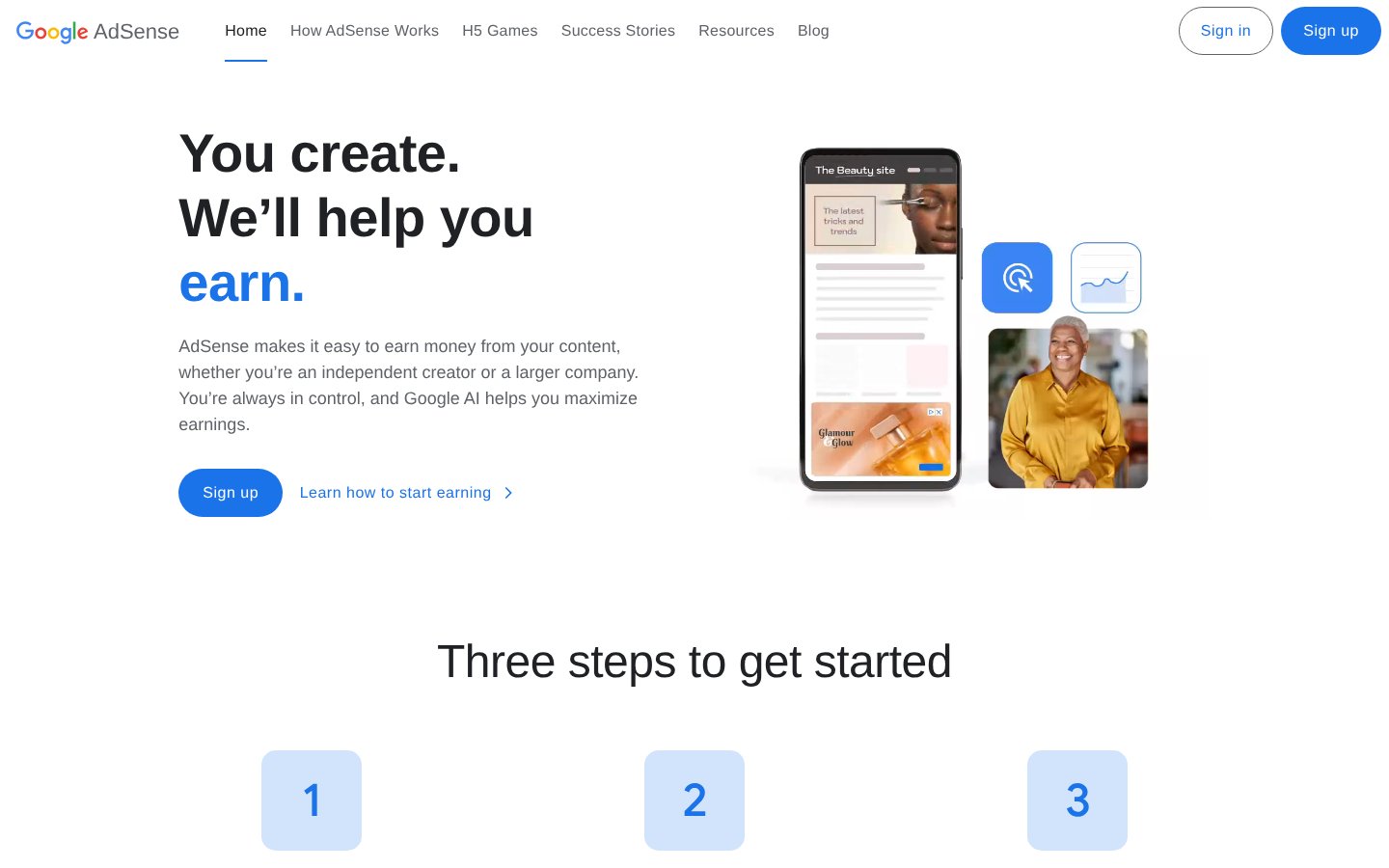
Google AdSense Key Features:
- AdSense Payout: Per click and per thousand impressions, set by advertiser auction
- AdSense Threshold: $100 before payout, monthly by bank transfer
- AdSense Traffic requirement: None officially, but thin or scraped content is rejected
- AdSense Formats: Display, in-feed, in-article, multiplex and auto ads
| ✔ Google AdSense Pros | ✕ Google AdSense Cons |
|---|---|
|
|
Best For: Newer sites and anyone who wants one network that works across every niche.
2- Media.net
Media.net is a contextual advertising network powered by Yahoo and Bing demand, and the closest thing to a genuine AdSense alternative rather than a supplement.
Among PPC affiliate programs it is unusual in reading the page rather than the visitor, so it performs best where content is tightly focused on a commercial topic.
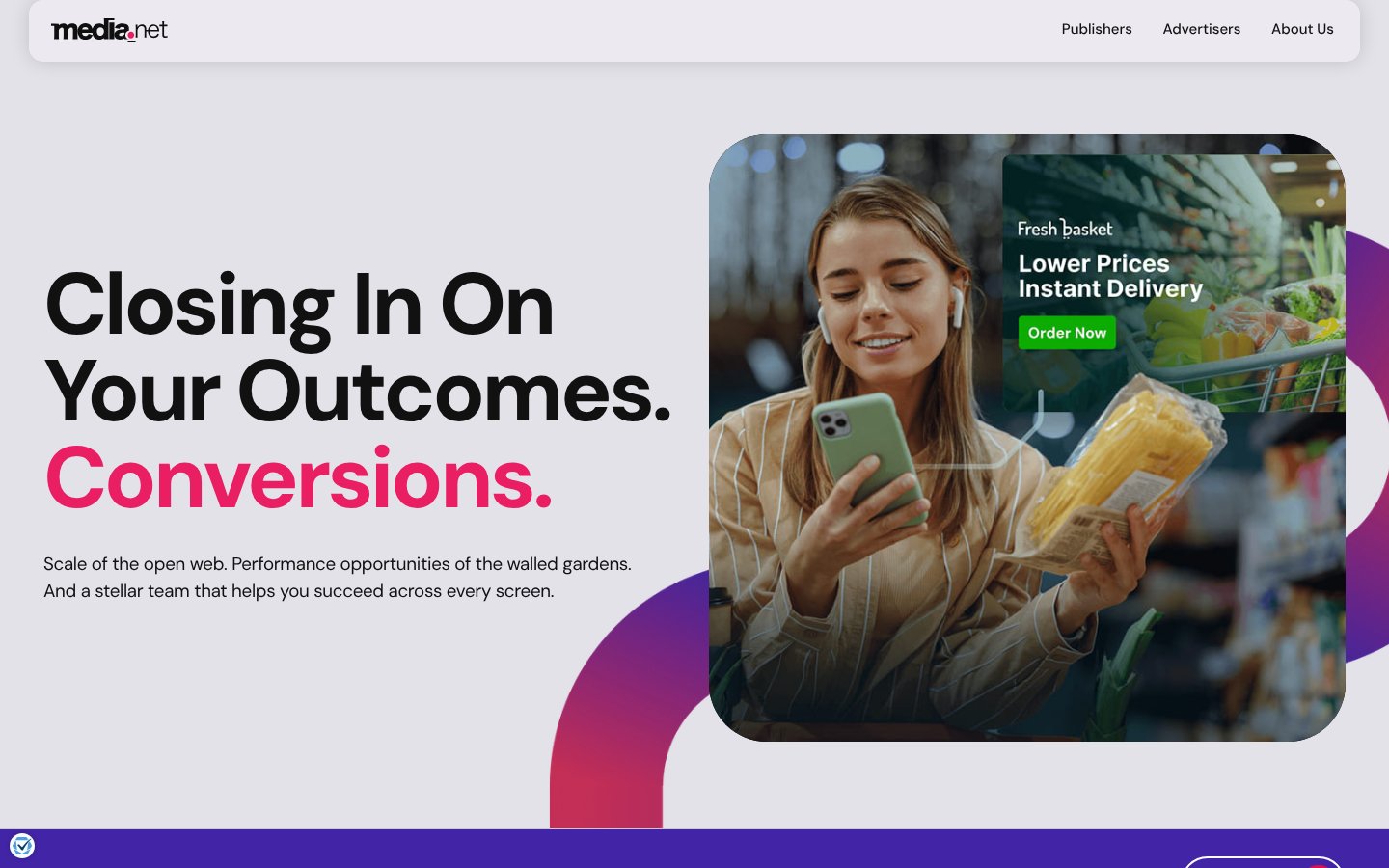
Media.net Key Features:
- Media.net Payout: Contextual CPC, strongest in finance, insurance, legal and tech
- Media.net Threshold: $100, paid monthly
- Media.net Traffic requirement: No hard number, but heavy US, UK and Canada traffic is expected
- Media.net Formats: Display, native and contextual units
| ✔ Media.net Pros | ✕ Media.net Cons |
|---|---|
|
|
Best For: Finance, insurance, legal and B2B software sites with mostly US or UK readers.
3- Ezoic
Ezoic is a monetization platform that sits between you and multiple ad networks, testing placements and layouts automatically to find the combination that earns most.
That makes it less a single pay per click affiliate program than a layer running several at once. The tradeoff is that it takes control of your layout, which some site owners find intrusive.
The bigger change is access. In February 2026 Ezoic raised its minimum for new publishers to 250,000 monthly users, so for most growing sites it is no longer an option. Smaller sites with strong potential can apply to its Incubator program, which accepts 20 publishers a month.
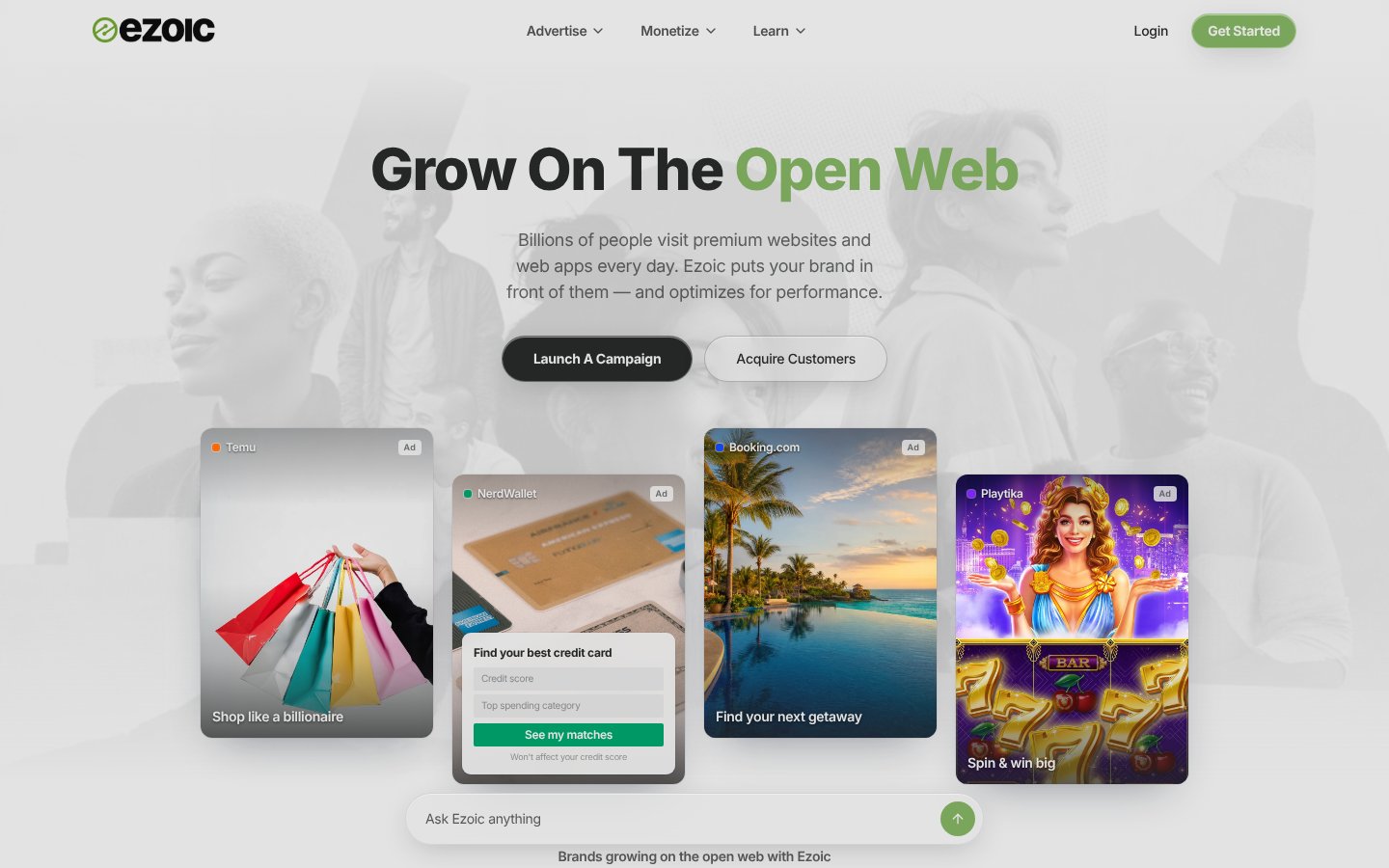
Ezoic Key Features:
- Ezoic Payout: Per thousand sessions, with revenue drawn from several networks at once
- Ezoic Threshold: $20, paid monthly
- Ezoic Traffic requirement: 250,000 monthly users for new publishers since February 2026, with an Incubator route for smaller sites
- Ezoic Extras: Site speed tools, analytics and a free CDN included
| ✔ Ezoic Pros | ✕ Ezoic Cons |
|---|---|
|
|
Best For: Large sites past 250,000 monthly users that want automated multi-network testing, or smaller sites accepted into the Incubator.
4- Mediavine
Mediavine is a premium ad management company that takes over monetization entirely for sites that qualify, and it is widely regarded as the point at which display income becomes a real business.
It sits at the top of most highest paying pay per click affiliate programs lists for good reason. Entry is now based on revenue rather than traffic: Mediavine looks for at least $5,000 in annual ad revenue. Sites below that can start on Journey by Mediavine, which accepts sites with 1,000 monthly sessions from the US, Canada, the UK or Australia.
Mediavine Key Features:
- Mediavine Payout: RPM typically $15 to $30, higher in finance and home niches
- Mediavine Threshold: $25, paid on net 65 terms
- Mediavine Entry requirement: $5,000 in annual ad revenue for full management, or 1,000 tier-one sessions in 30 days for Journey
- Mediavine Exclusivity: Exclusive, so it replaces all other display ads
| ✔ Mediavine Pros | ✕ Mediavine Cons |
|---|---|
|
|
Best For: Content sites earning $5,000 or more a year from ads, particularly food, home, finance and parenting, with Journey as the on-ramp for smaller sites.
5- Raptive
Raptive, formerly AdThrive, is a premium ad management network that reports the highest RPMs in the industry. It works the same way as Mediavine, and since October 2025 it accepts sites at a quarter of its old traffic requirement.
If you are ranking PPC affiliate networks purely on earnings per visitor, this is the top of the market. Its advertiser relationships skew toward large consumer brands, which is why lifestyle content performs unusually well.
Raptive Key Features:
- Raptive Payout: RPM typically $20 to $35, among the highest available
- Raptive Threshold: $25, net 45 terms
- Raptive Traffic requirement: 25,000 monthly pageviews, with at least 50% of traffic from the US, UK, Canada, Australia or New Zealand below 100,000 pageviews
- Raptive Extras: Revenue guarantee and creator business services
| ✔ Raptive Pros | ✕ Raptive Cons |
|---|---|
|
|
Best For: Lifestyle, food and travel sites past 25,000 monthly pageviews with mostly US, UK, Canadian, Australian or New Zealand readers.
6- Skimlinks
Skimlinks is an automatic affiliate linking service that converts ordinary product mentions in your content into tracked links across more than 48,000 merchants, paying on both clicks and resulting sales.
That hybrid model makes it the closest thing here to a true pay per click affiliate program, since it pays on clicks that never convert. You do not apply to individual merchant programs, which removes most of the admin from affiliate content.
Skimlinks Key Features:
- Skimlinks Payout: Commission share plus per-click revenue on unmonetized clicks
- Skimlinks Threshold: $65, £50 or €55 in cleared commissions
- Skimlinks Traffic requirement: None, though low-traffic sites earn little
- Skimlinks Coverage: 48,000+ merchants, applied automatically to existing links
| ✔ Skimlinks Pros | ✕ Skimlinks Cons |
|---|---|
|
|
Best For: Content sites that mention products constantly but do not want to manage dozens of merchant relationships.
7- Sovrn Commerce
Sovrn Commerce, previously VigLink, is an automatic affiliate linking service with a display advertising arm attached through Sovrn’s wider network.
It works on the same principle as Skimlinks and suits publishers who want both PPC affiliate program revenue and commission running from a single relationship.
Sovrn Commerce Key Features:
- Sovrn Payout: Commission share plus display revenue
- Sovrn Threshold: $25, paid monthly
- Sovrn Traffic requirement: None
- Sovrn Formats: Automatic affiliate links plus display and video inventory
| ✔ Sovrn Commerce Pros | ✕ Sovrn Commerce Cons |
|---|---|
|
|
Best For: Small and mid-size blogs wanting both display and affiliate income without running two systems.
8- Infolinks
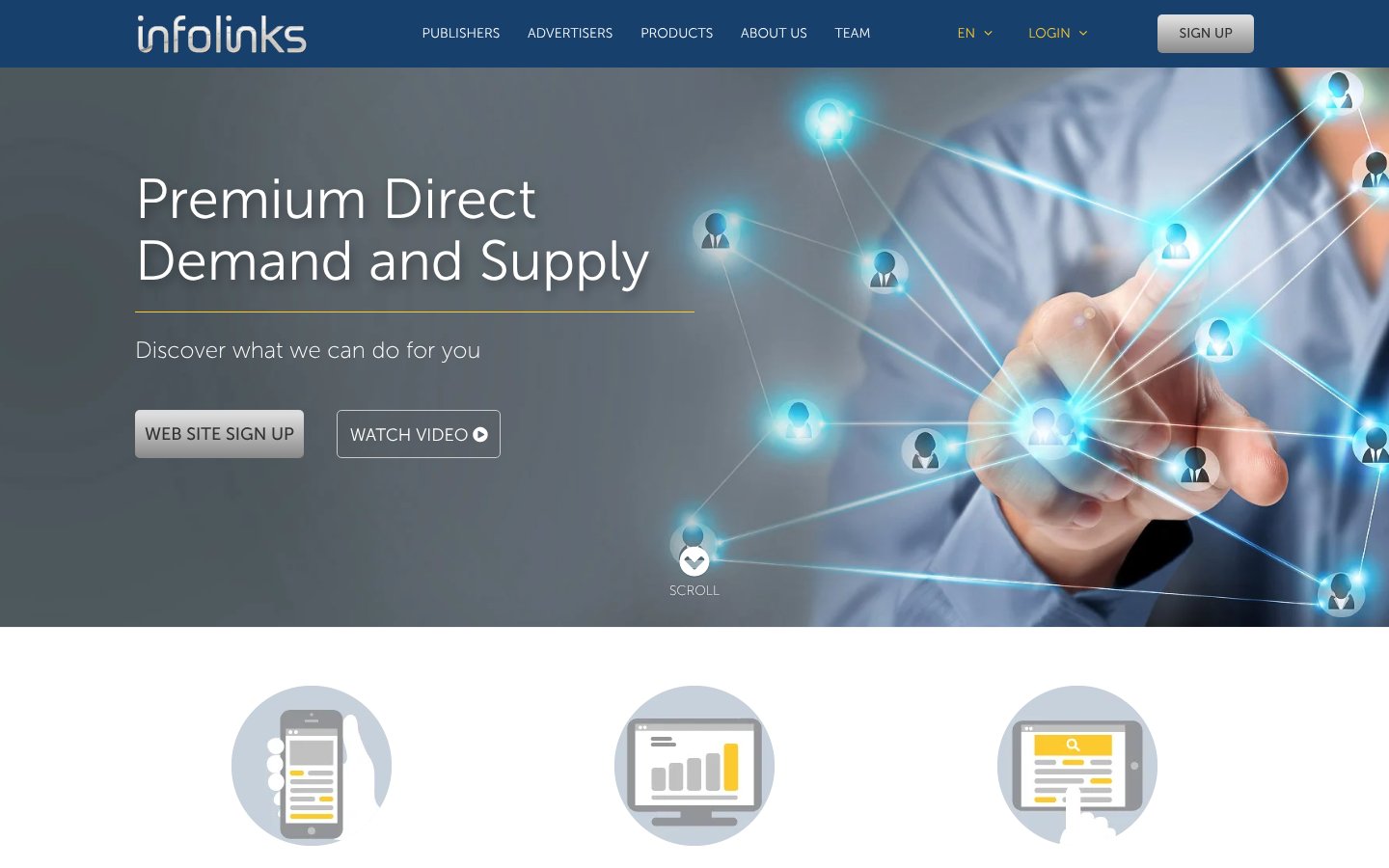
Infolinks is an in-content advertising network that places ads inside your existing text rather than in separate blocks, using in-text, in-frame and in-tag formats.
It is one of the few pay per click affiliate programs that costs you no layout space, which is why publishers commonly run it alongside another network rather than instead of one.
Infolinks Key Features:
- Infolinks Payout: CPC on in-text and in-fold units, plus CPM formats
- Infolinks Threshold: $50, paid monthly by PayPal, wire or eCheck
- Infolinks Traffic requirement: None
- Infolinks Formats: InText, InFold, InTag, InScreen and InArticle
| ✔ Infolinks Pros | ✕ Infolinks Cons |
|---|---|
|
|
Best For: Text-heavy blogs looking for incremental revenue on top of an existing network.
9- PropellerAds
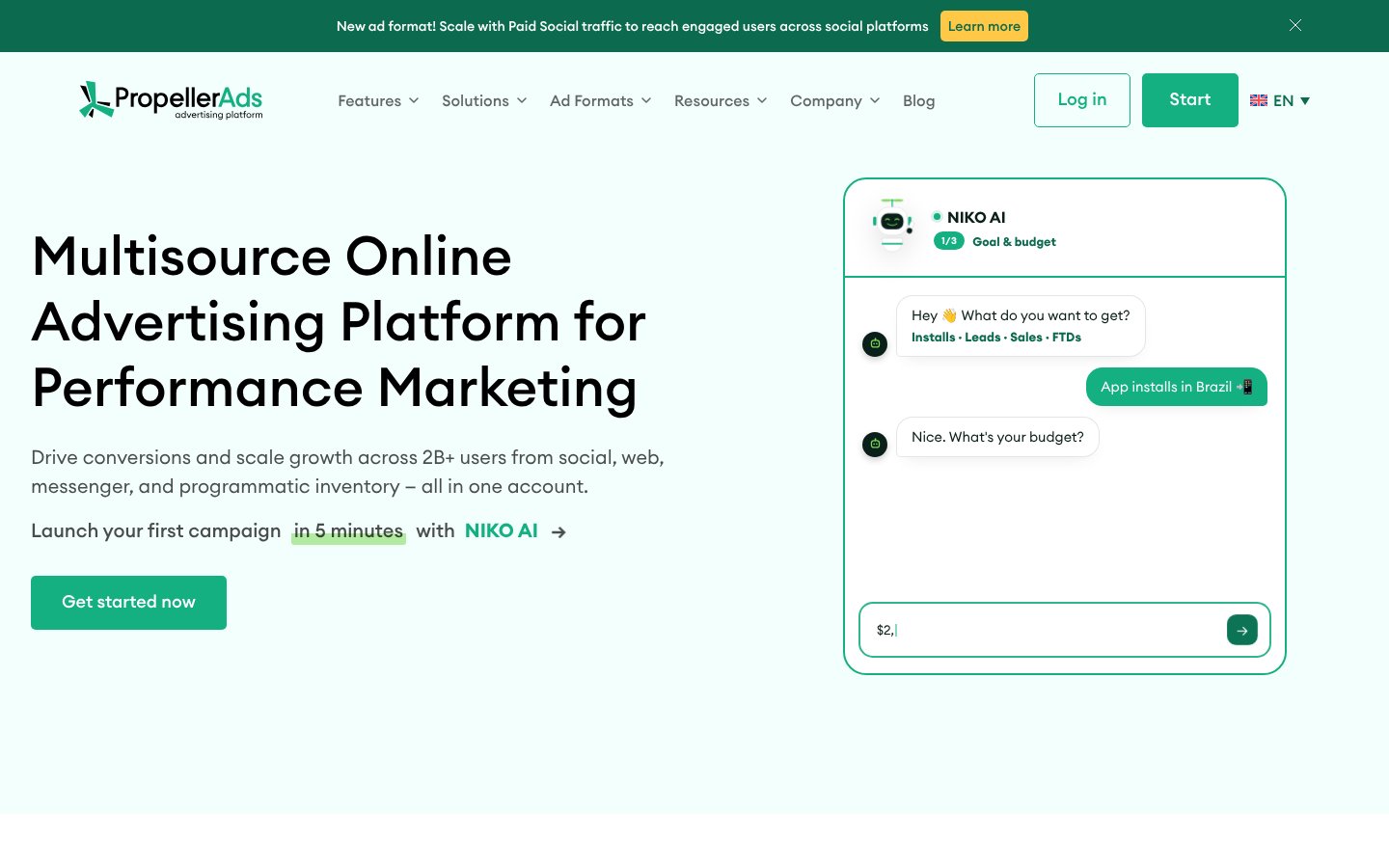
PropellerAds is a self-serve advertising network built around push notifications, interstitials and pop formats, accepting traffic and geographies that mainstream networks decline.
Among PPC affiliate networks it is the one that will monetize almost anything. The formats are aggressive, so it is a poor fit for a site whose reputation depends on reading experience.
PropellerAds Key Features:
- PropellerAds Payout: CPC and CPM across push, popunder, interstitial and in-page formats
- PropellerAds Threshold: $5, paid on net 30 through several methods
- PropellerAds Traffic requirement: None
- PropellerAds Reach: Global, including tier-two and tier-three countries
| ✔ PropellerAds Pros | ✕ PropellerAds Cons |
|---|---|
|
|
Best For: Publishers with large non-tier-one audiences that mainstream networks will not monetize.
10- Adsterra
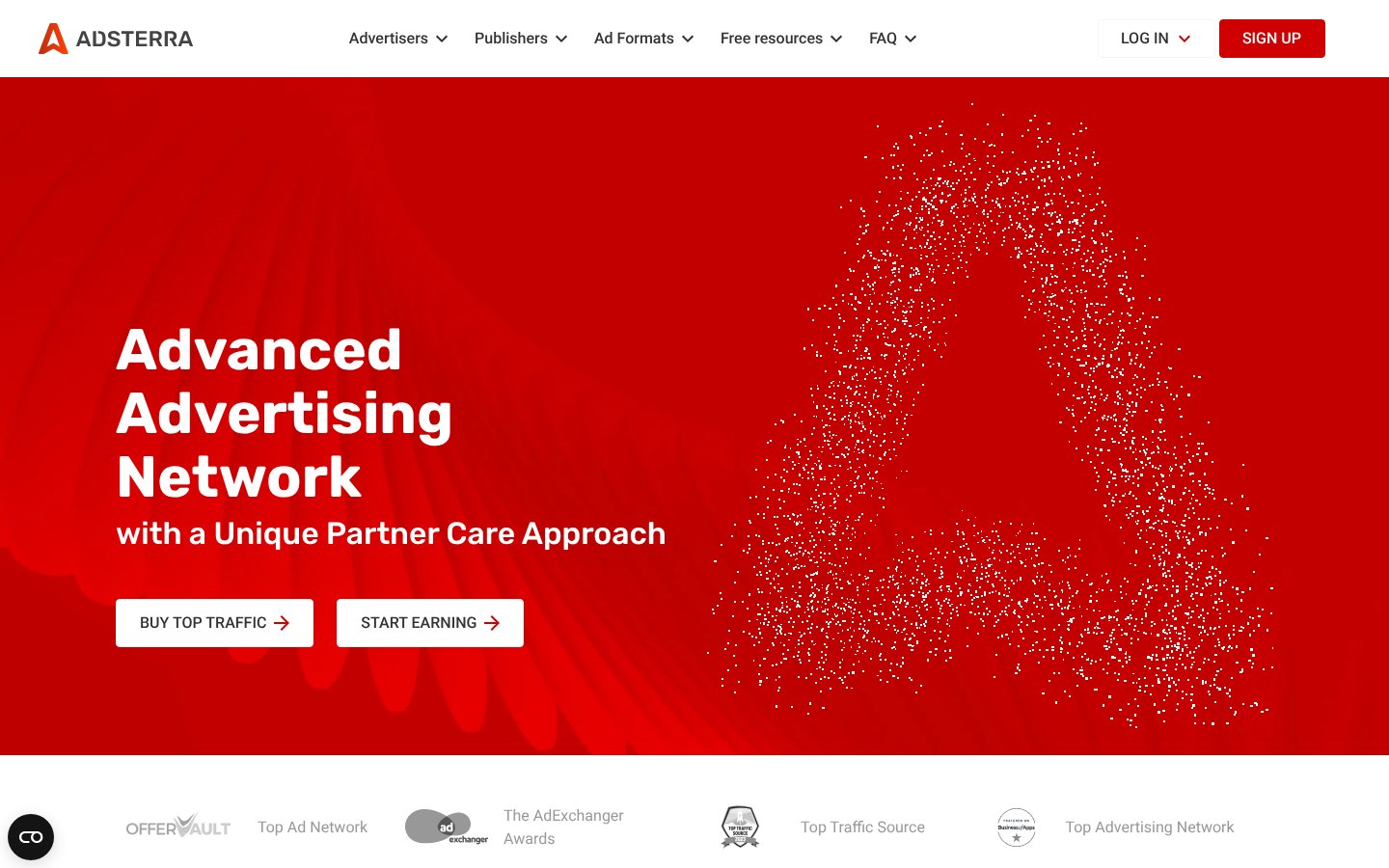
Adsterra is a global advertising network running CPC, CPM and CPA models in one account, with a broader format range and faster support than most self-serve platforms.
Its strength as a pay per click affiliate network is filling inventory the mainstream players ignore, particularly outside tier-one countries.
Adsterra Key Features:
- Adsterra Payout: CPC, CPM and CPA depending on the format chosen
- Adsterra Threshold: $5 on most methods, biweekly payments available
- Adsterra Traffic requirement: None
- Adsterra Formats: Popunder, social bar, in-page push, native, banner and direct link
| ✔ Adsterra Pros | ✕ Adsterra Cons |
|---|---|
|
|
Best For: Publishers with international traffic who need formats that work outside standard display.
11- RevenueHits
RevenueHits is a performance-based ad network where you earn when a visitor completes an action, with clicks contributing on some formats.
That makes it a hybrid rather than one of the pure pay per click affiliate programs, and it means earnings swing more than they would on a straight CPC network.

RevenueHits Key Features:
- RevenueHits Payout: CPA-led with CPC and CPM elements by format
- RevenueHits Threshold: $20 by PayPal or Payoneer, net 30
- RevenueHits Traffic requirement: None
- RevenueHits Formats: Banner, popunder, slider, footer, shadowbox and interstitial
| ✔ RevenueHits Pros | ✕ RevenueHits Cons |
|---|---|
|
|
Best For: Sites with high commercial intent traffic that converts, where a pure CPC rate would undersell the audience.
12- Taboola
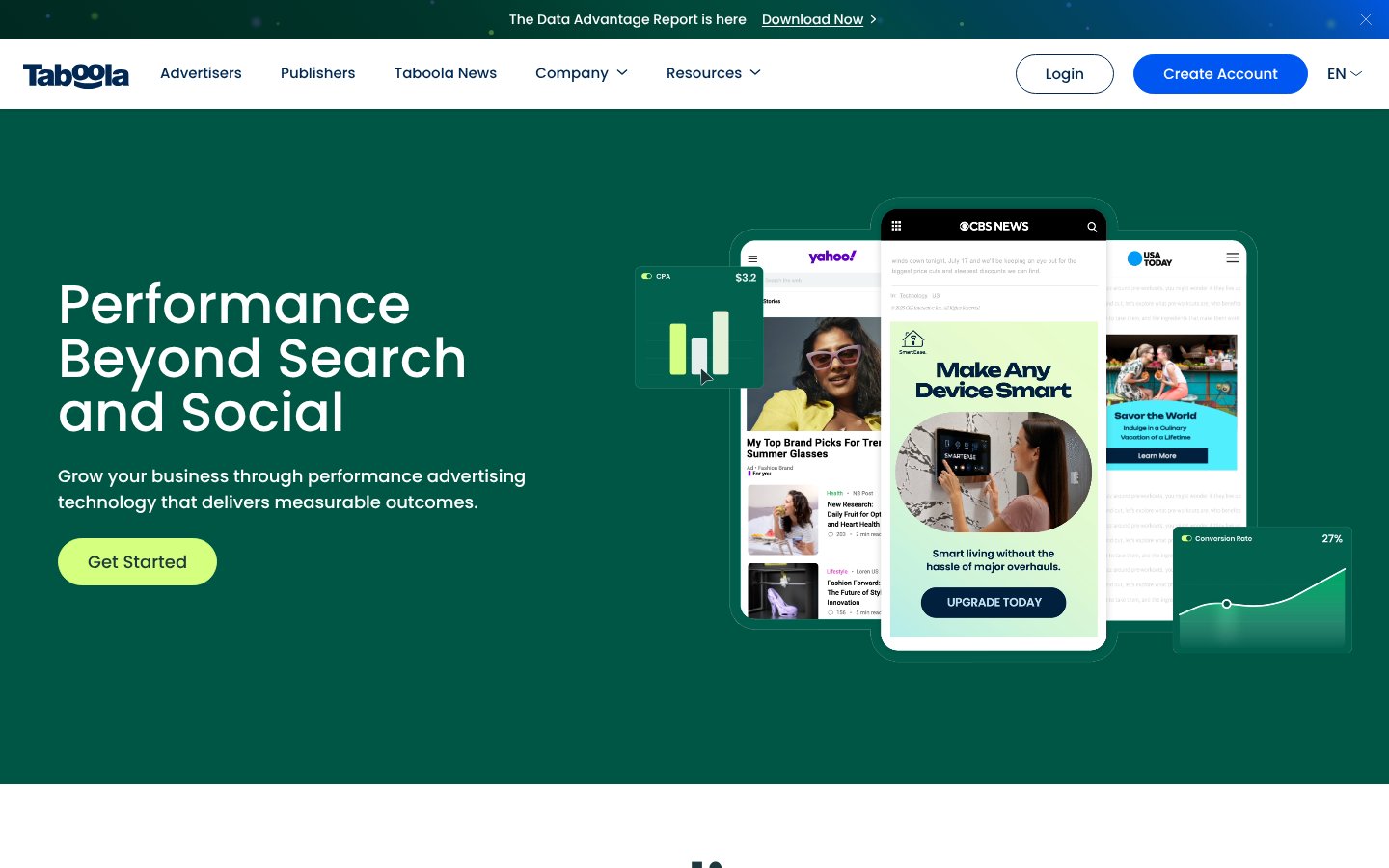
Taboola is a native advertising network supplying the recommended-content widgets that appear beneath articles on major publisher sites.
Its ads look like editorial links, which is why click rates beat every other PPC affiliate program here. It does not publish a traffic minimum, but in practice it works with large publishers, which puts it out of reach for most small sites.
Taboola Key Features:
- Taboola Payout: CPC on native recommendation widgets
- Taboola Threshold: $50, net 45
- Taboola Traffic requirement: No published minimum, but built for large publishers
- Taboola Extras: A/B testing of feed layouts and detailed engagement analytics
| ✔ Taboola Pros | ✕ Taboola Cons |
|---|---|
|
|
Best For: Large publishers with heavy monthly traffic who can absorb the format’s effect on page quality.
13- Bidvertiser
Bidvertiser is one of the oldest true pay per click networks. Advertisers bid for placement on your site, and you earn when a visitor clicks one of their ads.
That makes it the purest per-click model on this list, since payouts follow advertiser bids rather than impressions. The tradeoff is relevance, because ads are not matched to your content by default.
Bidvertiser Key Features:
- Bidvertiser Payout: CPC set by advertiser bidding, with CPM and CPA on some formats
- Bidvertiser Threshold: $10 by PayPal, $100 by check, $500 by wire, net 30
- Bidvertiser Traffic requirement: None
- Bidvertiser Formats: Native, slider, pop-under and push notification ads
| ✔ Bidvertiser Pros | ✕ Bidvertiser Cons |
|---|---|
|
|
Best For: Small, US-focused sites that want a pure per-click network running beside AdSense.
Highest Paying Pay Per Click Affiliate Programs, Ranked
Ranked by typical RPM, the revenue each network earns per thousand sessions, because that is the number that turns into money. The highest paying program you can actually join depends on where your traffic sits today.
| Rank | Program | Typical RPM | Entry bar |
|---|---|---|---|
| 1 | Raptive | $20 to $35 | 25,000 monthly pageviews |
| 2 | Mediavine | $15 to $30 | $5,000 yearly ad revenue |
| 3 | Ezoic | $8 to $20 | 250,000 monthly users for new sites |
| 4 | Media.net | $8 to $18 | Mostly US, UK and Canadian readers |
| 5 | Google AdSense | $4 to $12 | None |
| 6 | Adsterra and PropellerAds | $2 to $6 | None |
For a newer site, the highest paying option you can realistically join is AdSense or Media.net, then Journey by Mediavine once you pass 1,000 tier-one sessions a month. Raptive at 25,000 pageviews is now the first premium step most growing sites can reach.
What You Will Actually Earn
CPC is the number networks advertise and the wrong one to plan with. What matters is RPM: revenue per thousand sessions, which folds click rate and fill rate into a single figure.
A $2 CPC sounds excellent until you notice that only 1% of visitors click, which turns it into a $20 RPM. A $0.30 CPC with a 6% click rate produces the same result.
| Monthly sessions | At $5 RPM | At $15 RPM | At $30 RPM |
|---|---|---|---|
| 5,000 | $25 | $75 | $150 |
| 25,000 | $125 | $375 | $750 |
| 50,000 | $250 | $750 | $1,500 |
| 100,000 | $500 | $1,500 | $3,000 |
| 250,000 | $1,250 | $3,750 | $7,500 |
Clicks Versus Commission on the Same Traffic
This is the comparison that decides whether per-click monetization deserves your best pages, and it usually does not.
Amazon makes the contrast concrete. Rates in Amazon affiliate program categories run from 1% to 20%, so a single $200 order can pay more than a month of ad clicks on the same page.
| Pay per click | Affiliate commission | |
|---|---|---|
| Paid when | A visitor clicks | A visitor buys |
| Typical value per event | $0.05 to $3 | $5 to $200+ |
| Conversion needed | About 1% to 6% click through | About 1% to 3% purchase rate |
| Revenue per 1,000 visitors | Roughly $5 to $35 | Roughly $50 to $600 |
| Effort | Install once, mostly passive | Ongoing content and product research |
| Best used on | Informational pages with no buying intent | Reviews, comparisons and buying guides |
The practical rule is to keep display off your commercial pages. An ad click earns you thirty cents and removes a visitor who was about to earn you thirty dollars.
Getting that split right is the whole discipline, and an affiliate marketing guide covers how commission programs are structured once you decide which pages deserve them.
Working out which pages deserve which treatment is the same exercise as promoting affiliate links effectively, since both depend on reading intent rather than traffic volume.
EPC: How Earn Per Click Affiliate Programs Compare
Commission programs have their own per-click number, and it is the fairest way to compare them with ad networks. EPC, or earnings per click, is the total commission a program pays divided by the clicks it took to earn it. Some networks, including CJ, show it per 100 clicks instead of per click.
The formula: EPC = conversion rate × average commission. A 2% conversion rate on a $30 commission is an EPC of $0.60, double a $0.30 ad click on the same visitor.
| 1,000 clicks on | Earns | Per click |
|---|---|---|
| Ad network at $0.30 CPC | $300 | $0.30 |
| Affiliate offer, 2% convert, $30 commission | $600 | $0.60 |
| Affiliate offer, 1% convert, $15 commission | $150 | $0.15 |
| Affiliate offer, 3% convert, $40 commission | $1,200 | $1.20 |
When you look for the best EPC affiliate programs, read the numbers carefully:
- Use the three-month EPC, not the seven-day figure, which swings with a single good week.
- Remember it is an average across every affiliate in the program, including ones with far better or worse traffic than yours.
- Work out your break-even. To beat a $0.30 CPC with a $20 commission, you need a conversion rate of 1.5%.
- Track your own EPC after a few hundred clicks. That is the only figure that tells you which pages deserve commission links.
Rules Every Network Enforces
Publisher accounts get closed for the same handful of reasons, and the money in the account usually goes with them.
- No paid traffic. Buying clicks to sell clicks is arbitrage, and networks treat it as fraud.
- No clicking your own ads, including from another device or asking friends. Detection is straightforward.
- No encouraging clicks. Arrows, misleading labels and any wording that asks visitors to click will trigger a review.
- Placement limits apply. Ads that overlay content or sit under a cursor are counted as accidental-click bait.
- Traffic quality is monitored. Bot traffic and click farms are caught by pattern analysis, whether or not you bought them knowingly.
- Content restrictions hold. Adult, weapons, and most drug-adjacent content disqualify you from mainstream networks.
💡 The invalid traffic problem nobody warns about:
You are responsible for traffic you did not buy. A competitor sending bot clicks at your ads can get your account suspended, so watch analytics for unexplained spikes and report them to your network before it flags them itself.
PPC Affiliate Programs That Let You Buy Ads
If you searched for PPC affiliate programs because you want to run Google, Microsoft or Meta ads to affiliate offers, that is the advertiser model, and it lives or dies on one comparison: your EPC has to be higher than what you pay per click.
A campaign paying $0.80 a click, converting at 3% on a $40 commission, earns $1.20 per click and profits $0.40. Drop the conversion rate to 1.5% and the same campaign loses $0.20 on every click.
Before you spend anything, read the program’s paid search or PPC policy. SaaS programs such as CRM and marketing tools usually publish one, and most consumer brands bury the rules in their affiliate terms. These are the terms that matter:
| Policy term | What it means | Usual rule |
|---|---|---|
| Brand bidding | Bidding on the merchant’s brand name or trademarks | Usually banned |
| Trademark plus modifier | Brand name plus words like “review” or “coupon” | Sometimes allowed, often only with written approval |
| Misspellings and variants | Typos and close versions of the brand name | Treated the same as brand bidding |
| Direct linking | Ad clicks go straight to the merchant through your affiliate link | Often banned, so you need your own landing page |
| Negative keywords | The merchant requires you to exclude its brand terms | Common requirement |
| Brand in ad copy or URL | Using the trademark in headlines or display URLs | Usually banned |
💡 Get permission in writing.
If the policy is vague, email the affiliate manager and keep the reply. Programs detect paid search clicks through tracking parameters, and “nobody told me” does not get commissions reinstated.
Get Paid to Click Ads: Do PTC Sites Actually Pay?
Paid-to-click (PTC) and get-paid-to sites pay you to view ads, click links, watch videos and take surveys. Some are real businesses, but the clicks themselves are worth almost nothing. One review of TimeBucks puts its push clicks at $0.002 each when you earned nothing the day before, which is $2 for 1,000 clicks.
Most of the money on these sites comes from surveys and offers, not ad clicks, and even then the reviewers who test them say not to expect a living from it.
| Model | Who pays you | Realistic per click | Worth it? |
|---|---|---|---|
| PTC and reward sites | The site, from advertiser budgets | Fractions of a cent | Pocket change at best |
| Publisher CPC networks | The ad network | $0.05 to $3 | Yes, once you have traffic |
| Affiliate commission | The merchant | Your EPC, often higher than CPC | Yes, on pages with buying intent |
Red flags that mean a PTC site is a scam:
- It promises 50 cents, $5 or $50 per click. No advertiser pays an anonymous clicker that much.
- It charges an upgrade or membership fee to unlock higher click rates.
- Earnings mostly come from recruiting other members.
- The withdrawal threshold keeps rising just as you get close to it.
- It asks you to click ads on your own site or someone else’s, which is click fraud and gets publisher accounts banned.
If you want to get paid for clicks on your link, the realistic route is owning the link. Share affiliate products from a page like brandID and every click can turn into a commission instead of a fraction of a cent.
Where brandID Fits
Per-click programs pay because a click is worth something to an advertiser. That value is a fraction of what the same visitor is worth if they buy, which is the case for putting commission ahead of clicks wherever intent exists.
brandID runs an affiliate marketplace built for creators rather than site owners, which changes the requirements considerably.
- No traffic minimum and no approval. Nothing to qualify for, no application, and no waiting on a network to review your site.
- Over 5 million products from more than 2,000 brands across fashion, beauty, health, fitness, food, electronics, pets and most consumer categories.
- Commissions of up to 65%, against $0.05 to $3 for an ad click, which lifts your EPC on the same traffic.
- Weekly payouts with no minimum threshold, compared to $100 thresholds and net 45 terms on premium ad networks.
- It works without a website, which matters because most per-click networks require one and social traffic has nowhere else to go.
On your own products, brandID takes a 5% fee on the free plan and 0% on paid plans from $9 a month when you connect your own payment gateway. Affiliate products sit alongside your own digital products on the same page.
Pay Per Click Affiliate Programs in India
Most self-serve networks accept publishers in India, including Google AdSense, Adsterra, PropellerAds and Bidvertiser. What changes is the rate. Advertisers bid far less for Indian visitors, so AdSense RPMs on Indian traffic often sit around $1 to $3, against several times that for US readers.
- Media.net looks for mostly US, UK and Canadian readers, so sites with Indian audiences are usually declined.
- Raptive and Journey by Mediavine count tier-one traffic only, which rules out most India-focused sites.
- Adsterra and PropellerAds fill Indian traffic well, at the cost of more aggressive formats.
- Commission often travels better than clicks. A sale through an affiliate link pays the same commission rate wherever the buyer lives, which is why Indian creators with global audiences often earn more from affiliate links than from ads.
How to Choose a Program
- 1- Start from your traffic number. Below 10,000 sessions, only the no-minimum networks are open to you, so the choice is narrower than these lists suggest. Audience-size gates work the same way across monetization generally, which is why how many followers you need to get paid on Instagram has a comparable answer.
- 2- Check the threshold before the rate. A $5 threshold paying modestly beats a $100 threshold you will not reach for a year.
- 3- Match the network to your niche. Media.net rewards commercial topics, Raptive rewards lifestyle, and neither works well on the other.
- 4- Count the exclusivity cost. Mediavine and Raptive replace everything else, so joining means giving up any hybrid setup.
- 5- Protect the pages that convert. Keep display off reviews and comparisons where commission is available.
- 6- Test for at least 60 days. Seasonal advertiser demand swings enough that a shorter test tells you nothing.
Mistakes to Avoid
- Joining before you have traffic. Per-click income scales with visitors and nothing else. At 500 sessions a month there is no network worth the setup, and creators without a site are better served by one of the best link in bio tools instead.
- Stacking four networks on one page. Load time collapses, RPM falls, and page experience signals suffer.
- Chasing CPC instead of RPM. A high CPC with poor fill earns less than a modest CPC that always serves.
- Running display on money pages. The commission you lose is worth many multiples of the click you gained.
- Ignoring page speed. Ad scripts are usually the heaviest thing on the page, and slower pages rank lower.
- Treating it as passive income. Traffic has to be earned continuously, and the ad code is the easy part.
- Monetizing only through other people’s offers. Traffic that clicks ads will often buy directly, and learning how to sell digital products turns the same audience into margin you keep entirely.
Conclusion
Pay per click programs are the simplest monetization available and the least lucrative per visitor. They pay whether or not anybody buys, which is genuinely useful on informational content that was never going to sell anything.
What they are not is a substitute for commission. The same thousand visitors that produce twenty dollars in ad clicks will frequently produce several hundred through affiliate sales, provided the content matches buying intent.
Build for traffic first, since every network on this list rewards volume above all else. Then split your pages honestly: clicks where there is curiosity, commission where there is intent.
Frequently Asked Questions
What Are Pay Per Click Affiliate Programs?
Payouts typically run $0.05 to $3 per click, with high-competition niches such as insurance and legal occasionally exceeding $50.
Which Pay Per Click Program Pays the Most?
Among programs with no traffic minimum, Media.net generally out-earns AdSense on commercial US or UK traffic, and Journey by Mediavine opens up once you reach 1,000 tier-one sessions a month.
What Is EPC in Affiliate Marketing?
It is the fairest way to compare a commission program with a pay per click network. If a program’s EPC beats the CPC you would earn from an ad, the commission link is the better use of that click.
Can I Do Pay Per Click Affiliate Marketing Without a Website?
Creators without a website are usually better served by commission-based affiliate marketing through a storefront page, where the link itself is the monetization.
How Much Traffic Do I Need for PPC Affiliate Programs?
Journey by Mediavine starts at 1,000 tier-one sessions a month, Raptive at 25,000 monthly pageviews, full Mediavine at $5,000 in annual ad revenue, and Ezoic at 250,000 monthly users for new publishers. Below roughly 10,000 sessions, the earnings from any network are marginal.
Do Pay Per Click Affiliate Programs Work in India?
Media.net and the premium managers weight approval toward US, UK, Canadian and Australian readers, so sites with mostly Indian audiences rarely qualify.
Is Google AdSense an Affiliate Program?
The distinction matters because affiliate programs pay commission on sales, while AdSense pays for clicks and impressions regardless of what the visitor does next.
Can I Buy Traffic and Send It to PPC Ads?
Paid traffic is legitimate in the other model, where affiliates buy ads to drive visitors to commission-based offers, provided the merchant permits it.
Are Paid to Click Sites Legit?
If you want to get paid for clicks, the realistic route is owning the link: put ads on your own content or share affiliate links that earn commission.
What Is a Good RPM for a Website?
Premium networks reach $15 to $35. Anything under $3 usually indicates either a non-tier-one audience or a niche with little advertiser competition.
Can I Use AdSense and Another Network Together?
The exceptions are Mediavine and Raptive, which are exclusive and replace all other display advertising. Infolinks is commonly paired with AdSense because its in-text formats do not compete for the same space.
How Long Until I Get Paid?
Thresholds add to that wait. On a $100 threshold with $20 a month in earnings, the first payment arrives five months in.
Are PPC Affiliate Programs Worth It in 2026?
For pages where visitors are comparing products or ready to buy, commission earns several times more from the same audience. Most successful sites run both, separated by page intent.
 Summarize this article with: