Right now, millions of your ideal customers are searching in languages other than English, ready to buy, but they cannot find you because your content speaks only one language. Meanwhile, competitors who localize are quietly capturing those markets. The data is blunt: CSA Research found that 76% of consumers prefer to buy when product information is in their native language, and 40% will never buy from a site in another language. Multilingual content marketing is how you stop handing that audience away.
This guide is a complete 2026 playbook: what multilingual content marketing is, why it matters (with the numbers), a step-by-step strategy, multilingual SEO, real brand examples, and the mistakes to avoid. For the format that scales fastest across languages, see our guide on video localization.
Key Takeaways
- Adapt, do not just translate: Multilingual content marketing transforms tone, culture, visuals, and CTAs, not only words
- The demand is proven: 76% of consumers prefer to buy in their language and 40% never buy in another
- Strategy before translation: A multilingual content marketing strategy starts with market research, per-market KPIs, and personas
- SEO must be native: Research keywords per language and use hreflang, never translate keywords
- Video scales fastest: In multilingual content marketing, dubbing and subtitling existing videos turns one asset into many markets
- Localization pays: Industry research cites roughly $25 returned for every $1 invested
What Is Multilingual Content Marketing?
Multilingual content marketing is creating, adapting, and distributing content across multiple languages and markets so it reaches and converts international audiences. The word that matters is adapting. Translation converts words; multilingual content marketing transforms the whole message, including tone, cultural references, examples, visuals, and calls to action, so each piece feels native rather than imported. It spans websites, blogs, product pages, email, social media, SEO metadata, and video alike.
As one brand director put it, a brand is not what the company thinks it is; it is what customers think it is, and you want every audience worldwide to feel your content was created for them. Three approaches make that possible, and strong programs use all three.
| Approach | What it does | Best for |
|---|---|---|
| Translation | Converts the words accurately into another language | Manuals, documentation, straightforward copy |
| Localization | Adapts language, tone, visuals, seasons, and cultural references | Websites, blogs, video, product and landing pages |
| Transcreation | Recreates the message and creative intent for a market | Slogans, ads, and brand campaigns |
A quick example shows the difference. An outdoor brand running a European winter campaign around "cozy layers for snowy weather" will fall flat in the southern hemisphere, where winters are mild and snow is rare. Localized, it becomes "cozy layers for colder weather" with regionally appropriate imagery. Same product, very different resonance.
Why Multilingual Content Marketing Matters in 2026
The business case is overwhelming once you look at how people actually research and buy. In CSA Research’s "Can’t Read, Won’t Buy" study of 8,709 consumers across 29 countries, language preference shaped purchasing at every stage.
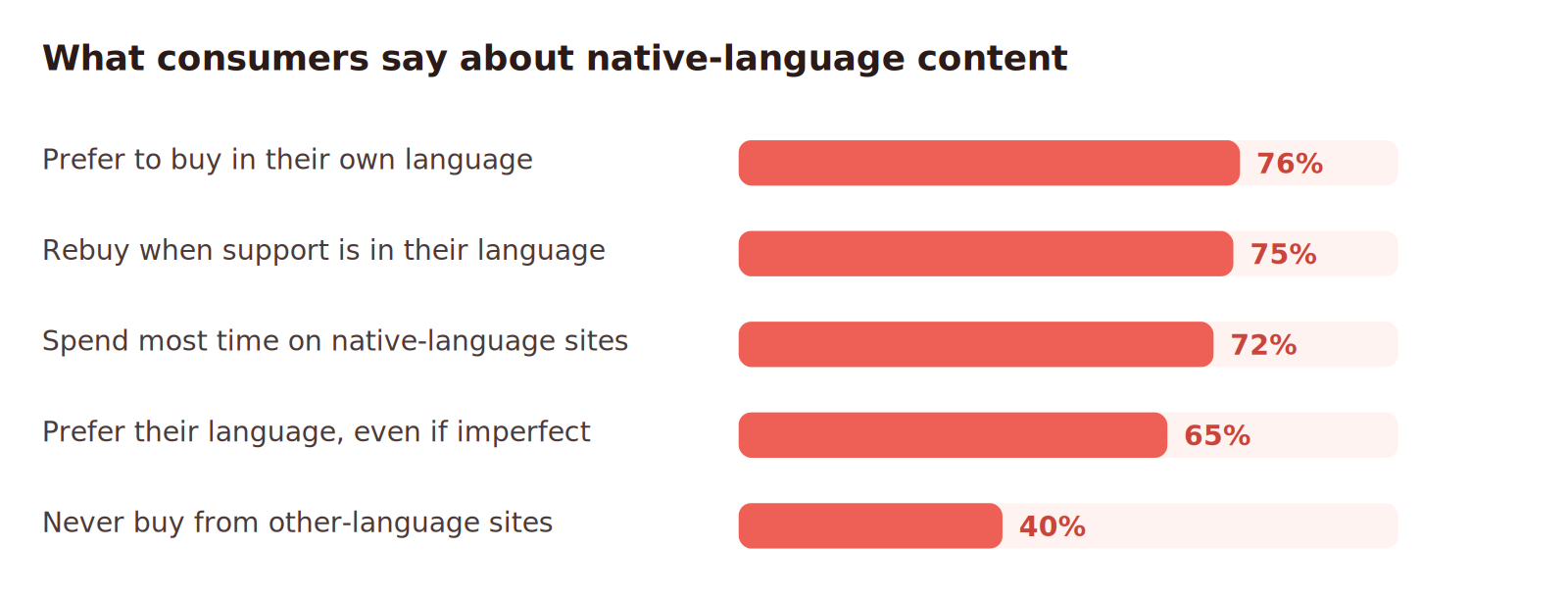
These are not soft preferences; they translate directly into revenue and return on investment.

The benefits stack up across the funnel:
- A larger addressable market: with roughly three-quarters of the world not speaking English, single-language content reaches a fraction of your potential audience.
- Higher search visibility: people search in their own language, so localized, SEO-optimized content ranks for queries your English pages never will.
- Better engagement and conversion: localized campaigns have been shown to convert far better than English-only, and localized pages convert around 70% higher on average.
- Trust and loyalty: speaking a customer’s language signals respect for their culture, and 75% say they are more likely to buy again when support is in their language.
What to Localize (Not Just Translate)
Multilingual content marketing touches far more than blog copy. To feel native, a market needs the whole experience adapted:
| Asset | What to adapt |
|---|---|
| Website & landing pages | Copy, UX, currency, formats, calls to action |
| Blog & SEO content | Topics, keywords, and metadata per language |
| Social media | Messaging, visuals, and the platforms each region uses |
| Subject lines, references, names, and local holidays | |
| Video | Scripts, subtitles, voiceover, dubbing, and on-screen text |
| Product descriptions | Terms, sizing, and benefits that resonate locally |
| Visuals & colors | Imagery and color meaning, which differ by culture |
How to Build a Multilingual Content Marketing Strategy
Multilingual content marketing is not about translating everything; it is a scalable system that delivers the right message, in the right language, to the right market. Here is the step-by-step strategy.
- Research your audience and prioritize markets: Use GA4, Search Console, and a keyword tool to see where demand and traffic already come from, then weigh market size, spending power, and English proficiency. Start with a few high-value languages rather than all at once.
- Set SMART goals and KPIs per market: Replace “expand internationally” with measurable targets like growing Spanish-language traffic 30% in a year, and define the one metric that matters most for each market.
- Build a buyer persona for each market: Search behavior, channels, and cultural norms differ by region, so a persona per market keeps content relevant instead of generic.
- Create a core message, style guide, and glossary: Define the brand themes that stay constant, then lock voice, approved terminology, and words to avoid per language so quality holds as you scale.
- Translate, then truly localize: Start from your core message, then adapt idioms, examples, visuals, and color choices, and have a native speaker review for nuance. This is where translation becomes localization.
- Do multilingual SEO properly: Run keyword research natively in each language, account for local search engines, and implement hreflang tags, clean URL structures, and localized metadata.
- Localize your video content: Video is the highest-engagement format, so dub and subtitle your best videos for each market to multiply reach from assets you already have.
- Promote through the right channels: Match each market’s platforms and habits, from WeChat or VKontakte to local influencers, email, and partnerships, rather than copying your home-market mix.
- Measure and optimize by language: Track traffic, engagement, and conversions per language and market, then double down on what works and refine the rest.
Multilingual SEO: The Part Most Brands Get Wrong
You cannot translate English keywords and expect to rank, because search behavior differs by market. Build multilingual SEO on three pillars. First, research keywords natively in each language with local tools, since the literal translation of a keyword often has little search volume. Second, account for the search engines people actually use; China leans on Baidu, Russia on Yandex, and South Korea on Naver. Third, get the technical layer right with hreflang tags, a clean URL structure (subdirectories or subdomains), and localized titles and meta descriptions. Done well, this tells search engines exactly which language and region each page serves and prevents duplicate-content problems.
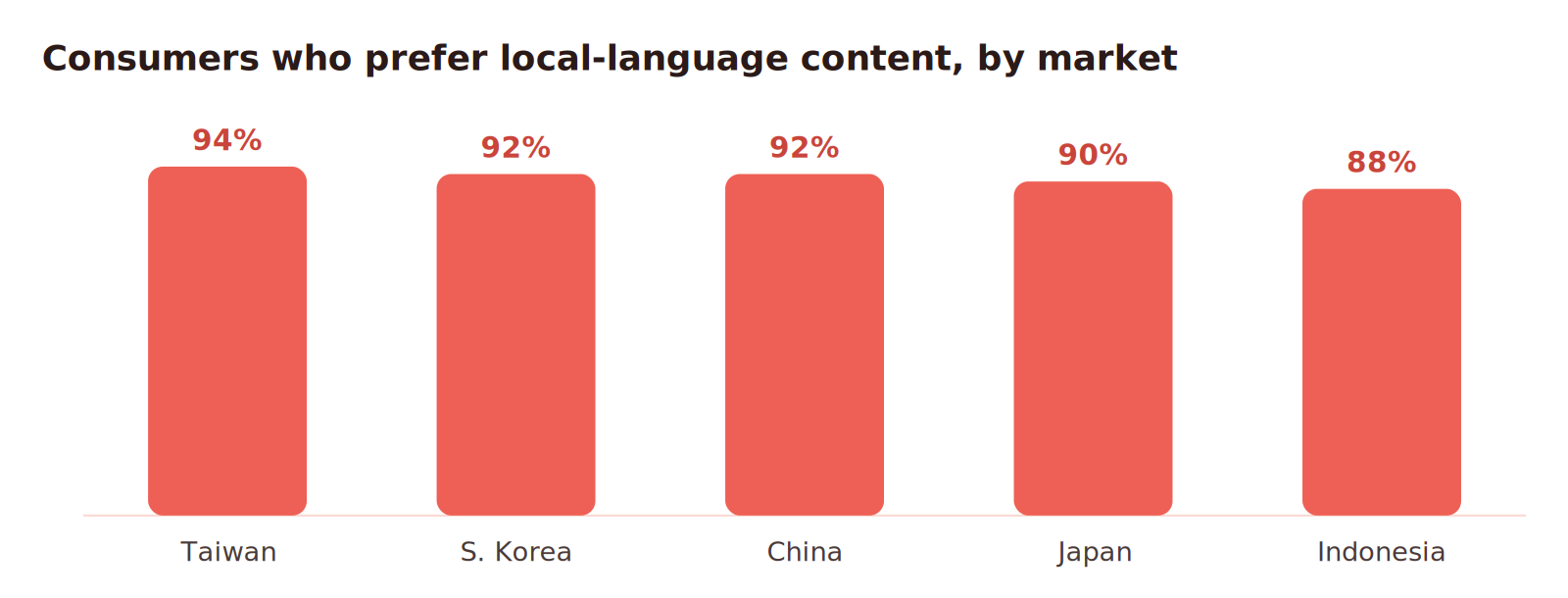
Demand for local-language content is especially high in Asia-Pacific, which is worth weighing when you prioritize markets.
Localize Your Video Content With brandID AI Video Translator
Video is the highest-engagement content format, yet it is the most underused multilingual asset. Around 91% of businesses use video, but only about 43% translate it, which means a market most of your competitors are ignoring. Instead of re-recording, the best video translator apps let you turn one video into many.
The brandID AI Video Translator dubs and translates your videos into 200+ languages and dialects while preserving your original voice, emotion, and lip-sync, so each version feels native rather than dubbed. What it does:
- Authentic voice cloning: your tone and emotional delivery carry into every language, keeping brand personality intact.
- Flawless lip-sync: translated audio matches the speaker’s mouth movements, removing the off-putting dubbed look.
- Multi-speaker support: it separates and clones up to 8 voices, so interviews and panels stay natural.
- 200+ languages and dialects: reach virtually every market from a single source video.
- A simple 3-step workflow: upload a file or paste a YouTube link, pick the language, then export and share in minutes.
- Works where you do: a Chrome extension dubs YouTube videos in your browser, and the iOS and Android apps localize Reels, Shorts, and TikToks on the go. Grab the download links below.
Pair it with our guide on how to translate YouTube videos and a full video localization workflow to make video the engine of your multilingual program. Pricing starts at $1 per minute, with monthly plans from $10.
Clone your voice, keep your lip-sync, and dub into 200+ languages in minutes. Try it free, no re-recording required.
Translate Your Video FreeMultilingual Content Marketing Examples
The brands that win globally localize deeply rather than translate literally:
- Coca-Cola: its "Share a Coke" campaign in India swapped first names for relationship titles like "Bhai" (brother), reflecting a more collectivist culture, and it uses local languages and packaging across regions.
- LEGO: broke into culture-coded markets like China by adapting kits for local moments such as Lunar New Year and partnering with regional influencers and universities.
- IKEA: built global appeal with multilingual instructions and marketing materials that travel across very different markets.
- The cautionary tale: Uber lost China to a local competitor that understood the market better, proof that translation without true localization is not enough.
Common Multilingual Content Marketing Mistakes
Most failures trace back to a handful of avoidable errors:
- Translating instead of localizing: Word-for-word translation strips cultural context. Uber learned this in China, where a competitor that understood local habits pushed it out of the market.
- Translating your keywords: Search behavior varies by market, so translated keywords rarely match real demand. Research keywords natively in each language.
- Ignoring local search engines and hreflang: Google leads in much of the world, but China uses Baidu, Russia uses Yandex, and South Korea uses Naver, and missing hreflang tags causes duplicate-content and wrong-region issues.
- One-size-fits-all KPIs: A small market may be judged on reach and growth while a large one is judged on conversions. Tailor KPIs to each market.
- Forgetting visuals and color: Images, symbols, and colors carry different meanings across cultures; white signals purity in some markets and mourning in others.
- Skipping native review: Without a native check, the famous AMC Matador became “killer” in Puerto Rico. Cultural review is cheaper than a recall.
Conclusion
The future of growth is multilingual, and the brands that localize today will lead tomorrow. By adapting your message, respecting cultural nuance, and getting multilingual SEO right, you do more than widen reach; you build trust and authority in every market you enter. Start with a clear strategy, prioritize a few high-value languages, prove the ROI, and scale what works.
The fastest lever is usually video. With the brandID AI Video Translator you can localize your best-performing videos into 200+ languages in minutes while keeping your voice and lip-sync, then support them with localized blogs, social, and email. Combine that with a plan to make money on TikTok and sell digital products globally, and your content becomes a worldwide growth engine.
Multilingual Content Marketing FAQs
What is multilingual content marketing?
Multilingual content marketing is creating, adapting, and distributing marketing content across multiple languages and markets to reach, engage, and convert international audiences. The key word is adapting. Unlike simple translation, it transforms tone, cultural references, visuals, examples, and calls to action so every piece, from blogs and social to video and product pages, feels made for that market rather than imported.
What is the difference between translation and localization?
Translation converts the words from one language to another. Localization adapts the whole experience, including tone, idioms, visuals, seasons, formats, and cultural references, so content resonates locally. A winter campaign about snow may need to become a campaign about colder weather in the southern hemisphere. Transcreation goes further, recreating creative intent for ads and slogans. Strong programs use all three.
Why is multilingual content marketing important?
Because most buyers want their own language. CSA Research found 76% of consumers prefer to buy when information is in their native language and 40% will never buy from other-language sites, while about 75% of the world does not speak English as a first language. Localized content also ranks better in local search, builds trust, and converts higher, with industry research citing roughly $25 returned per $1 spent on localization.
How do I choose which languages to target?
Base it on research, not guesswork. Use GA4 and Search Console to see where traffic and demand already come from, check keyword search volume per language, and weigh market size, spending power, and English proficiency. Prioritize a few high-value languages first, prove ROI, then expand. Adding Spanish to a US service can open about 13% more market, for example.
What is multilingual SEO and do I need hreflang?
Multilingual SEO optimizes content to rank in each target language and region. It requires native keyword research rather than translated keywords, attention to local search engines like Baidu, Yandex, and Naver, and the technical layer of hreflang tags, clean URL structures, and localized metadata. Hreflang tells search engines which language and region each page targets and prevents duplicate-content issues, so for a serious multilingual site, yes, you need it.
How does video fit into a multilingual content strategy?
Video is the highest-engagement format, which makes it one of the fastest ways to grow internationally. Rather than re-recording, you can dub and subtitle existing videos for each market. brandID’s AI Video Translator localizes video into 200+ languages while keeping your voice and lip-sync, turning a single video into a multilingual asset in minutes.
Should I use AI or human translators?
Use both. AI translation and AI video tools handle volume quickly and affordably, while native editors review for nuance, idioms, and cultural fit. This hybrid approach gives you speed and scale without the brand risk of unedited machine output, which is exactly how leading global teams operate in 2026.
How do I measure multilingual content marketing success?
Segment everything by language and region instead of looking only at totals. Track traffic, engagement, conversions, and revenue per market, and set KPIs that fit each market’s maturity: reach and growth for new markets, conversions and revenue for established ones. Then reinvest in the languages that perform.
 Summarize this article with: