Outbound leads close at roughly 1.7%. SEO leads close at 14.6%. Only about 18% of marketers believe outbound produces high-quality leads at all.
Those numbers get quoted constantly as proof that cold email and outbound generally are finished. They are not. They are proof that outbound at volume is finished, which is a very different claim, and one the same datasets support directly: campaigns sent to fewer than 50 recipients average a 5.8% reply rate, while campaigns over 1,000 average 2.1%.
Outbound did not stop working. It stopped working at scale, because the tooling made volume trivially cheap and everyone reached the same inboxes at once.
This guide covers how to rebuild it as a precision system: how the channels actually perform now, why smaller lists beat larger ones, what a multichannel sequence looks like, and how to reach the accounts that filter you out entirely.
Key Takeaways
- Small lists beat large ones measurably. Under 50 recipients averages 5.8% replies against 2.1% for lists over 1,000
- Multichannel is the single biggest lever. Combining channels reportedly cuts cost per lead by around 31% and lifts engagement substantially
- Cold email reply rates now average 4% to 6%, while top performers using tight targeting reach 15% to 25%
- Cold calling connects at about 16.6%, but once you are in a conversation the success rate rises sharply, and most C-level buyers still accept phone contact
- Outbound closes worse than inbound and that is fine, because outbound picks the accounts while inbound waits for them
- Companies running both grow roughly twice as fast as inbound-only organizations
- Deliverability is now a distribution problem, and the accounts that filter your email still publish a contact form
What Is Outbound Lead Generation?
Outbound lead generation is any process where you initiate contact with a prospect who has not raised a hand. Cold email, cold calling, LinkedIn outreach, direct mail, paid outbound, and contact form outreach all qualify. Inbound is the mirror image: content, search, and referral, where the prospect finds you.
The distinction that matters commercially is not which one converts better. It is who chooses the account.
| Outbound | Inbound | |
|---|---|---|
| Who picks the account | You do | They do |
| Close rate | About 1.7% | About 14.6% for SEO leads |
| Cost per lead | Higher | Lower, with SEO around $31 |
| Time to first pipeline | Days | Months |
| Predictability | Controllable by volume and targeting | Dependent on rankings and referrals |
| Best at | Reaching a named list on your timeline | Capturing demand that already exists |
That close-rate gap looks damning until you notice what it omits. Inbound cannot reach the forty accounts you have decided to win this year; it can only capture whoever happens to search. Outbound is the only channel where you choose. Organizations running both reportedly grow around twice as fast as inbound-only ones, which is the argument for outbound in a single statistic.
Why Outbound Stopped Working, and What Actually Broke
The decline is real and it has a specific cause, which is worth understanding because it tells you exactly what to change.
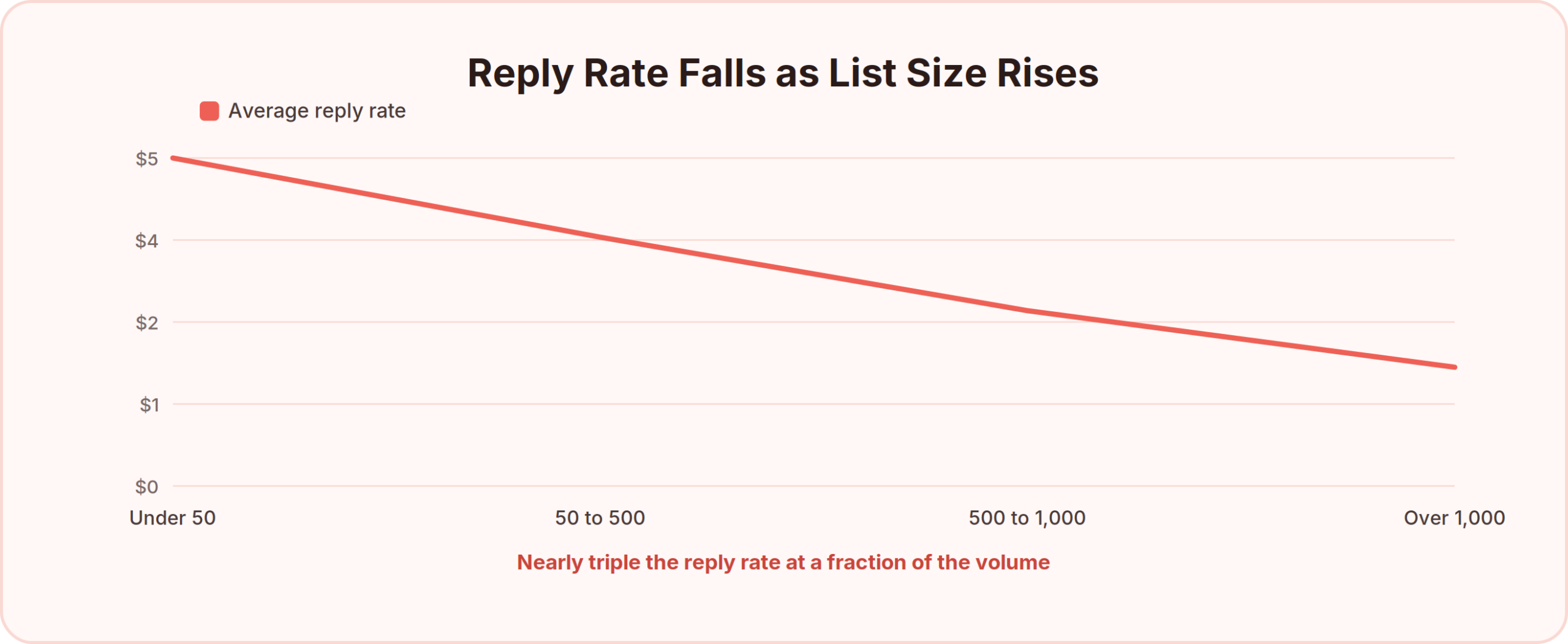
A campaign to fewer than 50 people replies at nearly triple the rate of one sent to over a thousand. Nothing about the channel changed between those two numbers. What changed is that a 50-person list can be researched and a 1,000-person list cannot.
- Automation made volume free, so everyone sent more, and the average inbox filled with near-identical outreach.
- Filters adapted. Provider-side spam detection now scores sending patterns, not just content, so the same message from a fresh domain performs differently.
- Buyers learned the format. Around 43% of recipients say they ignore outreach that feels impersonal or generic, and templated personalization tokens read as generic now.
- Personalization stopped being a differentiator and became the entry requirement.
So the fix is not better subject lines. It is fewer, better-targeted contacts across more than one channel, which is what the rest of this covers.
How Outbound Channels Actually Perform
Each channel has a distinct profile, and the mistake most teams make is running one of them and calling it an outbound program.
1- Cold Email
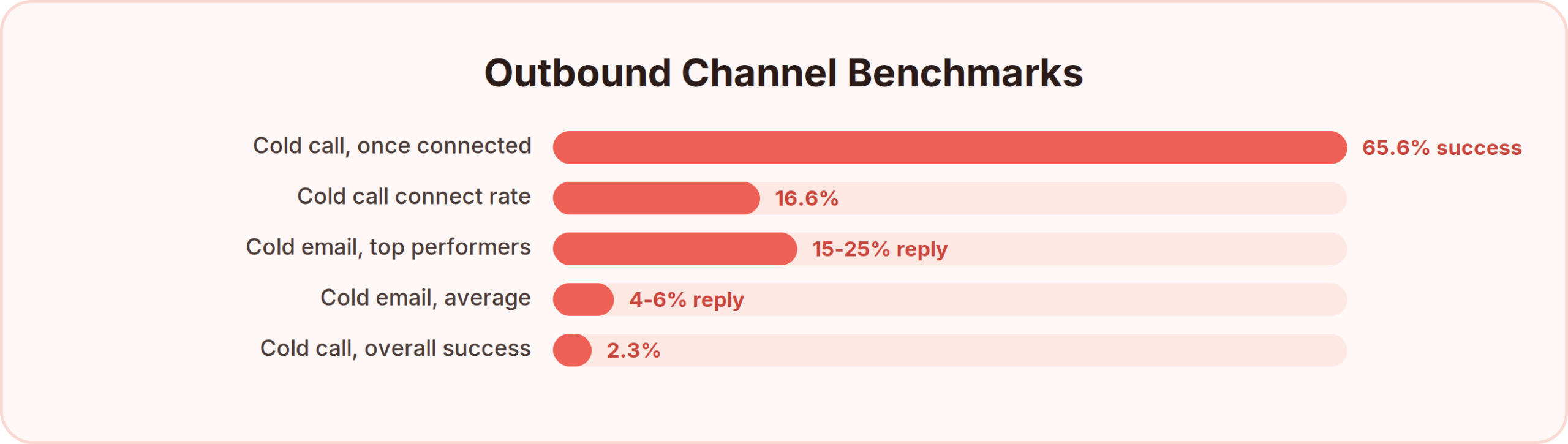
Average reply rates sit around 4% to 6%, down from roughly 7% in previous years. Top performers running tightly targeted, genuinely personalized campaigns reach 15% to 25%, and the gap between those numbers is entirely list quality and research depth.
It remains the best channel for reaching many accounts and for propositions that need space to explain, and the worst channel for reaching institutions and regulated organizations, for reasons covered further down. The platforms that run it are compared in cold email software, though the tool matters considerably less than the list.
2- Cold Calling
Overall success rates have fallen to around 2.3%, which reads as a channel in terminal decline until you separate the two numbers inside it. Connect rate with good data is about 16.6%, and once a conversation actually starts, the success rate rises to roughly 65.6%.
In other words, calling has a reach problem rather than a persuasion problem. It is also the channel most C-level buyers still prefer, and it outperforms in manufacturing, healthcare, construction, and other industries where the buyer is not at a desk all day.
3- LinkedIn
Around 89% of B2B professionals use LinkedIn for lead generation, which is both the reason it works and the reason it is saturated. Connection requests referencing something specific convert; templated InMail does not.
Its real value in a sequence is as a warming channel rather than a closing one. A prospect who has seen your profile, your comment on their post, and your name in their notifications reads your email differently, and LinkedIn outreach tools automate the tracking without automating the part that has to be human.
4- Contact Form Outreach
The least-used outbound channel and the only one whose deliverability does not degrade with volume, because there is no sender reputation to damage. Covered properly in its own section below.
5- Direct Mail and Gifting
Expensive per contact and correspondingly effective for a short list of high-value accounts. It works precisely because it is not email, and it is the only channel where a $50 spend on one prospect is defensible.
Multichannel Is the Single Biggest Lever
If you change one thing about your outbound program, change the number of channels. Multichannel campaigns reportedly cut cost per lead by around 31% against single-channel outreach, with reported engagement gains ranging from 75% to nearly 300% depending on the study.
The mechanism is straightforward. Each touch on a different channel raises the chance of being noticed and, more importantly, changes how the next touch is received. A cold email from an unknown sender is an interruption; the same email after a LinkedIn view and a voicemail is a follow-up.
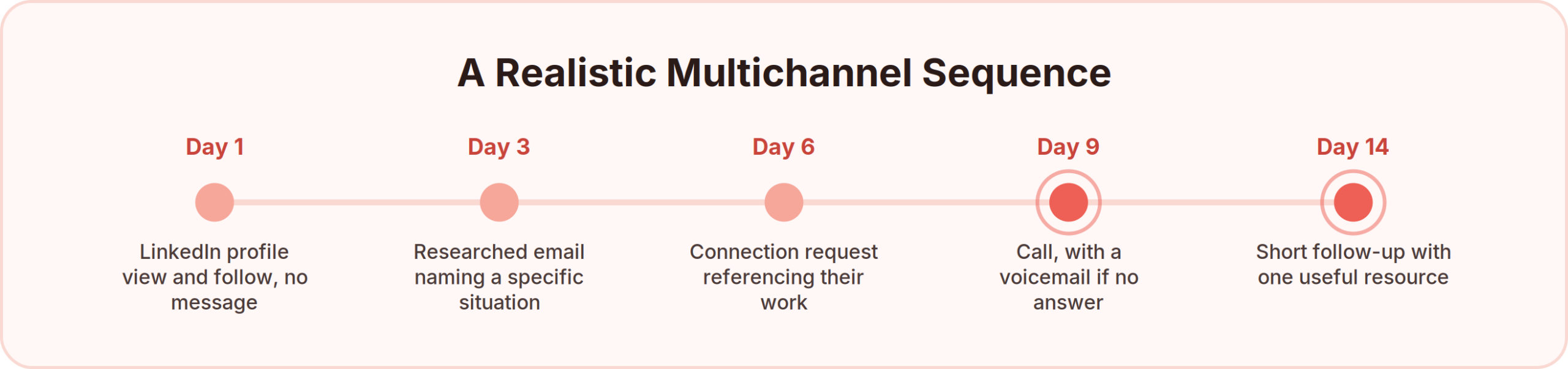
Two rules keep a sequence from becoming noise. Every touch should add something rather than repeat the ask, and the sequence should stop. Prospects who have ignored five touches across three channels are telling you something, and a sixth email does not change their mind.
Build a Smaller List and Research It Properly
This is where the reply-rate data becomes actionable. If under-50 lists reply at 5.8% and over-1,000 lists reply at 2.1%, the correct response is not to send more to compensate. It is to send less and research more.
| Instead of | Do this | Effect |
|---|---|---|
| 2,000 contacts, one template | 50 contacts, individually researched | Roughly triple the reply rate |
| Job title filtering only | Title plus a trigger event | Reaches people with a live reason to act |
| Personalization tokens | One specific, verifiable observation | Reads as human rather than merged |
| Everyone in the ICP | Accounts you have chosen to win | Effort concentrated where deals are large |
| Sending on your schedule | Sending on theirs, after a trigger | Timing does the work persuasion cannot |
Trigger events are the highest-value filter available and they are mostly public: funding rounds, leadership hires, expansions, acquisitions, compliance deadlines, and job postings that reveal what a company is building.
Vertical markets each have their own. In managed services the triggers are breaches and provider acquisitions, which is why MSP lead generation is a timing problem more than a volume one. In life sciences they are grant awards and clinical trial phases, and B2B lead generation for biotech companies is built around watching for them.
The Deliverability Ceiling
Every email-first outbound program eventually meets the same wall, and it is not a copy problem.
- Domain reputation caps your volume. Send more than your domain’s standing supports and delivery collapses across every campaign at once.
- Warmup takes weeks and has to be maintained, which makes scaling slow and fragile.
- Institutional and enterprise filters reject unknown senders far more aggressively than typical corporate inboxes, particularly in education, healthcare, government, and research.
- Shared and role-based inboxes are monitored by staff who forward almost nothing.
The result is that a portion of your target list is unreachable by email at any level of copy quality, and no amount of A/B testing surfaces this because the messages never arrive to be tested.
Contact Forms Reach What Email Cannot
Almost every company publishes a contact form. It is monitored, because it is how the business expects suppliers, partners, and customers to make first contact, and a submission arrives inside the organization’s own system rather than through the mail gateway.
| Cold email | Contact form outreach | |
|---|---|---|
| Reaches filtered domains | Frequently blocked before delivery | Bypasses the mail gateway |
| Setup | Domains, authentication records, weeks of warmup | None. The form already exists |
| Sender reputation risk | Real and cumulative | Not applicable |
| Scales by | Domain reputation | Number of published forms |
| Finding the contact | Requires an email finder and verification | Not required |
| Personalization | Fully controllable | Fully controllable |
It is not a replacement for email so much as the route into the accounts email cannot reach, and contact form marketing is the discipline built around using it well.
Automate Outbound Lead Generation With ContactID
The obvious objection is that filling forms manually does not scale, and it does not. A campaign across 400 target accounts is a week of work nobody repeats.
ContactID, formerly ContactUs AI, is a Chrome extension that turns contact form outreach into a repeatable outbound channel. It is built by brandID and runs entirely in your browser rather than through a sending server, which is the reason it carries none of the deliverability constraints that limit email.
The way it works in practice is straightforward. You load a list of target company URLs, write your message, and the extension visits each site in turn, locates the contact form, maps your content to the right fields, works through the captcha, and submits. What would take a week by hand runs while you do something else.
That distinction matters more than it first appears. Because there is no domain sending the message, there is no sender reputation to protect, no authentication records to configure, and no warmup period before you can run at volume. The constraint on how many accounts you can reach is simply how many of them publish a form.
What ContactID Handles
- ContactID form detection: locates the contact form on each site and maps the fields, including the older and non-standard layouts that break simpler tools
- ContactID captcha handling: works through the challenges that stop most automated submissions
- ContactID list cleaning: removes duplicates and dead URLs before you spend submissions on them
- ContactID AI message personalization: adapts your message to each company using what it finds on their site, so a submission reads as written for that account rather than merged from a template
- ContactID message rotation: varies the message across submissions so each account receives something written for it rather than an identical block
- ContactID bulk submission: runs the full campaign across your target list from the browser
- ContactID submission dashboard: records what was sent, what landed, and what failed, so you can measure the channel properly
Best For: outbound teams whose target accounts sit behind aggressive filtering, and campaigns where the list is a set of companies rather than a set of verified individual addresses.
Honest limits. Not every site has a reachable form, some submissions land with a general administrative inbox rather than the buyer, and reply rates depend entirely on whether the message names something specific. It solves distribution, not relevance.
Add ContactID to ChromeThe wider category is covered in contact form automation tools, and it sits among the best Chrome extensions for lead generation.
Measuring Outbound Properly
Most outbound reporting measures activity, which is why most outbound programs are killed for the wrong reasons or kept alive for the wrong ones.
| Metric | What it really tells you | Watch for |
|---|---|---|
| Delivery rate | Whether messages arrive at all | Below 95% means fix infrastructure before copy |
| Reply rate | Whether targeting and message fit | Under 2% usually means the list, not the copy |
| Positive reply rate | Genuine interest, not just responses | The number that actually predicts pipeline |
| Meetings booked per 100 contacts | Comparable across channels | The cleanest efficiency measure available |
| Cost per qualified conversation | True channel economics | Compare channels on this, not cost per lead |
| Opportunity rate | Whether meetings are the right meetings | High meetings and low opportunities means poor qualification |
One diagnostic saves a great deal of wasted iteration. If delivery is healthy and replies are near zero, the problem is the list. If replies are healthy and meetings are not, the problem is the offer. Teams routinely rewrite copy to fix a targeting failure, which cannot work.
Outbound Mistakes That Waste Budget
- Scaling before the message works. Ten thousand sends of a message that fails at a hundred is an expensive way to confirm it fails.
- Running one channel and calling it a program. Single-channel outbound leaves the largest available gain on the table.
- Treating personalization tokens as personalization. Recipients recognize a merge field instantly, and 43% say they ignore outreach that feels generic.
- Ignoring delivery data. A campaign with 60% delivery is not a copy problem and no amount of testing will reveal that.
- Sending on your calendar rather than their trigger. Timing beats persuasion in almost every B2B market.
- Never stopping a sequence. Five ignored touches is an answer. The sixth costs you the domain and the relationship.
- Judging outbound on close rate alone. It closes worse than inbound by design, because it reaches accounts inbound never would.
Conclusion
Outbound lead generation is not dead, but the version that worked in 2019 is. Cheap automation removed the cost of volume, everyone sent more, and the returns on sending more collapsed. The data showing outbound closing at 1.7% is measuring that, not measuring the channel’s ceiling.
What still works is the opposite of what broke it. Fewer accounts, chosen deliberately. Real research rather than merge fields. Several channels rather than one. Timing built around observable triggers instead of your own quarter.
And a route into the accounts that filter you out entirely, because the most carefully researched message in the world earns nothing if it never arrived.
What Is Outbound Lead Generation?
Outbound lead generation is any process where you initiate contact with prospects who have not raised a hand, including cold email, cold calling, LinkedIn outreach, direct mail, and contact form outreach. It differs from inbound in one important way: you choose which accounts to pursue, rather than capturing whoever finds you.
Is Outbound Lead Generation Still Effective in 2026?
Yes, but not at volume. Campaigns to fewer than 50 recipients average a 5.8% reply rate while campaigns over 1,000 average 2.1%, so the returns to sending more have collapsed. Companies running both outbound and inbound reportedly grow around twice as fast as inbound-only organizations, so the channel still earns its place when run as a precision system.
What Is the Difference Between Inbound and Outbound Lead Generation?
Inbound captures demand that already exists through content, search, and referral, and closes at higher rates, with SEO leads around 14.6%. Outbound reaches accounts you select, on your timeline, and closes lower at around 1.7%. The trade is control against efficiency, and most teams that grow quickly run both.
What Are the Best Outbound Lead Generation Channels?
Cold email for reach, cold calling for high-value and executive prospects, LinkedIn for warming and account-based work, contact form outreach for accounts that filter email, and direct mail for short lists of high-value targets. Multichannel programs reportedly cut cost per lead by around 31% compared with single-channel outreach.
What Reply Rate Should Outbound Email Get?
Average reply rates now sit around 4% to 6%, down from roughly 7% in previous years. Top performers running tightly targeted and genuinely researched campaigns reach 15% to 25%. If your reply rate is under 2% and delivery is healthy, the problem is almost always list quality rather than copy.
Does Cold Calling Still Work?
The overall success rate has fallen to around 2.3%, but that headline hides the useful detail. Connect rates with good data run about 16.6%, and once a conversation begins the success rate rises to roughly 65.6%. Calling has a reach problem rather than a persuasion problem, and most C-level buyers still accept phone contact.
How Many Touches Should an Outbound Sequence Have?
Five to eight touches spread across at least two channels over two to three weeks works for most B2B markets. Channel variety matters more than touch count, since each touch on a different channel changes how the next one is received. Sequences should also stop, because five ignored touches is an answer.
How Do You Improve Outbound Deliverability?
Authenticate your domain properly, warm it gradually over several weeks, keep volume within what your sender reputation supports, and clean lists before sending. None of that solves institutional filtering in education, healthcare, government, or research, where unknown senders are rejected regardless of reputation, so those accounts need a different channel.
What Metrics Should You Track for Outbound?
Delivery rate, reply rate, positive reply rate, meetings booked per 100 contacts, cost per qualified conversation, and opportunity rate. The useful diagnostic: healthy delivery with near-zero replies means the list is wrong, while healthy replies with few meetings means the offer is wrong. Teams frequently rewrite copy to fix a targeting failure.
How Do You Reach Companies That Block Cold Email?
Use a channel with no sender reputation attached. Nearly every company publishes a contact form that is monitored because the business expects it to be used, and submissions arrive inside the organization’s own system rather than through the mail gateway that was filtering you. It requires no email address to be found or verified.
 Summarize this article with: