Standard B2B lead generation advice assumes a buyer who feels urgency, downloads an ebook without thinking, and can sign off a purchase within a few weeks. Biotech buyers break all three assumptions at once.
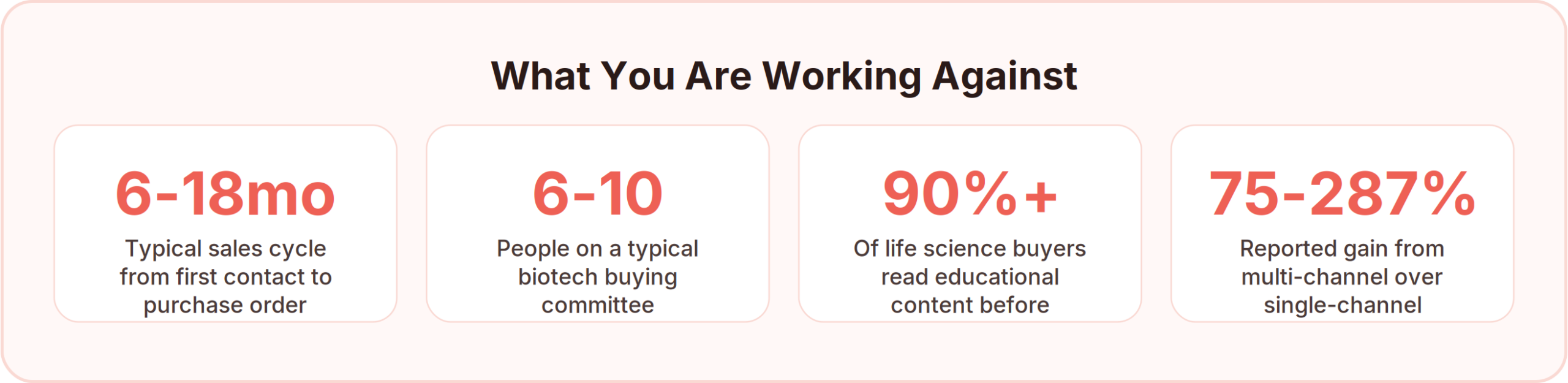
They are trained skeptics who evaluate a marketing claim the same way they evaluate a paper, looking for evidence, methodology, and sources. They sit on buying committees of six to ten people. And the cycle from first contact to purchase order routinely runs 6 to 18 months, sometimes longer if it is tied to a grant cycle.
None of that makes biotech lead generation harder than other B2B markets. It makes it different, and the tactics that work in SaaS mostly do not transfer.
This guide covers ten strategies that do work, who you are actually selling to, the trigger events worth watching, and the deliverability problem nobody in this industry talks about openly. If your product is closer to software than to reagents, B2B SaaS lead generation covers the version built for shorter cycles.
Key Takeaways
- Sales cycles run 6 to 18 months and are frequently tied to grant and funding calendars rather than your quarter
- Buying committees hold six to ten people, and the scientist who wants your product is rarely the person who can buy it
- Over 90% of life science buyers seek educational content before they will speak to a vendor, so content is a qualification gate rather than a nice-to-have
- Multi-channel outreach substantially outperforms single-channel in this market, with reported gains from 75% to nearly 300%
- Institutional email is the hardest channel in B2B. University, hospital, and pharma filters reject unknown senders that would land fine elsewhere
- Contact forms reach the same buildings that block your email, because research institutions monitor them and they bypass the spam filter entirely
- Trigger events beat volume. A funded grant, a Phase II readout, or a new facility tells you when to make contact, which matters more than how many contacts you make
Why Biotech Lead Generation Is Different
The differences are not cosmetic. Each one invalidates a tactic that works elsewhere.
| Standard B2B assumption | Biotech reality | What changes |
|---|---|---|
| Buyers respond to urgency | Purchases follow grant cycles and trial phases | Timing beats persuasion. Watch triggers, not quarters |
| Gated ebooks generate leads | Scientists distrust thin content and ungated competitors exist | Gate depth, not basics. Publish the useful parts openly |
| One champion can buy | Six to ten stakeholders across science, procurement, and compliance | Arm your champion to sell internally |
| A demo closes the deal | Validation data and a sample evaluation close the deal | Lead with evidence, not features |
| Cold email is the default channel | Institutional filters block unknown senders aggressively | Diversify or you will not reach the building |
| Fast follow-up wins | Evaluation can pause for months awaiting funding | Nurture for quarters, not days |
Who You Are Actually Selling To
The single most common failure in biotech outreach is treating the buying committee as one person. It is at minimum four roles, and each one cares about something different.
| Role | What they care about | What convinces them |
|---|---|---|
| Principal investigator | Will this work for my experiment? | Published validation, protocols, comparable studies |
| Lab manager | Reliability, lead times, and consumable cost | Availability data, support responsiveness, total cost |
| Core facility director | Throughput, service contracts, and training | Uptime figures, service terms, onboarding support |
| Procurement | Price, terms, and approved vendor status | Quotes, compliance paperwork, existing contract vehicles |
| Quality and regulatory | Documentation and compliance risk | Certificates of analysis, validation packages, audit trail |
| Finance or CSO | Budget fit and strategic case | ROI framing, capital versus operating cost |
The practical consequence is that your job is not to convince one person. It is to give your champion the material they need to convince five colleagues in a meeting you will not attend. That is why validation data, comparison documents, and clear pricing outperform any sales sequence.
Segment Before You Target Anything
Biotech is not one market. A reagent supplier, a lab instrument manufacturer, and a clinical data platform sell to different buildings with different budgets and different approval routes, and lumping them together produces messaging that lands nowhere.
- Academic and institutional labs. Grant-funded, price-sensitive, long procurement, enormous influence on later commercial adoption.
- Biotech startups. Asset-heavy and cash-light, working to investor timelines, outsourcing everything they cannot build. They buy fast when the need is urgent and disappear when funding stalls.
- Large pharma. Approved-vendor lists, formal RFPs, and procurement gatekeepers. Slow to enter, hard to displace once in.
- CROs and CDMOs. Buy on throughput and margin. They care about cost per sample more than novelty.
- Diagnostics and clinical labs. Regulatory documentation is the gate. CLIA, CE-IVD, and FDA status decide the shortlist before price is discussed.
- Hospital and translational research. Institutional procurement plus clinical governance, which is the slowest route of all.
Pick one or two to start. Messaging that speaks precisely to a Phase I startup racing a funding milestone reads as noise to a core facility director planning a five-year service contract.
Ten B2B Lead Generation Strategies for Biotech Companies
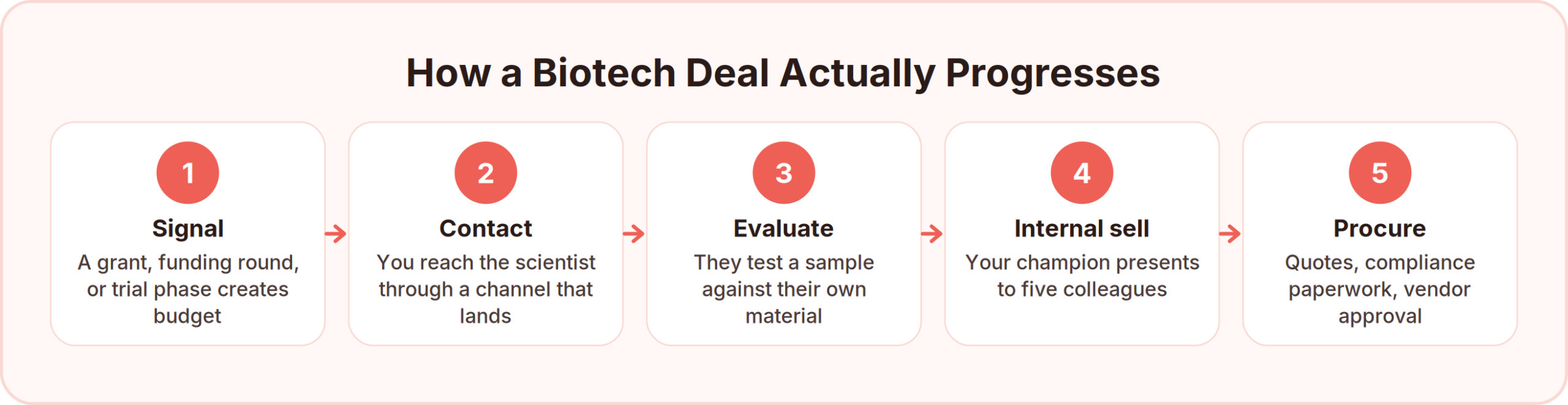
These lead generation strategies for biotech companies are ordered roughly by how quickly they produce qualified conversations, not by how impressive they sound in a board deck.
1- Publish Content That Survives Scientific Scrutiny
More than 90% of life science buyers read educational material before they will talk to a vendor, which makes content the qualification gate rather than a lead magnet. The bar is higher than in other industries because your readers review papers for a living.
- Application notes showing your product used in a real protocol, with methods and results.
- Comparison data against the incumbent, published openly. Scientists respect a fair comparison and distrust a vendor that avoids one.
- Protocols and troubleshooting guides that are genuinely useful whether or not the reader buys anything.
- Peer-reviewed citations. A product cited in published work carries more weight than any brochure, which is why seeding early-access units with respected labs pays back for years.
Two rules keep this working. Do not gate the basics, because an ungated competitor will take that search traffic. And do not overstate results, because a scientist who catches one inflated claim will discount everything else you publish.
2- Run Technical Webinars, Not Marketing Webinars
A webinar where a real scientist presents real data to an audience that asks hard questions is one of the highest-intent lead sources in this industry. A webinar that is a product pitch with slides is not.
The format that works is a customer or an internal scientist presenting a study, with your product appearing incidentally because it was used. Registration captures the lead; the Q&A tells you who has an active project.
3- Work Conferences Properly
Scientific conferences remain the highest-density gathering of qualified buyers in biotech, and most exhibitors waste them by collecting badge scans nobody follows up on.
- Book meetings before you arrive. The attendee list is published in advance. Outreach two to three weeks out fills a calendar that walk-up traffic never will.
- Send a scientist, not only sales. Technical questions asked at a booth are qualification signals, and a sales rep who cannot answer them loses the lead in the moment.
- Follow up within 48 hours with something specific to the conversation. Generic post-show blasts perform terribly.
- Attend the sessions. Knowing who presented what tells you which labs have active projects in your area.
4- Build an Account-Based Program on LinkedIn
Biotech is small enough that account-based marketing is genuinely practical. You can name the 200 institutions that matter for a given product and identify the people inside them.
LinkedIn works here because researchers use it more than most professionals for lab moves, funding news, and publication announcements, which are all buying signals. Connection requests referencing specific published work convert far better than templated notes, and the wider category of LinkedIn outreach tools automates the tracking without automating the message.
5- Use Trigger Events Instead of Volume
Timing matters more in this market than anywhere else in B2B, because budget appears and disappears on a schedule you can observe from outside.
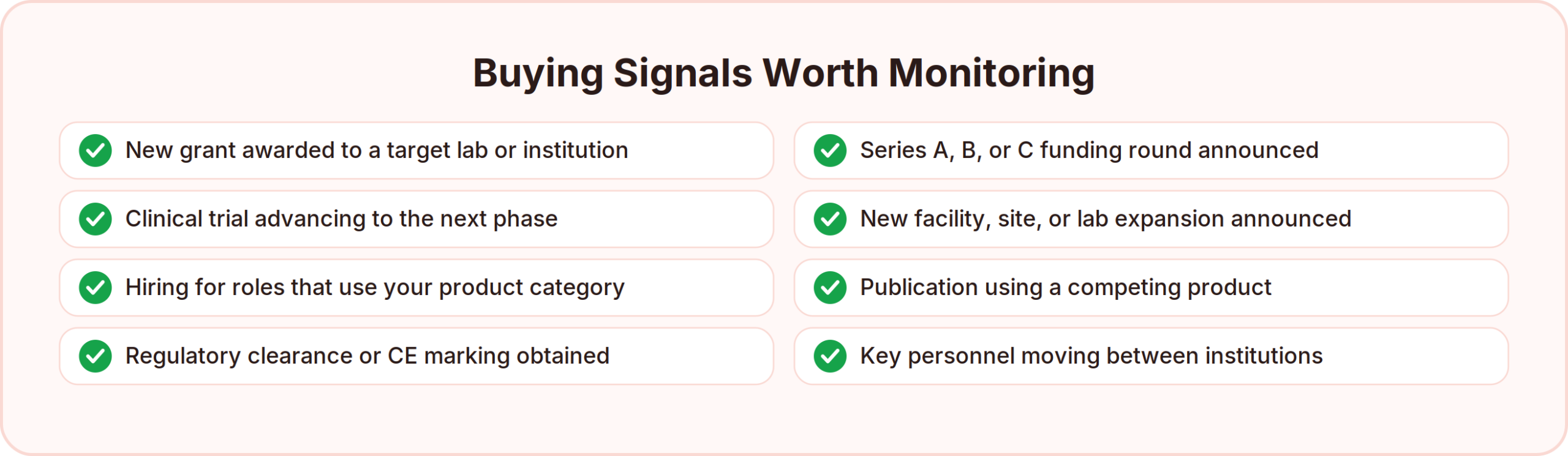
Grant databases, clinical trial registries, funding announcements, and job postings are all public. A message sent the week after a grant is awarded reaches someone who has money and a deadline, which is a different conversation from the same message sent at random.
6- Offer Samples and Evaluations, Not Demos
In most B2B markets a demo is the conversion event. In biotech the equivalent is putting the product in the customer’s hands to test against their own samples, because a scientist will not take your word for performance.
Sample programs, loaner instruments, and pilot evaluations shorten cycles more than any nurture sequence, and they qualify hard: a lab that invests time running your product has real intent. Build the offer into your outreach rather than holding it back for the sales call.
7- Build Distributor and Channel Relationships
For international markets and for smaller companies, distributors are a lead generation channel rather than a logistics decision. A distributor with existing relationships across a region reaches labs your outbound never will, and they carry the local language, currency, and regulatory paperwork.
The trade is margin and control. Treat distributor recruitment as its own outreach campaign, because good distributors are selective about what they carry, and the same targeting logic used for lead generation for technology companies applies when the prospect is a channel partner rather than an end user.
8- Get Cited in Published Research
This is the slowest strategy here and the most durable. A product named in the methods section of a well-cited paper generates inbound for years, because the next researcher designing a similar experiment will follow the same protocol.
The mechanics are unglamorous: early-access units to respected labs, support for researchers using your product, and a citation tracking habit so you know which papers to amplify.
9- Run Paid Search on Problem Terms
Paid search works in biotech when it targets the problem rather than the product category. Someone searching a specific assay failure, a contamination issue, or a protocol question has an active problem and a budget behind it.
Category terms are expensive and attract students and competitors. Long-tail technical queries cost less, convert better, and are where the actual buyers are. The wider toolkit for running this is covered by the best B2B sales tools, most of which handle the tracking and sequencing rather than the message.
10- Reach the Institutions Email Cannot
This is the strategy the other guides skip, and it deserves its own section below, because the reason it works is a problem specific to this industry.
The Deliverability Problem Nobody Mentions
Cold email is the default outbound channel in B2B, and in biotech it underperforms badly for reasons that have nothing to do with your copy.
Your prospects sit behind university IT, hospital systems, and pharmaceutical security infrastructure. Those environments filter considerably harder than a typical company inbox, because they are defending research data and patient records rather than a CRM.
Unknown senders get quarantined, and the person you wrote to never sees the message or knows it existed.
- Institutional domains filter hardest. University, hospital, and government research addresses reject unfamiliar senders that would land fine at a startup.
- Shared inboxes are gatekept. Generic addresses are monitored by administrators who forward almost nothing.
- Principal investigators ignore unknown senders as a survival habit, because they receive constant unsolicited contact.
- Domain warmup takes weeks and does not solve institutional filtering, only sender reputation.
So the message that would have worked never gets read. That is a distribution problem rather than a persuasion problem, and it is why cold email results in life sciences sit well below the benchmarks quoted in general B2B advice.
Why Contact Forms Reach What Email Cannot
Nearly every research institution, core facility, CRO, hospital lab, and biotech company publishes a contact form. Someone monitors it, because it is how collaborators, suppliers, and prospective partners are expected to make first contact.
A form submission arrives inside the organization’s own system rather than through the mail gateway, so it does not encounter the spam filter that was rejecting you. It also arrives through a channel the institution chose to publish, which changes how the recipient reads it.
| Cold email | Contact form outreach | |
|---|---|---|
| Reaches institutional domains | Frequently filtered before delivery | Bypasses the mail gateway entirely |
| Setup required | Domains, SPF, DKIM, DMARC, weeks of warmup | None. The form is already there |
| Sender reputation risk | Real, and cumulative across campaigns | Not applicable |
| Who reads it | Whoever survives the filter | Someone whose job includes monitoring it |
| Volume ceiling | Limited by domain reputation | Limited by the number of forms |
| Personalization | Fully controllable | Fully controllable |
The channel is not a replacement for email so much as a route into the accounts email cannot reach, and contact form marketing is the discipline built around it.
Automating Contact Form Outreach With ContactID
Filling forms one at a time is the obvious objection, and it is a real one. A campaign targeting 400 research institutions is a week of manual work nobody will do twice.
ContactID is a Chrome extension that automates the mechanical part while leaving the message under your control.
- ContactID form detection: finds the contact form on each site and maps the fields, including the non-standard layouts common on institutional and university sites
- ContactID captcha handling: works through the challenges that stop simple automation on research and hospital domains
- ContactID list cleaning: removes duplicates and dead URLs before you spend submissions on them
- ContactID message rotation: varies your message across submissions so each institution receives something written for it rather than an identical block
- ContactID bulk submission: runs the campaign across your target list from the browser
- ContactID submission dashboard: tracks what was sent, where it landed, and what failed
Best For: life science suppliers, CRO and CDMO business development, lab software vendors, and instrument manufacturers whose prospects sit behind institutional email filters.
Honest limits worth stating. Not every site has a reachable form, some institutions route submissions to a general administrative inbox rather than the lab, and reply rates depend entirely on whether your message is specific and relevant.
It is a distribution method rather than a substitute for having something worth saying. Regulated product claims still need the same medical, legal, and regulatory review they would need in any other channel.
Add ContactID to ChromeThe wider category is covered in contact form automation tools, and it sits among the best Chrome extensions for lead generation for teams running outreach from the browser.
What to Actually Say to a Scientific Buyer
Channel gets you delivered. The message decides whether anyone replies, and biotech recipients discard vague outreach faster than almost any audience because they read for a living.
| Do | Do not | Why |
|---|---|---|
| Name the specific application | Claim to help with research generally | Specificity signals you understand the field |
| Reference their published work | Use a generic personalization token | Scientists notice which one you did |
| Lead with data or a protocol | Lead with company background | Evidence is the currency here |
| Offer a sample or evaluation | Ask for a 30-minute discovery call | Testing is how this audience evaluates |
| Keep it under 120 words | Send a full capability statement | Nobody reads a wall of text from a stranger |
| Name the person and their role | Address it to whom it may concern | Institutional forms get plenty of the second kind |
One structural note: your message is not trying to close anything. It is trying to earn a reply from someone who will need five colleagues to agree before a purchase order exists. Ask for the smallest next step that produces a conversation.
Once a scientist has replied, the follow-up sequence matters as much as the opener, and B2B email marketing covers nurturing a contact across the months it takes for budget to appear.
Measuring Life Science Lead Generation
Standard SaaS metrics mislead in a market with a 6 to 18 month cycle, so life science lead generation needs its own scorecard. Judging a campaign at 90 days will tell you almost nothing about whether it worked.
| Metric | What it tells you | When to judge it |
|---|---|---|
| Qualified conversations | Whether outreach reaches real buyers | 30 to 60 days |
| Sample or evaluation requests | Genuine technical intent | 60 to 90 days |
| Committee expansion | Whether your champion is selling internally | 3 to 6 months |
| Quotes requested | Procurement has engaged | 4 to 9 months |
| Citations generated | Long-term inbound compounding | 12 months and beyond |
| Cost per qualified conversation | Channel efficiency, comparably across channels | Quarterly |
Track cost per qualified conversation rather than cost per lead. A form fill from a student writing a literature review and a message from a core facility director with a funded grant are both leads, and only one of them is a business.
Mistakes That Waste Biotech Lead Generation Budget
- Treating biotech as one market. A startup racing a funding milestone and a hospital core facility share almost no buying behavior.
- Selling features to scientists. They want performance data and methods, not benefit statements.
- Overstating results. One inflated claim discredits everything else you publish, and this audience checks.
- Judging campaigns on a SaaS timeline. Killing a channel at 90 days in an 18-month market guarantees you never see the return.
- Relying on email alone. Institutional filtering means a single-channel program simply misses the accounts it cannot reach.
- Ignoring procurement until the end. Approved vendor status and compliance paperwork can add months if they start after the science is agreed.
- Arming your champion with a brochure. They need a comparison document, validation data, and a price they can defend in a meeting.
Conclusion
Biotech lead generation rewards patience and precision in a way most B2B markets do not. The cycle is long, the committee is large, and the audience is professionally skeptical, so the tactics that win are evidence, timing, and reaching the right building at all.
Start by picking one segment and describing its buying committee properly. Publish material that would survive peer review. Watch grant awards, funding rounds, and trial phases so your outreach lands when budget exists. Offer an evaluation rather than a call.
And diversify the channel, because the most carefully written message in the world earns nothing if an institutional spam filter deleted it before anyone read it.
What Is B2B Lead Generation for Biotech Companies?
It is the process of finding and engaging organizations that buy life science products and services, including academic labs, biotech startups, pharmaceutical companies, CROs, CDMOs, and clinical laboratories. It differs from standard B2B lead generation because sales cycles run 6 to 18 months, buying committees hold six to ten people, and the audience evaluates marketing claims the way it evaluates research.
How Long Is a Typical Biotech Sales Cycle?
Commonly 6 to 18 months, and longer when purchases depend on grant funding or capital budgets. Academic and hospital procurement is slowest, biotech startups move fastest when a need is urgent, and large pharma is slow to enter but hard to displace once you are an approved vendor.
Who Are the Decision Makers in Biotech Purchases?
Usually a committee of six to ten people spanning the principal investigator or lead scientist, the lab manager, a core facility director, procurement, quality and regulatory, and finance or the CSO for larger purchases. The scientist who wants your product rarely has the authority to buy it, so your job is to equip them to persuade colleagues internally.
Why Does Cold Email Underperform in Biotech?
Because prospects sit behind university, hospital, and pharmaceutical email infrastructure that filters far more aggressively than typical corporate inboxes, since it defends research data and patient records. Unknown senders get quarantined before delivery, so the message is never read. Domain warmup improves sender reputation but does not solve institutional filtering.
What Are the Best Lead Generation Channels for Life Sciences?
Scientific content and SEO, technical webinars, conferences with pre-booked meetings, LinkedIn account-based outreach, trigger-based prospecting on grants and funding, sample and evaluation programs, distributor partnerships, research citations, problem-focused paid search, and contact form outreach for institutions that filter email. Multi-channel programs substantially outperform single-channel ones in this market.
How Do You Find Biotech Leads?
Start by segmenting into academic labs, startups, pharma, CROs, diagnostics, or hospitals, since each buys differently. Then build the target list from grant databases, clinical trial registries, publication records, conference attendee lists, and funding announcements. These sources are largely public and indicate both fit and timing.
What Trigger Events Signal a Biotech Buying Opportunity?
New grant awards, funding rounds, a clinical trial advancing to the next phase, facility or site expansion, hiring for roles that use your product category, publications using a competing product, regulatory clearances, and key personnel moving institutions. Most are published publicly, and outreach timed to one of them reaches someone with both budget and a deadline.
Should Biotech Companies Gate Their Content?
Gate depth, not basics. Over 90% of life science buyers read educational content before contacting a vendor, and if you gate a protocol or a comparison that an ungated competitor publishes freely, you lose both the lead and the search traffic. Gate detailed validation packages, full datasets, and webinar recordings instead.
How Do You Measure Biotech Lead Generation?
Use cost per qualified conversation rather than cost per lead, and judge each metric on its own timeline. Qualified conversations show at 30 to 60 days, sample requests at 60 to 90, committee expansion at 3 to 6 months, and quotes at 4 to 9 months. Judging an 18-month market on a 90-day window kills channels before they report.
Is Contact Form Outreach Compliant for Biotech Companies?
The channel itself carries the same obligations as any other business outreach: identify yourself honestly, have a genuine reason for contact, and honor opt-out requests, with GDPR applying to EU and UK recipients. Separately, if you promote a regulated drug, device, or diagnostic, promotional rules apply to a form submission exactly as they would to email, so your regulatory review process does not change.
 Summarize this article with: