Almost every business you want as a client already has an IT provider. That single fact explains why most MSP lead generation underperforms, and why the advice to send more emails does not fix it.
You are not selling a need. The need was met three years ago by whoever answered the phone first. What you are actually selling is a switch, and switches happen on a schedule you do not control: a breach, a bad outage, a compliance deadline, an acquisition, a contract renewal.
That changes what good MSP lead generation looks like. Volume matters far less than being present at the moment a business becomes willing to change providers.
This guide covers who those businesses are, the eight triggers that open a switching window, the channels that reach SMB owners who ignore cold email, and how to stay visible during the eighteen months when nothing appears to be happening. If your outbound program needs rebuilding more broadly, outbound lead generation covers the system underneath all of it.
Key Takeaways
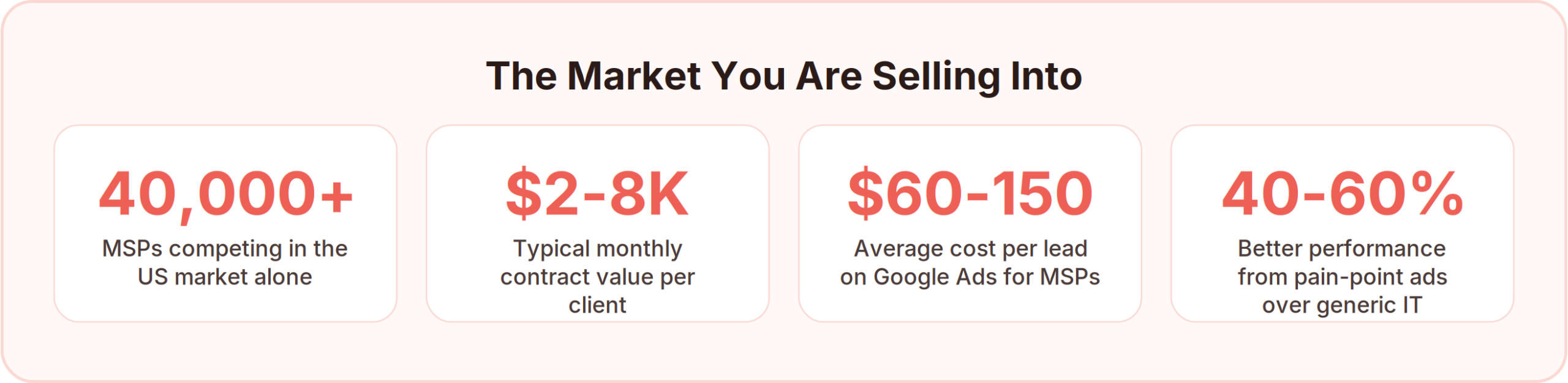
- The US has more than 40,000 MSPs competing for the same small and mid-sized businesses, so differentiation matters more than reach
- Your prospects are not shopping. They have a provider, and they become buyers only when something breaks or changes
- Trigger events are the whole game. A breach, an outage, an acquisition, or a compliance deadline creates a window measured in weeks
- Niche beats geography. An MSP for dental practices outsells a general MSP in the same city, because the buyer recognizes themselves
- Pain-point targeting outperforms generic IT support ads by a reported 40% to 60%
- Vendor partner programs are the most underused warm channel, with Microsoft, Datto, SentinelOne, and others routing SMB inquiries to certified partners
- Contracts run $2,000 to $8,000 a month, so a single client justifies a great deal of patience in the pipeline
Why MSP Lead Generation Is Harder Than It Looks
Three structural problems sit underneath every MSP marketing plan, and none of them is solved by doing more of what you are already doing.
- The market is saturated and undifferentiated. More than 40,000 US providers describe themselves in near-identical language: proactive monitoring, 24/7 helpdesk, cybersecurity, cloud migration. A prospect comparing three websites cannot tell you apart.
- Your buyer is not in market. Unlike software, where a company can adopt a new tool alongside existing ones, managed IT is a replacement purchase. Winning requires someone else losing.
- The decision is emotional, not technical. SMB owners switch providers because they are frustrated, not because they ran a feature comparison. That means your timing matters more than your stack.
Put together, those explain the pattern most MSPs experience: outreach produces polite non-answers for months, then a client appears from a referral or a panicked Google search after an incident. The goal of a real lead generation program is to make that second event less random.
Who You Are Actually Selling To
MSP buying committees are small compared with enterprise IT, which is an advantage, but the roles still want different things.
| Company size | Who decides | What they care about |
|---|---|---|
| 5 to 20 employees | Owner or office manager | Cost, responsiveness, and not having to think about IT |
| 20 to 100 employees | Owner plus an operations lead | Downtime cost, security posture, predictable billing |
| 100 to 500 employees | IT manager, CFO, sometimes a CTO | SLAs, compliance frameworks, escalation paths |
| Regulated SMBs | Owner plus a compliance officer | HIPAA, PCI, CMMC, or SOC 2 evidence above all else |
The 20 to 100 employee band is where most MSPs find their best economics. Below it, the contract value rarely supports the acquisition cost. Above it, you are competing against providers with dedicated sales teams and a compliance department.
The Eight Triggers That Open a Switching Window
This is the most useful thing in this guide. A business with an IT provider ignores your outreach for years and then, in the space of a fortnight, becomes willing to take a meeting. These are the events that cause it.
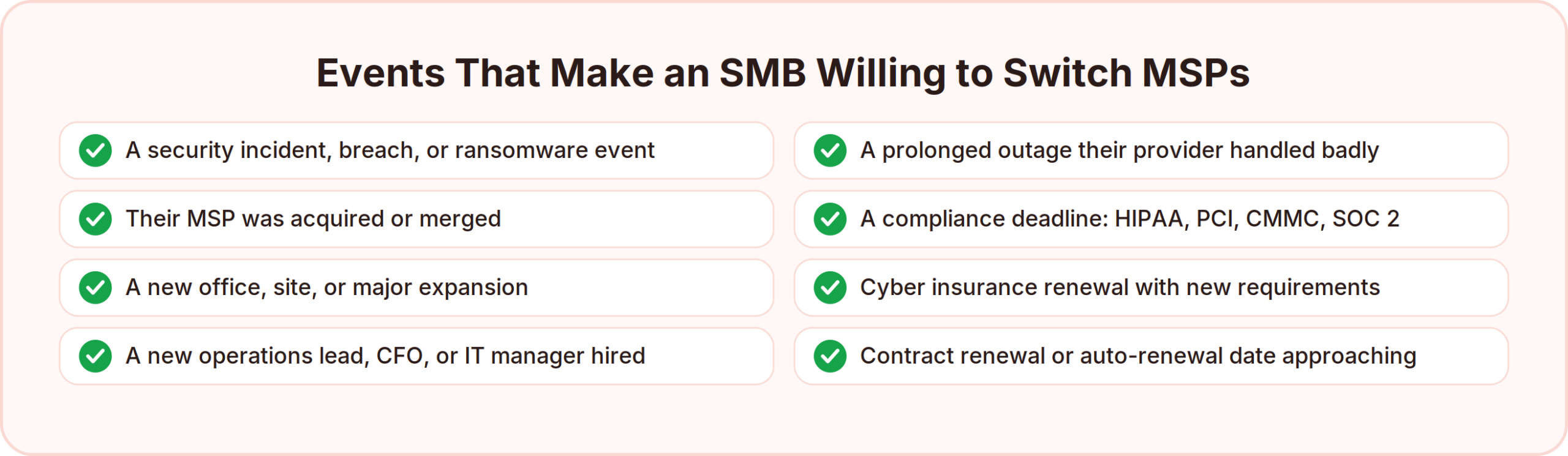
Several of those are publicly visible if you watch for them. Job postings reveal new operations and finance hires. Local news and press releases cover expansions and acquisitions. Industry compliance deadlines are published years in advance. MSP acquisitions are announced.
The insurance one deserves particular attention. Cyber insurance renewals now routinely require MFA, endpoint detection, and documented backup testing, and an SMB whose current provider has not delivered those is facing either a premium increase or a declined policy. That is a conversation they will take.
Build a simple watchlist rather than a mailing list. Fifty target businesses, checked monthly for hiring, expansion, and incident signals, will outperform two thousand contacts emailed on a schedule that has nothing to do with their situation.
How to Be There When the Window Opens
Windows close fast. A business that just had a breach will have chosen a new provider within weeks, and they will choose from names they already recognize.
That means the job between triggers is not selling. It is being remembered. Light, useful, and consistent presence beats intensive campaigns that stop when nothing converts:
- Quarterly value contact, not monthly pitches. A compliance deadline reminder or a genuinely useful security advisory earns the next one being opened.
- Local visibility. Chamber of commerce, industry associations, and local business press put your name in front of owners repeatedly at low cost.
- Vendor directory presence, so that when someone searches for a certified partner in your area, you exist.
- Search visibility for problem terms, because the post-incident search is the highest-intent moment in this entire market.
Why Niching Beats Widening
The instinct in a saturated market is to widen the offer so it fits more prospects. It is the wrong move, because the thing stopping prospects is not that you lack a service. It is that they cannot distinguish you.
| Generic positioning | Niched positioning | Why the second wins |
|---|---|---|
| IT support for small businesses | IT and HIPAA compliance for dental practices | The buyer recognizes themselves immediately |
| Cybersecurity services | CMMC readiness for defense subcontractors | A deadline and a specific regulation attached |
| Cloud migration specialists | Practice management migration for law firms | Names the software they actually run |
| 24/7 monitoring and helpdesk | After-hours coverage for manufacturing shifts | Solves a scheduling problem they already have |
A vertical focus also compounds in ways general positioning does not. You learn the compliance regime, you learn the line-of-business software, and every client becomes a reference for the next prospect in the same industry. Referrals inside a vertical travel further because the businesses know each other.
The same logic applies in any specialist market. B2B lead generation for biotech companies works on exactly this principle, where knowing the buying committee and the regulatory environment matters more than reach.
Channels That Work for MSP Lead Generation
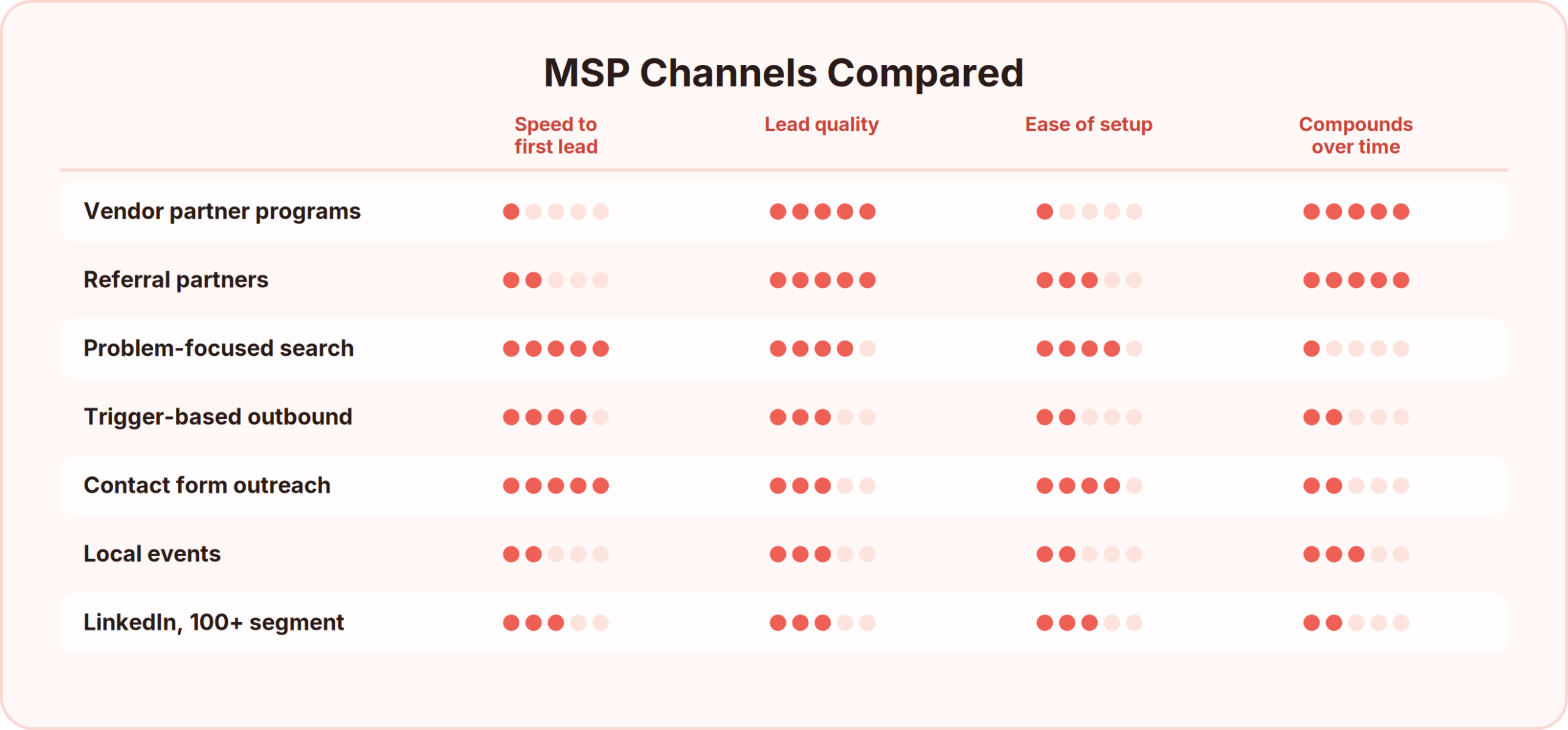
1- Vendor Partner Programs
This is the most underused warm channel in the industry. Microsoft, Datto, SentinelOne, Cisco, Acronis, and most major security vendors run partner programs that route SMB inquiries to certified partners in a region.
Reaching Gold or equivalent status with three to five vendors positions you as the recommended implementation partner locally, and those referrals arrive pre-qualified with a stated need. The certification investment is real and takes months, but the pipeline compounds for years rather than resetting each quarter.
2- Referral Systems, Not Referral Hopes
Most MSPs get referrals and almost none engineer them. The difference is a system with a specific ask and a reciprocal flow.
- Accountants and bookkeepers see which clients are growing and which are frustrated with software.
- Commercial insurance brokers know exactly who is failing a cyber insurance requirement, which is the strongest signal in this market.
- Commercial real estate agents know who is moving offices, which forces an IT decision.
- VoIP and telecom providers serve the same buyer with a non-competing service.
- Existing clients, asked specifically rather than generally. “Do you know another practice manager dealing with the same compliance headache?” beats “know anyone who needs IT?”
3- Search, Aimed at Problems Rather Than Categories
MSP Google Ads run $60 to $150 per lead, which is sustainable against a $2,000 to $8,000 monthly contract but only if the clicks are the right ones. Category terms like managed IT services attract competitors, students, and price shoppers.
Problem terms attract people in a trigger window: a specific error, a compliance question, a post-incident search. Pain-point targeting reportedly outperforms generic IT support advertising by 40% to 60%, and the reason is simply that the searcher has a live problem rather than an idle interest.
4- Local and Industry Events
Event attendance data is worth knowing here. AI-themed events reportedly draw around double the attendance of equivalent sessions branded around IT services or cybersecurity, because AI creates curiosity across every business function while managed services sounds like a vendor pitch.
That is a packaging lesson rather than a topic lesson. The same content about security posture and business continuity fills a room when it is framed around a question owners are already asking.
5- LinkedIn, for the 100-Plus Segment
LinkedIn works for MSPs targeting larger SMBs where an IT manager or CFO exists and maintains a profile. It works poorly for the 5 to 20 employee segment, where the owner is not on LinkedIn in any meaningful way and is far easier to reach locally or by phone.
Where it fits, the mechanics are the same as any account-based approach, and LinkedIn outreach tools handle the tracking without automating away the personalization that makes it work.
6- Outbound, Rebuilt Around Timing
Cold outbound has a poor reputation among MSPs, and mostly it has been earned by campaigns that blast the same message to every business in a postcode. Outbound works in this market when it is aimed at a trigger rather than at a list.
The message that follows a publicly announced office expansion, an acquisition of a local competitor MSP, or a compliance deadline in a specific vertical is a different message from a generic introduction, and it performs like one.
The Problem With Reaching SMB Owners
Here is the practical obstacle nobody in the MSP marketing space discusses honestly. The person who can sign your contract is very hard to reach by email.
- Owner inboxes are protected. The published address is usually info@ or a contact form, monitored by an office manager who forwards almost nothing.
- MSP outreach is the most-spammed category these businesses receive. Every SMB owner gets multiple IT services emails weekly and has learned to delete on sight.
- Their current MSP may run their email security, which means a competitor’s filtering rules stand between you and your prospect.
- Small businesses use shared inboxes heavily, so there is frequently no personal address to find at all.
That last point compounds the others. Email finding tools return a generic address, cold email tools then send to it, and the message lands in a queue nobody treats as a sales channel. It is a distribution problem rather than a copy problem, which is why cold email results in this vertical sit well below general B2B benchmarks.
Reaching Businesses Through Their Own Contact Form
Nearly every SMB publishes a contact form, and unlike the generic inbox, it is a channel the business chose to publish and expects to be used. Submissions arrive inside the site’s own system rather than through the mail gateway, so they do not encounter the spam filtering that was rejecting you.
For an MSP that is useful in a specific way: your target list is geographic and vertical rather than personal, which is exactly the kind of list where finding individual email addresses is slowest and least reliable. You do not need to find the owner’s address if the business publishes a route to them.
Automate MSP Lead Generation With ContactID
Filling forms by hand does not scale. A campaign across every dental practice or law firm in a metro area is days of work nobody repeats.
ContactID, formerly ContactUs AI, is a Chrome extension that turns contact form outreach into a repeatable channel for MSPs. It is built by brandID and runs entirely in your browser rather than through a sending server, which is why it carries none of the deliverability constraints that limit email.
The way it works is straightforward. You load a list of target business URLs, write your message, and the extension visits each site in turn, finds the contact form, maps your content to the right fields, works through the captcha, and submits. A campaign that would take a week by hand runs while you do something else.
That distinction matters for MSPs in particular. Because no domain is sending the message, there is no sender reputation to protect, no authentication records to configure, and no warmup period. It also removes the hardest step in SMB prospecting entirely, which is finding a working email address for an owner who has never published one.
What ContactID Handles
- ContactID form detection: finds and maps the contact form on each site, including the older and non-standard layouts common on SMB websites
- ContactID captcha handling: works through the challenges that stop most automated submissions
- ContactID list cleaning: strips duplicates and dead URLs before you spend submissions on them
- ContactID AI message personalization: adapts your message to each business using what it finds on their site, so a dental practice and a law firm receive outreach written for them rather than merged from one template
- ContactID message rotation: varies your message across submissions so each business receives something written for it
- ContactID bulk submission: runs a geographic or vertical campaign across your whole target list from the browser
- ContactID submission dashboard: tracks what was sent, what landed, and what failed, so you can measure the channel properly
Best For: MSPs running geographic or vertical campaigns where the target list is a set of businesses rather than a set of named individuals.
Honest limits. Not every site has a reachable form, some submissions reach an office manager rather than the owner, and reply rates depend entirely on whether your message names a specific situation. It moves the message past the filter; it does not make a generic pitch worth reading.
Add ContactID to ChromeThe category is covered in contact form automation tools, and it sits among the best Chrome extensions for lead generation for teams working from the browser.
What to Say to a Business That Already Has an MSP
The default MSP pitch is a list of services, and it fails because the prospect already receives all of those from someone else. What earns a reply is naming a situation they recognize.
| Instead of | Say | Why |
|---|---|---|
| We provide 24/7 monitoring and helpdesk | Most dental practices we speak to fail their cyber insurance MFA requirement | Names a specific, current, expensive problem |
| We are your local IT partner | You opened a second location in March. Multi-site IT is where most providers struggle | Proves you looked, and names the risk |
| Let us review your IT setup | A 20-minute compliance gap check against the CMMC deadline | A specific deliverable with a date attached |
| Better service at a better price | If your provider was acquired recently, response times usually slip within six months | Speaks to a change they have already noticed |
The ask matters as much as the message. A prospect with an existing provider will not book a sales meeting, but many will accept a short assessment, a compliance checklist, or a second opinion, because those do not require them to have decided anything yet.
Measuring MSP Lead Generation
Contract values of $2,000 to $8,000 a month with multi-year retention mean the economics tolerate a long payback, but only if you measure the right things over the right window.
| Metric | What it tells you | Healthy signal |
|---|---|---|
| Cost per qualified conversation | Whether targeting is working | Well under one month of contract value |
| Assessment or audit bookings | Real intent, since it costs them time | The best leading indicator in this market |
| Trigger-sourced conversations | Whether your watchlist is working | Rising share over time |
| Referral partner conversations | Whether the partner system is live | At least one per partner per quarter |
| Time from first contact to signed | Realistic pipeline planning | Commonly 6 to 18 months without a trigger |
| Client lifetime value | What acquisition cost you can afford | Multi-year retention justifies patience |
Mistakes That Waste MSP Marketing Budget
- Describing services instead of situations. Every competitor lists the same services, so the list identifies you as interchangeable.
- Marketing to businesses with no trigger. Perfect messaging sent to a satisfied client of another provider produces nothing, however good it is.
- Stopping campaigns at 90 days. In a market with 6 to 18 month cycles, that guarantees you quit before the window opens.
- Chasing companies too large for you. A 400-person company with an internal IT team is a long, expensive loss for most small MSPs.
- Competing on price. It attracts the clients who will leave you for the next cheaper provider, and it destroys the margin that funds good service.
- Neglecting vendor certifications. They are slow, and they are the only channel that delivers pre-qualified inbound consistently.
- Treating referrals as luck. Accountants, insurance brokers, and telecom providers all see your triggers before you do, and none of them will think of you unprompted.
Conclusion
MSP lead generation is a timing problem wearing the costume of a volume problem. Your prospects are not evaluating providers, they are getting on with their business, and they will consider switching only when something makes staying uncomfortable.
So build the program around that. Pick a vertical narrow enough that buyers recognize themselves. Watch for the eight triggers rather than emailing a list on a schedule. Get certified with the vendors that route referrals. Cultivate the accountants and insurance brokers who see the frustration before you do.
And when the window does open, make sure you are already a name they recognize, because the business that just had a breach will not run a procurement process. They will call someone they have heard of.
What Is MSP Lead Generation?
It is the process of finding and engaging businesses that will buy managed IT services, typically companies with 20 to 500 employees. It differs from most B2B lead generation because nearly every prospect already has an IT provider, so you are selling a switch rather than a new purchase, and switches happen only when a trigger event makes staying uncomfortable.
How Do MSPs Get New Clients?
Most new clients come from referrals, vendor partner programs, search visibility at the moment of a problem, and outbound aimed at trigger events. Referral sources worth cultivating include accountants, commercial insurance brokers, commercial real estate agents, and telecom providers, all of whom see a business’s frustration or change before you do.
What Are the Best Lead Generation Strategies for MSPs?
Vertical niching so buyers recognize themselves, vendor certification with three to five major vendors, an engineered referral system rather than a hopeful one, problem-focused paid search, local and industry events packaged around questions owners are already asking, and trigger-based outbound. Multi-channel consistently outperforms any single channel.
How Much Does an MSP Lead Cost?
Google Ads leads for MSPs typically run $60 to $150 each, which is sustainable against monthly contracts of $2,000 to $8,000 with multi-year retention. Cost per qualified conversation matters more than cost per lead, since a price-shopping click and a post-incident search are both leads and only one becomes a client.
Why Is MSP Lead Generation So Difficult?
Three reasons. More than 40,000 US providers describe themselves in nearly identical language, so prospects cannot differentiate. Managed IT is a replacement purchase, so winning requires another provider losing. And the decision is triggered by frustration rather than evaluation, which means timing matters more than messaging.
What Triggers a Business to Switch MSPs?
A security incident or ransomware event, a badly handled outage, their provider being acquired, an approaching compliance deadline such as HIPAA or CMMC, a new office or expansion, cyber insurance renewal requirements they cannot meet, a new operations lead or CFO, and contract renewal dates. Most of these are observable from outside the business.
Should MSPs Niche Down or Serve Everyone?
Niche. In a market with 40,000 competitors describing identical services, a vertical focus is the cheapest differentiation available. It also compounds, because you learn the compliance regime and line-of-business software, and referrals travel further inside an industry where businesses know each other.
How Long Is the MSP Sales Cycle?
Commonly 6 to 18 months without a trigger event, and as little as a few weeks with one. A business that has just suffered a breach or failed a cyber insurance requirement moves fast and chooses from providers it already recognizes, which is why consistent low-intensity visibility matters more than intensive campaigns.
Does Cold Email Work for MSPs?
Poorly, in most cases. SMB owner inboxes are protected, published addresses are usually generic and monitored by staff who forward little, and IT services is among the most-spammed categories these businesses receive. Their existing MSP may also run their email filtering. Contact forms, referrals, and local visibility generally reach further.
How Do You Get MSP Leads Without Cold Calling?
Build vendor partner certifications that route inbound, engineer a referral system with accountants and insurance brokers, target problem-focused search terms rather than category terms, host events packaged around questions owners are already asking, and use contact form outreach for geographic or vertical campaigns where individual email addresses are hard to find.
 Summarize this article with: