Before you learn how to sell AI art, you probably want to know whether you are allowed to. Yes, you are. In most countries you can sell AI-generated paintings commercially without asking anyone’s permission. What you usually cannot do is copyright them.
That distinction is the whole subject, and almost every guide skips past it. Selling and owning are two separate questions with two separate answers, and confusing them is what leaves people stuck at the research stage for months.
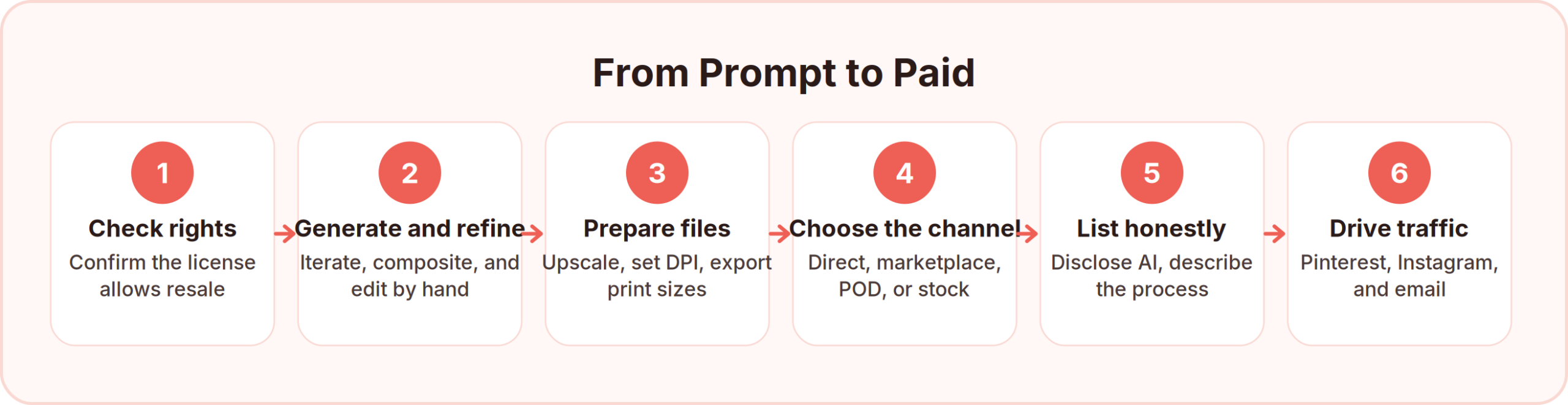
So this guide settles the permission question first, then walks through how to sell AI art in six steps: checking your commercial rights, choosing a platform that accepts AI work, preparing files, listing honestly, pricing, and bringing buyers.
It also covers which platforms quietly reject AI-generated work, which is where most beginners waste their first month. Anyone still deciding what to make should start with which digital products sell best, because the format decides the platform more than the artwork does.
Key Takeaways
- You can sell AI art and AI-generated paintings in most countries. No law prohibits it, and the major marketplaces have explicit policies allowing it
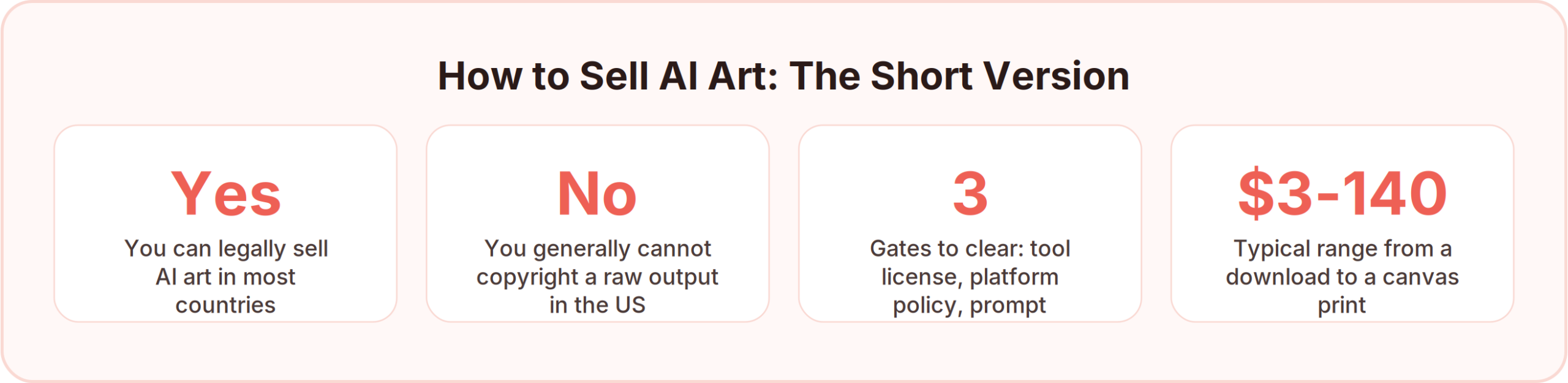
- You generally cannot copyright a raw AI output in the US. The Copyright Office requires human authorship, so prompt-in, image-out is not protectable
- Selling rights and copyright are different things. Your AI tool’s license grants commercial use; copyright is a separate question you often lose and rarely need
- The more you edit, composite, and paint over the output, the stronger your authorship claim and the better the work sells
- Platform policies conflict and change constantly. Shutterstock rejects direct AI uploads while Adobe Stock accepts them with labeling, and both have shifted position since 2023
- Disclosure is mandatory on some platforms and wise everywhere. Etsy requires an AI attribute, and misrepresenting AI work as hand-painted is the fastest route to a suspension
- Selling direct beats marketplace fees once you have any audience at all, because nobody takes a cut of a sale you made yourself
What Is AI Art, and Can You Legally Sell It?
AI art is artwork produced with a generative model such as Midjourney, DALL-E, Stable Diffusion, or Adobe Firefly. You describe an image in a text prompt, the model produces it, and you refine, edit, and finish the result.
The question almost everyone asks before anything else is whether selling it is allowed, so that gets answered first.
Can You Sell AI Art? The Direct Answer
Yes. There is no law in the United States, the United Kingdom, the EU, India, Australia, or New Zealand that makes selling AI-generated art illegal. People sell it openly on Etsy, Adobe Stock, Redbubble, Displate, and their own storefronts, and have done for several years.
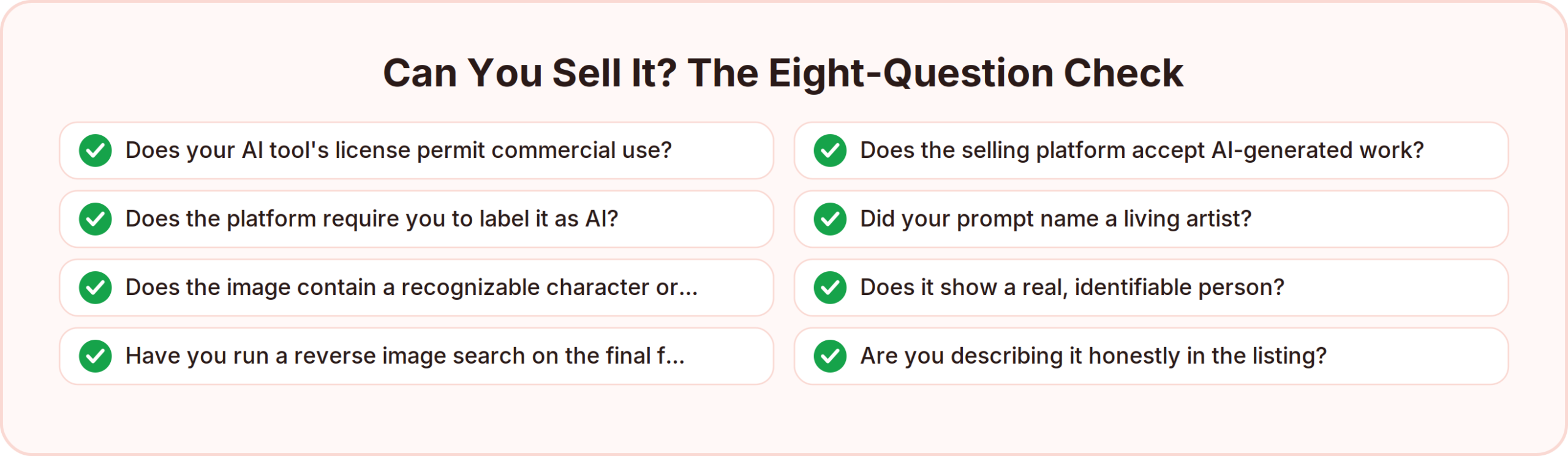
What actually constrains you is three things, none of which is a law against selling:
- Your AI tool’s license. The terms of service of whatever you generated with decide whether you have commercial rights to the output.
- The selling platform’s policy. Some marketplaces welcome AI work, some require it labeled, and at least one rejects it from contributors outright.
- What went into the prompt. Generating a recognizable character, a living artist’s named style, or a real person’s face creates a genuine legal problem that has nothing to do with AI.
Clear those three and you are selling legally. The six steps further down are how you do it in practice.
Can You Sell AI-Generated Paintings You Do Not Own the Copyright To?
This is the question underneath the question, and the answer surprises people: yes, routinely, and you already do it in other contexts.
Copyright is the right to stop other people copying your work. Commercial rights are the right to sell it. They usually travel together, which is why most people assume they are the same thing, but they are not.
| Copyright | Commercial rights | |
|---|---|---|
| What it gives you | The power to stop others copying your work | The power to sell the work |
| Where it comes from | Law, automatically, on creation by a human | Your AI tool’s license terms |
| AI raw output in the US | Generally not available, no human author | Usually granted by the tool |
| Can you sell without it? | Yes | No |
| What you lose without it | The ability to sue a copycat | Everything |
The US Copyright Office has been consistent that copyright requires human authorship, so an image produced by typing a prompt and accepting the result is not protectable. The Copyright Office’s guidance on AI sets out the position and is worth reading once rather than relying on forum summaries.
Practically, this matters far less than it sounds. If you are selling $12 digital downloads of abstract wall art, the ability to sue someone for copying a piece was never going to be exercised.
It matters in two situations: licensing to a brand that wants exclusivity, and building a signature style you intend to defend.
How to Strengthen Your Authorship Claim
The more human decision-making sits between the prompt and the finished file, the closer you get to something protectable and the better it tends to sell.
- Composite several generations into one image rather than shipping a single output.
- Paint over it. Actual editing in Photoshop, Procreate, or Affinity is both a creative contribution and a quality upgrade.
- Color grade and retouch. Fixing the hands, cleaning the edges, and grading the palette are all human choices.
- Document the process. Keep the layered file, the intermediate versions, and a note of what you changed.
- Iterate visibly. A hundred generations refined into one piece is a different act from accepting the first result.
If you could hand someone your prompt and they would get essentially your image back, you have a licensing product rather than an artwork. If they would get something clearly different because the value is in what you did afterwards, you have a stronger claim and usually a better product.
How to Sell AI Art in Six Steps
Everything above establishes that you can. This is how, in the order the work actually happens.
Step 1: Check That Your AI Tool Grants Commercial Rights
This is the first of the three gates, and it is the one most people never check. Every major tool publishes its position, and the terms differ meaningfully.
| Tool | Commercial use | Worth knowing |
|---|---|---|
| Midjourney | Granted on paid plans | Free-tier output has restricted rights. Very large companies face additional terms |
| DALL-E via ChatGPT | Granted to the user | OpenAI assigns output rights to you, subject to usage policies |
| Stable Diffusion | Permissive, model-dependent | Open weights, but individual checkpoints and LoRAs carry their own licenses |
| Adobe Firefly | Granted, trained on licensed data | Marketed as commercially safe, which matters for client and stock work |
| Leonardo AI | Granted on paid plans | Check the tier, since free plans are usually restricted |
| Canva AI | Granted with restrictions | Some outputs cannot be used for merchandise or resale as-is |
Two habits protect you here. Screenshot the license terms on the day you generate anything you intend to sell, and re-check before a big launch. Tools have changed their terms retroactively, and a saved copy of what you agreed to is worth having.
Step 2: Pick a Platform That Accepts AI Art
This is the gate that wastes the most time, because plenty of roundups list platforms without checking whether the door is open. People upload forty images to a marketplace that rejects AI work on principle and only find out at review.
| Platform | Accepts AI art? | Disclosure required |
|---|---|---|
| Etsy | Yes | Yes, you must select the AI attribute on the listing |
| Adobe Stock | Yes, with conditions | Yes, must be labeled as generative AI |
| Shutterstock | Not from contributors directly | Only through its own AI generation partnership |
| Getty Images | No | Bans AI-generated submissions outright |
| Redbubble | Yes | Not mandated, but recommended |
| TeePublic | Yes | Not mandated |
| Displate | Yes | Recommended |
| Society6 | Yes | Recommended |
| Zazzle | Yes | Not mandated |
| Amazon KDP | Yes | Yes, disclosure required during publishing |
| Your own storefront | Yes | Your choice, though honesty converts better |
Take that table as a starting point rather than gospel. Adobe Stock and Shutterstock have both moved position since 2023, published guides contradict each other on their current stance, and a policy page is the only reliable source. Upload three images and see what happens before you upload three hundred.
Uploading the same batch everywhere without checking. A rejection is survivable; repeated policy violations after a warning are how contributor accounts get closed, and closed accounts are rarely reopened.
Step 3: Prepare Your Files Properly
This is where most AI art fails commercially, and it is entirely fixable.
- Upscale before you sell. Native generation resolution is rarely enough for print. Upscale to at least 300 DPI at the intended physical size.
- Export standard aspect ratios. Buyers want 2:3, 3:4, 4:5, ISO, and square. Supplying one odd ratio guarantees a cropping complaint.
- Check the details at 100%. Hands, text, eyes, and repeating patterns are where AI artifacts hide, and buyers who zoom will find them.
- Use CMYK for print products and sRGB for digital delivery, or your colors will shift.
- Bundle multiple sizes in one download. It costs you an export and it removes the single most common refund request.
Step 3b: Run a Reverse Image Search Before Listing
Before anything goes on sale, put the final file through Google Images or TinEye. If something closely resembling a known work or a recognizable character comes back, rework it or discard it. This takes thirty seconds and it catches the problem that prompts alone will not reveal.
Step 4: List It Honestly
A lot of sellers worry that disclosing AI involvement kills the sale. The evidence points the other way: buyers care about whether the piece looks good on their wall, and the sellers who get into trouble are the ones who claimed something untrue.
What actually works is describing your process accurately and specifically.
| Instead of | Write | Why it works |
|---|---|---|
| Hand-painted original | Digitally created and hand-finished | True, and still signals human effort |
| 100% original artwork | Original composition, created with AI tools and edited in Photoshop | Specific, and specificity reads as confidence |
| No mention of AI at all | AI-assisted, refined over 40+ iterations | Turns the process into part of the appeal |
| AI generated | Created using AI, composited and color graded by hand | Separates you from single-prompt sellers |
The reframe worth internalizing is that your buyer is not purchasing your labour. They are purchasing an image they want on their wall or in their project. Time spent apologizing for the tool is time not spent showing the work at 4,000 pixels wide in a room they recognize.
Step 5: Price the Work
Pricing is where beginners lose most of their potential income, usually by anchoring to what the generation cost them rather than what the buyer gets.
- Do not compete on price. Undercutting signals low quality in a category already fighting that perception, and it caps you at volumes you cannot sustain.
- Bundle instead of discounting. Five themed pieces at $18 outperforms one at $6 because the buyer decorating a room needs a set.
- Price prints on the wall, not the file. A framed 24-inch canvas is a furniture purchase and is priced accordingly.
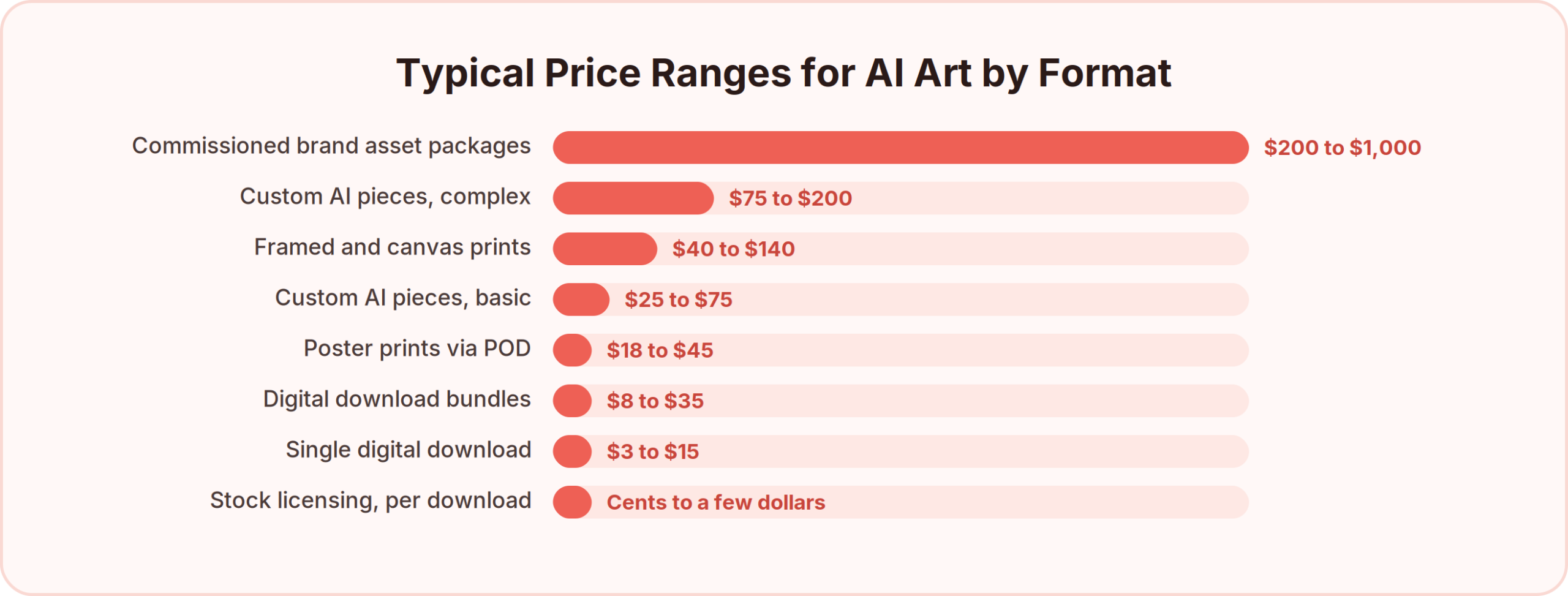
- Charge properly for commissions. Custom work is a service with revisions and a deadline, and the ranges above reflect that.
- Raise prices after your first twenty sales. If nothing slows down, you were too cheap. The broader mechanics are covered in how to price a product.
Step 6: Bring the Traffic
No platform will sell art for you, including the marketplaces. Traffic decides income.
- Pinterest is the strongest channel for art by a wide margin, because it is a visual search engine where people plan rooms. Pins keep driving traffic for months.
- Instagram and TikTok reward process content. Timelapse of a piece developing outperforms the finished image, because the process is the interesting part.
- Email is where repeat sales live. Someone who bought one piece is the most likely buyer of the next, and you can build an email list without a website in an afternoon.
- Being recognizable compounds. Personal branding is what turns a seller of generic wall art into an artist people follow, and it is the only asset here that transfers between platforms.
Where to Sell AI Art Online
There are four routes to selling AI art online, and they suit very different temperaments. Most sellers eventually run two of them at once.
| Route | How it pays | Best for | The trade |
|---|---|---|---|
| Your own storefront | Full price, minus payment processing | Anyone with any audience at all | You bring the buyers |
| Marketplaces like Etsy | Sale price minus listing and transaction fees | Sellers with no audience yet | Fees and heavy competition |
| Print-on-demand | Your markup over production cost | Physical products with no inventory | Thin margins, no customer data |
| Stock licensing | Cents to dollars per download, repeatedly | High-volume producers | Very low per-image income |
Selling Direct From Your Own Page
Direct selling is the highest-margin route and the one most beginners skip because it feels like it requires a website. It does not.
brandID is a creator storefront built for exactly this: one page holding your art, your links, and your buyers, with your own Stripe or PayPal connected so payments arrive in your account rather than being held by a marketplace.
For AI artists the practical appeal is that files deliver themselves. A buyer pays, the download arrives automatically, and there is no inventory, no shipping, and no fulfillment step to manage.
- Sell the files directly: selling digital products covers high-resolution images, bundles, and print-ready files with instant delivery
- Product galleries that display artwork properly, which matters more for art than for any other digital product
- Subscriptions for collectors who want a new piece each month, through subscriptions and memberships
- Tipping for people who like the work but are not buying today, via collecting tips
- Email capture so a buyer who liked one piece can be told about the next one
- 0% platform fee on your own payment gateway from $9 a month, against Etsy’s roughly 11% all-in
Best For: AI artists who already post work on Instagram, Pinterest, or TikTok and are currently sending that audience to a marketplace that charges them for the privilege.
Honest limits: this is a digital storefront, so physical prints need a print-on-demand partner alongside it, and it brings no marketplace traffic of its own.
Open a Free AI Art StoreWhichever page holds the work, the link in your bio is what carries traffic to it, and the best link in bio tools decide how much of that attention converts.
Marketplaces
Etsy remains the highest-intent marketplace for digital art, with buyers actively searching for printable wall art rather than browsing. It requires the AI attribute on listings and charges roughly 11% all-in once listing, transaction, and payment processing fees are counted.
The mechanics of listing there are covered in selling digital downloads on Etsy, and if those fees put you off, the Etsy alternatives compare what else is available.
The competition on Etsy for AI wall art is now severe. Winning there means niching hard, into specific rooms, specific color palettes, or specific subjects, rather than listing general abstracts.
Print-on-Demand
Redbubble, Displate, Society6, Zazzle, and Printful turn a file into posters, canvases, apparel, and phone cases with no stock held. You upload, they manufacture and ship on each order, and you take a markup.
Two things decide whether this works: resolution and format fit. A 1024-pixel generation will not print on a 24-inch canvas, and a busy composition that looks striking on screen frequently reads as noise on a t-shirt.
Stock Licensing
Stock is the most passive route and the lowest paid per image. It rewards volume and commercial usefulness rather than beauty. A striking fantasy scene earns very little; a clean image of a plausible team in a plausible office earns steadily, because marketing departments buy that every day.
What Kind of AI Art Actually Sells
Broad answer: art that solves a problem someone already has. Beautiful is not a category, and the AI-generated paintings that sell reliably are the ones with a use case attached.
| Sells reliably | Why | Sells poorly |
|---|---|---|
| Wall art for specific rooms | Buyers search by room and palette | Generic abstracts with no use case |
| Seasonal and holiday sets | Recurring, predictable demand | One-off pieces with no series |
| Nursery and children’s art | Emotional purchase, high willingness to pay | Complex adult fantasy scenes |
| Clip art and design assets | Bought by other creators as inputs | Single decorative images |
| Commercial stock scenes | Marketing teams buy them constantly | Beautiful scenery shots, heavily oversupplied |
| Themed collections | Buyers decorating want sets | Unrelated individual pieces |
Two adjacent products are worth knowing about, because they sell to the same audience with less competition. Selling AI prompts monetizes the skill rather than the output, and selling clipart serves designers who need assets rather than consumers who need decor.
Mistakes That Get AI Art Sellers Banned or Ignored
- Naming a living artist in the prompt. This is the single clearest legal exposure in the whole practice, and it is entirely avoidable.
- Generating recognizable characters or logos. Trademark and copyright apply exactly as they always did. The tool does not change that.
- Claiming AI work is hand-painted. Misrepresentation, not AI use, is what gets listings pulled and accounts closed.
- Uploading at generation resolution. A blurry print earns a refund and a review that costs more than the sale.
- Ignoring the platform’s disclosure field. If Etsy provides an AI attribute and you skip it, that is a policy violation on record.
- Flooding every platform on day one. Test with a few uploads, learn each platform’s review behavior, then scale.
- Treating volume as strategy. Three hundred generic images earn less than thirty considered ones in a defined niche.
Conclusion
Learning how to sell AI art starts with realizing the permission you were looking for is not in any law. It is in your AI tool’s license and the policy page of whichever platform you upload to, and both take ten minutes to check.
What you generally cannot do is copyright a raw generation in the US, and for most sellers that turns out not to matter. It matters if you are licensing exclusively to brands or defending a signature style, and in both of those cases the answer is the same: put more of yourself between the prompt and the finished file.
After that it stops being a legal question and becomes a business one. Pick a niche narrow enough to win, prepare files properly, price for the value rather than the effort, and send your own traffic somewhere that does not take a cut of every sale.
Can You Sell AI Art?
Yes. No law in the US, UK, EU, India, Australia, or New Zealand prohibits selling AI-generated art. Three things constrain you instead: your AI tool’s license must permit commercial use, the selling platform must accept AI work, and the image must not contain copyrighted characters, trademarks, a named living artist’s style, or a real identifiable person.
Can I Sell Paintings Made by AI?
Yes, and AI-generated paintings are among the best-selling categories on Etsy and print-on-demand platforms, particularly wall art for specific rooms. You may not be able to copyright a raw output in the US, but copyright and the right to sell are different things, and the tool’s license is what grants the second one.
Is It Legal to Sell AI-Generated Art?
In most jurisdictions, yes. The legal risk does not come from using AI; it comes from what the image contains. Generating a recognizable copyrighted character, a brand logo, a real person’s face, or work in a named living artist’s style creates exposure that would exist regardless of how the image was made.
Can You Copyright AI Art?
Generally not in the United States if the image is a raw AI output, because the Copyright Office requires human authorship. Substantial human contribution through compositing, painting over, and editing can support a claim in the parts you created. Commercial rights, which is what you need to sell, come from your tool’s license instead.
Which Platforms Accept AI-Generated Art?
Etsy, Adobe Stock, Redbubble, TeePublic, Displate, Society6, Zazzle, and Amazon KDP all accept it, most with a disclosure requirement. Getty Images bans it, and Shutterstock does not accept direct AI uploads from contributors. Policies shift frequently and published guides contradict each other, so check the platform’s own policy page before uploading a batch.
Do I Have to Disclose That My Art Is AI-Generated?
On some platforms yes, and it is sensible everywhere. Etsy requires you to select an AI attribute on the listing, Adobe Stock requires generative AI labeling, and Amazon KDP requires disclosure at publishing. Describing your process accurately protects the account, and specific descriptions like created with AI and hand-finished in Photoshop convert better than vagueness.
How Much Can You Sell AI Art For?
Single digital downloads typically go for $3 to $15, bundles $8 to $35, print-on-demand posters $18 to $45 after your markup, and framed or canvas prints $40 to $140. Custom commissions run $25 to $200 depending on complexity, and brand asset packages reach $200 to $1,000. Stock licensing pays cents to a few dollars per download but pays repeatedly.
Where Is the Best Place to Sell AI Art?
It depends on whether you have an audience. With any following, selling direct from your own page keeps the full price rather than losing roughly 11% to marketplace fees. Without one, Etsy has the highest buyer intent for digital art, and print-on-demand platforms handle physical products with no inventory.
Can I Sell AI Art on Etsy?
Yes. Etsy allows AI-generated work and requires you to mark it using the AI attribute on the listing. The bigger practical obstacle is competition, since AI wall art is now heavily saturated there. Niching into specific rooms, palettes, or subjects performs far better than listing general abstracts.
Does Selling AI Art Actually Make Money?
It can, and it follows the same rules as any digital product business. Sellers earning consistently pick a defined niche, prepare files to genuine print standards, build a catalog rather than posting one-offs, and drive their own traffic from Pinterest and email. Sellers uploading a hundred generic generations and waiting generally earn nothing.
 Summarize this article with: