B2B SaaS marketing looks like ordinary marketing on the surface, which is exactly why it trips people up. The tactics that win in B2C or e-commerce rarely translate, because here the sale is the beginning of a long relationship, not the end. Deals involve multiple stakeholders, sales cycles stretch for months, and most of the buying journey happens before a prospect ever talks to you.
That means the best b2b saas marketing strategies are full-lifecycle and revenue-aware: you align marketing and sales, earn trust while buyers self-educate, and keep growing accounts long after they sign. This guide is a complete 2026 playbook on how to market B2B SaaS, covering foundations, go-to-market motions, the lifecycle funnel, the metrics that matter, 12 proven strategies, and the tools to run them, so you can build a b2b saas marketing plan that compounds. If your priority is filling the pipeline, start with our pillar guide to B2B SaaS lead generation.
Key Takeaways
- Foundations first: nail your ICP, positioning, and pricing before choosing channels or spending money.
- Pick a GTM motion: product-led, sales-led, hybrid, or ABM, matched to your price point and sales cycle.
- Think lifecycle, not funnel: acquire, onboard, retain, expand, and turn customers into advocates.
- Measure what matters: LTV:CAC of 3:1+, CAC payback under 12 months, and NRR above 100%.
- Go deep on 2-3 channels: content and SEO, founder-led LinkedIn, email, ABM, reviews, referrals, and contact form outreach.
What Is B2B SaaS Marketing (and Why It Is Different)
B2B SaaS marketing means finding the right companies, showing them how you solve their problems, and making it obvious your product is the best fit, then keeping them as paying, expanding customers. Sometimes called saas b2b marketing, it is the discipline of turning that fit into recurring revenue, and a strong b2b saas marketing strategy treats the whole lifecycle, not a single sale. “B2B” means you sell to other businesses, not consumers; “SaaS” means customers subscribe to software online instead of buying it outright.
Three differences shape every decision in b2b saas marketing:
- Long, multi-stakeholder cycles: roughly three-quarters of B2B sales take three months or more and involve end users, champions, and finance.
- Self-educating buyers: prospects complete most of their research, often around 70%, before contacting sales, so content and reviews do much of the selling.
- Recurring revenue: because customers renew and expand, retention and expansion are marketing problems, not just customer-success ones.
If you are focused on the top of that journey, the demand and outbound strategies below pair directly with a focused lead-generation motion.
Start With Foundations: ICP, Positioning & Pricing
The fastest way to waste a marketing budget is to pick channels before you have nailed the basics. Top-performing SaaS teams get three foundations right before spending a dollar.
1. Define a Specific ICP
Your ideal customer profile cannot be “B2B companies that need our product.” Get specific about industry, company size, the exact roles you sell to, and the pain that keeps them up at night. A sharp ICP focuses spend on high-intent buyers and stops you firing arrows in the dark. Map the full buying committee too, since end users, champions, and finance all weigh in.
2. Sharpen Positioning & Your Value Proposition
Strong positioning answers three questions fast: what do you do, who is it for, and why you instead of the fifteen other tools in their inbox? Replace wallpaper like “all-in-one platform for modern teams” with a nerve-hitting promise such as “close deals 30% faster with one workspace for proposals, approvals, and signatures.” This is the core of b2b saas product marketing, connecting features to real outcomes, and clear positioning lifts every other strategy on this list.
3. Get Pricing & Packaging Right
Pricing is part of marketing. Keep tiers simple and transparent, and consider a free trial or freemium plan to reduce friction and fight rising acquisition costs. Match packages to the personas in your ICP so buyers can self-select the plan that fits.
Choose Your Go-To-Market Motion
There is no single right playbook; the best b2b saas marketing strategies depend on your business model, price point, and sales cycle. Pick the motion that matches how your buyers actually buy.
| GTM Motion | How It Works | Best For |
|---|---|---|
| Product-led (PLG) | Free trial or freemium; the product drives sign-ups and activation | Self-serve, lower-ACV tools with fast time-to-value |
| Sales-led | Demos and direct outreach close deals | Complex, high-ACV products with long cycles |
| Hybrid | Marketing creates demand, product activates, sales closes high intent | Most SaaS companies as they scale |
| Account-based (ABM) | Target a defined list of high-value accounts | Enterprise and high-ACV segments |
Most companies blend these as they grow: lead with a product-led or content-led motion to build pipeline efficiently, then layer in sales-led and ABM for larger deals. The point is to choose deliberately rather than copy a competitor with a different model. Whether you run growth in-house or bring in a b2b saas marketing consultant, the motion should match how your buyers actually buy.
The B2B SaaS Marketing Funnel Is a Lifecycle
Your buyers already move through stages whether you design them or not, but in 2026 the smart model is a lifecycle, not a linear funnel that ends at the sale. It runs from first touch through expansion, and your happiest customers loop back to create new awareness.
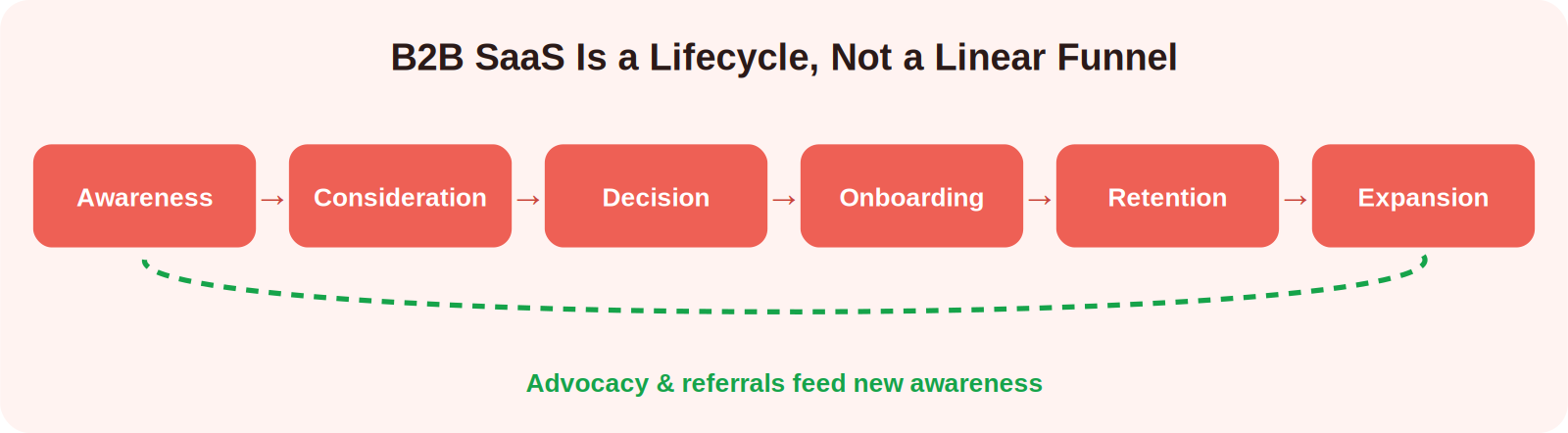
- Awareness: the right accounts discover you through SEO, LinkedIn, communities, outreach, and paid discovery.
- Consideration: they evaluate you with content, demos, webinars, case studies, and reviews. This is the biggest leak, with MQL to SQL averaging just 13%.
- Decision: sales enablement, tailored demos, pilots, and social proof remove the final excuses.
- Onboarding: fast time-to-value turns sign-ups into activated, sticky users.
- Retention & expansion: education and engagement lower churn and grow accounts.
- Advocacy: referrals, reviews, and case studies feed the next cycle of awareness.
B2B SaaS Marketing Metrics That Matter
Strategies are only as good as the metrics that govern them. Anchor your plan to the numbers that signal efficient growth, not vanity traffic.
| Metric | Healthy 2026 Benchmark | Why It Matters |
|---|---|---|
| LTV:CAC ratio | 3:1 minimum (4-5:1 is strong) | Whether acquisition is profitable and sustainable |
| CAC payback | Under 12 months (median ~8.6) | How fast you recover the cost of a customer |
| Net Revenue Retention | 100-110% (best-in-class 120%+) | Expansion can grow you without new sales |
| MQL to SQL | ~13% average (the top bottleneck) | Lead quality and sales-marketing alignment |
| Activation rate | 25-40% for product-led motions | Whether new users reach value fast |
| Landing page conversion | ~3.8% median for SaaS | Where most traffic quietly leaks away |
The throughline: chase efficient growth. Followers and pageviews feel good, but LTV:CAC, payback, and net revenue retention tell you whether your B2B SaaS marketing strategy actually works.
12 B2B SaaS Marketing Strategies That Work in 2026
Now from theory to practice. These are the saas marketing strategies you see again and again in companies that are actually growing. Here is the quick view before the detail, then pick the two or three where your ideal customer truly lives.
| Strategy | Lifecycle Stage | Best For | Note |
|---|---|---|---|
| Content & thought leadership | All stages | Educating buyers, topical authority | Foundation of SaaS growth |
| SEO & AI search (GEO) | Awareness-Consideration | Compounding inbound | ~702% long-term ROI |
| Demand generation | Awareness | Future pipeline | Reach the 95% not buying yet |
| Founder-led & LinkedIn | Awareness-Consideration | Trust at scale | Top source of quality B2B leads |
| Contact form outreach | Awareness | Targeted outbound | ~98% deliverability, no spam filters |
| Email & lifecycle | Consideration-Retention | Nurture and onboarding | ~$42 returned per $1 |
| Account-based marketing | All stages | High-ACV and enterprise | Focus on named accounts |
| Review sites & marketplaces | Decision | Validation and trust | G2 and Capterra close deals |
| Partnerships & integrations | All stages | Borrowed audiences | Co-marketing and listings |
| Affiliate & referral | All stages | Low-CAC word of mouth | Cheapest channel (~$150/customer) |
| Paid channels (PPC) | All stages | Scaling proven offers | Captures high-intent demand |
| Retention & expansion | Post-sale | NRR growth | Where the most profit lives |
1. Content Marketing & Thought Leadership
Content is the foundation of nearly every B2B SaaS growth engine and the backbone of b2b saas inbound marketing. Because buyers do roughly 70% of their research before they ever speak to sales, your content is often the first and most persuasive salesperson you have. The goal is not traffic for its own sake; it is creating the touchpoints that educate buyers and move them through long, complex decisions.
Win by being genuinely useful and differentiated: original research, real data, customer stories, and opinionated thought leadership beat the sea of AI-generated sameness. Map each piece to a lifecycle stage so content does not just attract visitors, it helps convert and retain them.
2. SEO, Topical Authority & AI Search
Even as AI search grows, SEO remains one of the highest-ROI b2b software marketing strategies, delivering around 702% return over three years and roughly 44% of B2B SaaS traffic. Modern SaaS SEO is about topical authority: covering a topic in depth and connecting related pages with internal links so both Google and AI answer engines (GEO) trust you.
Do not chase traffic alone. Prioritize transactional, buyer-intent keywords that signal a decision is near:
- “best alternative to [X]”
- “[X] vs [Y]”
- “[X] pricing”
- “[X] reviews”
These middle-of-funnel searches convert far better than top-of-funnel volume, which is exactly how leaders win category keywords. It is also the most cost-effective lever in b2b saas digital marketing.
3. Demand Generation (Not Just Lead Gen)
At any moment, only about 5% of your potential buyers are actively shopping; the other 95% are not in-market yet. Treating marketing as a lead-gen assembly line that pushes “book a demo” at everyone wastes most of your reach. Demand generation instead builds awareness and trust with the 95%, so when they do enter the market, you are already on their day-one shortlist, which is where roughly 80-90% of deals are won.
In practice that means consistent, valuable content and presence across the channels your buyers actually use, measured by pipeline and revenue rather than vanity lead counts.
4. Founder-Led Marketing & LinkedIn
LinkedIn is still the default platform for B2B SaaS. According to LinkedIn’s lead generation data, around 40% of marketers say it delivers their highest-quality leads and nearly nine in ten use it for lead generation. In 2026 the highest-performing accounts are personal, not corporate: founders, marketers, and product leaders sharing stories, frameworks, and customer wins. Creator-led media now makes up a large share of how top brands reach buyers.
Treat it like an ongoing keynote: show up consistently, teach, and let the right people come closer. To scale prospecting safely, pair posting with reputable LinkedIn automation tools.
5. Contact Form Outreach
Most teams overlook contact form marketing because it does not feel scalable, but in 2026 it works precisely because it matches how companies want to be approached. A Contact Us page is an explicit invitation, and that path is built into the company’s own workflow, so your message is read, evaluated, and routed internally instead of dying in a spam folder.
6. Email & Lifecycle Marketing
Email is where attention turns into action, and it is still the highest-ROI owned channel in B2B SaaS, returning roughly $42 per $1 spent. Once someone joins your list from a demo, trial, or lead magnet, you can onboard them, drive activation, nurture toward a stronger commitment, and win them back if they drift. Make capturing that audience a priority, and build an email list so an algorithm change never cuts off your pipeline.
One 2026 note: Apple Mail Privacy Protection makes open rates unreliable, so track click-to-open and click-through instead. For cold, outbound email, the right cold email software keeps you out of spam.
7. Account-Based Marketing (ABM)
For higher-ACV and enterprise SaaS, account-based marketing beats broad campaigns. Instead of casting a wide net, you select a defined list of high-value accounts and tailor messaging, content, and outreach to the specific roles inside them, end users, champions, and economic buyers alike.
Used consistently, ABM improves conversion quality and shortens sales cycles, because every touch speaks directly to an account’s context rather than a generic persona.
8. Review Sites & Marketplaces
When buyers reach the decision stage, they trust peers over vendors. Being visible and well-reviewed on platforms like G2, Capterra, and TrustRadius validates your product exactly when risk and politics peak. Comparison and review pages often influence the final shortlist more than your own website.
Actively request reviews from happy customers, keep your profiles current, and claim category and “best [software]” placements. App marketplace listings (for the tools your customers already use) add another high-intent discovery path.
9. Partnerships, Integrations & Co-Marketing
Partnerships let you borrow trust and reach audiences you could not buy efficiently. Integrations with complementary tools increase your product’s value and put you in partner marketplaces, while co-marketing (joint webinars, collaborative content, and bundles) shares audiences for mutual growth.
For early-stage and enterprise SaaS especially, strategic relationships with vendors in your space often outperform cold paid acquisition.
10. Affiliate & Referral Programs
Your happiest users, consultants, and partners can sell you better than your ads, and the economics prove it: referrals are the cheapest acquisition channel in B2B SaaS at roughly $150 per customer. Strong affiliate and referral programs reward customers who bring in other teams, encourage agencies to recommend you, and turn niche creators into scalable acquisition channels.
When referrals are easy and clearly worth it, word of mouth shifts from “nice when it happens” to a channel you can forecast.
11. Paid Channels (PPC & Retargeting)
Paid media does not fix weak positioning, it scales whatever you already have, so optimize your funnel first. Once your copy and conversion paths work, PPC captures existing high-intent demand and keeps you visible to warm accounts. Common plays include search ads for bottom-of-funnel keywords, LinkedIn ads targeting specific roles, and retargeting visitors who viewed key pages.
With Google non-brand CPCs commonly $8 to $14 and LinkedIn $5 to $9, the discipline is constant: start small, test ruthlessly, and scale only what brings customers, not just clicks.
12. Retention & Expansion Marketing
Treating “customer won” as the finish line is the most expensive mistake in B2B SaaS, because that is where the most profitable marketing begins. Healthy companies hold 100 to 110% net revenue retention and best-in-class teams reach 120%+, growing from existing customers even with flat new business. This is the heart of b2b saas growth marketing.
Focus on onboarding users to value fast, educating them on advanced use cases, and keeping engagement high so churn stays low. Every point of retention compounds your LTV and lets you invest more aggressively in acquisition.
Note: If contact form outreach is part of your plan, do not run it manually. ContactUs AI by brandID is an AI Chrome extension that finds, fills, and submits high-intent Contact Us forms for you, solving CAPTCHAs, personalizing each message, and auto-detecting each site’s language. It reaches a company’s primary inbox with around 98% deliverability, no domains or warm-ups, and you pay only per website processed.
Submit AI-personalized messages through thousands of contact forms a day, straight to decision-makers, without spam filters or warm-ups. Start with 30 free credits.
Install ContactUs AI FreeB2B SaaS Marketing Tools to Run It
You do not need a 30-tool stack to win. A focused set of b2b saas marketing tools, organized by job, beats a sprawling one.
- Outbound & contact-form outreach: ContactUs AI for contact form submission at scale, plus cold email and social prospecting tools, and Chrome extensions for lead generation to find accounts.
- SEO & content: a research and rank-tracking suite (such as Ahrefs or Semrush) to find buyer-intent keywords and brief content.
- CRM & automation: HubSpot, Salesforce, or Pipedrive to track pipeline and run nurture and lifecycle sequences.
- Analytics & attribution: GA4 plus an attribution and heatmap layer so you can measure pipeline, not just clicks.
Wire everything to one source of truth so you can attribute revenue. The same discipline applies whether you are scaling outbound or running local lead generation.
Conclusion
B2B SaaS marketing in 2026 is a data-driven system, not a pile of tactics. Get your foundations right, choose a go-to-market motion that fits your model, design for the full lifecycle, and measure LTV:CAC, payback, and retention instead of vanity metrics. Then go deep on the two or three strategies where your ideal customer actually spends time.
Do that consistently and you turn scattered effort into compounding, efficient growth. And if contact form outreach is part of your strategy, do not run it manually: install ContactUs AI‘s Bulk Cold Outreach Chrome extension and turn high-intent contact forms into a scalable revenue channel without sounding like spam. For more on filling the top of your funnel, start with the contact form outreach strategy above.
B2B SaaS Marketing FAQs
What is B2B SaaS marketing?
B2B SaaS marketing is how software-as-a-service companies attract, convert, and retain other businesses as customers. Because the product is sold by subscription, the goal is not just sign-ups but the entire lifecycle: defining who you serve, attracting the right decision-makers, nurturing trust across a longer buying cycle, and expanding revenue from existing customers. It blends content, SEO, demand generation, outbound, email, paid, partnerships, and retention into one revenue-focused system.
How is B2B SaaS marketing different from traditional marketing?
Three things set it apart. First, sales cycles are long and involve multiple stakeholders, so roughly three-quarters of B2B deals take three months or more. Second, buyers self-educate, completing most of their research before talking to sales, so your content and reviews do much of the selling. Third, because revenue recurs, retention and expansion are marketing problems, not just customer-success ones. The job runs across the whole lifecycle, not a single sale.
What are the most effective B2B SaaS marketing strategies in 2026?
The highest-impact strategies are content and SEO (around 702% long-term ROI), founder-led marketing on LinkedIn, demand generation aimed at future buyers, email and lifecycle nurture (about $42 per $1), account-based marketing for high-ACV deals, review-site presence on G2 and Capterra, partnerships, referrals (the cheapest channel), and contact form outreach. The winners pick two or three channels where their ideal customer actually lives and go deep rather than spreading thin.
What is the B2B SaaS marketing funnel?
It is better seen as a lifecycle than a linear funnel: Awareness, Consideration, and Decision get the customer in, then Onboarding, Retention, and Expansion grow their value, with Advocacy feeding new awareness. Each stage has its own metrics, and the biggest leak is usually MQL to SQL, which averages around 13%. Designing for the full lifecycle, not just acquisition, is what separates efficient SaaS companies from the rest.
What is a good LTV:CAC ratio and CAC payback for B2B SaaS?
Target an LTV:CAC ratio of at least 3:1, with 4 to 5:1 considered strong, and a CAC payback period under 12 months (the median is around 8.6). These signal that each customer returns several times their acquisition cost, fast enough to keep cash flowing. Also track net revenue retention, where 100 to 110% is healthy and 120%+ is best-in-class, since expansion revenue can grow you even with flat new business.
What is the average B2B SaaS marketing budget?
Most SaaS companies spend between 6% and 25% of annual recurring revenue, scaled to growth stage. Early-stage startups under $10M ARR often invest 15 to 25% to fuel acquisition, growth-stage companies spend roughly 8 to 15%, and mature companies settle around 6 to 10%. Allocation matters as much as the total: teams that over-index on paid ads while neglecting owned channels like SEO and email tend to report higher CAC.
How is generative AI changing B2B SaaS marketing?
Generative AI speeds up content creation, enables hyper-personalized campaigns, and sharpens targeting from real-time intent signals, with teams reporting roughly a 10% conversion uplift from AI-driven personalization. It is also reshaping discovery: buyers increasingly use AI answer engines, so structuring content for generative search (GEO) matters. The winners use AI to scale judgment and personalization, not to flood the web with undifferentiated content.
How do I set marketing goals for B2B SaaS revenue?
Work backward from revenue. Start with the number leadership wants to hit, translate it into the new ARR you need, then move up the funnel: how many closed deals that requires, and how many SQLs, MQLs, and visitors that implies based on your conversion rates and average deal size. Make every goal SMART, and keep CAC, LTV, and payback front and center so growth stays efficient rather than just big.
 Summarize this article with: