Plenty of creators want the income that affiliate marketing offers without putting their face on the internet. Camera shyness, privacy concerns, a day job, or simply preferring to stay anonymous all keep talented people on the sidelines. Faceless affiliate marketing solves that by letting you build a profitable channel using voiceovers, text overlays, screen recordings, stock footage, and AI-generated assets instead of selfie videos.
This guide breaks down exactly how faceless affiliate marketing works in 2026, the platforms that reward this format, the strategies that convert, the niches with the highest commissions, and a step-by-step plan you can start today. For broader context on commissions, networks, and tracking, the brandID complete affiliate marketing guide pairs well with everything below.
By the end, you will know which platform fits your style, which content format to start with this week, and how to turn a faceless account into a sustainable income stream without ever appearing on camera.
Key Takeaways
- Faceless affiliate marketing works at scale. Voiceovers, B-roll, screen recordings, and AI avatars produce billions of monthly views and consistent affiliate revenue across every major platform.
- Pick one platform first. TikTok and Instagram Reels deliver the fastest reach, YouTube Shorts and long form build search authority, and Pinterest plus blogs compound for years.
- Niche selection drives income. Personal finance, software, AI tools, home improvement, and pet care pay the highest commissions per click in 2026, with SEO affiliate programs sitting at the top of the software tier for recurring commission math, and the newer category of AI affiliate programs right behind them on both commission share and audience intent.
- A storefront beats raw links. Organize affiliate products into a shoppable link in bio so every post sends viewers to a curated landing page instead of a single dead-end URL.
- Consistency outperforms perfection. Posting 5 to 7 short videos per week for 90 days produces results faster than polished monthly uploads.
- Don’t skip disclosure. The FTC requires clear affiliate disclosure on every post, faceless or not, and platforms will demote accounts that hide it.
What Is Faceless Affiliate Marketing?
Faceless affiliate marketing is the practice of promoting affiliate products through content that never shows the creator’s face, voice on camera, or personal identity. Income still comes from the standard model of earning a commission each time someone buys through your tracked link, but the content is built from voiceovers, screen recordings, animations, AI avatars, stock footage, carousels, blogs, and text-on-screen videos.
The format removes the personal branding barrier that stops millions of people from starting. You do not need to be photogenic, charismatic on camera, or comfortable with strangers recognizing you at the grocery store. You only need a niche, an angle, and a content system you can repeat.
Faceless does not mean low effort. Successful accounts still pick a clear niche, write strong scripts, edit tightly, and choose affiliate products their audience genuinely wants. The face is missing, but the strategy is the same as any other affiliate channel. Done well, it becomes one of the more durable passive income ideas for creators, because a back catalog of videos keeps earning long after publishing.
Is Faceless Affiliate Marketing Still Allowed in 2026?
Yes, faceless affiliate marketing is still allowed in 2026, and none of the major networks or platforms have banned it. What has changed is how strictly each platform enforces two things: honest affiliate disclosure and the rules around AI-generated or repurposed content. Understand where the lines are drawn and a faceless account can run for years without a single strike.
The rules that actually matter in 2026:
- Affiliate networks (Amazon Associates, ShareASale, Impact, CJ, Awin) do not require a face on your channel. They require a working site or profile, real audience engagement, and a clear disclosure that you earn a commission. Amazon in particular expects your first three qualifying sales within 180 days, faceless or not.
- FTC disclosure is mandatory. Every video description, pin, or caption with an affiliate link needs a plain-English note like “This post contains affiliate links.” Hiding your face is fine. Hiding the commercial relationship is not.
- TikTok, Instagram, and YouTube all allow faceless content. What they penalize is unoriginal, mass-reposted, or purely AI-generated video with no added value. Voiceover, editing, script, on-screen text, or a genuine perspective is enough to count as original.
- YouTube Partner Program tightened its “reused content” policy again in 2025. Faceless is fine, but pure clip-farming and text-to-speech slideshow spam is not monetizable. Add commentary, structure, and original writing.
- Pinterest is the most faceless-friendly platform there is. It cares about pin quality and destination, not who you are.
Follow the disclosure rules, keep your content original enough to add real value, and faceless affiliate marketing remains one of the safest content models to run in 2026.
Why Faceless Affiliate Marketing Is Working In 2026
Three forces converged to make faceless content the fastest-growing corner of affiliate marketing right now. The global affiliate marketing industry is on track to surpass $15.7 billion in spend by 2026, according to Statista, and faceless creators are capturing a growing share of that pie because their content fits how short-form platforms now distribute video.
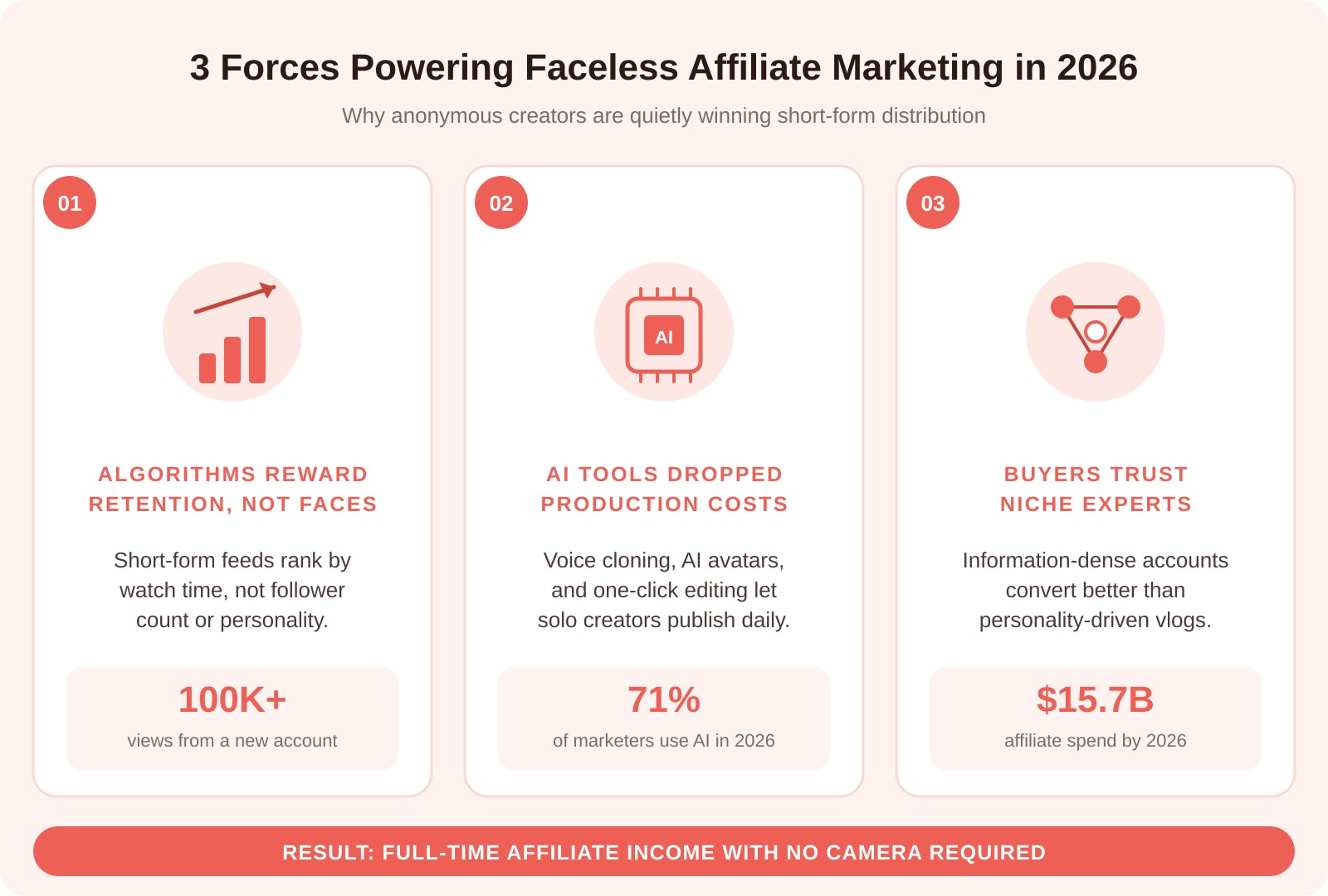
The three forces behind faceless affiliate marketing growth in 2026: retention-based algorithms, cheaper AI production, and rising trust in niche experts.
First, the algorithms on TikTok, Instagram Reels, and YouTube Shorts reward retention and watch time above all else. A well-scripted 30-second voiceover with crisp B-roll holds attention as well as a talking-head video, sometimes better, because the visuals constantly change.
Second, AI production tools dropped the cost of faceless content to almost nothing. Voice cloning, AI avatars, automatic captions, and one-click editing apps mean a single person can publish daily without a studio. As of 2026, 71 percent of marketers reported using AI in some part of their content workflow, which raised the floor of quality across the board.
Third, audiences increasingly trust niche, information-dense accounts over personality-driven ones for purchase decisions. When someone is comparing two laptops or three protein powders, they want clear data, not vlogs. Faceless channels deliver that better than most influencers.
Faceless Affiliate Marketing for Beginners: The Simplest Path
If you are brand new, faceless affiliate marketing for beginners comes down to one honest question: what is the fastest, lowest-risk way to earn your first commission without showing your face or spending money you do not have? The full six-step system below covers everything, but the beginner path is deliberately shorter. It skips gear, teams, ads, and long-form video.
The 5-move beginner playbook
- Pick one niche you already care about. Kitchen gadgets, budgeting apps, dog gear, home office setups, skincare, board games. Something you would happily read about for an hour. If you cannot narrow it down, start with the niche where you have bought the most in the last 12 months.
- Join one beginner-friendly network. Amazon Associates is the easiest to get into and has the widest catalog. Once you have three sales it stays active. Add one specialty network later.
- Pick one platform, not four. Instagram Reels, TikTok, Pinterest, or a small blog. Whichever you already spend time on. Split attention kills beginners.
- Ship 30 pieces of content in 30 days. Each one is a short faceless video, pin, or article that helps someone decide on a product. No fancy editing. Voiceover, text overlay, and stock or product footage is enough.
- Put every affiliate link inside a link-in-bio page. Social platforms only give you one clickable link on your profile, so a good link-in-bio is where your commissions actually get earned. Add clear disclosure once at the top and once in each caption.
Beginners fail because they chase the algorithm before they understand a product. Pick one niche, one platform, one link-in-bio, and one network. Everything else is optimization you earn the right to worry about after your first ten commissions.
How To Start Faceless Affiliate Marketing In 6 Steps
Here is the shortest path from zero to your first affiliate sale. If you are wondering how to start faceless affiliate marketing or how to do faceless affiliate marketing without wasting weeks on setup, this sequence skips the noise.
Choose a topic with strong commercial intent and enough product options. Aim for the intersection of personal interest and proven affiliate demand, like home tech, personal finance, or pet care.
Mix one large marketplace (Amazon, brandID), one mid-tier network (Impact, ShareASale), and one or two high-commission direct brand programs in your niche. The brandID roundup of the best affiliate programs is a good starting shortlist.
Pick TikTok, Instagram, YouTube, Pinterest, or a blog. Master one before adding a second. Cross-posting comes after you understand what works.
Build a link in bio that hosts every affiliate product you mention. Group products into collections so a single tap leads viewers to the right item, not a wall of links.
Before going live, batch 30 short videos or articles. This buffer protects momentum and lets you post daily without burning out in week two.
After 30 days, identify your top 3 performing posts and reverse engineer the format. Recreate that structure with new products instead of chasing new ideas.
If budget is the blocker, the brandID guide on starting affiliate marketing with no money walks through the free tools, free programs, and free platforms that get you to your first sale.
Best Platforms For Faceless Affiliate Marketing
Each platform rewards a different format and pays attention to different signals. The five below cover every reliable distribution channel for faceless creators in 2026.
TikTok is the most reach-friendly platform for faceless affiliate marketing tiktok creators because the For You algorithm distributes content based on retention, not follower count. Faceless tiktok affiliate marketing accounts can pull 100,000 views on a third post if the hook lands. Voiceover product breakdowns, side-by-side comparisons, and AI avatar reviews all perform well here.
Recommendation: Start here if you want the fastest feedback loop. Pair videos with a guide on how to make money on TikTok to layer in TikTok Shop, Creator Fund, and brand deals on top of your affiliate income.
Faceless instagram affiliate marketing thrives on Reels, carousels, and quote-style posts. Instagram’s audience skews older and higher income than TikTok, which boosts conversion on premium and aspirational products. Aesthetic mood-board accounts, niche tip carousels, and tutorial Reels with on-screen text dominate the format.
Recommendation: Match your account to one of the most profitable Instagram niches and post three Reels plus two carousels each week. Drive traffic through a single shoppable bio link.
YouTube is the highest-paying platform for faceless affiliate marketing strategies because each video keeps earning for years. Shorts drive new subscribers fast, and long-form reviews dominate Google search for buying queries. Faceless formats here include voiceover top-10 lists, screen-recorded software walkthroughs, and animated explainers.
Recommendation: Pick a buying-intent niche and publish one long-form review plus three Shorts per week. A single ranking video can pay for months of work. The brandID guide on how many subscribers you need to make money on YouTube spells out the monetization milestones.
Pinterest is the most underrated platform for faceless affiliate marketing because it is a visual search engine, not a social feed. Pins keep driving traffic 12 to 18 months after upload. Faceless creators win here with product roundup graphics, idea pins, and infographics that link straight to blog reviews or affiliate landing pages.
Recommendation: Pair Pinterest with a blog or a bio page. Use 5 pins per article to compound traffic over months.
A niche blog or newsletter is the most defensible faceless affiliate marketing asset because you own the distribution. Search traffic compounds, email lists keep paying, and a single ranking comparison post can generate four-figure monthly commissions. This format suits writers, researchers, and anyone who prefers depth over hooks.
Recommendation: Combine a blog with social distribution. Publish review and comparison content, then clip blog highlights into 30-second voiceover videos for TikTok and Reels.
Affiliate Marketing Without Showing Your Face: Platform-Specific Playbook
Every social platform rewards a slightly different format, so affiliate marketing without showing your face has to be tailored per platform. The tactics below are the ones that consistently perform for faceless accounts in 2026.
Faceless Affiliate Marketing on Instagram and Reels
Reels favor a hook in the first second, a clear payoff by second three, and text overlay that reads without sound. For faceless affiliate marketing on Instagram, that usually means a hand-only demo, a screen recording, or a product B-roll with a voiceover script. Keep videos under 15 seconds when you can, park the affiliate link in your link-in-bio, and put a “link in bio” prompt on both the last frame and in the caption. A carousel of five product screenshots with captions works just as well as a Reel when the topic is comparison or “best of” content.
Faceless Affiliate Marketing on TikTok
TikTok’s algorithm cares about watch time and rewatches more than followers, which is what makes it the strongest early platform for faceless creators. Voiceover plus stock or B-roll is the workhorse format. So is a slow zoom on a product with typed-out benefits. The one rule to internalize is originality. Straight reposts and unedited AI voice slideshows get suppressed. Add real script, structure, and a genuine perspective and the same faceless format performs indefinitely.
Faceless Affiliate Marketing on YouTube (Shorts and Long-Form)
YouTube gives faceless creators two lanes. Shorts work like Reels and TikTok, with the added benefit that a description box holds every affiliate link cleanly. Long-form is where faceless channels quietly build the biggest income, because a well-written 10-minute review scores watch time, generates ad revenue, and stays searchable for years. Screen recordings, product B-roll, animated slides, and voiceover cover almost every review, comparison, and how-to topic without ever needing a face on camera.
Faceless Affiliate Marketing on Pinterest
Pinterest is engineered for faceless creators. Every pin is a static or short-video card that links directly to an article, product page, or link-in-bio. There is no algorithm penalty for never appearing on camera and no expectation of a personal brand. Design bright, text-first pins in Canva, publish 3 to 5 a day, target buying-intent keywords like “best budget standing desk,” and route traffic to a blog post, a comparison page, or an affiliate-friendly link-in-bio. Pinterest results build slowly for the first 60 days and then compound for years.
Anonymous Affiliate Marketing: Extra Privacy Layers
Faceless usually just means no camera. Anonymous affiliate marketing goes one step further and hides your legal identity from the public side of your business as well. It is completely legal in almost every country, but there are three practical layers most privacy-focused affiliates set up.
The 3-layer privacy stack:
- A brand name, not your legal name. Publish and sign up for networks under a channel or brand name. Amazon Associates, ShareASale, and Impact all allow a business or trade name on the payee record while your legal identity stays in the tax file.
- An LLC or single-member business entity. Once you cross a few hundred dollars a month, an LLC lets you sign up for networks under the business name, keep your home address off public records with a registered agent, and receive payments to a business bank account. It also cleans up your taxes.
- Domain and profile privacy. If you run a blog, turn on WHOIS privacy at your registrar. On social profiles, use a brand handle, an illustrated or logo avatar, and route all business email through a dedicated address separate from your personal one.
Anonymous affiliate marketing does not exempt you from FTC disclosure or taxes. It only controls what strangers, competitors, and search engines can trace back to you personally. For most creators the middle path (brand name plus a dedicated business email) is enough, and full LLC formation only becomes worthwhile once income is consistent.
7 Faceless Affiliate Marketing Strategies That Convert
These are the content formats producing the most sales for anonymous creators right now. Pick one as your signature format and refine it for 30 days before adding a second.
Voiceover videos remain the dominant faceless affiliate marketing strategy. You record a 20 to 45 second script over screen recordings, B-roll, or product clips, then add captions. The pattern that converts: bold claim, 3 quick benefits, one objection handled, then a clear next step pointing to the link in bio.
Comparison content has higher buying intent than any other format. Whether it is Product A versus Product B or a budget pick versus a premium pick, viewers are deciding in real time. Use a split-screen layout, list 3 differences, and end with which one is right for which buyer.
Instagram carousels with bold typography and zero face still rack up saves and shares. Each slide should hold one idea, the cover slide is the hook, and the final slide is the soft CTA to the bio link. This is one of the easiest faceless instagram affiliate marketing formats for beginners. Reinforce it with a profile built from these Instagram bio ideas so visitors instantly understand your niche and tap through.
For SaaS, AI tools, and app affiliate programs, nothing beats a 60-second screen recording showing the product solving a problem. Loom or the native phone screen recorder is enough. Software affiliate programs often pay $50 to $500 per sale, making this a highly profitable faceless tiktok affiliate marketing angle. Privacy tools work especially well here since you can demo the product without ever showing your face, which is why the NordVPN affiliate program consistently out-earns one-time payouts for voiceover channels.
AI tools generate a synthetic presenter or a synthetic voice that reads your script. Quality jumped sharply in 2025 and 2026, and entire faceless channels are now built on this stack. Always disclose AI usage when required, and avoid impersonating real people. The brandID roundup of the best AI tools for content creation covers the avatar, voice, and script generators worth starting with.
“Top 5 gifts under $50” or “3 AI tools that pay you to use them” formats are a staple for a reason. Each item in the list points to one affiliate link, which spreads risk across products and gives viewers options. Roundups also stretch a single video into 5 follow-up pieces, one per product.
Instead of pointing every post to a different URL, build a faceless storefront where viewers can browse all your recommended products in one place. This is where a creator-friendly platform earns its keep: the brandID Affiliate Marketplace lets you pick from over 5 million products across 2,000+ brands, organize them into collections, and link every social post to a shoppable bio page with average commissions up to 65 percent.
Best Niches For Faceless Affiliate Marketing In 2026
Niche choice determines your ceiling. The table below compares the strongest faceless affiliate niches by average commission, content difficulty, and ideal platform. Higher commission usually means a longer sales cycle, so pick based on the platform you plan to start on.
| Niche | Avg. Commission | Difficulty | Best Platform |
|---|---|---|---|
| Personal Finance | $50 to $200 per signup | Medium | YouTube, Blog |
| AI Tools And Software | 20% to 40% recurring | Medium | TikTok, YouTube |
| Home And Kitchen | 4% to 10% | Low | Pinterest, Instagram |
| Beauty And Skincare | 8% to 20% | Low | TikTok, Instagram |
| Pet Products | 5% to 15% | Low | TikTok, Pinterest |
| Web Hosting And SaaS | $50 to $500 per sale | High | Blog, YouTube |
A deeper breakdown lives in the brandID guide to the most profitable affiliate marketing niches, which adds search volume, top programs per niche, and example accounts.
Tools Every Faceless Affiliate Marketer Needs
A faceless content stack is simpler than people think. You need a scripting tool, an editor, a voice option, a graphics tool, and a destination page for your affiliate offers.
ChatGPT or Claude for drafting, refined manually so the script sounds human. Use it for hook variations and CTA testing inside your faceless affiliate marketing strategies.
CapCut and InShot dominate mobile editing for faceless creators. Both offer free templates, auto-captions, and stock footage that make short-form production fast. A short list of alternatives lives in the brandID roundup of the best content creation tools.
ElevenLabs and the native text-to-speech inside CapCut produce realistic voices in dozens of languages, which is critical for faceless affiliate marketing if you do not want to record your own audio.
Canva remains the default for quote graphics, carousels, and Pinterest pins. Use brand templates so every faceless instagram affiliate marketing post looks like part of one series.
A creator-focused link in bio is the single most important tool in faceless affiliate marketing because every video, pin, and post ends with the same tap. The brandID bio page hosts affiliate collections, captures emails, and accepts tips, all from one URL, which makes it one of the simplest ways to build an email list without a website.
Why brandID Is Built For Faceless Affiliate Marketing
brandID is an all-in-one creator monetization platform. It combines a customizable link in bio storefront, an affiliate marketplace with 5 million+ products from 2,000+ brands, digital product sales, paid memberships, tipping, email capture, and an AI Video Translator. One profile replaces a stack of separate link in bio, affiliate, checkout, and email tools.
For faceless accounts, the two features that matter most are the affiliate marketplace and the bio storefront. Once content is moving on TikTok, Reels, or Pinterest, the next bottleneck is where you send traffic. brandID solves that by pairing a curated affiliate marketplace with a shoppable link in bio, so every video, pin, and carousel routes to a destination built to convert.
brandID gives faceless creators access to over 5 million products from more than 2,000 brands, with average commissions up to 65 percent (some brands pay even higher). You pick the products that fit your niche, organize them into themed collections, and link every video, pin, or carousel to one curated bio page that turns views into commissions.
Realistic Income Expectations In 2026
Income from faceless affiliate marketing scales with consistency, niche payout, and platform. High-ticket affiliate programs accelerate the curve because a single sale can be worth months of smaller commissions. Use these benchmarks to set goals, not as guarantees.
$0 to $200 per month. Income is unreliable. The goal is one sale, then a repeatable post format. Track which video drove it and replicate the structure.
$300 to $2,500 per month. A few content patterns are working. Double down on the top-performing 20 percent and cut the rest.
$3,000 to $15,000+ per month. Multiple platforms feed a single bio storefront. Email and brand deals stack on top of affiliate revenue.
For more strategies to push past beginner income, the brandID guide on how to promote affiliate links covers email, SEO, and paid traffic add-ons that scale faceless income further.
Conclusion
Faceless affiliate marketing is no longer a workaround for people who do not want to be on camera. It is a category of its own with proven formats, growing platforms, and a 2026 production stack that anyone can assemble in a weekend. The creators winning right now picked one niche, picked one platform, batched 30 posts, and pointed everything at a single shoppable destination.
If you want a faster ramp, build that destination on brandID. The affiliate marketplace gives you access to over 5 million products from 2,000+ brands, with average commissions up to 65 percent and some programs paying even higher. You pick the products that fit your niche, group them into themed collections, and link every faceless video, pin, or carousel to a clean bio page that turns views into commissions.
Frequently Asked Questions
Is faceless affiliate marketing legal?
How much money can you make with faceless affiliate marketing?
Which platform is best for faceless affiliate marketing beginners?
Do I need a website to start faceless affiliate marketing?
Is faceless affiliate marketing still allowed in 2026?
Can you do affiliate marketing without showing your face?
Is anonymous affiliate marketing legal?
What is the best faceless affiliate marketing setup for beginners?
 Summarize this article with: