B2B affiliate marketing pays partners a commission for referring paying business customers, and in 2026 it has become one of the most cost-efficient ways for software and service companies to grow. You pay only when a real account signs up, but the economics differ from consumer affiliate deals in ways that decide whether a program scales or stalls.
The mechanics match how affiliate marketing works for any product, but the commission structures, sales cycles, and partner types are built for higher-value deals. This guide covers which programs pay the most, the software to run your own, and the mistakes that quietly kill results.
Key Takeaways
- B2B pays for value, not volume. SaaS recurring commissions sit near 22.5% of first-year revenue in 2026, versus roughly 8.4% for ecommerce, so fewer referrals earn far more.
- Long cookies are non-negotiable. B2B buying cycles run weeks or months, so top B2B affiliate programs use 90 to 180 day windows instead of 30 days.
- The best B2B affiliate programs are SaaS. HubSpot, Semrush, GetResponse, Shopify, Jotform, and FreshBooks lead on payout and audience fit.
- Choose affiliate program software by stage. Rewardful, FirstPromoter, and Tolt suit startups, PartnerStack and Impact.com suit scale.
- Referral partners belong in the mix. Layering B2B referral programs onto affiliate tracking turns happy customers into a second acquisition channel.
What Is B2B Affiliate Marketing?
B2B affiliate marketing is a performance model where a business rewards partners for referring other businesses that become paying customers. The partner shares a tracked link, the platform credits the referral, and the vendor pays a commission on the sale or qualified lead. It is the same core idea as consumer affiliate marketing, applied to software, tools, and services that companies buy.
The difference lives in the details. B2B deals carry higher prices, longer decision cycles, and multiple stakeholders, so the payout and tracking rules shift to match. SaaS affiliate marketing in particular leans on recurring commissions because the product itself is a subscription, which is part of why software ranks among the most profitable affiliate marketing niches. The table below shows how B2B and B2C affiliate programs diverge in practice.
| Dimension | B2C Affiliate Marketing | B2B Affiliate Marketing |
|---|---|---|
| Sales cycle | Fast, often impulse | Weeks to months, multi-stakeholder |
| Cookie window | 24 hours to 30 days | 90 to 180 days |
| Commission model | One-time percentage of order | Recurring percentage or per-lead bounty |
| Deal value | Low average order value | High ACV, long lifetime value |
| Partner type | Coupon, deal, lifestyle influencer | Niche experts, agencies, consultants, review sites |
Does B2B Affiliate Marketing Actually Work?
Yes, and the data in 2026 makes the case clearly. Affiliate is now the third-largest performance channel behind paid search and paid social, with global spend forecast at around $19.4 billion this year. For B2B teams, that signals a channel too big to skip without handing ground to competitors who use it.
The returns are strongest where products are subscriptions. B2B SaaS delivers the highest average revenue per affiliate-referred customer at roughly $14,200 per year, with referred accounts staying active around 28 months. That long lifetime is exactly why generous recurring payouts still leave healthy margin. Adoption reflects it: B2B affiliate participation climbed to 46% of companies in 2026, up from 32% in 2020, so the model has moved from experiment to standard practice.
Commission economics are the clearest signal of all. The chart below compares median payout rates, and the gap explains why marketers with business audiences increasingly favor software offers over consumer products.
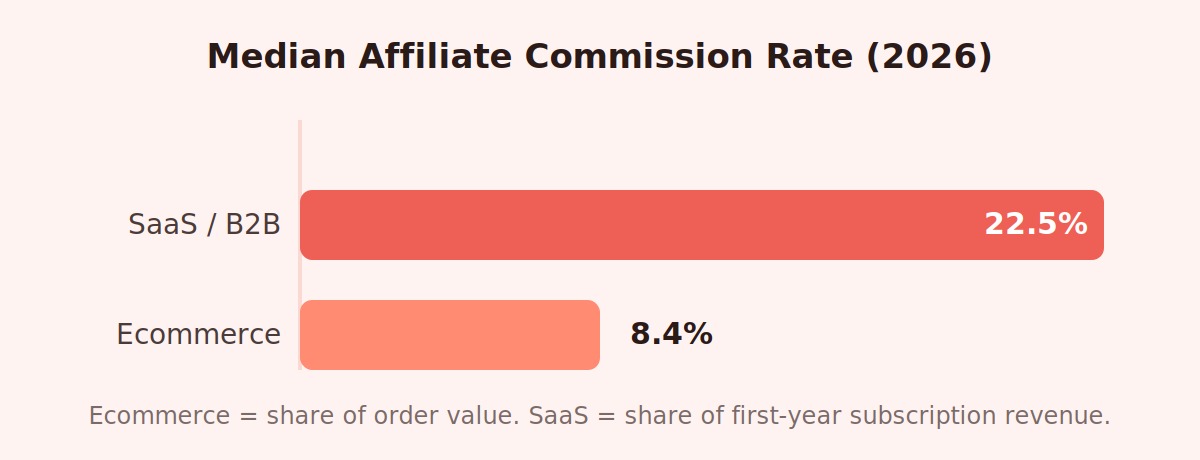
SaaS affiliate marketing pays roughly 2.7 times the median ecommerce rate, before recurring revenue compounds it further.
One caution worth pricing in: smart programs now run incrementality tests, and they find that 18% to 24% of attributed affiliate conversions would have happened anyway. That does not break the channel, but it does mean you should reward partners who create new pipeline, not just partners who intercept buyers already on their way to checkout. For the wider picture, our roundup of affiliate marketing statistics tracks these benchmarks in more detail.
Best B2B Affiliate Programs to Join in 2026
These are the strongest B2B affiliate programs to promote right now, chosen for payout quality, cookie length, and how easily they convert a business audience. The table gives a quick view, then each program gets a full breakdown. If your audience spans categories, compare these against the wider list of best affiliate programs across niches.
| Program | Category | Commission | Cookie |
|---|---|---|---|
| brandID | Creator marketplace | Up to 65% | Platform-managed |
| HubSpot | CRM and marketing | 30% recurring, up to 12 months | 180 days |
| Semrush | SEO toolkit | $200 per sale, $10 per trial | 120 days |
| GetResponse | Email marketing | 33% recurring or $100 bounty | 120 days |
| Shopify | Ecommerce platform | Bounty per referred merchant | 30 days |
| Jotform | Online forms | 30% recurring | 60 days |
| FreshBooks | Accounting | Up to $200 per sale | 120 days |
brandID Affiliate Marketplace
brandID is a creator monetization platform, and its Affiliate Marketplace lets you earn from thousands of brands without applying to each program separately. You get access to over 5 million products from more than 2,000 brands, then pick the ones that fit your niche and earn a commission on every sale. It is the fastest on-ramp into B2B affiliate marketing when you would rather promote offers than build a program.
brandID Best For: creators, bloggers, and B2B publishers who want one dashboard instead of applying to many separate B2B affiliate programs.
brandID Features:
- Average commissions up to 65% (some brands pay higher)
- A storefront you build in minutes
- Product collections by niche, season, or campaign
- Shoppable bio links so every post can drive sales
- Sells alongside digital products, subscriptions, and tipping
- 5M+ products from 2,000+ brands
- Commissions up to 65%
- Storefront ready in minutes
- Shoppable bio-page links
- No separate application per brand
- Extra monetization tools built in
- Best suited to creators with an audience
- Focused on marketplace offers, not custom SaaS deals
brandID Recommendation: start here to monetize an audience across many brands at once, then layer in the niche B2B programs below.
HubSpot Affiliate Program
HubSpot is a CRM, marketing, sales, and service platform used by hundreds of thousands of growing businesses, which makes it a natural anchor for any B2B affiliate program you promote. Because buyers spend real money, the commissions are among the most generous in SaaS affiliate marketing.
HubSpot Best For: marketing professionals, sales coaches, and business bloggers whose readers are scaling their stack.
HubSpot Commission: 30% recurring for up to 12 months, with one of the longest cookie windows in the category at 180 days and a large library of promotional assets.
- Recurring payouts for up to 12 months
- Long 180-day cookie window
- Trusted brand that converts B2B traffic
- Longer B2B buying cycle
- Casual promotion rarely converts
HubSpot Recommendation: the default first program for anyone building B2B or marketing content, especially paired with educational reviews.
Semrush Affiliate Program
Semrush is the leading SEO and digital marketing toolkit, covering keyword research, competitor analysis, and site audits. Its program, run through Impact, is one of the easiest B2B affiliate programs to recommend because a marketing audience is usually already evaluating it.
Semrush Best For: SEO creators, agencies, consultants, and marketing educators.
Semrush Commission: $200 per new subscription plus $10 per free trial, a 120-day cookie, and quarterly loyalty bonuses that raise the payout to as much as $350 per sale at 50 or more sales per quarter.
- Earn on trials, not only sales
- Escalating quarterly bonus tiers
- Flat payout, not recurring
- No compounding revenue over time
Semrush Recommendation: ideal when your readers are marketing-savvy and comparing SEO tools already.
GetResponse Affiliate Program
GetResponse is an email marketing and automation platform with a wide range of B2B use cases, from newsletters to sales funnels. It is one of the best-known recurring options in B2B affiliate programs and a favorite for creators who teach marketing.
GetResponse Best For: email marketers, course creators, and small-business advisors.
GetResponse Commission: choose 33% recurring for the life of the customer or a $100 one-time bounty, with a 120-day cookie and higher tiers for top performers.
- Choose recurring or one-time bounty
- Dependable payouts
- Broad B2B appeal
- Crowded category
- Competition from many affiliates
GetResponse Recommendation: the recurring option wins when your referred customers tend to stay subscribed.
Shopify Affiliate Program
Shopify is the platform business owners use to build and run online stores, so referring a merchant is a genuine B2B transaction. It carries a massive brand and a clear value proposition for anyone serving entrepreneurs.
Shopify Best For: creators who serve store owners, dropshippers, and small-business founders.
Shopify Commission: a fixed bounty for each referred merchant who starts a paid plan, managed through Impact, with amounts that vary by plan and region.
- Instant brand recognition
- Simple, easy-to-explain product
- One-time bounty only
- Shorter 30-day cookie window
Shopify Recommendation: best for audiences actively planning to launch or migrate a store.
Jotform Affiliate Program
Jotform is an online form and workflow builder used across HR, operations, and client intake, which gives it broad B2B reach. Its program is one of the most accessible B2B affiliate programs for newer partners.
Jotform Best For: beginners and business-tool publishers who want a fast approval and no traffic minimums.
Jotform Commission: 30% recurring, with approvals typically within one business day and a short apply, share, and earn setup.
- Easy entry with fast approval
- Recurring income
- Simple product to explain
- Lower price point
- More referrals needed to scale
Jotform Recommendation: a strong starter program while you build authority in a B2B niche.
FreshBooks Affiliate Program
FreshBooks is cloud accounting software built for freelancers, agencies, and small businesses. Accounting is a sticky purchase, which makes it one of the higher-converting B2B affiliate programs for the right audience.
FreshBooks Best For: publishers serving freelancers, bookkeepers, and service-based SMBs.
FreshBooks Commission: up to $200 per paid signup plus a bounty per trial, with a 120-day cookie that suits considered financial decisions.
- High per-sale payout
- Sticky product with strong retention
- Narrow audience
- Best where readers need invoicing
FreshBooks Recommendation: pair it with content about pricing, invoicing, or getting paid as a freelancer.
Once you have a shortlist, focus your effort. Three well-chosen programs promoted consistently beat ten promoted casually. Comparison articles and honest tool reviews convert B2B traffic best, and you can improve results further with the tactics in our guide on how to promote affiliate links without spamming your audience. For bigger payouts, many of these overlap with the high-ticket affiliate programs worth a dedicated review.
Best Affiliate Program Software to Run a B2B Program
If you sell a product and want partners promoting it, you need affiliate program software to track links, calculate commissions, and pay out. The right affiliate management software depends mostly on your revenue stage and billing stack. Here are five proven picks for B2B and SaaS.
PartnerStack
PartnerStack is a B2B SaaS partner platform that goes beyond affiliate links to handle referral, reseller, and co-sell partners in one place. Its standout asset is a marketplace of more than 100,000 software-focused partners you can recruit from, which is why it dominates lists of affiliate program software for technology companies.
PartnerStack Best For: B2B SaaS companies past roughly $1M ARR with multiple partner types.
PartnerStack Pricing: custom, typically $500 or more per month, with a free Spark plan that charges a 10% processing fee on commissions.
- Built-in partner marketplace
- Recurring MRR logic
- Multi-partner support
- Heavy and pricey for early teams
- Steeper learning curve
PartnerStack Recommendation: graduate to it once partnerships become a real acquisition motion, not a side test.
Rewardful
Rewardful is Stripe and Paddle native affiliate management software designed for SaaS companies that want to launch fast. It focuses on the core jobs of referral links, coupon tracking, recurring commissions, and a branded portal, which makes it a favorite for non-technical founders.
Rewardful Best For: Stripe-first startups and growth-stage SaaS launching a first program.
Rewardful Pricing: from $49 per month, with PayPal and Wise mass payouts and setup often done in a couple of hours.
- Fast Stripe setup
- Clean affiliate experience
- Predictable pricing
- Limited depth outside Stripe and Paddle
- No built-in email automation
Rewardful Recommendation: the easiest starting point if your billing already runs on Stripe.
FirstPromoter
FirstPromoter is affiliate program software built for subscription businesses, with a reputation for accurate recurring commissions across upgrades, downgrades, and renewals. It integrates with Stripe, Paddle, Chargebee, and Recurly and adds fraud protection and email automation.
FirstPromoter Best For: growth-stage SaaS that needs bulletproof billing accuracy.
FirstPromoter Pricing: from $49 per month with 0% transaction fees, though auto-payouts sit on the higher tier.
- Accurate recurring tracking
- 18-plus reporting metrics
- Built-in email automation
- Interface feels dated
- Tier pricing rises with revenue
FirstPromoter Recommendation: pick it when commission accuracy across plan changes is the priority.
Tolt
Tolt is a newer affiliate management software made specifically for Stripe-powered SaaS startups. It keeps the interface clean and the setup fast, so a small team can launch a first affiliate or referral program without a dedicated manager.
Tolt Best For: early-stage SaaS launching their very first program.
Tolt Pricing: around $49 per month with easy Stripe and Paddle setup.
- Simple, modern UI
- Quick launch for lean teams
- Fewer advanced features at scale
- Limited as volume grows
Tolt Recommendation: a smart first step you can outgrow into FirstPromoter or PartnerStack later.
Impact.com
Impact.com is an enterprise partnership platform that manages affiliates, influencers, and B2B agencies at scale. It handles the complex attribution that long B2B journeys demand, with cross-device tracking, multi-touch attribution, fraud prevention, and a polished marketplace.
Impact.com Best For: enterprise brands and performance teams with complex partner mixes.
Impact.com Pricing: custom, quoted after a demo, and priced for larger programs.
- Deep multi-touch attribution
- Enterprise-grade controls
- Large brand marketplace
- Overkill for early programs
- Costly for single-channel use
Impact.com Recommendation: reserve it for scaled programs that already justify the investment.
Access 5M+ products from 2,000+ brands, commissions up to 65%. Build a shoppable storefront in minutes.
Start Earning With brandIDHow to Build a B2B Affiliate or Referral Program
To launch your own program, define the offer first, then choose software, then recruit partners. B2B referral programs and affiliate programs share the same infrastructure, so you can run both from one platform. The infographic below maps the sequence at a glance, and the steps under it add the detail.
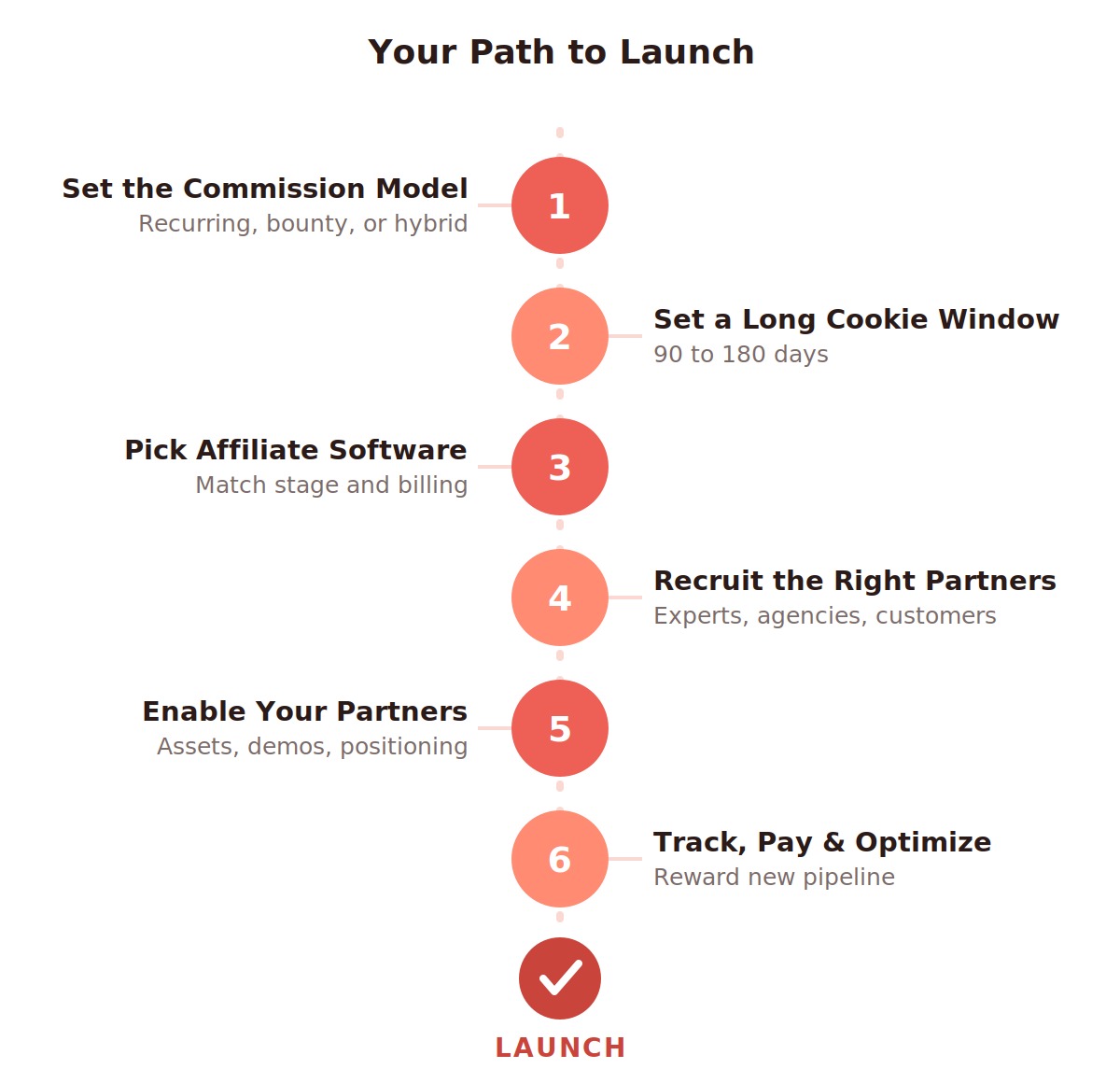
The six-milestone path from offer design to a live B2B affiliate or referral program.
- Set the commission model. Decide between recurring percentage, per-lead bounty, or a hybrid. Hybrid tends to recruit the most active partners because they earn before a deal closes.
- Use a long cookie window. Match your sales cycle with 90 to 180 days so partners still earn when a slow B2B deal finally converts.
- Pick affiliate program software. Choose by stage and billing stack, using the five options above as your shortlist.
- Recruit relevant partners. Prioritize niche experts, agencies, and consultants over broad reach. Invite happy customers into a referral track for warm, high-trust leads.
- Enable them properly. Provide comparison assets, demo links, and clear positioning. Pair this with the right B2B sales tools so referred leads get followed up fast.
- Track, pay, and test incrementality. Reward partners who create new pipeline, and prune those who only intercept buyers already converting.
These moves fit inside a wider growth plan, and they work best alongside the channels covered in our guide to B2B SaaS marketing strategies.
Conclusion
B2B affiliate marketing rewards patience and fit over raw volume. The high-value deals, recurring commissions, and long lifetimes mean a small group of well-matched partners can drive meaningful pipeline, provided you give them long cookies, fair payouts, and real enablement. If you are joining programs, start with two or three strong B2B affiliate programs like HubSpot, Semrush, and GetResponse and promote them consistently. If you are building one, pick affiliate program software that fits your stage and layer in a referral track.
Ready to earn without running your own program? The brandID Affiliate Marketplace lets you turn any audience into shoppable income in minutes.
Frequently Asked Questions
Does affiliate marketing work for B2B?
What are the best B2B affiliate programs to join?
What is the best affiliate program software for B2B SaaS?
What is the difference between B2B affiliate and referral programs?
Benchmarks reflect 2026 industry data. For source figures, see Statista affiliate marketing research.
 Summarize this article with: