Sales cycles keep getting longer, budgets keep getting tighter, and buyers keep doing more research on their own before ever talking to a rep. The teams closing deals in 2026 are not working harder. They are using better b2b sales tools to research prospects, personalize outreach, and follow up without dropping the ball.
The problem is choice. Hundreds of platforms promise to help you generate more B2B leads, and most of them overlap in what they do. This guide breaks down the ten best B2B sales tools worth your budget in 2026, grouped by what they actually accomplish, so you can build a stack instead of buying features. If you are pairing prospecting with paid distribution, our roundup of online lead generation tools worth pairing with sales workflows makes a strong companion read.
Key Takeaways
- Five core jobs define the stack. Data, outreach, CRM, conversation intelligence, and workflow automation. Every tool below fills one.
- Avoid overlapping platforms. Buying two products in the same category is the most expensive mistake teams make in 2026. Pick one leader per category.
- Automation is the biggest lever. AI sales tools now automate research, drafting, and objection prep that used to eat almost 40% of a rep’s day.
- Add contact form outreach. It is quietly outperforming cold email in 2026 because it lands in inboxes reserved for real inbound signals.
- Data quality beats seat price. A cheap tool with stale data will burn more rep hours than a costly one that actually connects.
What Are B2B Sales Tools?
B2B sales tools are software platforms that help sales teams find, engage, and close business customers. They cover the full cycle: pulling contact data on target accounts, sending outreach at scale, tracking pipeline in a CRM, recording calls for coaching, and automating the busywork between conversations.
The category has broadened fast. In 2020, a “sales stack” mostly meant a CRM and maybe an email tool. In 2026 it means a coordinated set of B2B sales software that shares data across prospecting, engagement, and revenue analytics. The best B2B sales tools now sit on top of AI models that draft emails, score accounts, and summarize calls in seconds.
Teams use them for three outcomes: shorter sales cycles, more qualified pipeline, and higher win rates. According to Salesforce’s State of Sales research, 81% of sales reps say AI helps them spend more time actually selling. That extra selling time is what modern B2B sales automation tools are really selling you.
The Main Categories of B2B Sales Software
Before you compare vendors, get the shape of the stack right. Almost every B2B sales tool fits into one of five categories. Buying two products in the same category is where budgets get burned and reps get frustrated.
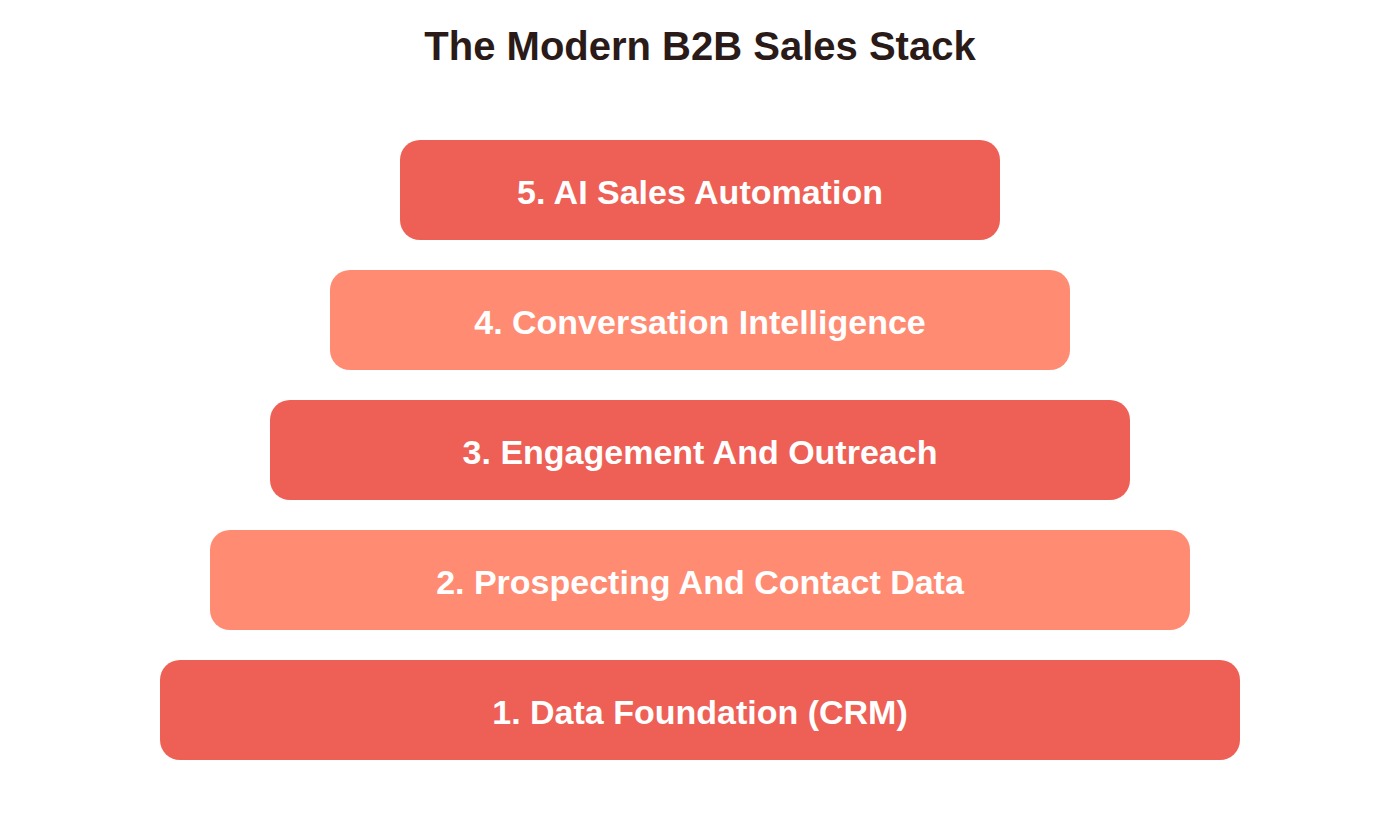
The five layers of a modern B2B sales stack in 2026.
The data foundation (usually your CRM) is where every deal lives. Prospecting tools feed it new accounts and contacts. Engagement platforms drive the outreach cadence. Conversation intelligence records what actually happens on calls. And AI sales tools sit across all of them, doing the research, drafting, and admin that used to eat rep hours.
You do not need a tool in every layer on day one. But you should know which layer you are buying into every time you swipe a card. That framing alone will save most teams five figures a year.
10 Best B2B Sales Tools For 2026
These ten picks cover the full modern stack. Each is a category leader with real traction in 2026, not a shiny demo. We call out best fit, real pros and cons, and pricing signals so you can shortlist without a two-week evaluation.
ContactID
ContactID (formerly known as ContactUs AI) is a B2B contact form outreach platform that automates sending personalized pitches through the “Contact Us” forms on your target companies’ websites. Your message lands in the same inbox that sales, partnerships, and vendor teams check every day for real inbound, which is one of the highest-signal channels a B2B rep can reach in 2026.
You upload a target list, ContactID’s AI drafts a custom pitch for each company based on their website and industry, and the platform submits the form on your behalf at scale. It handles CAPTCHAs, form variations, and validation automatically, so a single operator can reach thousands of qualified accounts a month without domain warm-up and without inbox management overhead.
Best For: B2B teams selling into SMB and mid-market accounts where a real human on the buyer side reviews the contact form.
ContactID Features: Bulk contact form outreach, AI personalization per company, deliverability without domain warm-up, target list uploads, CAPTCHA handling, and reporting on submissions and replies.
- Bypasses cold email spam filters
- Reaches inboxes cold email cannot
- Strong top-of-funnel second channel
- No domain warm-up or sender reputation risk
- AI personalizes every submission at scale
- Scales without inbox or infrastructure overhead
- Works best on SMB/MM targets
- Not a replacement for a CRM
- Requires quality target lists
ContactID Pricing: Usage-based plans with a free trial. Team plans scale by submissions per month.
Recommendation: Add it as a second outbound channel alongside cold email and LinkedIn. Contact form outreach is one of the highest-signal channels available in 2026.
HubSpot Sales Hub
HubSpot Sales Hub is an all-in-one CRM and sales engagement platform built around a free core with paid tiers that add automation, forecasting, and coaching. It is the default choice for small and mid-market B2B teams that want CRM, email tracking, and pipeline reporting in one place without stitching four vendors together.
Best For: SMB and mid-market B2B teams that want a low-friction CRM with built-in outreach and reporting.
HubSpot Features: Free CRM baseline, email sequences, meeting scheduler, deal pipelines, AI email assistant, forecasting, playbooks, and native integrations with marketing and service hubs.
- Genuinely usable free tier
- Clean UI that reps adopt fast
- Strong reporting out of the box
- Contact-based pricing scales fast
- Advanced automation locked to top tiers
- Enterprise governance is thinner
HubSpot Pricing: Free plan available. Sales Hub Professional starts around $100 per seat per month. Enterprise around $150 per seat per month, billed annually.
Recommendation: Start here if you are under 50 reps and want the fastest path to a working sales stack.
Salesforce Sales Cloud
Salesforce Sales Cloud is the enterprise-grade CRM that most large B2B revenue orgs still standardize on. It handles complex territories, multi-product forecasting, and deep customization that mid-market tools cannot match, and its Einstein AI layer now drives account scoring and next-best-action suggestions natively.
Best For: Enterprise and complex mid-market teams with custom sales processes and multiple business units.
Salesforce Features: Advanced pipeline and forecasting, territory management, Einstein AI, Slack integration, AppExchange marketplace, revenue intelligence, and granular permission control.
- Handles almost any process
- Massive third-party ecosystem
- Trusted by procurement
- Long implementation timelines
- Total cost climbs quickly with add-ons
- Needs admin resource to run well
Salesforce Pricing: Professional starts around $80 per user per month. Enterprise around $165. Unlimited plans and Einstein AI add-ons push totals higher.
Recommendation: Pick Salesforce when you have 100+ reps, complex quotas, or governance requirements that HubSpot cannot support cleanly.
Apollo.io
Apollo.io combines a 275+ million contact database with sequences, dialer, and buying-intent signals in a single interface. It has become one of the most popular B2B lead generation tools of the last three years because reps can go from ICP filter to launched cadence in the same window.
Best For: Startup and mid-market SDR teams that want prospecting data plus outreach without paying for two separate platforms.
Apollo.io Features: Contact and company search, verified emails and mobile numbers, sequences, dialer, AI email writer, intent data, LinkedIn extension, and CRM sync.
- Data + engagement in one tool
- Aggressive pricing for the value
- Fast to deploy on small teams
- Data quality varies by region
- Deliverability needs tuning
- Reporting less deep than dedicated CRMs
Apollo.io Pricing: Free plan with limited credits. Basic starts around $59 per user per month. Professional at $99. Organization at $149, billed annually.
Recommendation: The default pick for SMB outbound teams that want to generate more B2B leads without a five-tool stack.
ZoomInfo
ZoomInfo is the enterprise B2B data platform of record, with one of the largest verified contact and firmographic databases plus a mature intent signal layer. Larger revenue teams pick it when data accuracy and territory coverage matter more than sticker price, and it powers many of the biggest outbound programs in tech and finance.
Best For: Enterprise B2B teams that need deep firmographic data, technographics, and buying intent across large TAMs.
ZoomInfo Features: Verified contacts, org charts, intent topics, website visitor identification, workflow automation, chat, and native CRM enrichment.
- Best-in-class data depth
- Strong intent and technographic layer
- Trusted for enterprise procurement
- Contracts and negotiation are heavy
- Overkill for small teams
- Some regional data still thin
ZoomInfo Pricing: Custom, quoted by seat and modules. Realistic entry points sit in the $15,000+ per year range in 2026, and enterprise deals go well beyond that.
Recommendation: Choose ZoomInfo when your ACV justifies the price and you have a defined outbound motion built on account signals.
Outreach
Outreach is a sales execution platform that manages sequences, calls, meetings, and deal insights across the pipeline. It is the choice for scaling SDR and AE teams that need consistent outreach at volume, and its AI now drafts personalized messages and flags at-risk deals inside the same workflow. If your team is also running cold email at volume, our roundup of best cold email software pairs naturally with a sales engagement platform like Outreach.
Best For: Mid-market and enterprise sales teams running structured outbound and account-based motions.
Outreach Features: Multi-step sequences, dialer, meeting scheduler, AI Kaia call assistant, deal insights, forecasting, and CRM sync.
- Powerful sequence logic
- Strong deal and forecasting layer
- Mature admin controls
- Steeper learning curve
- Premium pricing
- Overkill for small teams
Outreach Pricing: Custom pricing, typically starting around $100 per user per month at scale, with sales execution and revenue intelligence tiers.
Recommendation: The right pick once you have 15+ outbound reps and need governance around cadences and reporting.
Gong
Gong is the category-defining conversation intelligence platform. It records and analyzes every sales call, surfaces what winning reps do differently, and pushes coaching moments into your workflow, making it one of the most impactful AI sales tools for teams that live on calls and demos.
Best For: Sales teams closing deals over Zoom, Teams, or phone that want data-backed coaching and deal risk signals.
Gong Features: Call recording and transcription, AI topic tracking, deal risk alerts, coaching workflows, market intelligence, and CRM data sync.
- Massive lift in coaching quality
- Deal risk signals catch slips early
- Loved by front-line managers
- Premium price point
- Requires cultural buy-in from reps
- Value drops on very short call cycles
Gong Pricing: Custom, typically $1,200 to $1,600 per user per year with a platform fee. Enterprise deals scale from there.
Recommendation: A high-ROI pick once your team is doing 20+ discovery and demo calls a week.
Clay
Clay is a data enrichment and AI research platform that has become one of the most talked-about B2B sales automation tools since 2024. Reps and ops teams use it to pull data from 100+ providers, run AI research on every account, and push a fully enriched list straight into CRM or sequences.
Best For: Modern outbound and RevOps teams building highly personalized, signal-based outreach at scale.
Clay Features: Waterfall enrichment across providers, AI research agents, table-based workflows, HTTP integrations, and native CRM and sequencer connectors.
- Extremely flexible data workflows
- Great for signal-based outbound
- Cuts enrichment vendor sprawl
- Learning curve for non-ops users
- Credit-based pricing can surprise
- Best value with an owner assigned
Clay Pricing: Free tier available. Paid plans start around $149 per month, with Explorer, Pro, and Enterprise credit tiers.
Recommendation: Buy Clay when you have someone who owns outbound experimentation. Skip it if you just want a one-click contact list.
LinkedIn Sales Navigator
LinkedIn Sales Navigator is the source of truth for B2B decision-maker data. It powers advanced search, buyer intent inside the LinkedIn network, and account and lead lists that feed almost every other tool in this list. If you already use paid social channels for outbound, our overview of safe LinkedIn automation tools shows what to layer on top without risking your account.
Best For: Any B2B sales team that sells to job-titled buyers on LinkedIn, from solo founders to enterprise ABM teams.
Sales Navigator Features: Advanced lead and account search, buyer intent signals, InMails, saved lists, CRM sync, and Deep Sales AI suggestions.
- Freshest B2B people data anywhere
- Warm signals for account changes
- Nearly universal in B2B stacks
- Not a full outbound engine
- InMails have limited response rates
- Automation restrictions are strict
Sales Navigator Pricing: Core around $99 per user per month. Advanced around $149. Advanced Plus is quote-based for CRM integration.
Recommendation: A near-mandatory layer for B2B outbound. Just do not treat it as your only prospecting source.
Chili Piper
Chili Piper is an inbound meeting scheduling and lead routing platform that converts form fills, chats, and inbound emails into booked meetings on the spot. It is one of the highest-ROI B2B sales automation tools because it recovers pipeline that would otherwise be lost between a form fill and an SDR follow-up. For B2B SaaS teams especially, our guide to B2B SaaS lead generation strategies pairs cleanly with a router like Chili Piper.
Best For: B2B teams with heavy inbound demand-gen where every hour of follow-up delay costs a meeting.
Chili Piper Features: Instant scheduling from forms, round-robin routing, live handoff to AEs, calendar integration, and reporting on booked-meeting rates.
- Direct lift on inbound conversion
- Kills lead-response delay
- Easy exec win to justify
- Only pays back with inbound volume
- Routing rules can get complex
- Overlaps with HubSpot scheduler
Chili Piper Pricing: Concierge starts around $22.50 per user per month. Distro and Handoff modules priced separately.
Recommendation: Add Chili Piper once your inbound generates more than a few dozen qualified leads per week.
How To Choose The Right B2B Sales Tools
The best B2B sales software is not the one with the most features. It is the one your reps will actually use every day. Before you buy, run each shortlisted vendor through these five lenses.
| Criteria | What To Ask | Why It Matters |
|---|---|---|
| Data Quality | Bounce rate on 200 verified emails in your ICP? | Bad data burns rep hours and hurts sender reputation. |
| CRM Fit | Native, two-way sync with your CRM? | Broken sync creates duplicate work and reporting gaps. |
| Adoption Curve | Time to first value for a new rep? | Any tool your team avoids is money set on fire. |
| Total Cost | Seat price plus overage plus onboarding? | Real cost is usually 30 to 50% above list. |
| AI Roadmap | What ships in the next two quarters? | AI sales tools are moving fast. Buy vendors keeping up. |
The single question that matters most is data quality. If your prospecting tool ships 40% bad emails, no amount of AI drafting or beautiful reporting will fix your pipeline. Run a paid trial with a live bounce test before you sign a multi-year deal.
Common Mistakes When Building A B2B Sales Stack
Even good teams waste six figures a year on stack mistakes that are easy to spot in hindsight. Here are the four we see most often across B2B sales software rollouts in 2026.
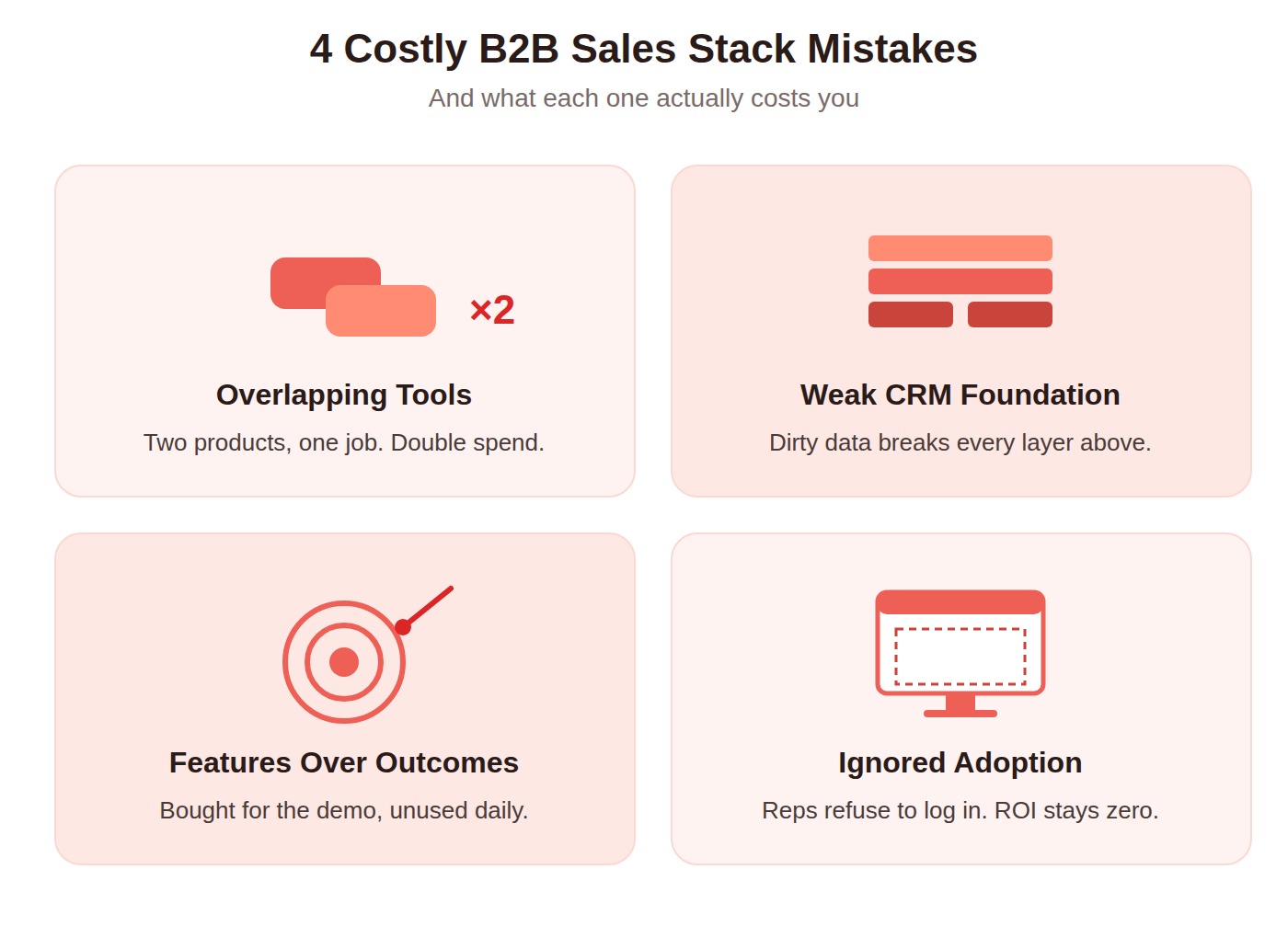
The four mistakes that quietly waste six-figure sales budgets in 2026.
Conclusion
The best B2B sales tools of 2026 do not win because they have the longest feature list. They win because they cover one job in the stack and cover it well: a CRM you can trust, prospecting data that connects, engagement that scales without spamming, conversation intelligence that coaches your team, and AI sales tools that hand your reps their day back.
Start with the layer that is hurting most right now. If your data is stale, fix that first with Apollo, ZoomInfo, or Clay. If your outbound is stuck, layer in Outreach and a second channel like contact form outreach to reach inboxes that cold email cannot. Then track weekly usage and revenue impact so the next tool you add is the one you actually need.
Frequently Asked Questions
What Are The Most Important B2B Sales Tools For A Small Team?
Are AI Sales Tools Actually Worth The Money In 2026?
How Do I Choose Between HubSpot And Salesforce?
Which B2B Lead Generation Tools Work Best Alongside Cold Email?
 Summarize this article with: