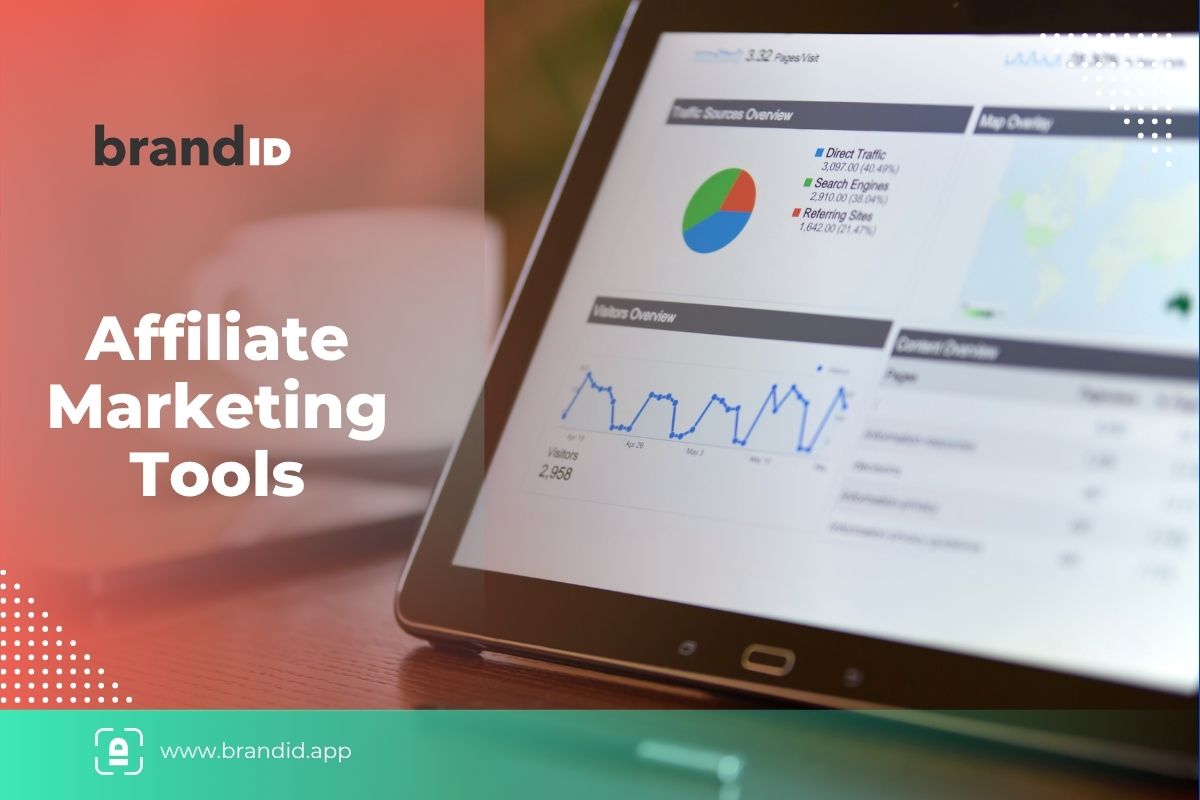
The right affiliate marketing tools decide whether you spend your week hunting for products and copying links by hand, or whether your traffic quietly turns into commissions while you sleep. In 2026 the affiliate channel is bigger than ever, and so is the software built around it. Picking the wrong stack wastes money. Picking the right one compounds every hour you put in.
This guide breaks down the best affiliate marketing tools for creators, publishers, and brands, grouped by what they actually do (research, content, link management, tracking, and monetization). If you are still learning the mechanics of the channel first, the complete affiliate marketing guide is the best place to start. Everyone else, keep scrolling for the software, real 2026 pricing, and the mistakes that quietly kill programs.
Key Takeaways
- Match tools to stages. Affiliate marketing tools split into five jobs: niche and keyword research, content creation, link management, tracking, and monetization. You rarely need all of them on day one.
- Start free, then reinvest. Free affiliate marketing tools like Google Search Console, Canva, and Kit can carry you to your first commissions before you pay for anything.
- AI is now a core layer. AI tools for affiliate marketing handle keyword clustering, drafts, and ad creatives, but human editing still separates ranking pages from filler.
- Tracking protects your income. With cookie windows shrinking in 2026, a dedicated tracker or analytics setup is no longer optional for paid traffic.
- Monetization is the tool most people skip. A storefront that makes every post shoppable, like the brandID Affiliate Marketplace, closes the gap between an audience and actual sales.
What Are Affiliate Marketing Tools?
Affiliate marketing tools are software platforms that help you find products, create content, manage links, track performance, and get paid. They cover the full workflow from picking a profitable affiliate marketing niche to cashing a commission. Some are built for affiliates promoting offers, others are affiliate management software used by brands running their own programs.
The channel keeps growing, which is why the tooling has matured so fast. Global affiliate spend reached roughly $19.4 billion in 2026, up from $17.1 billion in 2025 (Forrester). For you, that number means more brands are launching programs, so there are more offers to promote and more competition to out-execute with better software.
Affiliate is now the third-largest performance channel behind paid search and paid social. That maturity is the reason your keyword research, content, and tracking now have to be sharp: sloppy execution no longer ranks or converts the way it did a few years ago.
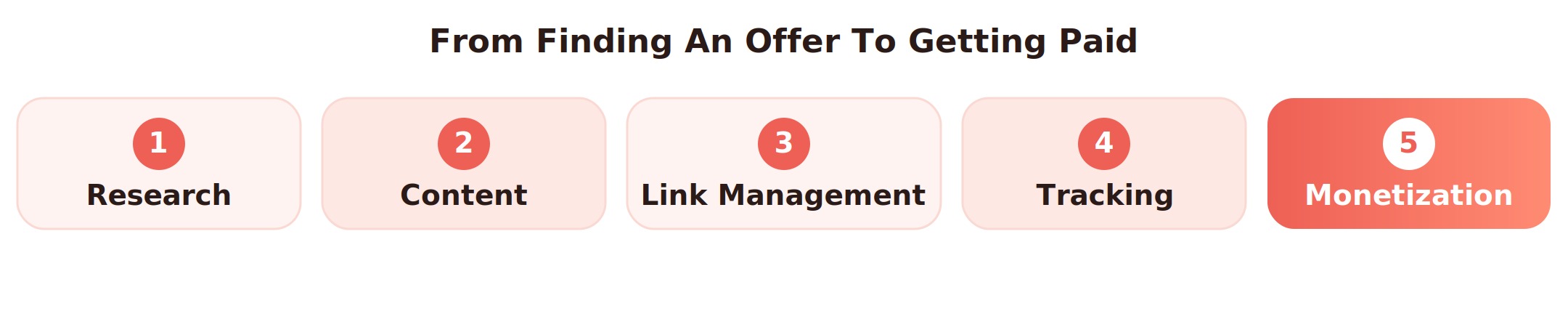
The five jobs every affiliate marketing tool falls into. Build your stack outward, one layer at a time.
How To Choose The Right Affiliate Marketing Tools
Pick tools that match your current stage, not your five-year dream. A beginner with no traffic does not need a $500 enterprise tracker. Start with the layer that is blocking you right now, then add software only when a real bottleneck appears.
Run every affiliate marketing platform through four questions before you pay. First, does it save more time than it costs? Second, does it fit the channel you actually use (SEO, social, email, or paid)? Third, does it integrate with what you already run? Fourth, can you cancel monthly while you test it?
Context helps here. As of 2026, roughly 78% of affiliate marketers rely on SEO as their main traffic source, so search tools tend to earn their keep faster than paid-traffic trackers for most beginners. And 85% of social affiliates have under 10,000 followers, which tells you audience size matters far less than choosing the right offers and tools to convert the audience you have.
Best Affiliate Marketing Tools In 2026
Here are the best affiliate marketing tools worth your time this year, organized so you can jump to the layer you need. Each entry explains what it does, who it fits, and where it falls short, with real 2026 pricing so there are no surprises on your first invoice.
brandID Affiliate Marketplace
brandID is the monetization layer most affiliates are missing. Instead of applying to networks one by one, you get instant access to an affiliate marketplace of over 5 million products from more than 2,000 brands, build a shoppable storefront in minutes, and link every social post to those products so your bio page becomes a checkout, not just a link dump.
- No approval maze, one dashboard
- Every post becomes shoppable
- Free to start building a storefront
- Best suited to creators, not brands running their own program
- Storefront curation still takes effort
Semrush
Semrush is the all-in-one research engine behind most SEO-driven affiliate sites. It finds the buyer-intent keywords that actually convert, shows what competitors rank for, and audits your site for technical issues. In 2026 it also tracks how your brand shows up inside ChatGPT and Google AI Overviews, which matters as search shifts toward AI answers.
- Replaces 5-6 separate tools
- Huge keyword database
- PPC and content tools included
- Extra seats cost $45-$100/month
- Add-ons inflate the bill fast
Ahrefs
Ahrefs is the backlink and competitor-intelligence tool serious affiliates trust. It reveals exactly why a competing page ranks, which links it earned, and which keywords you are missing, so you can reverse-engineer proven pages instead of guessing. Its crawler is second only to Google, which makes its link data reliable.
- Best-in-class backlink data
- Clean, fast interface
- $29 Starter plan for light use
- Credit system limits heavy users
- No PPC or social tools
Surfer SEO
Surfer SEO is a content-optimization tool that scores your draft against the pages already ranking and tells you what to add. It turns “write a good article” into a checklist of terms, headings, and length targets, which is why it pairs so well with any keyword tool above.
- Content Score tracks with rankings
- Fast to learn
- Great for briefing writers
- Not a keyword research tool on its own
- Over-optimizing can read robotic
Jasper AI
Jasper is an AI content platform built for volume without losing your brand voice. For affiliates who ship 15 to 30 posts a month, it drafts product roundups, comparison intros, and email sequences quickly, then lets you refine rather than start from a blank page. It is one of the more useful AI tools for affiliate marketing when speed is the bottleneck.
- Fast drafts at scale
- Consistent brand voice
- Good template library
- Needs heavy human editing
- Raw output can trigger AI detection
Kit (Formerly ConvertKit)
Kit is an email marketing tool built for creators, and email is where affiliate income quietly compounds. You own the list, so you are not at the mercy of an algorithm. Its free plan is generous enough to build an audience before you spend a cent, which is rare in this category.
- Free up to 10,000 subscribers
- Creator-friendly automations
- Scales with you
- Automation has a small learning curve
- Design templates are basic
ThirstyAffiliates
ThirstyAffiliates is a WordPress plugin that cloaks, organizes, and manages your affiliate links from inside your dashboard. Instead of pasting long, ugly tracking URLs into every post, you insert a clean branded link that you can update in one place if an offer changes.
- Update links site-wide instantly
- Cleaner, trustworthy URLs
- Free version available
- WordPress only
- Best features are paid
Voluum
Voluum is a dedicated campaign tracker for affiliates running paid traffic. It records every click and conversion across sources so you can see which ad, placement, and offer combination actually turns a profit. With cookie windows shrinking in 2026, this kind of first-party tracking has moved from nice-to-have to essential.
- Trusted at scale
- Deep optimization rules
- Reliable real-time data
- Overkill for organic-only affiliates
- Steeper learning curve
Canva
Canva handles the visuals that make affiliate content convert: comparison graphics, Pinterest pins, thumbnails, and product mockups. Its free plan covers most of what a solo affiliate needs, and the drag-and-drop editor means you never have to hire a designer for a quick pin.
- Strong free plan
- No design skills needed
- Fast for pins and thumbnails
- Templates can look generic
- Advanced assets are paid
Impact
Impact is affiliate management software for the other side of the table: brands running their own programs. It handles affiliates, influencers, and brand partnerships in one platform, with partnership automation for discovery, contracting, tracking, and payment, plus built-in fraud detection that matters at scale.
- One dashboard for all partners
- Powerful automation
- Strong fraud controls
- Enterprise pricing
- Too heavy for small programs
PartnerStack And Refersion
PartnerStack and Refersion are the go-to affiliate marketing platforms for mid-market and SaaS brands. PartnerStack shines for software companies, with a partner marketplace of affiliates who already promote tools in your category. Refersion suits ecommerce brands that want tracking, commission management, and payouts without stitching several tools together.
- Built for their niche
- Warm partner marketplaces
- Flexible commission rules
- Costs climb with volume
- Less suited to solo affiliates
| Tool | Layer | Best For | Starting Price |
|---|---|---|---|
| brandID | Monetization | Creators, social affiliates | Free to start |
| Semrush | Research | SEO content sites | $139.95/mo |
| Ahrefs | Research | Backlink analysis | $29/mo |
| Surfer SEO | Content | On-page optimization | ~$49/mo |
| Jasper AI | Content | High-volume drafting | ~$49/mo |
| Kit | List building | Free plan | |
| ThirstyAffiliates | Link Management | WordPress links | Free plan |
| Voluum | Tracking | Paid traffic | ~$119/mo |
| Canva | Content | Visuals & graphics | Free plan |
| Impact | Management | Enterprise brands | Custom |
| PartnerStack & Refersion | Management | SaaS & ecommerce brands | From $99/mo |
Quick comparison of leading affiliate marketing tools and software by layer, use case, and 2026 starting price.
AI Tools For Affiliate Marketing
AI tools for affiliate marketing now touch every layer of the stack. In 2026 they cluster keywords, draft product roundups, generate ad creatives, and even flag AI-written text before Google does. Used well, they compress days of work into hours.
The winners pair a general model (for research and outlining) with a specialist tool. Jasper and Copy.ai handle drafting, Surfer AI optimizes for rankings, and AdCreative-style tools spin up paid ad variations trained on billions in ad-spend data. Originality-style checkers act as a quality gate so thin content never ships.
One caution: AI raises your output ceiling, not your standards. Combining influencer and affiliate tactics drove about 46% more sales in recent industry data, and that lift comes from authentic recommendations, not mass-produced text. Use AI to move faster, then edit until the page sounds like a person who actually tested the product.
Get instant access to over 5 million products from 2,000+ brands, earn commissions up to 65%, and build your storefront in minutes. No approval maze, no website required.
Common Mistakes To Avoid With Affiliate Marketing Tools
Most affiliate tool mistakes fall into four buckets. Here they are at a glance, each paired with the fix, before a closer look at why they hurt.
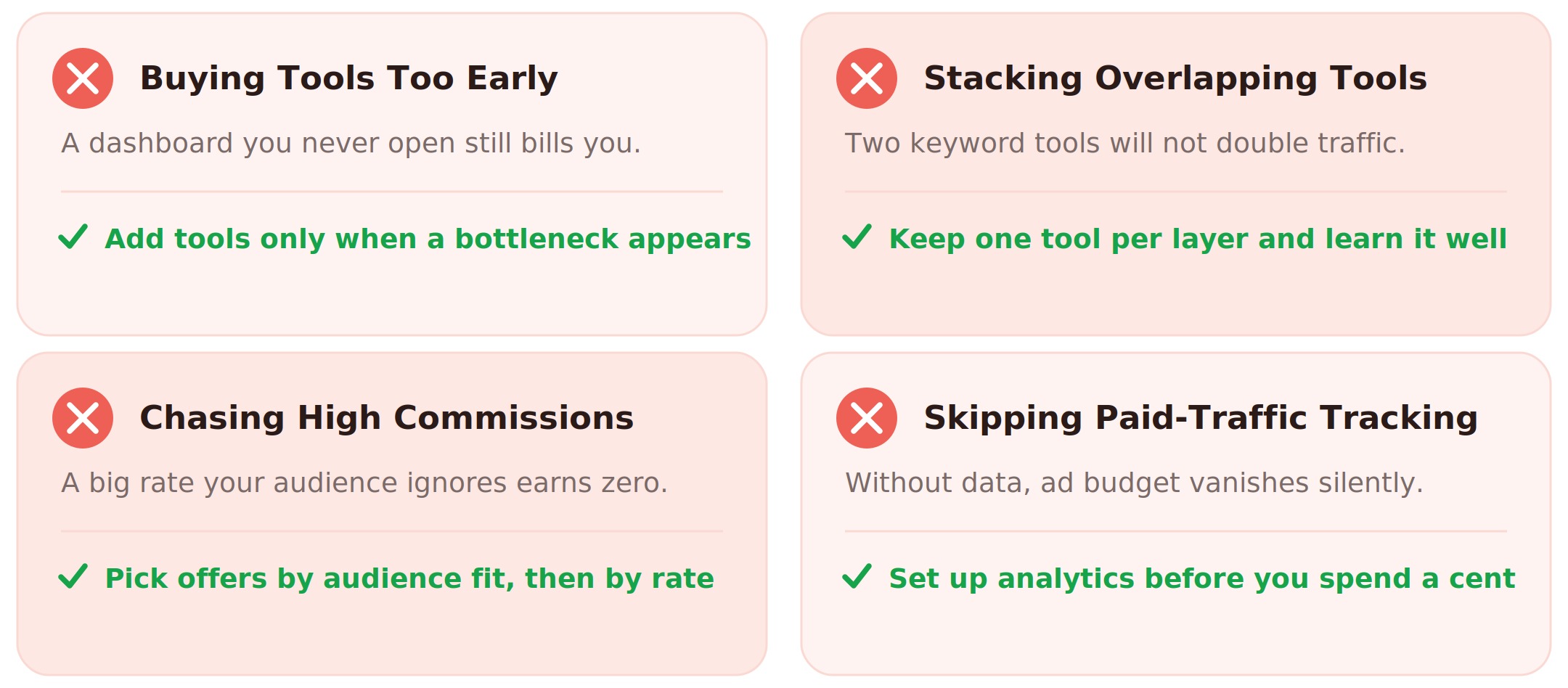
The four costliest affiliate marketing tool mistakes, each paired with the fix. A closer look follows below.
The most expensive mistake is buying tools before you have a bottleneck. A blank Semrush dashboard does not create traffic, and a $119 tracker tracks nothing if you run no campaigns. Add software only when a specific problem is costing you time or money.
The second mistake is stacking overlapping tools. You do not need Semrush and Ahrefs on day one, or three AI writers. Pick one per layer, learn it deeply, and switch only when you outgrow it. Tool sprawl quietly eats margin.
The third is chasing high commissions over fit. Median ecommerce commissions sit near 8.4% while SaaS recurring commissions climbed to around 22.5% of first-year revenue in 2026, but a 22% offer your audience ignores earns less than an 8% offer they trust. Choose your affiliate programs around audience fit first, rate second.
The last is skipping tracking on paid traffic. As cookie windows collapse in 2026, guessing which ad converts is how budgets disappear. Set up analytics before you spend, not after.
Conclusion
The best affiliate marketing tools are the ones that remove your specific bottleneck this month, nothing more. Start with free research and email tools, add a content optimizer when you scale writing, and layer in tracking only when you spend on ads. Match the software to your stage and the stack stays cheap while your income grows.
One layer, though, deserves attention from day one: monetization. A great tool stack means little if your audience has no simple way to buy. That is the gap the brandID Affiliate Marketplace closes, turning every post into a storefront with commissions up to 65% across 5 million products, no website required.
Pick one tool from each layer that fits where you are now, and revisit this list as you grow. If you want to go deeper on strategy next, browse the latest affiliate marketing statistics to benchmark where you stand.
Frequently Asked Questions
What tools do I need to start affiliate marketing?
Are free affiliate marketing tools good enough?
What is the difference between affiliate software and affiliate platforms?
Do AI tools for affiliate marketing actually help?
 Summarize this article with: