Here’s the first thing nobody tells you: becoming a UGC creator has nothing to do with growing an audience. You do not need followers. You do not need to post on your own account. You get paid to film short vertical videos that brands run as their own ads.
That one difference is why UGC creation is the fastest paid-work route in the creator economy right now. You can start today with the phone in your pocket, a few products you already own, and a listing on paid-brief UGC platforms where brands post exactly what they need.
Here’s the plan: what a UGC creator actually does (and how it differs from being an influencer), the seven steps that take you from zero to your first paid gig, the real gear budget, the rates you can charge in your first six months, and the five mistakes that keep most beginners stuck.
Key Takeaways
- Become a UGC creator with zero followers: brands buy the footage, not the audience. Your account can be private and you can still get paid.
- UGC creator starter budget is $0 to $500: a modern phone, natural light, and a tripod cover 90 percent of jobs. Fancy cameras come later, if at all.
- UGC creator starting rates in 2026 are $50 to $150 per video: and jump to $300 to $500 per video once you have 5 to 10 paid jobs under your belt.
- UGC creator first paid gig lands in 2 to 8 weeks: if you ship a short portfolio, pick one niche, and pitch daily. Longer if you wait for brands to find you.
- UGC creator career path is contracts, not virality: steady monthly income from 3 to 5 brand relationships beats one viral video. Treat it like freelance filmmaking, not content creation.
What a UGC Creator Actually Does
A UGC creator films short vertical videos (usually 15 to 60 seconds) that brands use in their own paid ads, product pages, and social accounts. You do not run the ads. You do not grow a following. You hand off the raw footage and the brand takes it from there.
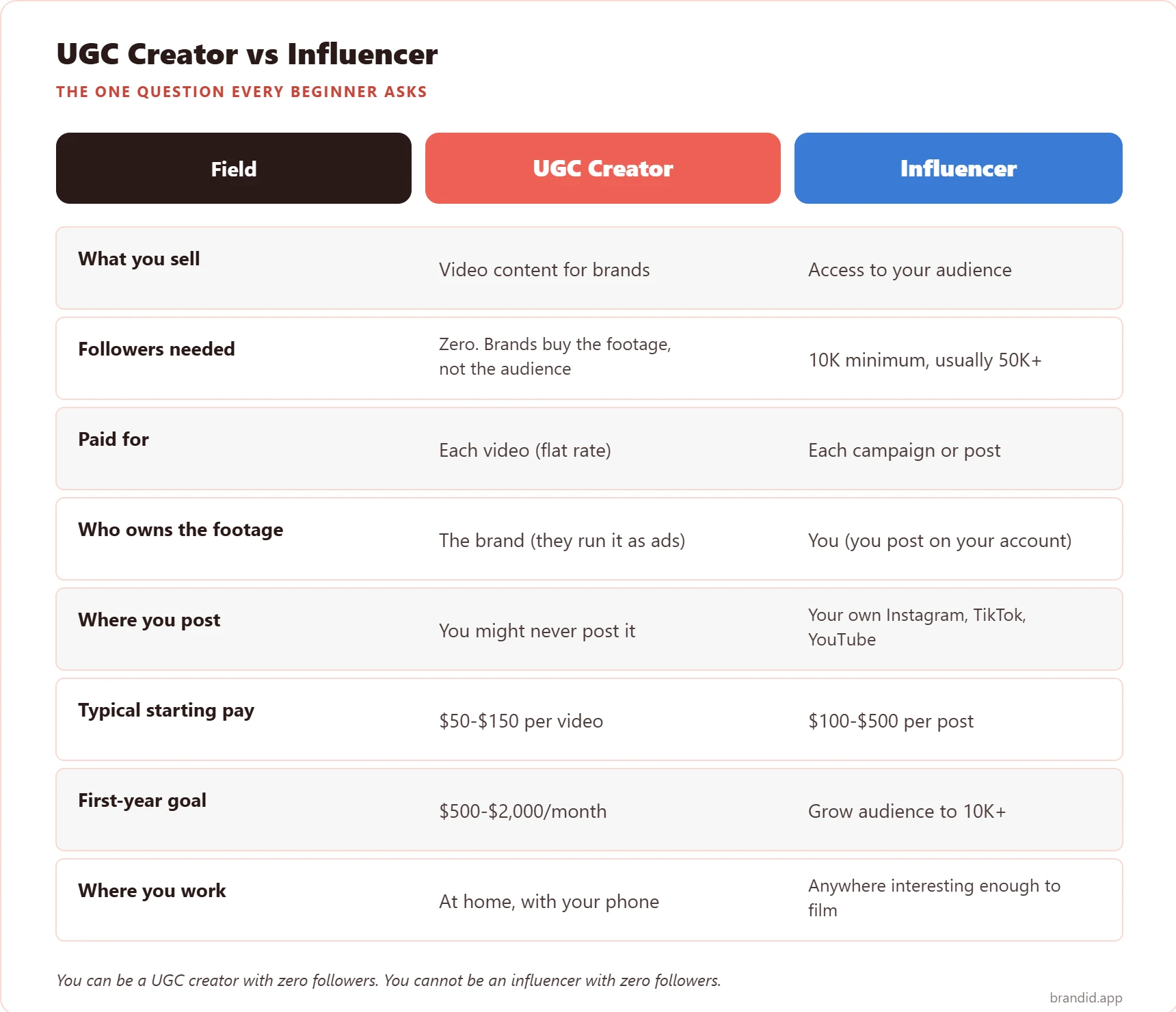
The confusion that trips up every beginner: UGC creator is NOT a synonym for influencer. The two jobs look similar from the outside, but the business model is completely different. Side by side:
7 Steps to Become a UGC Creator
This is the exact order that works. Skip any step and the next one gets harder than it needs to be.
Step 1: Pick One Niche and Stick With It
Beauty, fitness, pet, food, kitchen gadgets, pet, baby products, home decor, SaaS demos. Pick one. Brands pay more to specialists than generalists, and your portfolio is twice as persuasive when every video is in the same lane. You can broaden later. Start narrow.
Step 2: Film 3 to 5 Sample Videos With Products You Already Own
You do not need brand jobs to make sample videos. Pick five products you use daily, film one 15 to 60 second video for each (unboxing, hook, review, tutorial, testimonial), portrait 9:16, natural light near a window. Treat them like paid work.
Step 3: Build a Short Portfolio Page
One page. Hero video at the top. One sentence under your name (“I film 30-second UGC for pet brands that need TikTok-ready product videos”). Grid of three to six clips. Your rates. One booking email. For layout references, 8 real UGC portfolio examples by niche show what each category converts best with.
Step 4: Sign Up for 2 or 3 Paid-Brief Platforms
Billo, AspireIQ, Aspire, Insense, Trend. Each platform lists active briefs with pay and usage rights visible before you apply. Create a creator profile, upload your portfolio samples, and apply to five briefs per week per platform. Most pay $50 to $200 per video at the beginner tier.
Step 5: Send 10 Cold Pitches a Week to Small DTC Brands
Platforms are the baseline. Cold outreach to brands directly is where the higher-paying jobs come from. Find 10 small DTC brands in your niche per week. Email a short pitch: who you are, one portfolio link, one video idea tailored to their product, your rates. Keep it under 100 words.
Step 6: Price Confidently From Day One
Beginner rates: $50 to $150 per video for a single 30-second edit. After 5 to 10 paid jobs: $200 to $400. Add usage rights (paid ads, exclusivity) as line items on top of the base rate. Underpricing early does not get you more work; it just trains brands to expect $50 videos.
Step 7: Deliver Fast and Follow Up
Standard turnaround is 5 to 10 business days from brief to final video. Hitting that window reliably is more valuable than extra polish. Email every brand two weeks after delivery to ask if they need the next round. Repeat work is where the real income lives.
UGC Creator Gear and Setup Budget
You can start for free. You can also waste $1,000 on gear you do not need. Here are the three tiers that actually line up with what paid UGC work requires in 2026.
| Tier | Total Budget | Setup | When to Upgrade |
|---|---|---|---|
| Starter (free to $100) | $0 to $100 | Modern smartphone (any iPhone from the last 3 years, any mid-range Android), tripod ($20), ring light ($30) | After your first 5 paid jobs |
| Pro ($200 to $500) | $200 to $500 | Starter kit plus lavalier mic ($40), external LED panel ($100), extra tripod head ($30), backdrop ($60) | After 15+ paid jobs, when turnaround quality is being requested |
| Studio ($800+) | $800 and up | Pro kit plus mirrorless camera (Sony ZV-E10 or similar), prime lens, dedicated editing laptop | Only if clients specifically ask for 4K cinematic UGC |
How Much UGC Creators Actually Make
Rate ranges you can quote with confidence, pulled from 2026 platform data and creator-reported invoices.
| Experience | Rate per 30s video | Rate per 60s video | Typical Monthly Income |
|---|---|---|---|
| Beginner (0 to 5 jobs) | $50 to $150 | $100 to $250 | $200 to $800 |
| Growing (5 to 20 jobs) | $200 to $400 | $300 to $600 | $1,500 to $4,000 |
| Established (20+ jobs) | $500 to $1,200 | $800 to $2,000 | $5,000 to $15,000+ |
The jump from Beginner to Growing is the hardest one. Most UGC creators stall at $100 per video for too long because they underprice to try to win more work. The data points the other way: brands that pay $50 for a video are usually one-off bookings, while brands that pay $200+ repeat for months.
Side income can also kick in from affiliate commissions on the products you film. Pitch frameworks that work even without a big follower count sit in a related piece on how micro influencers land brand deals, and most of them overlap directly with UGC-creator outreach.
Beginner UGC Creator Mistakes to Avoid
The five things that keep new UGC creators stuck in the free-work loop:
- Pitching with no portfolio. Brands skim the portfolio link first and decide from the first video. No link = no reply.
- Niche-hopping every month. A beauty-only portfolio converts twice as well as a jack-of-all-trades one. Pick a niche and stay there for your first 10 jobs.
- Charging $20 to “get your foot in the door”. You get the opposite effect. Brands that pay $20 do not become brands that pay $200 later; they just book you for more $20 jobs.
- Posting your UGC videos on your own account for reach. Brands often require exclusivity. Posting first can disqualify you from the better-paying jobs.
- Waiting for brands to find you. Platforms deliver briefs, but the higher-paying work comes from cold outreach to small DTC brands directly. Daily pitching is the lever.
Earn Commission on Every Product You Film
Here is the second income line most new UGC creators miss. You already film real products in real settings. If you also drop an affiliate link to that product on your page, every viewer who clicks and buys sends you a commission on top of the UGC fee you got from the brand.
The problem has always been that affiliate programs are a mess. You apply to each brand separately. You wait days (sometimes weeks) for approval. Half the time you get rejected because your follower count is “too low”. This is where brandID‘s ShopID marketplace changes the equation.
- 5 million+ products from 2,000+ brands already in the marketplace, searchable by niche (beauty, pet, fitness, tech, home, baby, more).
- One-click affiliate links. No application. No approval wait. You pick a product, click, get your link, and start earning the moment someone buys through it.
- No follower minimum. UGC creators with 0 followers get the same affiliate access as creators with 500K. ShopID looks at the product you want to promote, not your audience size.
- Commissions up to 65 percent on the highest-paying brands, with payout rates visible before you grab the link so you know what you are earning.
- A storefront that sits on your brandID page, grouped into collections (“My skincare recs”, “Kitchen gear I actually use”). Every brand manager who clicks your portfolio sees it, and so does every viewer who follows your bio link from TikTok.
- Connect your socials once and the storefront shows which video promotes which product. Your UGC footage becomes a live affiliate funnel instead of a one-time deliverable.
The practical read: a UGC creator earning $200 per video on paid jobs can clear another $200 to $800 per month in affiliate commissions on the same products, with the same effort, just by linking what they already film.
Bottom Line
Becoming a UGC creator is the fastest paid-work route in the creator economy because the one thing that stops most people (building an audience) is not required. Pick one niche, film three to five sample videos with products you already own, put them on a short portfolio page with your rates, sign up for two paid-brief platforms, and send 10 cold pitches a week.
Beginners who stick with this cadence for 60 days land their first paid gig at $50 to $150 per video and clear $1,500 to $4,000 per month by month six. If you are thinking longer-term about turning this into a full creator career, becoming a modern influencer is the natural next read.
FAQs
Do you need followers to become a UGC creator?
How much do beginner UGC creators make?
What gear do I need to start as a UGC creator?
How long does it take to get the first UGC job?
Is UGC creator the same as influencer?
What are the best platforms for UGC creators?
Can I be a UGC creator without showing my face?
Do UGC creators need to sign a contract?
What niches pay the most for UGC in 2026?
How do I pitch brands as a new UGC creator?
 Summarize this article with: