Support queues slow down not because agents are lazy, but because the same three questions arrive a hundred times a day, context lives in five tabs, and nobody can tell which ticket is on fire. The right customer support tools fix that by putting every conversation in one place, automating the repetitive work, and freeing people to handle the problems that actually need a human.
The catch in 2026 is that the category has split in two. Traditional help desks charge per agent. AI-native platforms charge per resolution. Pick wrong and you either overpay for seats you barely use or get a surprise bill from a per-resolution meter. This guide compares the platforms that matter, shows real pricing, and gives you a simple way to choose. If live chat is your main channel, our roundup of the best live chat software pairs well with everything below.
Key Takeaways
What Are Customer Support Tools And Why They Matter In 2026
Customer support tools are software that collect every customer conversation, from email and live chat to social and phone, into a single workspace where a team can respond, collaborate, and measure results. Instead of checking three inboxes, a Slack channel, and a chat widget separately, agents see one queue with full history on each request.
This matters more every year because expectations keep climbing. As of 2026, Zendesk’s CX Trends research found that 85% of CX leaders say customers will abandon a brand over an unresolved first-contact issue. That one stat reframes support software from a cost center into a retention engine, because a fast, complete first answer is what keeps the customer.
The modern stack usually blends several categories of customer service tools: a help desk or ticketing system, live chat support tools, a knowledge base for self-service, and increasingly an AI layer that resolves routine questions on its own. Understanding how those pieces fit is the first step to choosing well, and it feeds into the wider B2B SaaS marketing strategies that treat support as a growth channel, not just a cost line.
| Category | What It Solves | Example Tools |
|---|---|---|
| Help desk / ticketing | Turns requests into trackable tickets across channels | Zendesk, Freshdesk, Zoho Desk |
| Shared inbox | Simple, email-first collaboration for small teams | Help Scout, Front |
| Live chat | Real-time messaging on your site or app | Intercom, Tidio, Chatgram |
| AI support agent | Resolves repeat questions end to end | Intercom Fin, Zendesk AI |
| Ecommerce support | Order-aware workflows for online stores | Gorgias, eDesk |
Table: The main categories of customer support software and where each one fits.
Best Customer Support Tools Compared
Below are ten of the best customer support tools worth evaluating in 2026, spanning traditional help desk software, live chat support tools, and AI customer support tools. Each entry leads with what the tool is, then covers who it fits, key features, pros, cons, and pricing, so you can shortlist without opening twenty browser tabs. Pricing is verified against vendor pages as of mid-2026 and is billed annually unless noted.
Chatgram
ChatgramChatgram leads this list because it turns live chat into something a small team can actually keep up with, whether replies come from Telegram or the web dashboard. Drop a chat widget on your site and every visitor message becomes a structured ticket you can answer from your phone, a shared Telegram channel, or a browser tab.
AI-powered replies, instant notifications, multi-agent collaboration, and translation in 180+ languages all come standard. Unlimited domains and unlimited agents mean an agency can run support for every brand it owns from a single account, with no per-seat fees.
For founders, ecommerce brands, and small support teams in 2026, it is the fastest way to start replying to customers without adopting a heavy help desk or a dashboard the team never opens.
Best For: Startups, DTC brands, and small support teams that want to launch website live chat in minutes and reply on the go.
Chatgram Features: One-line website chat widget, Telegram-native reply workflow, multi-agent support via Telegram groups, real-time push notifications, visitor context, mobile-first workflow with no separate dashboard to learn.
Chatgram Pricing: Simple, low-cost plans built for founders and small teams, with no per-agent seat gouging. See chatgram.brandid.app for current tiers.
Recommendation: The best starting point in 2026 for teams that want website live chat without the enterprise overhead. Launch here first, then layer on a ticketing tool or knowledge base only when volume forces the upgrade.
Zendesk
ZendeskZendesk is an enterprise-grade customer support software suite that unifies email, chat, phone, social, and self-service into one agent workspace with deep automation and reporting. It is the platform large organizations reach for when they need complex routing, SLAs, and heavy customization, and it remains the default all-in-one help desk software for high-volume teams.
Best For: Teams of 50-plus agents that need the deepest workflow engine and can staff an admin to configure it.
Zendesk Features: Trigger-based automation, skill-based routing, unified agent workspace, native knowledge base, Advanced AI add-on with intelligent triage.
Zendesk Pricing: Suite plans from $55/agent/month; Support-only from $19/agent/month. Advanced AI add-on around $50/agent/month. Median contract reported near $48K/year for larger teams.
Recommendation: Choose Zendesk when your workflows are genuinely complex and you have the volume to justify it. Smaller teams will find the same core ticketing far cheaper elsewhere.
Freshdesk
FreshdeskFreshdesk is a cloud-based help desk software that gathers tickets from every channel into one place and layers on automation, SLA management, and the Freddy AI assistant. It is the most popular Zendesk alternative because it delivers solid multi-channel customer support software at a fraction of the entry price.
Best For: Growing teams that want multi-channel support and automation without enterprise pricing.
Freshdesk Features: Omnichannel routing, SLA and round-robin assignment, Freddy AI Agent, marketplace apps, multilingual support.
Freshdesk Pricing: Free program (1-2 agents, 6 months), Growth $15-19/agent/month, Pro $55/agent/month, Enterprise $79-89/agent/month. Freddy AI Agent adds per-session fees beyond an included allowance.
Recommendation: A strong default for mid-market teams. Compare Growth against Help Scout and Zoho Desk before jumping to Pro, where the value narrows.
Intercom
IntercomIntercom is a chat-first customer support platform built around in-app messaging, proactive engagement, and its Fin AI agent, one of the strongest AI customer support tools for conversational, product-led companies. It pioneered the modern messenger and now leans hard into resolving tickets automatically rather than just deflecting them.
Best For: SaaS and product-led teams where in-app messaging and onboarding matter more than email ticketing depth.
Intercom Features: Fin AI agent, best-in-class Messenger, product tours, outbound campaigns, help center.
Intercom Pricing: Seats from about $29/seat/month (Essential); Fin AI charges $0.99 per resolved conversation. Unresolved conversations incur no Fin charge.
Recommendation: Ideal if conversational support drives your growth. Model your monthly resolution count first, since the AI meter, not the seat price, is where the cost lives.
Help Scout
Help ScoutHelp Scout is a shared-inbox customer service software that feels like email, keeps support personal, and bundles a knowledge base and the Beacon chat widget on every paid plan. It is the friendliest option for small teams that want to sound human, not robotic, while still tracking every conversation to resolution.
Best For: Small to mid-size email-first teams that value simplicity and a warm customer experience.
Help Scout Features: Shared inbox, collision detection, Beacon widget, knowledge base, CSAT surveys, AI drafts and summaries.
Help Scout Pricing: Free plan available; paid from about $22-25/user/month. AI Answers add-on around $0.75 per resolution with a trial period for new accounts.
Recommendation: The best pick when you want great customer service tools without complexity. Add AI Answers only once repeat volume justifies it.
Zoho Desk
Zoho DeskZoho Desk is an affordable help desk software with an omnichannel dashboard, automation, and the Zia AI assistant, and it is the natural pick for teams already living inside the Zoho ecosystem. It packs a surprising amount of customer support automation into its lower tiers, which makes it one of the best value customer service tools for budget-conscious teams.
Best For: Small businesses and teams that use Zoho CRM or want strong features at a low price.
Zoho Desk Features: Omnichannel ticketing, workflow automation, Zia AI, SLA management, tight Zoho CRM integration.
Zoho Desk Pricing: Free for up to 3 agents; paid plans from around $7-14/agent/month, scaling up for advanced tiers.
Recommendation: Excellent bang for the buck, especially if you already run Zoho. Standalone teams should weigh it against Freshdesk and Help Scout.
Tidio
TidioTidio is a chat-first customer support tool that combines live chat, chatbots, and the Lyro AI agent, aimed squarely at small businesses and online stores. It is one of the easiest live chat support tools to launch, with visitor tracking and automation that help small teams punch above their weight.
Best For: Small businesses and ecommerce sites wanting affordable live chat with light automation.
Tidio Features: Live chat widget, Lyro AI chatbot, live visitor tracking, prebuilt automation flows, ecommerce integrations.
Tidio Pricing: Free chat-first plan; paid plans start low with Lyro AI priced by conversation volume.
Recommendation: A smart entry point for small stores. Growing teams that need ticketing depth will eventually outgrow it.
Gorgias
GorgiasGorgias is an ecommerce-focused customer support software built for Shopify and direct-to-consumer brands, with the widest ecommerce app marketplace of any help desk. It pulls order data straight into the conversation and automates the “where is my order” questions that flood online-store queues.
Best For: Shopify and DTC stores that want deep, order-aware support automation.
Gorgias Features: Native Shopify and ecommerce integrations, order-API access, macros with live order data, AI automation for WISMO and returns.
Gorgias Pricing: Tiered by ticket volume; AI automations add a per-resolution fee (reported around $0.90 per AI resolution as of mid-2026). Check current tiers on the vendor site.
Recommendation: The go-to for Shopify brands that want the biggest integration ecosystem. Model the combined ticket-plus-AI cost before committing.
HubSpot Service Hub
HubSpot Service HubHubSpot Service Hub is customer service software that sits inside the HubSpot CRM, unifying support with marketing and sales data so every conversation carries full customer context. It shines when you already run HubSpot, because the shared record turns support into part of one connected customer view.
Best For: Teams already committed to HubSpot who want support, sales, and marketing on one platform.
HubSpot Service Hub Features: Ticketing, live chat, knowledge base, customer feedback tools, unified CRM record, Breeze AI.
HubSpot Service Hub Pricing: Free tier available; paid Service Hub plans scale with seats and contacts across Starter, Professional, and Enterprise.
Recommendation: A natural choice for HubSpot shops. As a standalone tool, dedicated help desks usually give more support-specific depth.
eDesk
eDeskeDesk is ecommerce customer support software that consolidates marketplace, social, email, and live chat into one inbox, built specifically for online retailers selling across channels. It automatically pulls order, tracking, and customer history into every conversation, which cuts the tab-switching that slows down multi-channel sellers.
Best For: Multi-channel ecommerce sellers on marketplaces like Amazon and eBay alongside their own store.
eDesk Features: Marketplace integrations, unified inbox, AI-assisted replies, order context on every ticket, ecommerce-specific automation.
eDesk Pricing: Tiered plans scaling with channels and ticket volume; free demo available. Check the vendor site for current rates.
Recommendation: The strongest choice for retailers juggling several marketplaces. General-purpose teams should look at Freshdesk or Zendesk instead.
| Tool | Best For | Pricing Model | Entry Price |
|---|---|---|---|
| Chatgram | Fast Telegram-native live chat | Simple plan | Affordable |
| Zendesk | Enterprise workflows | Per agent + AI add-on | $19-55/agent/mo |
| Freshdesk | Mid-market multi-channel | Per agent | Free / $15/agent/mo |
| Intercom | Product-led SaaS | Seat + per resolution | $29/seat + $0.99/res |
| Help Scout | Small email-first teams | Per user | Free / $22/user/mo |
| Zoho Desk | Budget / Zoho users | Per agent | Free / ~$7/agent/mo |
| Tidio | Small ecommerce chat | Freemium + AI usage | Free plan |
| Gorgias | Shopify / DTC | Ticket tier + per AI res | By ticket volume |
| HubSpot | HubSpot ecosystem | Seat + contacts | Free tier |
| eDesk | Multi-channel retail | By channels / volume | Demo-based |
Table: Side-by-side snapshot of the best customer support tools, their ideal fit, and how each one charges (verified mid-2026).
AI Customer Support Tools And Automation In 2026
AI customer support tools now resolve routine questions end to end, not just deflect them to a search box. That shift is the biggest change in the category, and it explains why so much of the pricing conversation has moved from seats to resolutions. As of 2026, the global AI customer service market reached $15.12 billion, growing at roughly 25% a year, and that scale means competition is pushing resolution quality up and pricing into the open, so this is a good moment to adopt customer service automation tools rather than wait.
Performance has caught up to the hype in one narrow area. AI-native platforms now hit 55 to 70% first-contact resolution with average handle times under three minutes, while traditional static self-service resolves only about 14% of issues, per Gartner. The lesson for buyers is to measure resolution, not deflection, because a knowledge base that only redirects still leaves the work on a person.
Customer sentiment stays split, which shapes how you should deploy AI. Around 79% of Americans still prefer a human for general support, yet 51% prefer a bot when they want an immediate answer to a simple question. The practical takeaway is to let AI own the fast, repetitive queries and route anything complex to a person with easy, one-click escalation.
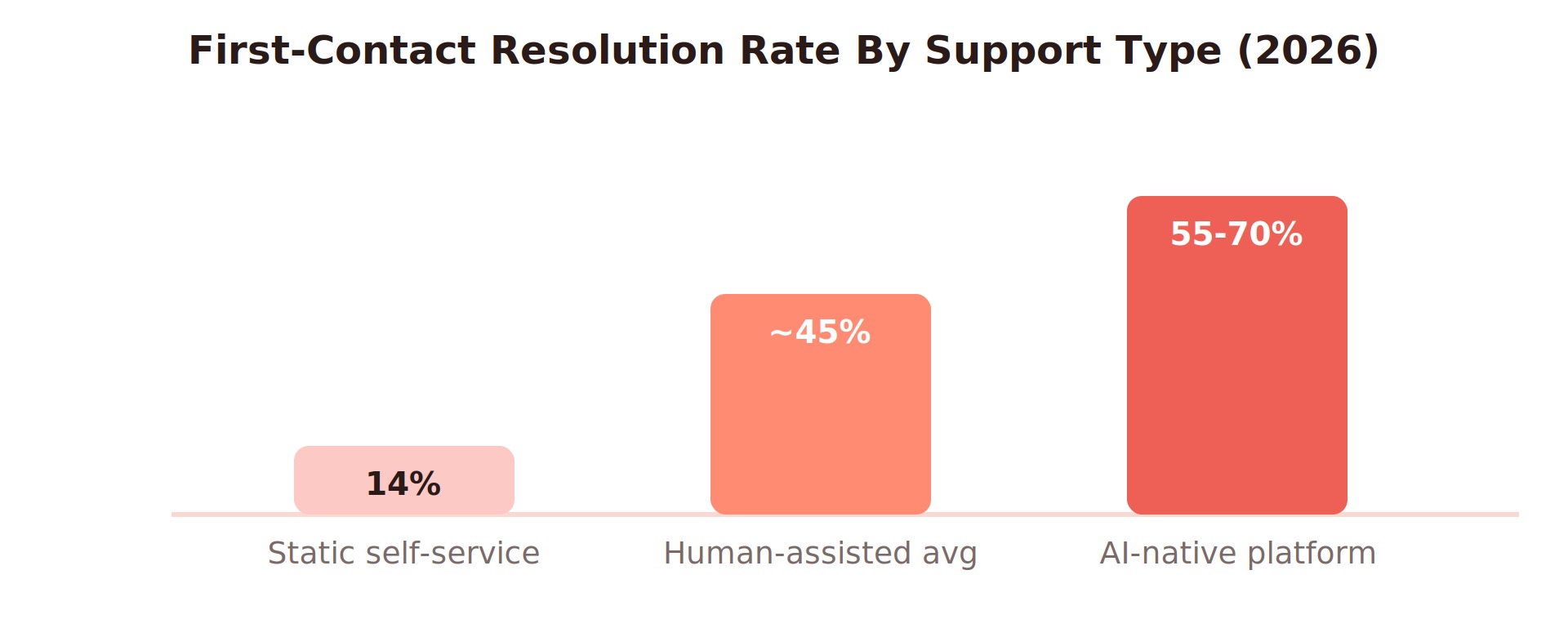
Infographic: AI-native customer support tools resolve far more on first contact than static self-service (Gartner, Lorikeet data, 2026).
Watch the “double meter.” Some ticketing-first platforms charge an AI add-on per agent and then a fee per automated resolution on top, effectively billing twice for AI. When comparing AI customer support tools, ask each vendor exactly what triggers a charge, since that single question separates a predictable bill from a runaway one.
How To Choose The Right Customer Support Software
The best customer support tools for your team depend on three things: your channels, your team size, and how far along you are with automation. Answer those and the shortlist writes itself. Here is a simple framework.
One more test that saves regret: pick where you will be in 6 to 12 months, not just today. A tool that handles the jump from a founder answering tickets to a five-person team without a painful migration is worth more than a few dollars saved on the entry plan.
Finally, run a short sandboxed pilot with clear metrics before you sign. Track first-response time, resolution rate, and CSAT on a real slice of your queue, then document playbooks so the whole team onboards the same way. Creators and small brands managing outreach and support from one place often find value pairing these tools with an Instagram chatbot for social DMs and the right cold email software for proactive follow-up.
That stack often extends beyond support. Adding the best Chrome extensions for lead generation on top turns every prospect a support agent touches into a lead you can reach again, not just a closed ticket.
Common Mistakes To Avoid With Customer Support Tools
Buying customer service software is easy to get wrong because the sticker price rarely matches the real bill. These are the traps that catch most teams, and the quick fix for each.
- Chasing feature checklists. A long feature list means nothing if your team only uses six of them. Fix: shortlist on the two or three jobs you actually need, then test those.
- Ignoring the AI meter. Per-resolution fees can dwarf seat costs at volume. Fix: estimate monthly resolutions and multiply before you commit.
- Optimizing for deflection, not resolution. Deflection just means the customer did not reach a human, resolved or not. Fix: measure whether the issue actually got solved.
- Hiding the human. Around 23% of customers lose trust when trapped in an AI loop. Fix: make one-click escalation to a person obvious.
- Skipping the pilot. Full rollouts before testing lead to painful migrations. Fix: sandbox with real tickets and clear metrics first.
Conclusion
The best customer support tools in 2026 are not the ones with the longest feature list. They are the ones that match your channels, your team size, and your automation stage while keeping the bill predictable. Small email-first teams thrive with a shared inbox, product-led SaaS leans into chat and AI resolution, and multi-channel retailers need order-aware workflows. Pick for fit, watch the AI meter, and pilot before you commit.
Support does not end when a ticket closes. Every helpful interaction is a chance to point customers to the products, links, and offers they actually want next. That is where brandID comes in: a link-in-bio and monetization platform where creators and small brands can build a shoppable bio page, organize products into collections, and turn support conversations and social posts into revenue. If you monetize through affiliate products, the brandID Affiliate Marketplace gives creators access to over 5 million products from more than 2,000 brands, with average commissions up to 65%.
Frequently Asked Questions
What are the best free customer support tools?
Strong free customer support tools in 2026 include Zoho Desk (up to 3 agents), HubSpot Service Hub Free, and Tidio’s chat-first plan. Freshdesk offers a limited free program for 1-2 agents. These let small teams manage tickets, live chat, and a basic knowledge base at no cost, which is ideal for piloting before you pay.
What is the difference between a help desk and a ticketing system?
A ticketing system simply converts requests into trackable tickets. A help desk goes further, bundling ticketing with a knowledge base, automation, reporting, live chat, and customer portals in one platform. Most modern customer support software is a full help desk, so “help desk” and “ticketing” are often used loosely, but the help desk is the broader, more capable category.
Do AI customer support tools actually resolve tickets?
Yes, the better ones do. AI-native platforms reach 55 to 70% first-contact resolution as of 2026, and mature agents handle up to 80% of routine queries like order status, refunds, and subscription changes. The key is choosing tools that take action and resolve, not just deflect to a search box, and measuring resolution rather than deflection.
How much do customer support tools cost in 2026?
Per-agent tools range from free tiers to about $19-89 per agent monthly, with Zendesk Suite from $55 and Freshdesk Growth from $15. AI-native pricing shifts to per resolution, such as Intercom Fin at $0.99 per resolved conversation. The real cost often lives in AI add-ons and per-resolution fees, so model your monthly volume before signing.
 Summarize this article with: