Your support inbox quietly decides whether customers stay or churn. Missed tickets, slow replies, and lost context are where trust breaks, and the right help desk software is the fastest way to fix all three at once.
In 2026, the category has changed. AI now drafts replies, deflects repetitive questions, and summarises threads while agents focus on messages that need a human.
This guide compares the 10 best help desk tools available right now, with honest pricing, real strengths, and where each one struggles. It is written for founders, support leads, and IT managers who need a decision they can act on this week.
If chat is your primary channel, pair this shortlist with our roundup of best live chat software, since modern help desks sit alongside a chat widget rather than replace it.
Key Takeaways
- Yes, help desk software is worth it. Consolidating email, chat, and social into one platform cuts resolution time by 35 to 45 percent and lifts CSAT by roughly 15 points.
- Real 2026 prices span a wide range. Zoho Desk starts at $14 per agent, Freshdesk Growth at $19, and Zendesk Suite at $55, before AI add-ons that can double the bill.
- AI decides the winners now. Modern help desk tools resolve 55 to 70 percent of routine tickets end to end when they can read and write to your CRM and order system.
- Freshdesk, Zoho Desk, and Help Scout lead for small and mid-market teams; Zendesk, ServiceNow, and Jira Service Management lead at enterprise scale.
- Match the tool to your channel mix, not the feature grid. Email-heavy, chat-first, and IT support teams each have a different best-in-class option.
What Is Help Desk Software?
Help desk software is a centralised platform that captures every customer or employee request from email, chat, phone, social, and web forms, then turns each one into a trackable ticket assigned to the right agent.
It replaces shared inboxes and spreadsheets with a ticket management system, automation rules, a knowledge base, and reporting in a single workspace.
There are two flavours. Customer support software handles external requests from buyers about orders, products, and billing. IT help desk software handles internal requests from employees about laptops, access, and outages, usually with ITIL workflows on top.
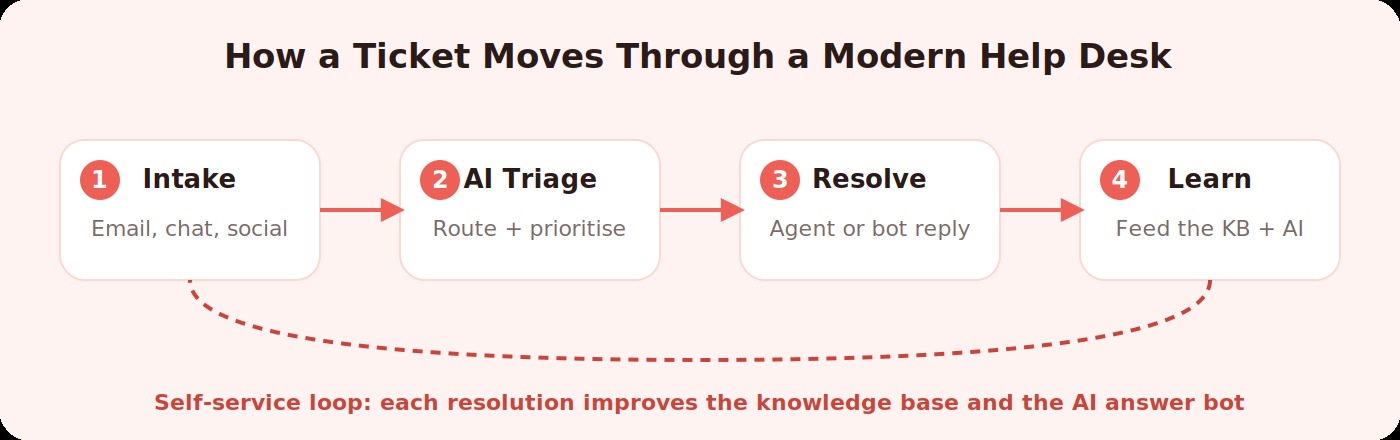
A ticketing system is the engine. A full help desk adds automation, self-service, SLA tracking, and analytics on top. Any modern help desk system also embeds AI for triage, summaries, and reply drafts.
Must-Have Features in Modern Help Desk Tools
Before you compare vendors, agree on the non-negotiables. Any serious ticket management system should ship the following as standard, not paywall them behind an enterprise tier.
Omnichannel ticketing. Email, chat, social, WhatsApp, and web forms all flow into one queue with a single customer timeline, so agents never re-ask questions the customer already answered.
Automation and SLA management. Rule-based routing, macros, collision detection so two agents do not reply to the same ticket, and SLA timers with escalation. If these are gated behind a higher plan, calculate the real price.
Knowledge base and self-service. A branded help centre plus an AI answer bot that cites articles. Seed it with the same care you would bring to any content creation tools workflow.
AI that actually acts. Reply drafting and ticket summaries are table stakes. The differentiator is whether the AI can read and write to your CRM, payment tool, and order system to resolve issues end to end.
Reporting that answers real questions. Backlog by category, first-response and resolution time by agent, CSAT trends, and knowledge base deflection. If those reports need the top tier, you fly blind.
The 10 Best Help Desk Software in 2026
Every tool below is used at scale in 2026 and priced transparently. Each entry lists what it is, who it fits, features, pros, cons, pricing, and a recommendation.
Chatgram
Chatgram is a live chat and help desk platform that lets support teams reply from Telegram or a web dashboard. Add a chat widget to your site and every visitor message becomes a structured ticket that syncs across both surfaces in real time.
Agents pick whichever inbox they prefer, whether that is the Telegram channel on their phone or the browser dashboard at their desk. AI replies, multi-agent collaboration, translation across 180+ languages, and unlimited domains are included on every plan.
Best For: Ecommerce and D2C brands whose customers reach out over Telegram, especially in India, MENA, CIS, and Southeast Asia.
Chatgram Features: Telegram-native shared inbox, multi-agent ticket assignment, canned replies and macros, order lookup, customer profile view, chat routing rules, mobile agent apps, campaign broadcasts.
- Meets customers on the messaging app they already use
- Zero web widget setup, works with any Telegram business account
- Ecommerce features like order lookup built in
Chatgram is a new app.
Chatgram Pricing: Free tier for early teams. Paid plans priced per agent per month with volume-based scaling; see chatgram.brandid.app for current tiers.
Recommendation: Pick Chatgram when Telegram is where your customers actually message you. Pair it with one of the tools below if most of your inbound sits on email or web chat.
Zendesk
Zendesk is the category benchmark. It runs ticketing, omnichannel messaging, voice, and a branded help centre in one suite, powering the customer support software stack at Uber, Slack, and Shopify. Depth is unmatched; the trade-off is price and complexity.
Best For: Mid-market and enterprise teams that need omnichannel depth, granular routing, and a mature app marketplace.
Zendesk Features: Omnichannel workspace, skills-based routing, macros, side conversations, Copilot AI, workforce management, 1,700-plus marketplace apps.
- Deepest feature set in the category
- Best-in-class analytics and reporting
- Huge integration ecosystem
- Suite Team is the realistic entry, not $19
- Copilot AI adds $50 per agent
- Setup cost is high without an admin
Zendesk Pricing: Suite Team $55, Suite Growth $89, Suite Professional $115, Suite Enterprise $169 per agent per month. Copilot AI is $50 extra per seat.
Recommendation: Pick Zendesk when your ticket volume, channel mix, or compliance needs will genuinely use the depth. Below 15 agents, you are usually paying for features you will not touch.
Freshdesk
Freshdesk is the strongest mid-market alternative to Zendesk, with a cleaner UI and 40 to 50 percent lower per-seat pricing at comparable tiers. Freddy AI handles triage, summaries, and reply drafts. It is one of the best help desk software picks for teams that want capability without the sticker shock.
Best For: Growing support teams from 3 to 50 agents that want omnichannel and AI without enterprise complexity.
Freshdesk Features: Multichannel ticketing, collision detection, SLAs, Freddy AI copilot, 1,000-plus marketplace apps, mobile apps for iOS and Android.
- Fast to deploy, easy to learn
- Free plan for 1 to 2 agents
- Cheaper than Zendesk at every tier
- Advanced routing sits at Pro and above
- Freddy AI session costs can spike
- Reporting is lighter than Zendesk
Freshdesk Pricing: Free (1 to 2 agents), Growth $19, Pro $55, Enterprise $89 per agent per month, billed annually. Freddy AI Copilot from $29.
Recommendation: Default pick for most 5 to 30-agent teams. Start on Growth; step up only when SLAs or custom roles force it.
Zoho Desk
Zoho Desk is the best value help desk system on the market, especially for teams already inside Zoho CRM or Zoho One. Zia AI ships in the seat price rather than as a paid add-on, and Blueprint automation handles multi-step processes that force other platforms into custom workflows.
Best For: Budget-conscious SMBs and any team using the wider Zoho ecosystem.
Zoho Desk Features: Multichannel ticketing, Blueprint process automation, Zia AI (sentiment, reply suggestions, anomaly detection), multi-brand help centres, deep Zoho CRM sync.
- Free plan for up to 3 agents
- 60 to 75 percent cheaper than Zendesk
- AI bundled, not an add-on
- UI feels busier than rivals
- Best Zia features gated to Enterprise
- Weaker outside the Zoho ecosystem
Zoho Desk Pricing: Free (3 agents), Express $7, Standard $14, Professional $23, Enterprise $40 per agent per month, billed annually.
Recommendation: Pick Zoho Desk when budget matters or your CRM sits in Zoho. A 20-agent Standard plan is $3,360 a year versus roughly $27,600 for a Zendesk equivalent.
Help Scout
Help Scout is the go-to customer support software for teams that want a shared inbox that does not feel like a ticket system. Every reply looks like a normal email to the customer, with a strong knowledge base plus AI Drafts, Summarize, and Answers built in.
Best For: Small to mid-size teams that live in email and want a human, friendly customer experience.
Help Scout Features: Shared inbox, workflows, Docs knowledge base, Beacon chat widget, AI Drafts and Summarize, CSAT surveys included in every plan.
- Cleanest UI of any help desk
- CSAT and KB on every paid plan
- Feels like email to customers
- Reporting is thinner than rivals
- No free plan
- Voice and social are lighter
Help Scout Pricing: Standard from $22 per user per month, Plus from $44, Pro custom. 15-day free trial.
Recommendation: Choose Help Scout when your inbound is 80 percent email and you want the tool to disappear for the customer. It is the least ticket-flavoured ticket management system.
HubSpot Service Hub
HubSpot Service Hub is the smart pick when marketing and B2B SaaS lead generation already run on HubSpot. Tickets, contacts, and deals share one record. Free help desk tools plus a knowledge base and live chat give startups a real on-ramp.
Best For: Teams already on HubSpot Marketing or Sales that want native support tooling.
HubSpot Service Hub Features: Ticketing, live chat, knowledge base, customer portal, feedback surveys, Breeze AI copilot, native CRM sync.
- Native CRM, marketing, and support in one
- Generous free tier
- Clean, familiar interface
- Advanced tickets need Pro tier
- Seat pricing climbs at scale
- Weaker for pure IT service management
HubSpot Service Hub Pricing: Free tier available, Starter from $20 per seat per month, Professional from $100, Enterprise from $150.
Recommendation: Adopt Service Hub as the natural next step when HubSpot already runs your funnel. Standalone, it is fine but not cheapest.
Intercom
Intercom is the chat-first pick, built around a real-time messenger and its Fin AI agent, one of the most autonomous AI resolutions on the market. If customers reach you in-app, this ticket management system feels native. Our guide to the best Instagram chatbots pairs well.
Best For: SaaS and product-led teams where the messenger is the primary support channel.
Intercom Features: Business messenger, Fin AI agent, product tours, outbound campaigns, help centre, workload management.
- Best chat and in-app messenger
- Fin resolves genuinely complex questions
- Strong product tour and campaign tools
- Bill can climb fast with Fin usage
- Email-heavy teams overpay
- Pricing model is opaque
Intercom Pricing: Essential $29, Advanced $85, Expert $132 per seat per month. Fin AI charged separately at $0.99 per resolution.
Recommendation: The right choice for chat-first SaaS. Model Fin volumes carefully so a busy month does not double your bill.
Freshservice
Freshservice is the leading mid-market IT help desk software, engineered for internal support with ITIL-style incident, problem, and change workflows. Built-in IT asset management links hardware and tickets in one view.
Best For: Mid-market IT teams supporting 100 to 5,000 employees.
Freshservice Features: Incident, problem, and change management, IT asset discovery, CMDB, employee service catalogue, Freddy AI agent, 1,200-plus enterprise integrations.
- Modern ITSM without ServiceNow bloat
- Asset management built in
- Fast to deploy for mid-market
- Higher tiers get expensive fast
- Reporting can feel limited at enterprise
- Not for customer-facing support
Freshservice Pricing: Starter from $19, Growth from $49, Pro from $95, Enterprise from $119 per agent per month, billed annually.
Recommendation: The safe default IT help desk system for mid-market IT teams. Growth tier hits the sweet spot for most.
Jira Service Management
Jira Service Management is the IT help desk software of choice for engineering-led organisations on Atlassian. Tickets link natively to Jira Software issues, so incidents connect to the developer work that resolves them. Rovo AI turns Confluence articles into conversational answers.
Best For: Software companies where IT, DevOps, and support share workflows.
Jira Service Management Features: ITSM workflows, deep Jira Software and Confluence integration, Rovo AI agents, incident management, change management, asset and configuration management.
- Best fit for Atlassian shops
- Strong incident and change management
- Free tier for up to 3 agents
- Steep learning curve for non-technical users
- Reporting often needs add-ons
- Overkill for pure customer support
Jira Service Management Pricing: Free (up to 3 agents), Standard about $19.04, Premium about $47.82 per agent per month; Enterprise is quote-based.
Recommendation: A must-shortlist if you already run Jira. Skip it if IT does not touch code.
Gorgias
Gorgias is the customer support software of choice for ecommerce, purpose-built for Shopify, BigCommerce, and Magento. Order details, refunds, and edits happen inside the ticket, so agents rarely leave the help desk. Pricing is by ticket volume rather than per agent.
Best For: Direct-to-consumer ecommerce brands on Shopify or BigCommerce.
Gorgias Features: Deep Shopify integration, revenue statistics per agent, AI Agent for autonomous replies, macros, self-service order tracking, chat and social channels.
- Best ecommerce integration in the market
- Ticket-based pricing scales with revenue
- AI Agent resolves order questions natively
- Non-ecommerce use cases fit poorly
- Overage on tickets can spike bills
- Reporting is lighter than Zendesk
Gorgias Pricing: Starter from $10 per month (50 tickets), Basic $60, Pro $360, Advanced $960 per month. AI Agent priced per automated resolution.
Recommendation: The obvious pick if you run a Shopify store. Anywhere else, one of the general-purpose help desk tools above will fit better.
Help Desk Software Comparison Table
A side-by-side snapshot of the shortlist. Prices below are entry-tier per agent per month at annual billing, current for 2026.
| Help Desk | Best For | Entry Price | Free Plan |
|---|---|---|---|
| Chatgram | Telegram ecommerce | Free tier | Yes |
| Zendesk | Enterprise CX | $55 | No |
| Freshdesk | Mid-market | $19 | 2 agents (6 mo) |
| Zoho Desk | Budget SMB | $7 / $14 | 3 agents |
| Help Scout | Email-first teams | $22 | No |
| HubSpot Service Hub | HubSpot users | $20 | Yes |
| Intercom | Chat-first SaaS | $29 | No |
| Freshservice | Mid-market IT | $19 | No |
| Jira Service Mgmt | Atlassian shops | $19.04 | 3 agents |
| Gorgias | Ecommerce | $10 flat | No |
Is Help Desk Software Worth It in 2026?
Short answer: yes, for almost any team handling more than about 100 tickets a month. The global help desk software market sits at $14.3 billion in 2025 and is projected to reach $35 billion by 2035, so support tooling is now core infrastructure.
Assembled research from 2026 shows integrating a help desk with your other tools cuts average resolution time by 35 to 45 percent and lifts CSAT by around 15 points. A ticket that took two hours now closes in just over one.
AI is where the biggest 2026 gains sit. AI-powered help desk tools resolve 55 to 70 percent of routine tickets autonomously when they can read and write to your CRM and payment system, versus 10 to 25 percent for platforms that only surface knowledge base articles.
Cost per resolution drops from $8 to $12 with an agent to $1 to $3 with AI.
A Harvard Business School study of 256,934 chats found agents using AI-suggested replies cut response time by 22 percent, echoed by McKinsey State of AI research. Across a five-agent team, that is effectively a sixth agent for the price of an AI licence.
How to Choose the Right Help Desk System
The right help desk software is the one that fits how your team actually works. Walk through these five questions and the shortlist collapses fast.
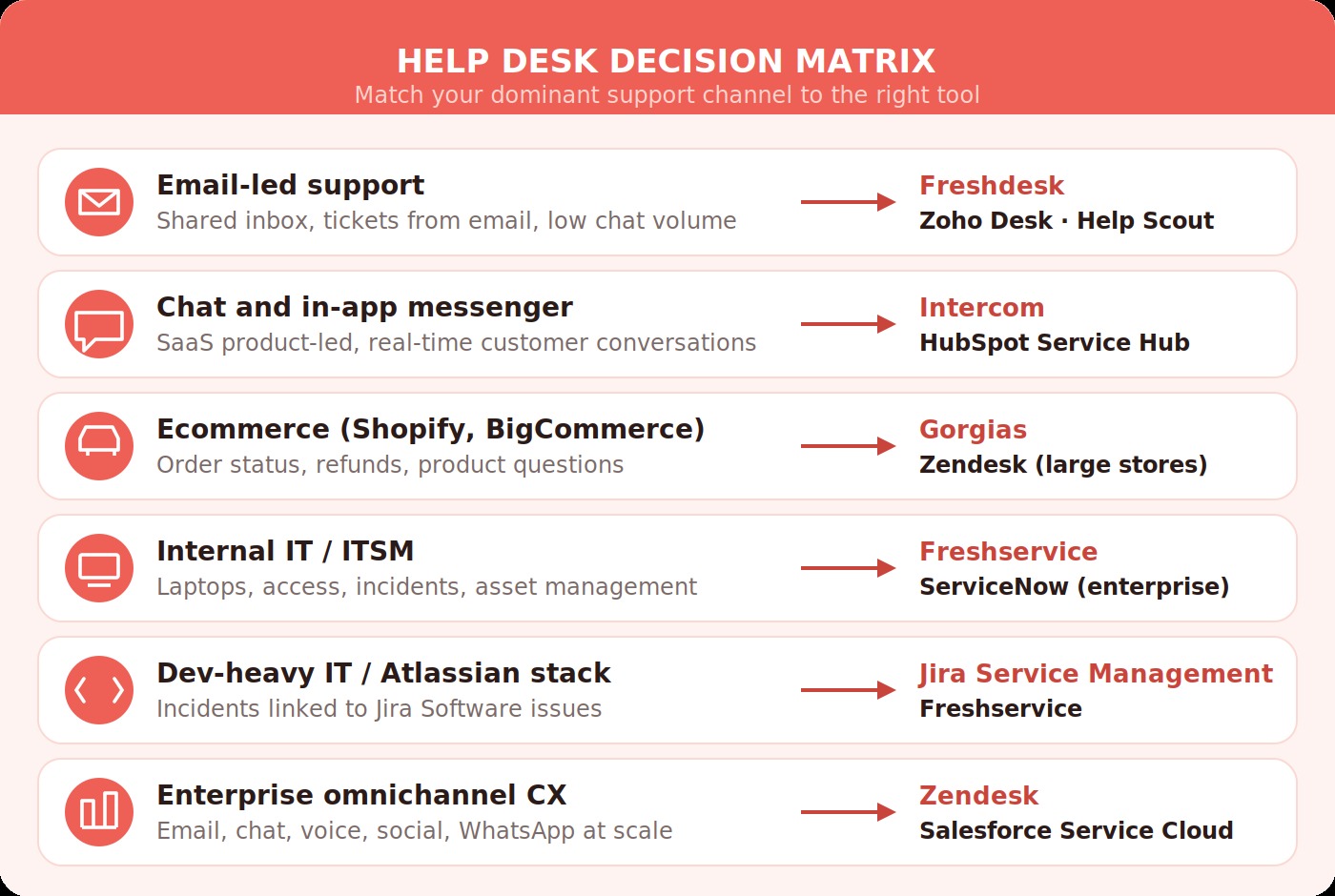
1. Which channel dominates? Email-led: Help Scout, Freshdesk, Zoho Desk. Chat-led: Intercom. Telegram-led ecommerce: Chatgram. Shopify: Gorgias. Internal IT: Freshservice or Jira Service Management.
2. What is the real 12-month price? Multiply the tier that includes what you need (SLA, custom roles, collision detection) by your agent count, then add AI. Sticker prices often triple.
3. How reliable are the integrations? Confirm two-way sync with your CRM, order system, Slack, and any LinkedIn automation tools your sales side runs. A brittle integration is worse than none.
4. Can the AI take actions, or only surface articles? Deflection is not resolution. Demo the AI processing a refund or updating an account in your test environment.
5. Run a 30-day parallel pilot. Route 20 to 30 percent of real tickets through the candidate. Baseline first-response time, resolution time, deflection, and CSAT. Numbers, not demos, pick the winner.
Conclusion
The best help desk software in 2026 matches your channel mix, budget, and appetite for setup work. For most 5 to 30-agent teams, that is Freshdesk or Zoho Desk. Enterprise CX: Zendesk. Chat-first SaaS: Intercom. Telegram-first ecommerce: Chatgram. IT: Freshservice or Jira Service Management. Shopify: Gorgias.
Whatever you pick, help desk software only pays back when it changes how work happens. Consolidate channels into one queue, seed a real knowledge base, tune the AI, and feed ticket signal back into your B2B SaaS marketing strategy and product roadmap. That is where the 35 to 45 percent resolution-time drop actually shows up.
If your bottleneck is reaching customers first rather than answering them, pair the shortlist above with our guide to contact form marketing or explore best cold email software to fill the top of the funnel.
Frequently Asked Questions
What is the difference between a help desk and a ticketing system?
Is help desk software worth it for small businesses?
What is the best IT help desk software in 2026?
How much should a help desk system actually cost per agent?
 Summarize this article with: