
RocketReach Review 2026: Pricing, User Complaints and the Best Alternative
RocketReach promises what every seller wants: type in a name or a company and get a verified email and direct dial in seconds. With 700 million-plus profiles and self-serve plans, it looks like an easy win over enterprise databases. This RocketReach review checks whether that promise holds up in 2026, and where the fine print starts to bite.
We break down the features buyers actually use, what each plan costs once export caps kick in, and the complaints that fill its one-star reviews. We also weigh it against the best cold email software and a channel that skips the inbox entirely, so you can decide where your prospecting budget should go.
Key Takeaways
- It finds people, not replies. RocketReach searches 700M+ profiles for emails and phone numbers and now adds Sequences and Autopilot, but your messages still leave from your own mailbox.
- RocketReach pricing starts low, but caps shape the bill. As of August 2026, Essentials, Pro, and Ultimate list at $19, $52, and $115 per seat a month billed annually ($39, $79, $169 monthly), with export caps on every tier.
- Accuracy is the recurring gap. RocketReach claims 90 to 98 percent accuracy, while reviewers report 20 to 30 percent bounce rates on some lists.
- Billing drives the worst reviews. It holds 4.4 on G2 but 1.2 on Trustpilot, where most complaints describe silent annual renewals and refused refunds.
- Pick the alternative by your goal. contactID builds niche lists of business websites and reaches them through their contact forms. Hunter.io suits email-only finding, Snov.io is the budget all-in-one, and UpLead guarantees accuracy.
What Is RocketReach?
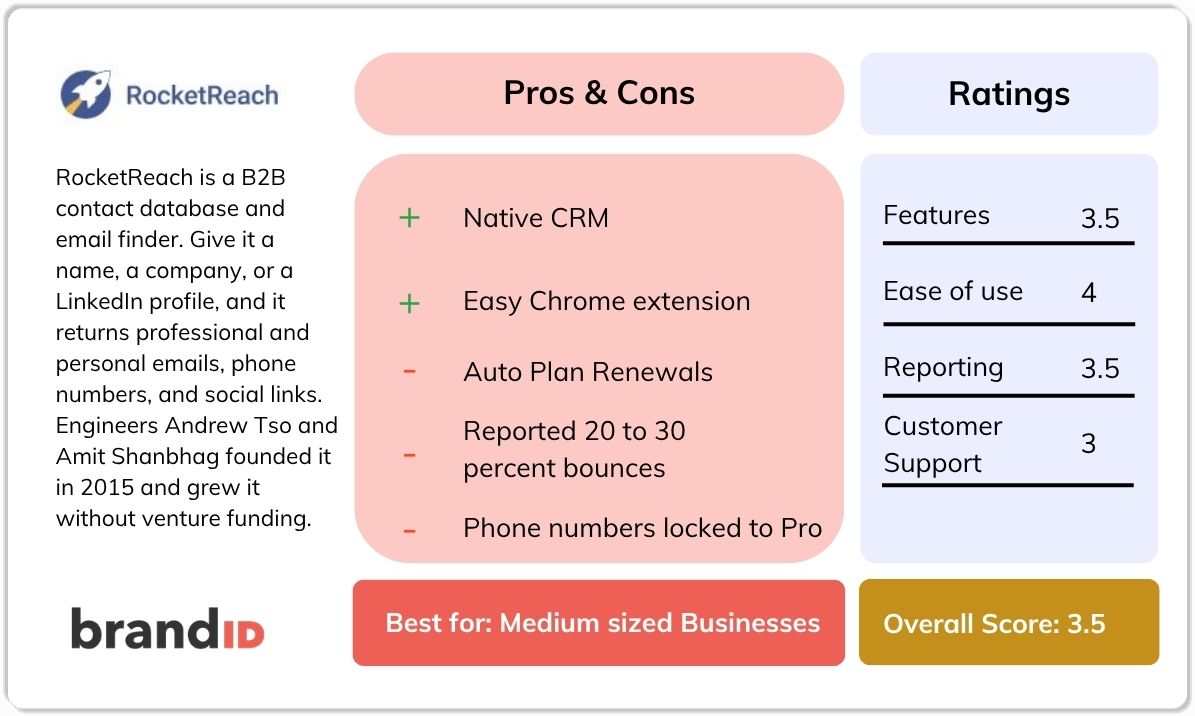
RocketReach is a B2B contact database and email finder. Give it a name, a company, or a LinkedIn profile, and it returns professional and personal emails, phone numbers, and social links. Engineers Andrew Tso and Amit Shanbhag founded it in 2015 and grew it without venture funding.
By its 2025 anniversary, RocketReach claimed 700 million-plus profiles, 60 million companies, and more than 26 million users. That reach is why recruiters, founders, and SDRs try it first. It sits between free email finders and enterprise platforms like ZoomInfo, with published prices instead of five-figure contracts.
One limit shapes the rest of this review. RocketReach tells you where to send, but it does not deliver anything for you. Even its new Sequences go out from your own mailbox, so every bounce and spam flag lands on your domain.
RocketReach at a Glance
At a Glance
- Category: B2B contact database and email finder, with light sales engagement (Sequences, Autopilot).
- Track record: founded in 2015 and bootstrapped; it says 95 percent of the S&P 500 use it, which marks an established vendor rather than a startup gamble.
- Claimed data: 700M+ profiles and 60M companies, with self-reported accuracy of 90 to 98 percent.
- Who uses it: recruiters, founders, and small sales teams who need individual lookups at a low entry price.
RocketReach Features
RocketReach has grown from a lookup box into a small prospecting suite. Six features carry most of its value, and each one has a catch that buyers often discover after checkout.
Contact Database and Email Finder
This is why people open RocketReach. Search by name, title, company, or domain, and it returns emails, direct dials, and social profiles with a confidence grade. For hard-to-reach executives, the breadth is real: you usually find a record, which beats guessing email formats by hand.
Chrome Extension for LinkedIn and Company Sites
The RocketReach Chrome extension reveals contact details while you browse LinkedIn profiles or company websites and saves them to lists. It works on every plan and is one of the most praised parts of the product, and one of the handier Chrome extensions for lead generation for one-off lookups.
Advanced Search and Bulk Lookup
Filters cover title, seniority, industry, location, company size, and technology, so you can build a prospect list instead of hunting names one by one. Bulk CSV enrichment helps when cleaning an old CRM export.
Sequences, Messages, and Autopilot
RocketReach launched multi-step email Sequences in February 2026, with up to 50 steps per campaign sent from your mailbox. Autopilot, still in beta, reruns saved searches on a schedule and adds new contacts automatically, and an AI writer drafts first-touch emails.
That covers light campaigns. For real volume, a dedicated sender such as Instantly for high-volume cold email handles warm-up and inbox rotation better.
Intent Data, Technographics, and Healthcare Data
Higher tiers add buying-intent signals, technology filters, company news, org charts, and a healthcare dataset with provider records. Intent helps you prioritize accounts already researching your category, and the healthcare data is a genuine strength for medical recruiters and vendors.
CRM Integrations and API
From Pro upward, RocketReach syncs with Salesforce, HubSpot, Outreach, Salesloft, and Bullhorn, and a contact data API serves RevOps teams. For recruiting agencies on Bullhorn, that integration alone can justify the seat.
RocketReach Pricing
RocketReach pricing is public, which is rare for a B2B contact database. What you pay in practice depends on three things the plan cards play down: export limits, the data types each tier includes, and how renewals work. Figures come from RocketReach's pricing page as checked on August 13, 2026.
One caution: published prices have shifted during 2026, and another August 2026 snapshot lists $329, $829, and $1,699 a year for the same tiers. Confirm the price at checkout.
The Plans
Here is each tier side by side, with the caps that decide your real volume.
| Plan | Annual Billing | Monthly Billing | Limits | What You Get |
|---|---|---|---|---|
| Free | $0 | $0 | 5 lookups, one time | Email only, no bulk |
| Essentials | $229/yr ($19/mo) | $39/mo | 1,200 exports/yr (100/mo monthly) | Email only, Chrome extension |
| Pro | $619/yr ($52/mo) | $79/mo | 3,600 exports/yr (250/mo monthly) | Phones, CRM sync, 10 Autopilot jobs |
| Ultimate | $1,379/yr ($115/mo) | $169/mo | 20,000 exports/yr (1,000/mo monthly) | Intent, healthcare data, API, 25 jobs |
| Custom Team | From about $6,000/yr | Not offered | Pooled credits | SSO, account manager, higher API limits |
Export caps matter more than list price once bounces enter the picture. The infographic below divides each plan's price by the exports that survive a 20 to 30 percent bounce rate.
Hidden Limits That Change the Real Bill
- Automatic renewals. Plans renew by default. Per RocketReach's FAQ, canceling keeps access to the end of the term, with no partial refund for unused time.
- Bounces still cost you. A lookup is only refunded when RocketReach returns no verified data. If a “verified” email bounces later, the credit is gone.
- No top-ups. There is no published price for extra credits, so running out mid-cycle means upgrading.
- Per-seat math. Every plan is priced per user, so a five-person Pro team runs about $3,095 a year at list price.
RocketReach Reviews: What Real Users Say
RocketReach reviews split sharply by platform. The pattern that matters is that the complaints are rarely about a missing feature. They are about support, setup friction, and features locked behind higher plans. Here are the negative themes that show up most often across Capterra, G2, and GetApp.
Recurring Complaints in Negative RocketReach Reviews
1. Renewals with no warning
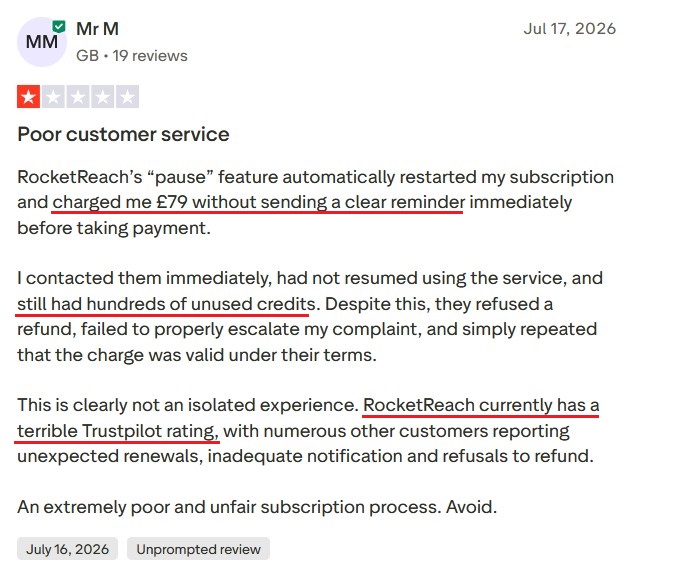
A UK user on Trustpilot says the pause feature quietly restarted his subscription and charged £79. He still had hundreds of unused credits, and the refund was refused.
2. Rules over people
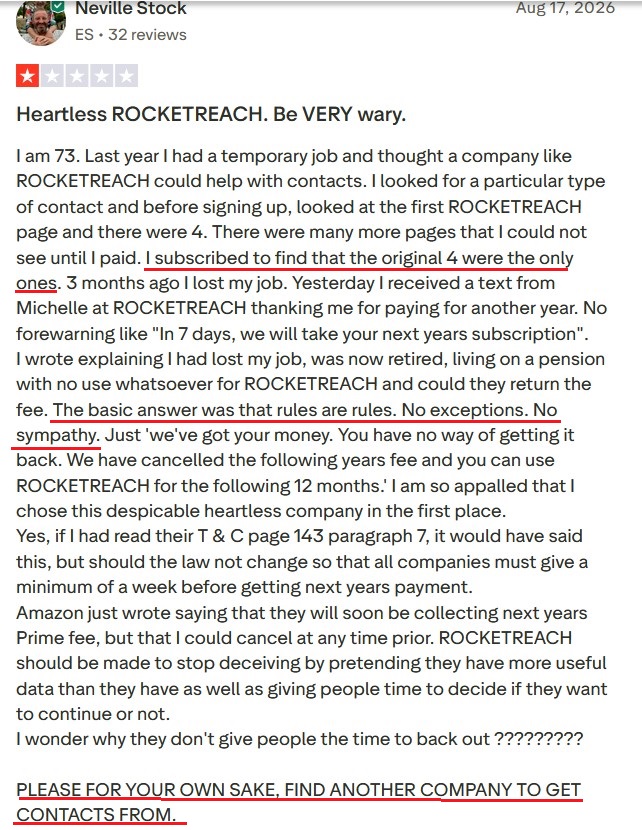
A 73-year-old reviewer in Spain (August 2026) had lost his job and retired when his plan renewed with no advance notice. His refund was declined, and he was told he could keep using the year he had paid for.
3. Personal emails sold as business data
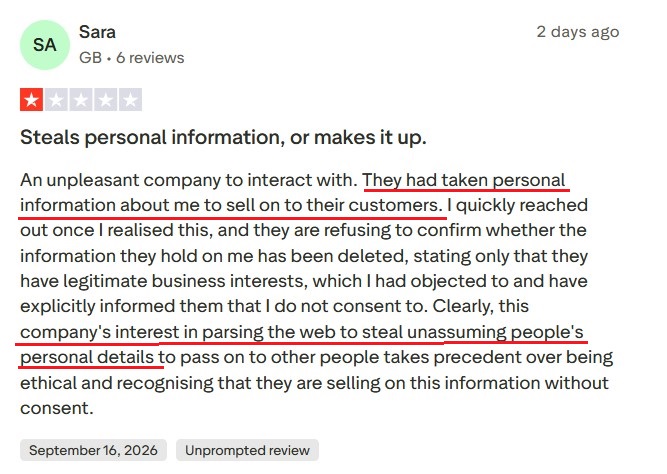
Sara says that she found out that RocketReach is selling her personal information to other 3rd-party companies, which is against the law.
4. Privacy removal problems
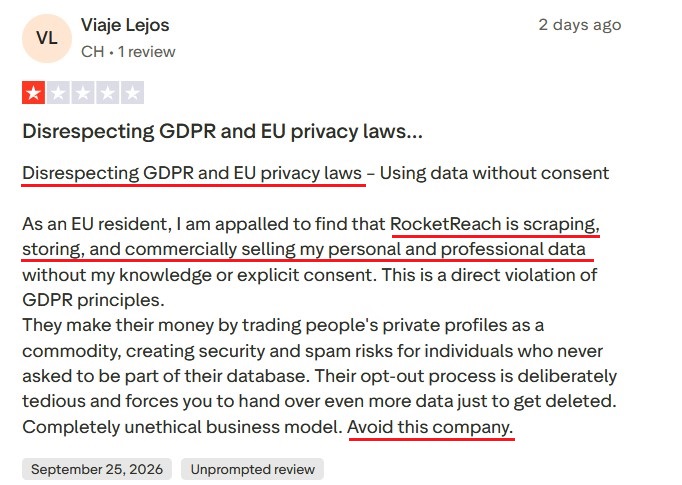
EU professionals on Trustpilot, such as Viaje, say deletion requests were confirmed but profiles stayed public. If you prospect in Europe, that GDPR friction can follow your outreach.
RocketReach Pros and Cons
Put the lookups, the plan limits, and hundreds of user reports side by side, and RocketReach's strengths and weak spots become easy to see.
RocketReach Pros
- Huge B2B contact database (700M+ profiles)
- Published, self-serve pricing with a low entry point
- Easy Chrome extension for LinkedIn lookups
- Native CRM and ATS integrations
RocketReach Cons
- Reported 20 to 30 percent bounces on some lists
- Phone numbers locked to Pro and above
- Export caps with no rollover or top-ups
- Auto-renewals and refused refunds dominate Trustpilot
- Outreach still sends from your own domain
- Weaker data outside the US
contactID: The Best RocketReach Alternative for Teams That Want Replies
Every tool in this RocketReach review, alternatives included, stops at the same point: a list of addresses you still have to email. If a fifth of those addresses bounce, a fifth of your outreach is never read, however sharp the copy.
contactID works from the other end. It delivers your message through each company's own Contact Us form, the inbox a business already checks for new leads. Nothing bounces, nothing lands in spam, and there is no domain to warm up.
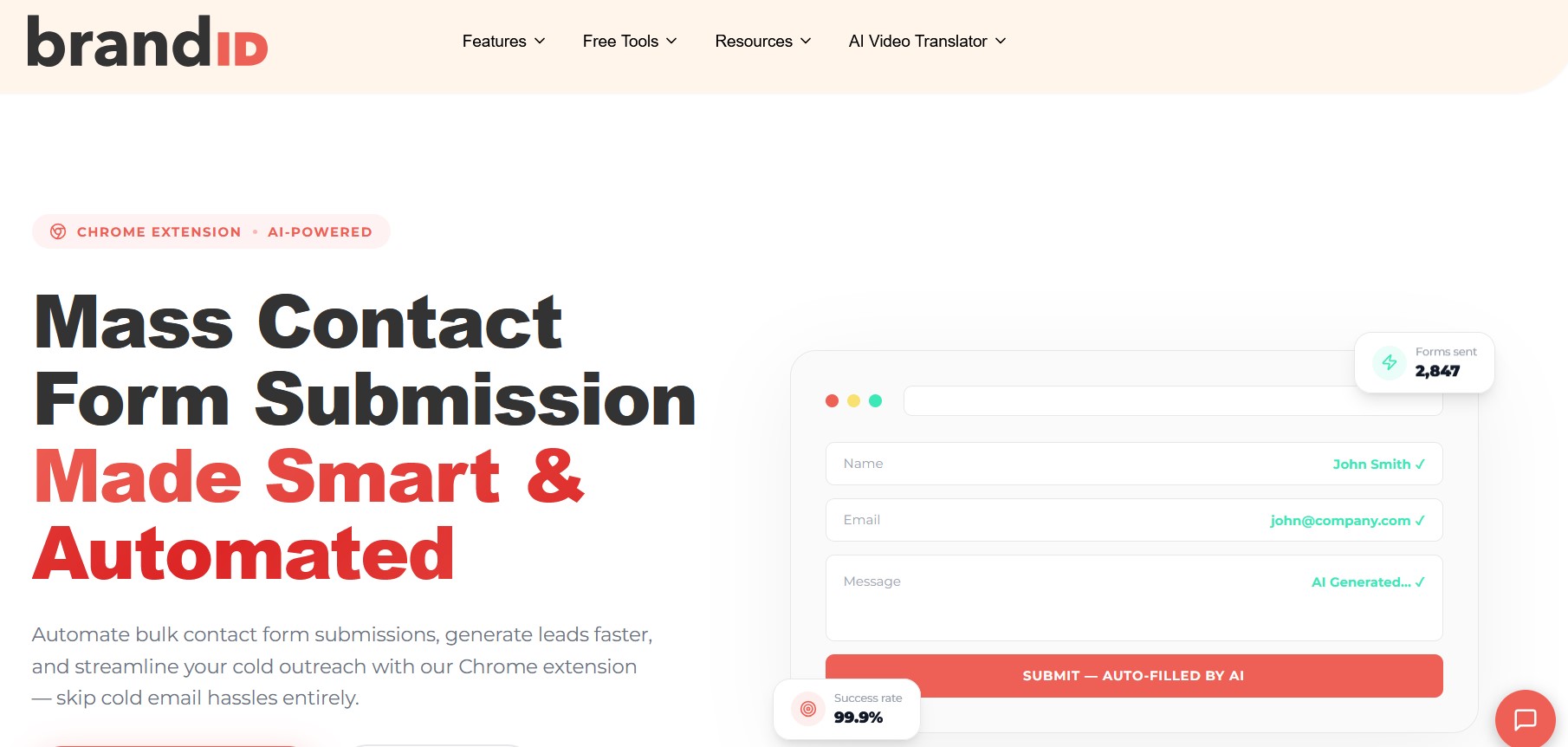
Its newest feature, Find websites, closes the last gap. Instead of buying contacts person by person, you pick a niche and a city and get a ready list of business websites to reach. That turns contactID from a sending tool into a full RocketReach replacement for anyone selling to small and local businesses.
What You Get With contactID
New: find websites in any niche
Pick a business type, a country, and a city, and contactID returns matching business websites with emails, phone numbers, language, tech stack, and contact-page details. You see how many are available before paying, so local lead generation lists for dentists, roofers, or law firms take a few clicks instead of a week of research.
Never pay twice for the same business
Businesses you already have are excluded automatically, and a credit is spent only on a place delivered with a website. Lead credits run from $0.05 down to $0.025 each, never expire, and can be exported without running outreach.
Delivery through contact forms
Your message reaches the form inbox a company already monitors, with no daily send cap.
An AI-written message per site
Set a prompt and merge fields, and contactID tailors the message to every website, so a 500-site campaign still reads like one-to-one outreach.
Hands-off automation
It finds forms in any language, maps each field, solves 99.9 percent of CAPTCHAs, and submits in bulk. More than a million forms have gone out through it.
Pay per success, not per seat
Free to install. Pay as you go at $0.15 per website, or pick a plan from $6.99 to $139.99 a month that drops the rate to $0.01 per website (annual saves 30 percent). Failed forms cost nothing.
The short version: RocketReach tells you who to contact, while contactID chooses the businesses and makes sure the message arrives. Few contact form automation tools build the target list as well. This table compares the two on the points buyers raise most.
RocketReach vs contactID
| Factor | RocketReach | contactID |
|---|---|---|
| Core job | Find a person's email and phone | Find niche businesses and deliver your message |
| List building | Search profiles person by person | Pick niche, country, and city; get websites |
| Delivery channel | Your own mailbox | Each company's contact form |
| Bounce risk | 20 to 30% reported on some lists | None; forms do not bounce |
| Domain warm-up | Needed for volume | Not needed |
| Pricing model | Per-seat plans that auto-renew | Pay per success; lead credits never expire |
| Best for | Recruiting and one-off person lookups | Outreach to SMBs, local and ecommerce businesses |
Prefer a walkthrough first? Book a demo.
Other RocketReach Alternatives Worth Considering
Prefer to stay with a contact database? These three RocketReach alternatives each fix a different weakness from the reviews above: price, all-in-one outreach, and accuracy. All three still feed an email workflow, so pair them with a sound outbound lead generation process.
1. Hunter.io
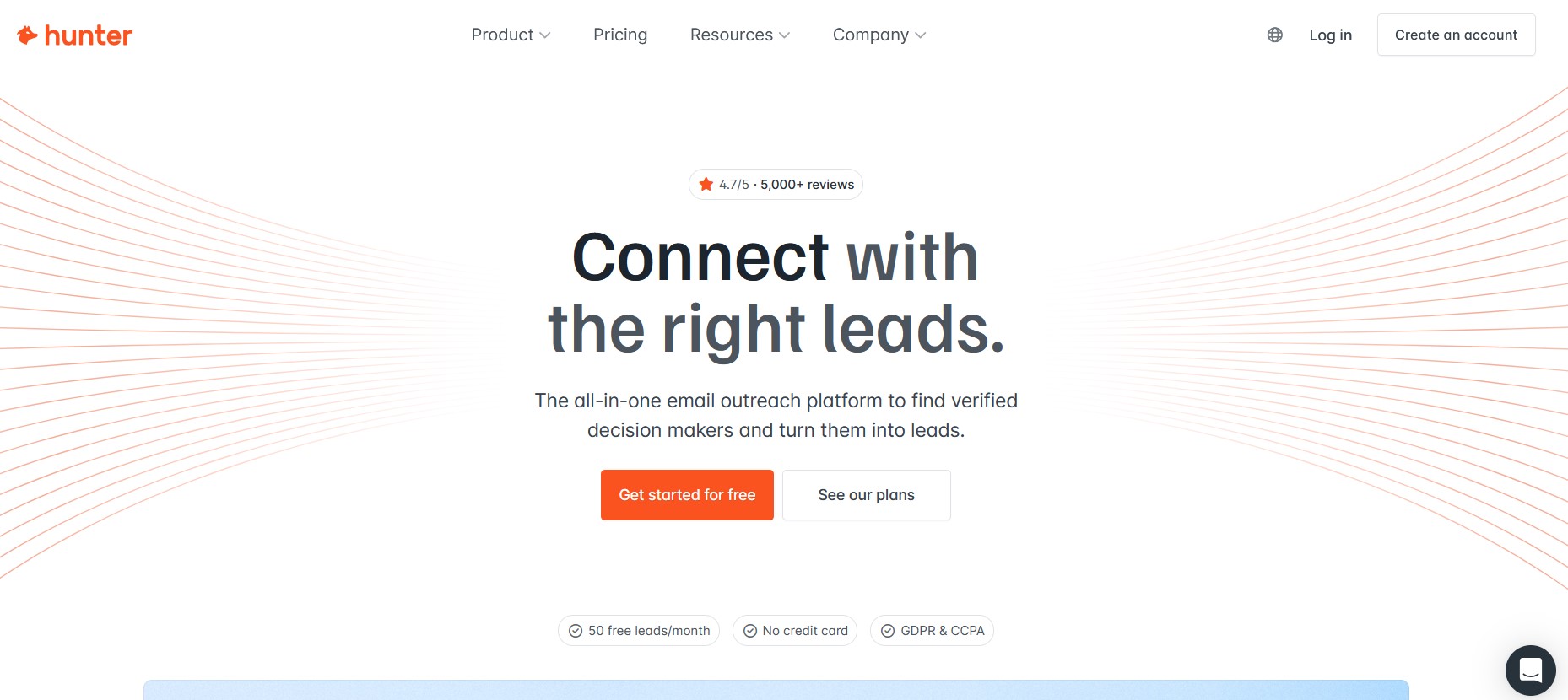
Hunter.io is an email finder and verifier built around company domains. Domain Search lists the public emails found for a company with their sources, and the verifier checks each address before you send. As a RocketReach alternative, it trades phone data for a tighter focus on verified email, and it holds a 4.3 Trustpilot rating in 2026.
- Best For: Founders, marketers, and link builders who need verified emails, not phone numbers.
- Key Features: Domain Search, Email Finder, Email Verifier, a Chrome extension, simple campaigns, and unlimited team members.
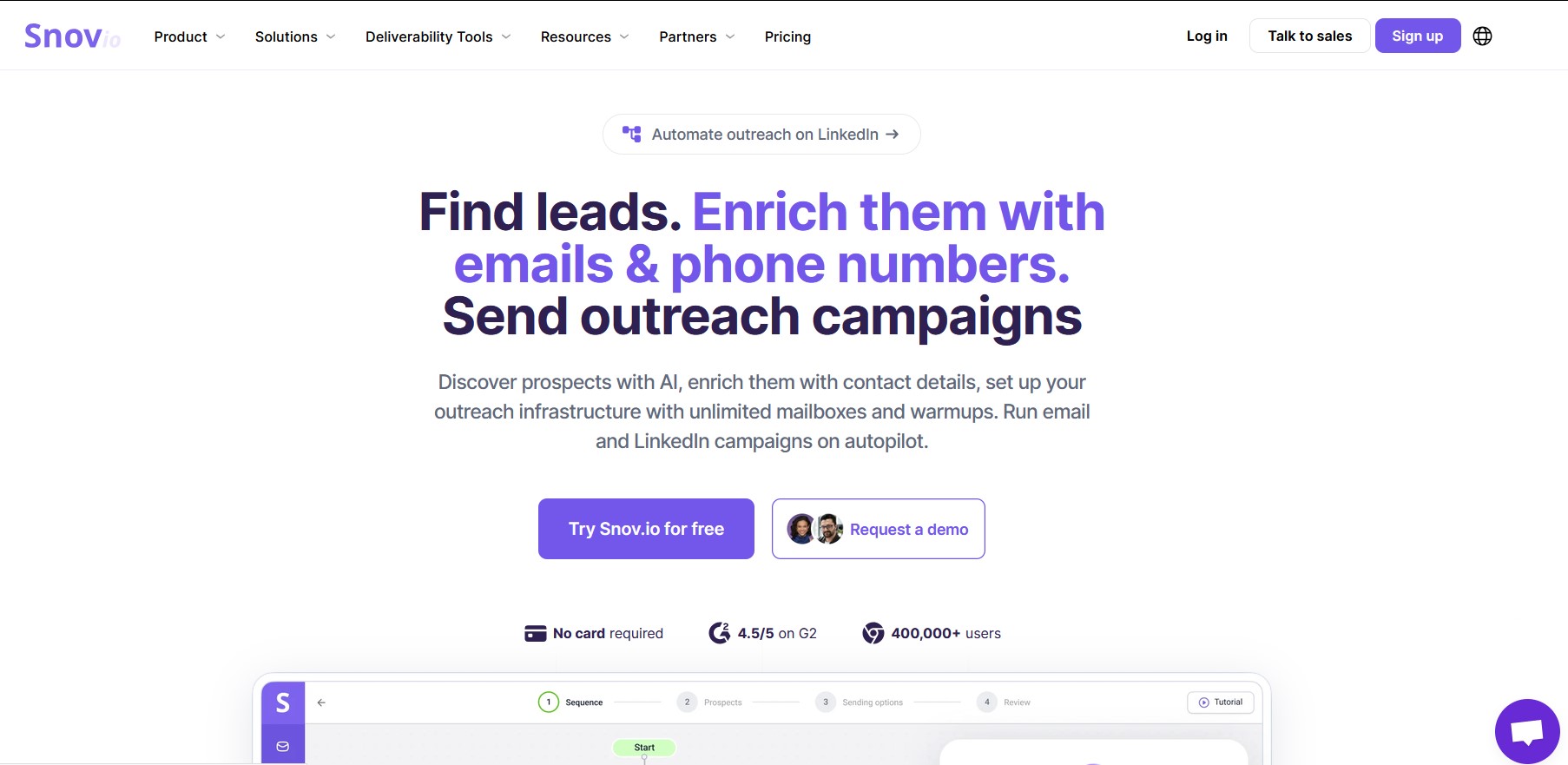
2. Snov.io
Snov.io bundles an email finder, a multi-step verifier, drip campaigns, mailbox warm-up, and a free CRM in one subscription. As a RocketReach alternative, it suits people who want to find and email prospects without stitching tools together, and it holds a 4.6 Trustpilot rating from about 2,000 reviews in 2026.
- Best For: Solo founders and small teams running email-only outbound on a budget.
- Key Features: Email Finder with a Chrome extension, verifier, drip campaigns, warm-up, a built-in CRM, and optional LinkedIn automation.
3. UpLead
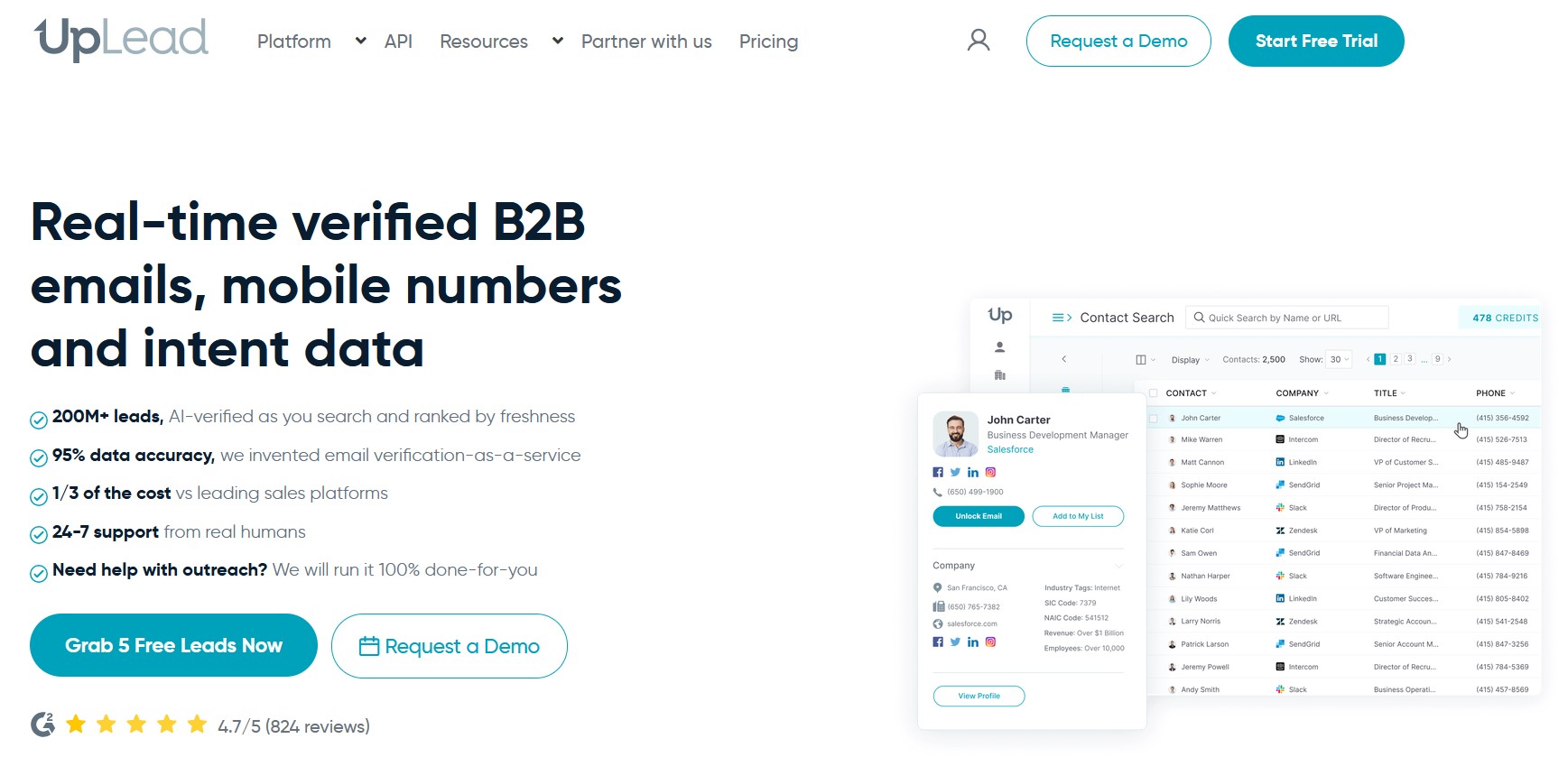
UpLead is a B2B contact database that puts money behind accuracy: it verifies every email in real time at export and refunds the credit if a contact bounces, under a 95 percent accuracy guarantee. As a RocketReach alternative, it costs more per contact but removes most of the bounce risk reviewers complain about.
- Best For: Teams where a clean sender reputation matters more than raw volume.
- Key Features: 160M+ contacts, 50+ search filters, technographics, real-time verification, a Chrome extension, and intent data on higher tiers.
Conclusion
Our RocketReach review verdict is 3.6 out of 5. It finds a specific person's email or phone number fast and cheaply, but accuracy drops outside the US and renewals cause most of its one-star ratings. Use it for targeted lookups, verify before sending, and note your renewal date.
If you want replies from businesses in a niche, pick a tool that finds them and delivers the message for you.