Viator is the single largest tours and activities marketplace on the web, with over 300,000 experiences across 190+ countries, and it is owned by TripAdvisor. If you write about travel, run a city guide, or make day-trip content, this is probably the single highest-converting affiliate program you can add to your site.
The Viator affiliate program pays 8 percent commission on net booking value with a 30-day cookie, no minimum traffic requirement, and payouts through PayPal or bank transfer. It consistently ranks among the highest-converting travel affiliate programs, and it is where most travel bloggers earn their first serious affiliate check.
This review covers commission math, cookie behavior, exclusions people miss, realistic monthly earnings by audience size, step-by-step signup through the Partner Portal and Awin, and the content formats that actually convert Viator links in 2026.
Key Takeaways
- Viator affiliate program pays 8 percent commission: on the net booking value after taxes and booking fees, through a 30-day cookie window from the first click.
- Viator affiliate signup is open with no minimum traffic requirement: and most applications are approved within a few business days through the Partner Portal, Awin, FlexOffers, or CJ.
- Viator partner program commission is paid monthly: once the referred experience has been completed by the traveler, not at booking time, with $0 PayPal minimum and $50 bank-transfer minimum.
- Viator affiliate commission is best suited for travel-specific audiences: city guides, tour reviews, destination YouTube channels, and travel newsletters convert far better than general lifestyle traffic.
- How much Viator pays affiliates scales with average order value: typical tour orders run $80 to $250 and premium experiences run $400 to $1,500, so a single referral can clear $6 to $120 in commission.
Viator affiliate program quick facts
What is Viator and why travel affiliates promote it
Viator is TripAdvisor’s tours, activities, and experiences marketplace. It is to travel experiences what Amazon is to physical goods: the largest catalog, the brand recognition, and the easiest checkout. In 2026 it lists more than 300,000 bookable experiences across 190+ countries, from day tours and museum tickets to multi-day adventures and private guides.
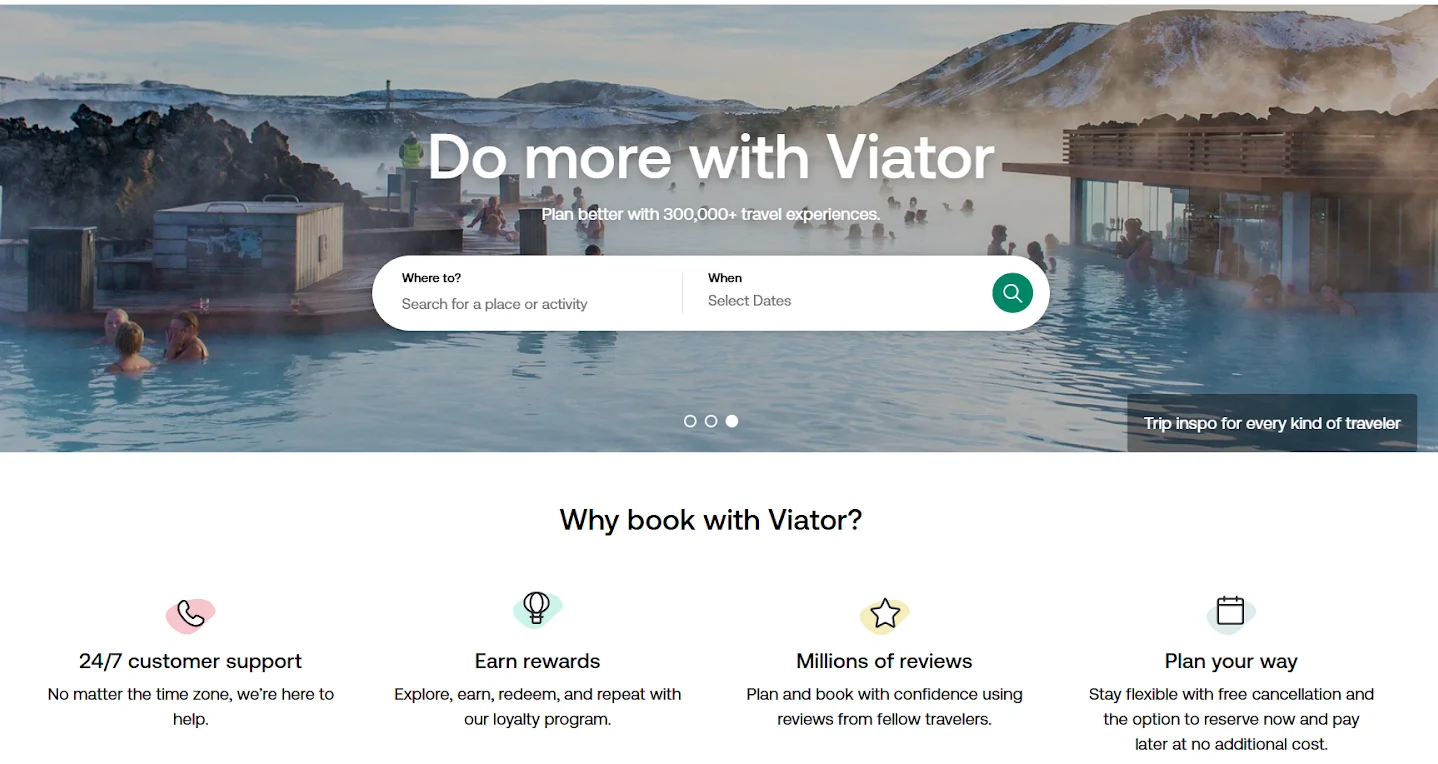
For travel content creators, three things make the Viator affiliate program the default pick:
- Catalog breadth. Almost every destination you write about has multiple bookable Viator experiences, so your links fit the content you already produce.
- Brand trust. TripAdvisor is the most-recognized travel brand in the US and most of Europe, which translates directly to better click-through and conversion rates than lesser-known travel programs.
- Average order value. Tours and activities carry higher order values than most impulse purchases, with the typical booking in the $80 to $250 range and premium multi-day experiences running $400 to $1,500.
The trade-off is that the Viator affiliate commission rate (8 percent) is modest compared to software or digital-product programs. The way photographers and travel creators make this work is volume and relevance: when the entire article is about things to do in Barcelona and every link routes to Barcelona-specific experiences, conversion rates climb to levels software programs can only dream about.
Viator affiliate commission and cookie explained
The headline Viator commission rate is 8 percent, paid on the net booking value after taxes and booking fees are removed. A $200 tour booking does not generate $16 in commission; it generates roughly $12 to $14 depending on local tax and the small platform fee Viator deducts first.
The 30-day cookie is one of the better windows in travel affiliate marketing, especially given that travel buyers spend longer in the research phase than almost any other category. A reader who finds your Rome itinerary in week 1 and books four Rome experiences in week 3 still earns you commission on all four, as long as each click fell within the cookie window and the booking page they completed matched the attribution logic.
Important exclusions that affiliates frequently miss:
- Theme park admissions (Disney, Universal, SeaWorld) are not commissionable even when booked through Viator.
- Virtual tours and online experiences are excluded.
- Bookings routed through travel agents are excluded, which can quietly cost tour-adjacent sites a chunk of expected commission.
- Cancellations and no-shows reverse the commission at reconciliation.
Payment is tied to experience completion, not to the booking date. If a reader books a January tour in November, you do not see that commission until February or later. For travel content creators this means the earnings cycle lags your clicks by weeks to months, which is worth modeling into your cash flow if Viator becomes a significant income line.
How much does the Viator affiliate program pay in real numbers
Honest math on the Viator affiliate commission at a typical $150 experience booking:
- Gross booking: $150
- Approximate taxes and platform fee: $15 to $25
- Net booking value: $125 to $135
- Affiliate commission at 8 percent: roughly $10 to $11
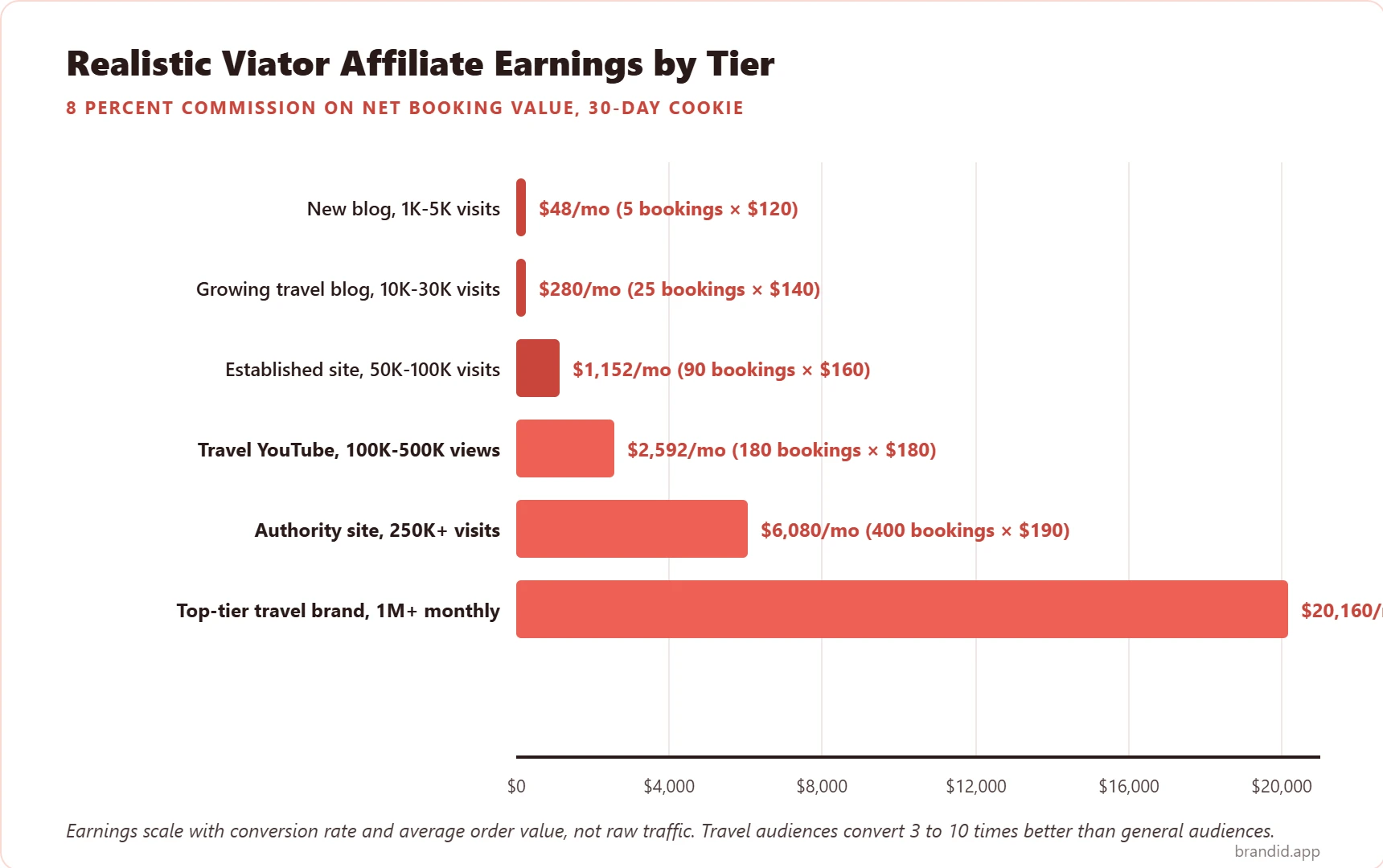
Scale that out across traffic tiers, assuming the conversion rate a travel-specific audience actually produces:
| Tier | Monthly Travel Traffic | Est. Bookings | Est. Monthly Commission |
|---|---|---|---|
| Beginner travel blog | 1K to 5K visits | 3 to 10 | $30 to $100 |
| Growing travel blog or small YouTube channel | 10K to 30K visits | 15 to 40 | $150 to $500 |
| Established travel site | 50K to 100K visits | 60 to 150 | $600 to $1,800 |
| Travel YouTube channel | 100K to 500K monthly views | 120 to 300 | $1,200 to $3,600 |
| Travel authority site | 250K+ visits | 300 to 700 | $3,000 to $8,500 |
| Top-tier travel brand | 1M+ monthly visits | 900 to 2,000 | $9,000 to $25,000 |
The gap between the beginner tier and the authority tier is not just raw traffic, it is intent match. A traveler who searches “things to do in Lisbon” and lands on your Lisbon itinerary converts at 2 to 4 percent, while general lifestyle traffic typically converts under 0.3 percent on the same links.
How to join the Viator affiliate program (step by step)
You have four routes into the Viator affiliate program. The direct Partner Portal is the simplest and currently pays the headline 8 percent rate in most markets.
Option 1: Direct partner portal (recommended)
- Go to viator.com/distribution-partners or the official Viator Partner Resources site.
- Click the Affiliate option and complete the application with your site URL, promotional channels, and expected monthly traffic.
- Submit and wait 1 to 5 business days for approval. Travel-focused sites are almost always approved; general-purpose sites take longer.
- Once approved, log in to the Partner Portal to grab your Viator affiliate link, generate deep links to specific experiences, and set up your preferred payout method.
Option 2: Awin
Awin hosts Viator in most regions and is a good pick if you already run multiple Awin programs and prefer a consolidated dashboard. Note the commission rate: some Awin market pages still show 4 percent as the Viator affiliate commission, not 8 percent. Verify your market rate before promoting.
Option 3: FlexOffers
FlexOffers is a strong secondary network for US-based affiliates, typically mirroring the 8 percent rate. The approval process on FlexOffers is slower than the direct Partner Portal but covers a wider range of travel programs under one dashboard.
Option 4: CJ Affiliate
CJ Affiliate also lists Viator in some regions. CJ is best if you already run a CJ-heavy portfolio and want unified reporting; standalone it is not meaningfully better than the direct route.
Viator affiliate program pros and cons
| Pros | Cons |
|---|---|
| + 30-day cookie is above the travel-industry average of 7 to 14 days. | − 8 percent commission is modest versus software or digital-product programs that pay 20 to 50 percent. |
| + Catalog of 300,000+ experiences means almost every destination has fitting links. | − Payment tied to experience completion means earnings lag clicks by weeks to months. |
| + TripAdvisor brand recognition drives higher click-through and conversion rates than lesser-known travel programs. | − Theme park admissions, virtual tours, and travel-agent bookings are all excluded from commission. |
| + No minimum traffic requirement for signup. | − Some Awin market pages still display 4 percent instead of the headline 8 percent. |
| + Deep linking to specific experiences lets you match links tightly to article context. | − Commission reversed on cancellations and no-shows, which is common in tours and activities. |
| + Mobile-optimized checkout converts well on travel-vlog traffic from phones. | − Dashboard reporting is functional but less detailed than Impact or Partnerize affiliate networks. |
Who the Viator affiliate program fits (and who it does not)
Who should join
- Travel bloggers publishing destination guides, city itineraries, or specific-attraction content.
- Travel YouTube channels and TikTok creators making day-trip, vlog, or itinerary videos.
- Travel newsletter writers whose readers actively plan trips.
- Trip-planning tools and sites where the user is already in a bookable mindset.
- Expat and digital-nomad content that touches local experiences, day tours, and arrival-week activities.
Who should skip it or pair it with something else
- General lifestyle blogs where travel is tangential. Conversion rates stay below 0.3 percent and the 8 percent commission barely covers the time.
- Pure gear-review sites that cover luggage or cameras without destination context. Pair Viator with gear programs rather than leading with it.
- Audiences in regions Viator covers thinly, mostly parts of Africa and Central Asia, where catalog depth is limited.
Best content formats for promoting the Viator affiliate program
Viator affiliate links convert dramatically differently depending on the content format they live inside. Four formats that consistently outperform the rest:
Destination guides and “things to do in X” posts
The highest-converting format on the entire Viator catalog. A reader who searches “things to do in Barcelona” has one job: build a shortlist of bookable experiences. Match every section to a Viator deep link and conversion rates typically land between 2 and 5 percent.
Day-trip itineraries
A “Day Trip from Lisbon to Sintra” article naturally lives inside the Viator catalog, which has dozens of Sintra tour options. Drop deep links in each section and the article becomes a booking funnel.
Travel YouTube and TikTok with pinned links
Travel vlogs that mention “the tour I booked was in the description” convert surprisingly well because the viewer already saw you enjoy the experience on video. Travel YouTube pairs especially well with the YouTube affiliate programs approach of layering one brand mention per video with pinned-comment links.
Newsletter sections tied to specific destinations
A weekly “Where to go this month” newsletter with 3 to 5 Viator links per destination earns disproportionately well because newsletter readers are higher-intent than social traffic.
Viator vs alternatives: GetYourGuide, Expedia, TripAdvisor Experiences, Klook
The 4 main tours and activities affiliate programs in 2026, and how each compares on commission, cookie, and audience fit:
| Program | Commission | Cookie | Best For |
|---|---|---|---|
| Viator | 8% | 30 days | US and global travel content, broadest catalog |
| GetYourGuide | 8% | 31 days | European travel content, strong on walking tours and city passes |
| Expedia (activities) | 2 to 6% | 7 days | Flight and hotel content that bundles activities |
| TripAdvisor Experiences | ~50% of referral fee | 14 days | Review-focused travel sites |
| Klook | 2 to 5% | 30 days | Asia-focused travel content |
Running Viator plus GetYourGuide in parallel is a common move for travel bloggers who cover both US and European destinations. The catalogs overlap but the better match for a specific tour varies by city, and the 30 and 31-day cookies both let the reader take their time.
Common Viator affiliate program mistakes to avoid
- Linking to the Viator homepage instead of deep-linking to the specific experience. Homepage links convert at a fraction of the rate of product-page deep links.
- Promoting Viator to non-travel audiences. General lifestyle traffic converts under 0.3 percent and the 8 percent commission rate cannot carry low intent.
- Forgetting the exclusion list. Theme park admissions and travel-agent bookings are not commissionable, and recommending Disney tickets through Viator wastes clicks that could have earned on a different program.
- Not refreshing dead links. Experiences get discontinued often. A quarterly audit catches the dead Viator affiliate links before they cost you a booking season.
- Modeling earnings on booking date instead of trip date. Viator pays after the experience is completed, so November bookings for January trips do not pay out until February or later.
Launch your travel affiliate storefront on brandID in 30 seconds
Every Viator affiliate link is one tracked URL. Someone has to click it, land somewhere, and book. That somewhere is almost always a bio page or travel portfolio that curates your top destination guides, Viator-tour picks, travel-gear affiliate links, and your newsletter signup.
Open brandID, hit Build with AI, type something like “a travel creator storefront with my top 10 Barcelona Viator tours, luggage affiliate picks, and a newsletter signup block”, and the whole page builds itself. Hero section, product grid, destination categories, custom URL at brandid.app/yourname. All free.
If you use Claude, brandID has an official MCP connector. Tell Claude “add my 5 best-performing Viator affiliate links from the Rome trip to my brandID travel storefront” and Claude edits the page directly through the MCP. No clicking around an editor.
One brandID page handles your Viator deep links, your travel-gear picks, your newsletter signup, and your YouTube and Instagram bios side by side. Your TikTok, YouTube, and Instagram all route to one URL that does the sorting.
Bottom line
The Viator affiliate program is the default pick for travel content creators in 2026. The 8 percent commission is modest on paper but the 30-day cookie, 300,000+ experience catalog, high conversion rates on destination traffic, and the TripAdvisor brand behind it stack up to make Viator one of the few travel programs that reliably pays rent for creators who put in the destination-content work.
If your content covers destinations, day trips, tours, or things to do in specific cities, join the Viator affiliate program through the direct Partner Portal, pair it with outdoor and travel-gear affiliate programs, and ship 30 destination-focused articles over your first 90 days. That is the formula that lifts travel sites from a few hundred dollars a month to the $3,000 to $8,500 authority-tier range in year one.
FAQs
How much does the Viator affiliate program pay?
What is the cookie duration for Viator affiliate links?
Is there a minimum traffic requirement to join Viator?
How do you join the Viator affiliate program?
When does Viator pay affiliate commissions?
What is excluded from Viator affiliate commissions?
Can you deep-link to specific Viator experiences?
Is the Viator affiliate program better than GetYourGuide?
Do you need a travel blog to join the Viator affiliate program?
How do you find your Viator affiliate link after signup?
 Summarize this article with: