Gaming affiliate programs pay you for something you already do: telling other players what gear, games, and tools are actually worth buying. A single Discord recommendation, a setup video, or a “best budget headset” post can turn into recurring income once the tracking link is in place. The tricky part is that most lists online just dump 30 brand names on you with a commission percentage attached and no explanation of which ones actually convert.
This guide fixes that. Every program below includes what it sells, who it suits, the real commission math, and the catch nobody mentions (usually cookie length). Gaming almost never cracks the general roundups of the best affiliate programs, and that is exactly the opening: far less competition on the review keywords that actually convert.
Key Takeaways
- Hardware pays low percentages on big carts. Razer, Logitech G, and NVIDIA sit at 2% to 12%, but a $1,500 laptop still clears a useful commission.
- Digital game keys pay small and fast. Kinguin runs 5% to 10% on cheap keys, so it only works at real traffic volume.
- Cookie length decides your income. A 1-day window punishes research-heavy content; 30 to 90 days rewards it.
- Guides and software beat gear on margin. Zygor and similar info products pay up to 50% because there is no inventory cost.
- Run two or three programs, not twelve. Spread traffic thin and you never hit payout thresholds.
- The destination matters as much as the program. A shoppable bio page beats a raw affiliate URL.
Why Gaming Affiliate Marketing Is Worth Your Time In 2026
Gaming affiliate marketing works because the audience is enormous, spends constantly, and researches before buying. Newzoo puts global games revenue at roughly $205 billion in 2026, and Midia Research pushes that closer to $236.9 billion once hardware is counted. That gap matters to you: hardware is where affiliate commissions actually live, since almost nobody pays a percentage on a free-to-play download.
Player volume backs it up. Around 3.6 billion people played games as of 2025, roughly 43% of humanity. For an affiliate, that scale means even a small niche (sim racing rigs, retro handhelds, Valorant peripherals) has enough searchers to build real income around.
Spending patterns favour affiliates too. In-game purchases drove $74.4 billion in 2025, up 4.6% year on year, which tells you players are comfortable paying inside games they already own. That habit transfers: an audience that buys skins without hesitating will buy a headset you recommend. Statista’s worldwide games market forecast tracks the wider spend picture.
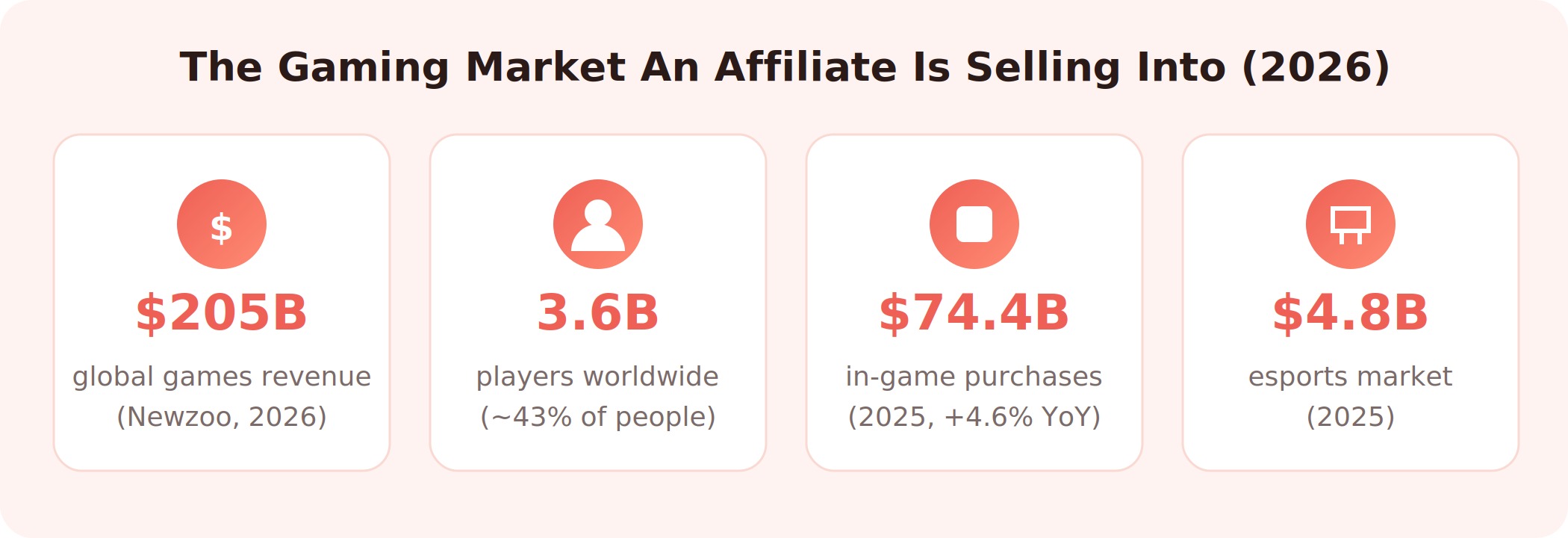
The four numbers behind every gaming affiliate program: a $205 billion market, 3.6 billion players, and spending habits already proven inside the games themselves.
Gaming Affiliate Programs Compared At A Glance
Here is the shortlist in one view. Scan the cookie column first: it is the most under-rated field in any gaming affiliate program, because a short window means your reader has to buy almost immediately.
| Program | What You Promote | Commission | Cookie | Network |
|---|---|---|---|---|
| brandID Affiliate Marketplace | 5M+ products, 2,000+ brands | Up to 65% avg | Varies by brand | In-house |
| Razer | Laptops, peripherals, chairs | 3% to 12% | 30 days | In-house / Impact |
| Logitech G | Mice, keyboards, headsets | 4% to 10% | 30 days | Impact |
| SteelSeries | Headsets, keyboards, mice | Up to 10% | 30 days | Impact |
| Kinguin Mafia | Game keys, marketplace | 5% to 10% | 30 days | In-house |
| GameFly | Game rental subscriptions | $5 to $20 per lead | 30 days | CJ Affiliate |
| Epic Support-A-Creator | Fortnite and Epic Store | 5% | 14 days | In-house |
| Twitch | Subs, bits, game sales | Rev share | Session-based | In-house |
| NVIDIA | GPUs, laptops, monitors | 2% to 5% | 45 days | Rakuten |
| Zygor Guides | WoW leveling guides | 50% | 60 days | ShareASale |
The 10 Best Gaming Affiliate Programs In 2026
These ten video game affiliate programs were picked on four criteria: gamers already trust the brand, the terms are published rather than hidden behind a rep, the cookie window is workable, and the product has real search demand. The first entry is the odd one out, because it is a marketplace rather than a single brand.
brandID Affiliate Marketplace
brandID is a creator monetization platform, and its Affiliate Marketplace is the part that matters here. Instead of applying to gaming brands one at a time and living across half a dozen network dashboards, you browse one catalogue of over 5 million products from more than 2,000 brands, with average commissions up to 65% and some paying higher.
The workflow is the differentiator. You group products into collections by niche or campaign (a Valorant setup shelf, a Black Friday peripherals drop), then link social posts straight to those products on your bio page. The storefront is yours and takes minutes to build, so it keeps working when a brand cuts its rate.
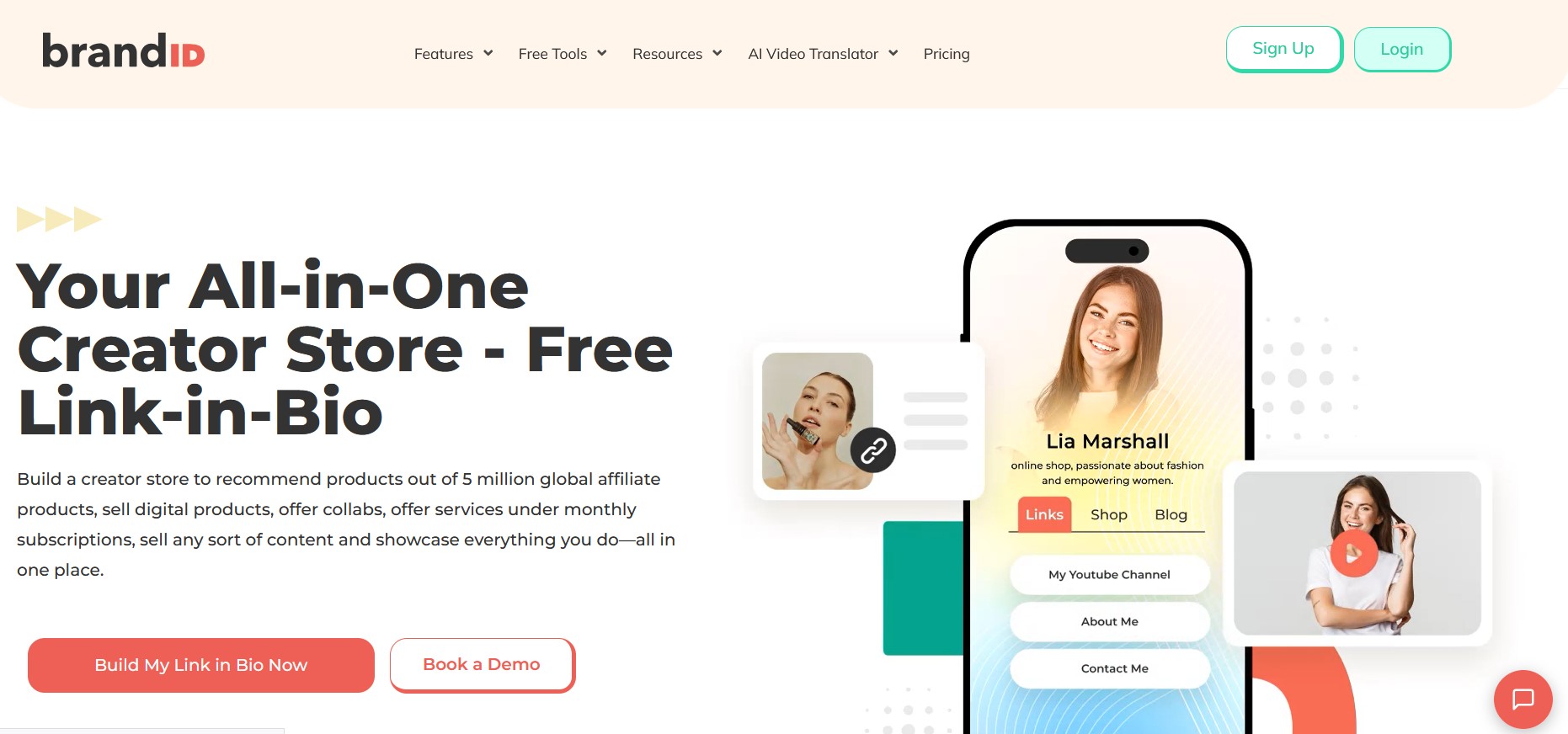
The brandID Affiliate Marketplace puts 5 million products from 2,000+ brands behind one dashboard, with collections feeding a shoppable bio page.
- Catalogue of 5M+ products from 2,000+ brands
- Average commissions up to 65%, higher with some brands
- Storefront live in minutes, no site build required
- Collections by niche, season, or campaign
- Shoppable bio page linked to individual social posts
- One dashboard across every brand you promote
- One dashboard instead of five networks
- Average commissions up to 65%
- Storefront and bio page built in
- Collections keep campaigns organised
- Turns existing social posts shoppable
- Brand coverage varies by category
- Does not replace first-party creator codes like Epic’s
- You still have to build the audience
Best For: social-first gaming creators who post clips and setups and need one shoppable destination rather than scattered links.
brandID Recommendation: start here, then add one or two specialist gaming partner programs on top for brands you review constantly. Owning the destination is what makes the rest compound. Pair it with the best link in bio tools comparison if you are still weighing where to send social traffic.
Razer
Razer designs and sells gaming laptops, keyboards, mice, headsets, chairs, and apparel, with one of the strongest brand pulls in the category. Its affiliate program hands you banners, text links, and a product feed, so you can slot recommendations into reviews without designing anything.
Commission runs 3% to 12% by category, with chairs at the top end and laptops lower. That tiering is why Razer works better as a “gaming setup” program than a single-product one: a $1,500 laptop at 5% still returns around $75, and pairing it with a chair lifts the whole cart.
The Razer gaming affiliate program pays 3% to 12%, with chairs and accessories at the top of the tier.
- Instant brand recognition with gamers
- Tiered rates reward high-value carts
- Ready-made creative assets
- Low rate on the highest-ticket items
- Heavy affiliate competition on review keywords
- Rates shift by campaign
Best For: setup tour channels, peripheral reviewers, and anyone whose audience buys gear rather than games.
Razer Recommendation: a strong default anchor program. Build around chairs and accessories where the percentage is highest, not the laptops.
Logitech G
Logitech makes peripherals, and its Logitech G sub-brand covers competitive mice, mechanical keyboards, headsets, webcams, and racing wheels. It is the safest bet in gaming affiliate marketing because return rates are low and satisfaction is high, which protects you from reversed commissions.
The program runs on Impact at 4% to 10% with a 30-day cookie. Average order value sits around $125, so a typical sale pays roughly $12.50 at the top tier. Modest per unit, which means Logitech rewards volume content: budget roundups, “best mouse for X” pages, gift guides.
Logitech G runs on Impact at 4% to 10%, with an average order value around $125.
- Very low return and refund rate
- Huge catalogue for roundup content
- Seasonal promos boost conversion
- Small commission per unit
- Rate depends on sub-brand
- Shoppers often price-check on Amazon
Best For: bloggers publishing comparison and buyer-intent content at scale.
Logitech G Recommendation: pair it with a higher-ticket brand. On its own the per-sale payout is too small to carry a channel.
SteelSeries
SteelSeries builds esports-grade headsets, keyboards, mice, and mousepads with a reputation for durability. Among gaming partner programs focused on peripherals, it carries one of the higher published rates in its class.
Expect up to 10% with a 30-day cookie via Impact. The Arctis headset line is the conversion engine: people search it by name, so your content can rank for a branded query and capture buyers who have already decided.
SteelSeries pays up to 10% on peripherals, with the Arctis headset line driving most branded search.
- Competitive rate for peripherals
- Strong branded search demand
- Credible with esports audiences
- Narrower catalogue than Logitech
- Premium pricing slows casual buyers
- Fewer high-ticket items to lift AOV
Best For: competitive FPS creators and headset review content.
SteelSeries Recommendation: worth applying to if you rank for headset comparisons. Skip it if your audience is console-casual.
Kinguin (Kinguin Mafia)
Kinguin is a digital marketplace where third-party sellers list game keys for PC, PlayStation, Xbox, and Nintendo with instant delivery. Its affiliate arm, Kinguin Mafia, is among the better-known game affiliate programs for deal-hunting audiences.
The structure is tiered: 5% base on qualifying sales, rising toward 10% in the Pro tier, which adds giveaway prizes, release intel, and custom banners. Keys are cheap, though: 5% of a $30 game is $1.50, so this only earns real money on consistent deal traffic.
Kinguin Mafia is tiered from a 5% base toward 10% in the Pro tier, so it rewards deal traffic at volume.
- Tiered rate rewards volume
- Discount pricing converts easily
- Dedicated affiliate support in Pro
- Tiny commission per transaction
- Marketplace model means variable seller quality
- Needs high volume to matter
Best For: deal channels, Discord communities, and price-tracking sites.
Kinguin Recommendation: use it as a supplementary earner behind a hardware program, not as primary income.
GameFly
GameFly is a subscription rental service for PlayStation, Xbox, and Switch titles, letting players rent, try, and buy without paying full price up front. That low-commitment offer is why it converts well from cold traffic.
It pays per lead rather than per sale, roughly $5 to $20 per signup depending on tier, with a 30-day cookie through CJ Affiliate. Lead-based payouts are the underrated corner of gaming affiliate programs: your reader never has to spend money for you to earn.
GameFly pays $5 to $20 per signup rather than per sale, one of the few per-lead gaming affiliate programs.
- Paid per signup, not per purchase
- Free-trial offer lowers friction
- Predictable payout per conversion
- Primarily a US-focused offer
- No upside on high-value carts
- Higher tiers require proven volume
Best For: console audiences and budget-gaming content.
GameFly Recommendation: excellent early-stage program. Per-lead payouts land before you have the traffic to make percentages work.
Epic Games Support-A-Creator
Support-A-Creator is Epic’s own creator program, giving you a tag players enter at checkout in Fortnite, Rocket League, and the Epic Games Store. It is closer to a creator code than a classic affiliate link, and that is its advantage.
You earn 5% on eligible in-game and store purchases with a 14-day attribution window, paid via PayPal or bank transfer. Given in-game spending hit $74.4 billion in 2025, a 5% cut on V-Bucks from a loyal audience compounds faster than the percentage suggests.
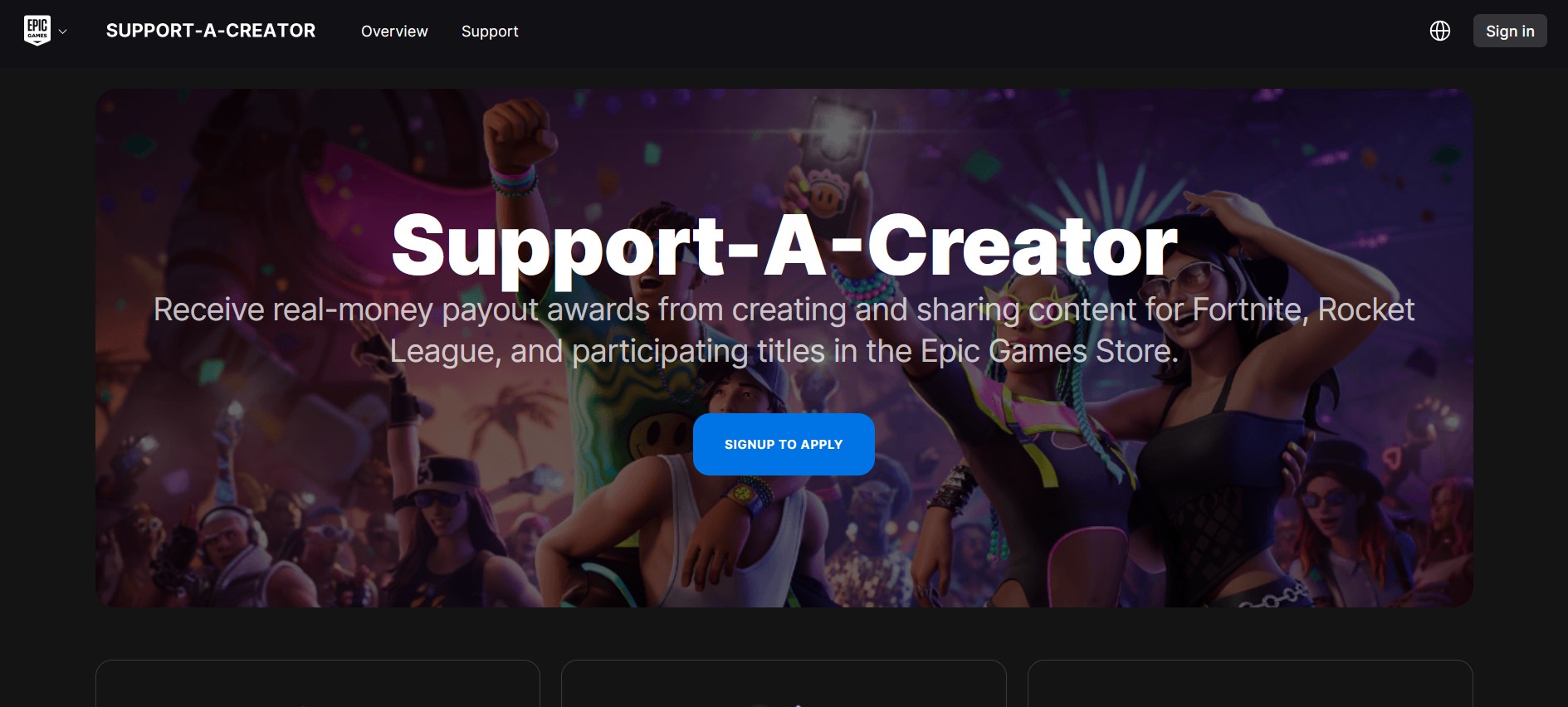
Support-A-Creator gives you a code players enter at checkout, paying 5% on eligible Epic purchases.
- Creator code is easy to remember and share
- Recurring in-game spend, not one-off sales
- Works natively on stream and in video
- Short 14-day window
- Only useful for Epic-ecosystem audiences
- Eligibility rules and terms change
Best For: Fortnite streamers, YouTubers, and TikTok clip accounts.
Epic Games Recommendation: mandatory if you cover Epic titles. The code costs nothing to add to every description.
Twitch Affiliate Program
Twitch is the live streaming platform for games and esports. Its Affiliate tier turns a channel into a revenue stream through subscriptions, Bits, and game sales from your channel page. It is the one entry here where the “product” is your own broadcast.
Qualification is the gate: you need 50 followers, eight hours streamed across seven different days, and an average of three concurrent viewers. Once in, revenue share on subs and Bits accrues continuously, which is why streamers treat Twitch as a base layer and stack gear programs on top.
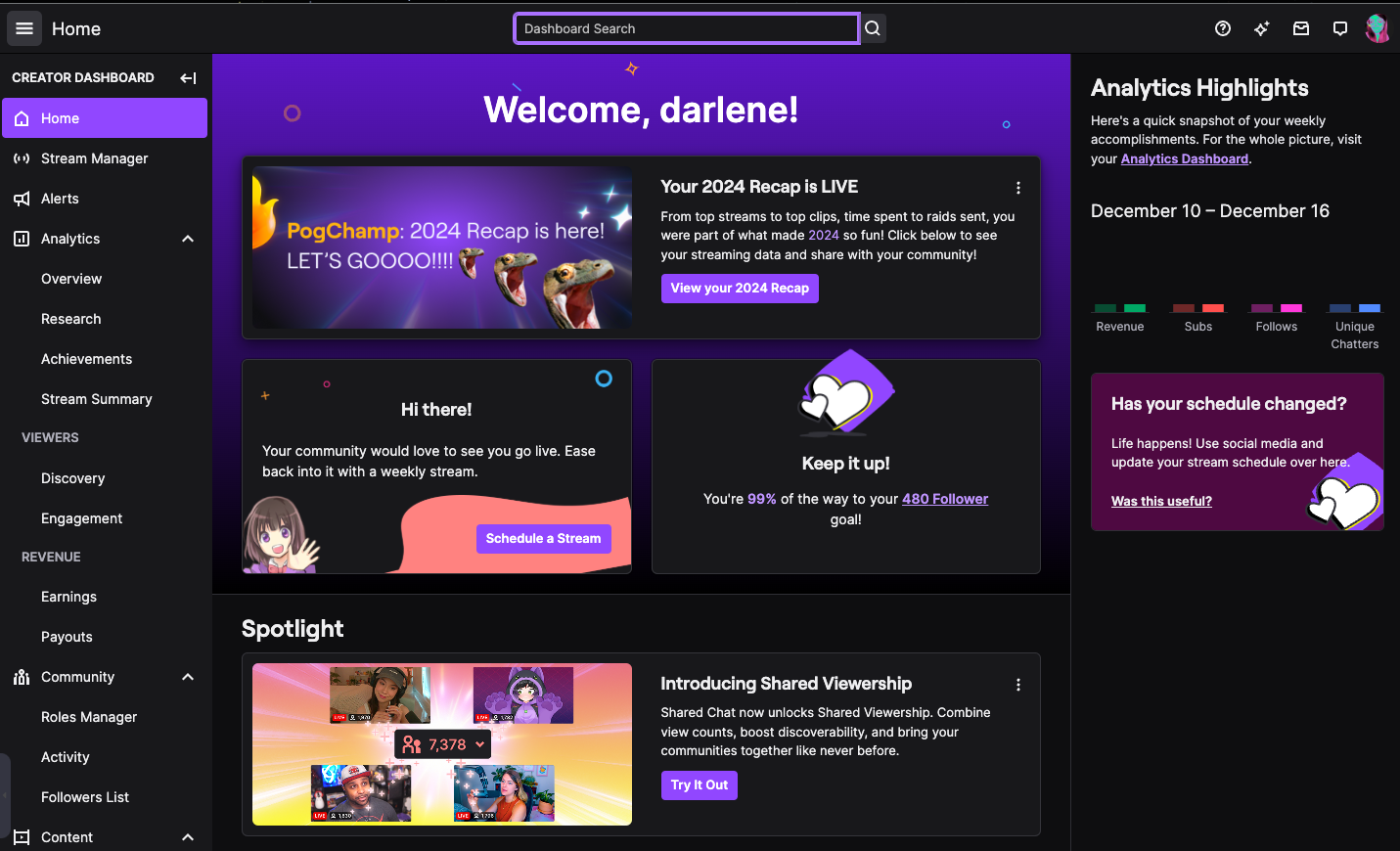
Twitch Affiliate needs 50 followers, eight hours streamed across seven days, and three average viewers.
- Recurring subscription income
- Low, achievable entry requirements
- Monetises engagement, not just clicks
- Income tied to one platform
- Needs consistent live hours
- Revenue share favours the platform early on
Best For: live streamers building a community rather than a search audience.
Twitch Recommendation: qualify first, then layer hardware links into your panels so one audience feeds two income streams.
NVIDIA
NVIDIA makes the GPUs most PC gaming builds are planned around, plus partner laptops and monitors. Its affiliate program runs through Rakuten and is the classic low-percentage, high-ticket trade.
Commission is around 2% to 5%, but the 45-day cookie is one of the longest of any video game affiliate programs, and it exists for a reason: nobody buys an $800 card on impulse. That window is what makes GPU content viable.
NVIDIA pays 2% to 5%, but the 45-day cookie covers the long research cycle behind every GPU purchase.
- 45-day cookie suits long research cycles
- Very high average order value
- Evergreen search demand every GPU cycle
- Thin commission percentage
- Stock shortages kill conversions
- Buyers often go through third-party retailers
Best For: PC build guides, benchmark content, and upgrade advice.
NVIDIA Recommendation: worth running purely for the cookie length. Treat commissions as a bonus on top of the build-guide traffic.
Zygor Guides
Zygor sells in-game leveling and questing guides for World of Warcraft, delivered as an addon that walks players through routes step by step. It is a digital product, which changes the economics entirely.
Commission is 50% with a 60-day cookie through ShareASale. On a subscription around $9.99 monthly or $99.99 yearly, one annual signup pays roughly $50, more than most hardware sales in these gaming affiliate programs return.
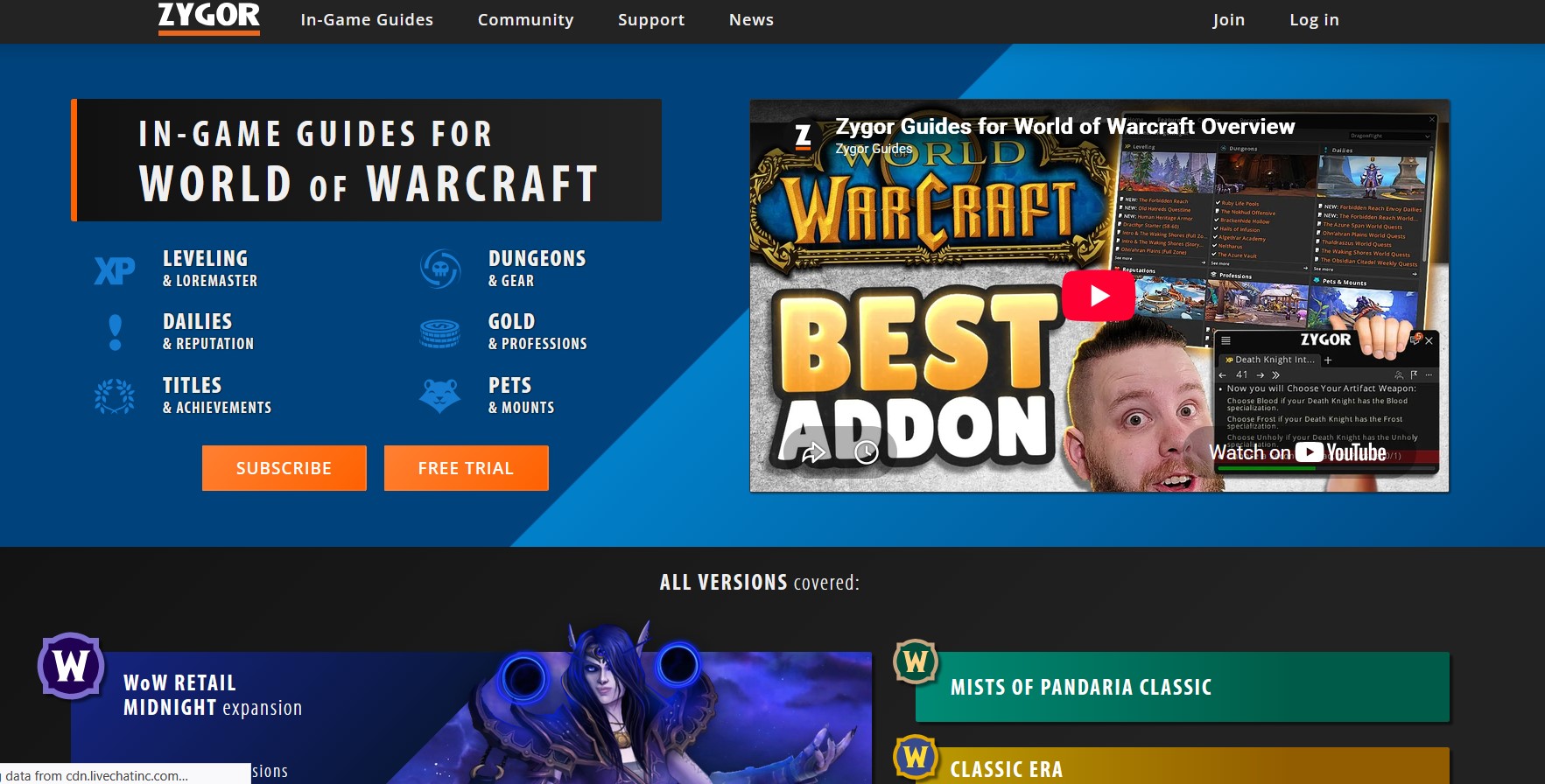
Zygor pays 50% with a 60-day cookie, the highest-margin option on this list of gaming affiliate programs.
- 50% rate, no inventory cost
- Generous 60-day cookie
- Subscription model, recurring potential
- Audience limited to WoW players
- Demand follows expansion cycles
- Free community guides compete
Best For: MMO creators and WoW-focused blogs.
Zygor Guides Recommendation: the highest margin option here. If your niche fits, prioritise it over any hardware brand.
How To Choose The Right Gaming Affiliate Program
Choose on content format and your audience’s buying window, not the headline commission rate. A 50% program is worthless if your viewers do not play that game, while a 2% program on a $1,200 GPU beats it outright when your content ranks for build guides.
Run any candidate through these four filters before you apply. They take five minutes and save months of promoting an offer that was never going to convert.
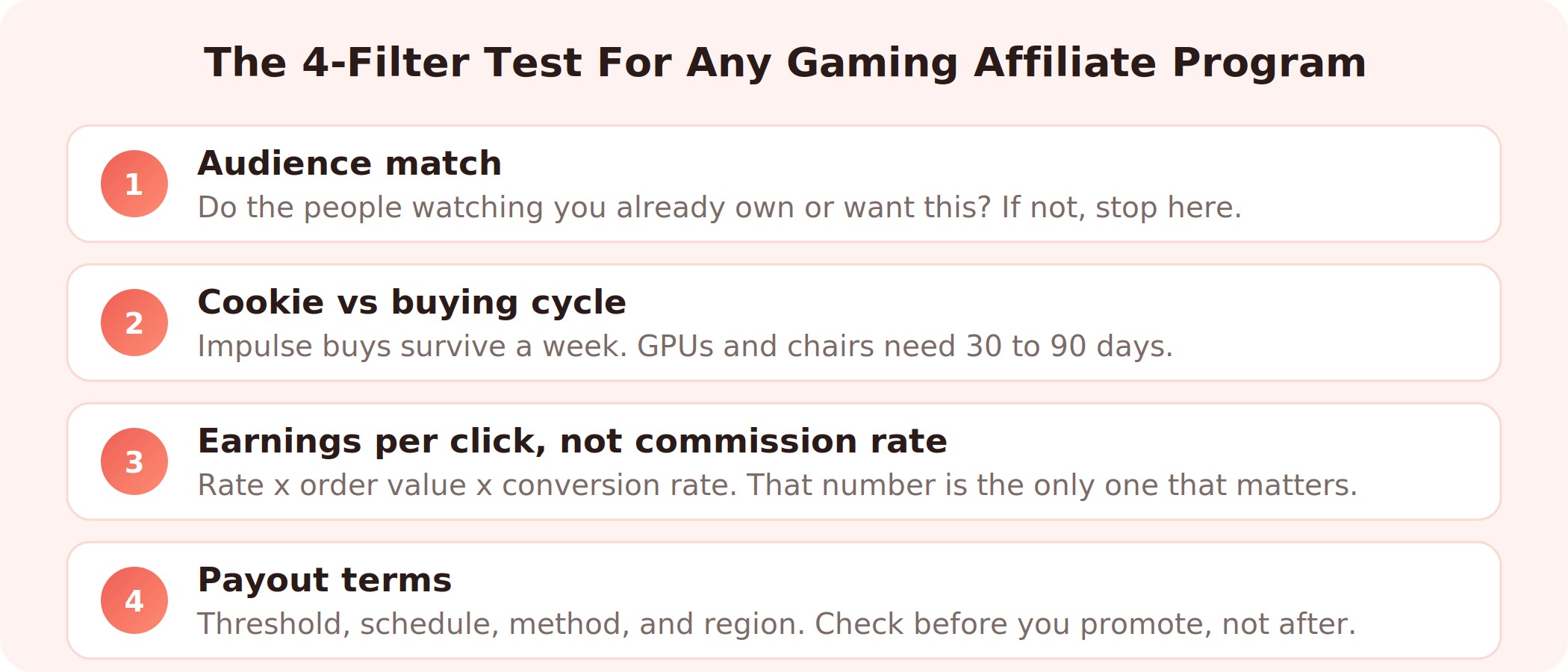
Run every candidate through these four filters in order. A program that fails the first one is not worth the application, whatever the commission rate says.
Match The Program To Your Content Format
Review blogs and build guides should lean on hardware with long cookies (NVIDIA, Razer, Logitech G), because readers arrive mid-research. Streamers and short-form creators do better with codes and rev share (Epic, Twitch), since attribution happens live rather than after a week of comparison shopping.
Community operators sitting on a Discord server occupy a third position. Deal drops and per-lead offers like GameFly convert there because the ask is small. Our breakdown of the most profitable affiliate marketing niches shows how gaming stacks up.
How To Actually Earn From Gaming Referral Programs
Getting accepted into gaming affiliate programs takes a day. Getting paid meaningfully takes a system. These moves separate creators earning pocket change from those treating this as income. If the underlying mechanics are still fuzzy, our complete guide to affiliate marketing covers tracking through to payout.
Write for the moment of purchase. “Best wireless headset under $150” outperforms “my top 10 headsets” because it matches what someone types when their card is already out.
Show the product in use. Gaming audiences detect spec-sheet regurgitation instantly. A 20-second clip of mic quality in a real match beats 500 words of feature listing.
Build one destination, not fifteen links. Send social traffic to a single shoppable page holding your whole setup. It compounds, and it survives a program changing its terms.
Track which links earn per click. Most creators know their total revenue and nothing else. Knowing that your keyboard link earns $0.40 per click while your chair link earns $0.03 tells you exactly what to publish next. For channel-specific tactics, see our guide on how to promote affiliate links across platforms.
Common Mistakes In Gaming Affiliate Marketing
The fastest way to improve results is usually to stop doing one of these four things.
- Joining ten programs in week one. Traffic splits, no program hits its payout threshold, and you earn nothing from any of them. Pick two, prove them, then expand.
- Ignoring the cookie window. Promoting a short-cookie program inside an evergreen buying guide means most of your commissions expire before the purchase happens.
- Chasing the highest percentage. A 50% cut on a $10 product loses to 3% on a $1,200 one. Multiply before you commit.
- Recommending gear you have not touched. One bad recommendation costs more trust than ten good ones build, and gaming audiences talk. Honest cons in your reviews raise conversions, not lower them, because they make the pros credible. Our affiliate marketing statistics roundup has the benchmark data behind these patterns.
Conclusion
The best gaming affiliate programs are not the ones with the biggest number attached. They are the ones where your audience, your content format, and the cookie window line up. Zygor’s 50% is meaningless without WoW players; NVIDIA’s 2% is excellent when you rank for build guides. Run the four filters, pick two programs, and give them six months of buyer-intent content before judging.
One thing separates creators who earn from those who do not: they own the destination. A storefront you control keeps working when a brand cuts its rate or shortens its cookie. The brandID Affiliate Marketplace lets you pick from millions of products, build niche collections, and make every post shoppable from your bio page.
Frequently Asked Questions
Do you need a website to join gaming affiliate programs?
Not always. Many gaming affiliate programs accept a YouTube channel, Twitch account, or an active social profile as your promotional platform. Networks like Impact and CJ usually want to see an owned property with real traffic, while creator programs such as Epic’s Support-A-Creator care more about audience engagement. A link-in-bio storefront often satisfies the “website” field on applications.
How much can a gaming affiliate realistically earn?
It depends almost entirely on traffic intent rather than traffic size. A blog with 5,000 monthly visitors landing on “best gaming mouse” pages can out-earn a channel with 100,000 casual viewers. Work in earnings per click: a peripheral program converting at 3% on a $125 order at 8% commission returns around $0.30 per click. Multiply by your realistic click volume.
Are gambling and casino offers the same as gaming affiliate programs?
No, and conflating them causes problems. iGaming (casino and betting) is a separate, heavily regulated vertical with different licensing rules, advertising restrictions, and age-gating requirements that vary by country. Video game affiliate programs covering hardware, keys, and subscriptions carry none of those obligations. Most mainstream platforms also restrict gambling promotion, so keep the two streams entirely separate.
Which gaming affiliate program pays the fastest?
Per-lead offers clear quickest because there is no return window to wait out. GameFly pays on a signup rather than a sale, so the commission locks in without a purchase. Hardware programs typically hold payouts 30 to 60 days to cover refunds. Check the minimum threshold too: Razer pays from $50 via PayPal, while others require $100 before releasing funds.
 Summarize this article with: