Apollo Review: Complete Guide to Features & Pricing
Apollo built its reputation on one promise: an entire outbound stack, a 275 million contact database, sequencing, a dialer, and a CRM, bundled into a single seat that undercuts ZoomInfo by thousands of dollars a year. In 2026, that bundle still sells, but the fine print bites. Credits expire at cycle end with no rollover, so unused balance is money forfeited.
This Apollo review cuts past the marketing to look at what you actually get for the money in 2026: the Apollo features that hold up, the pricing math the landing page downplays, Apollo user reviews that surface the friction, and the drawbacks worth knowing before you sign a per-seat annual contract. By the end, you will know whether Apollo is worth it, or whether one of the other best cold email software options (or a completely different outbound channel) would deliver more for less spend.
Key Takeaways
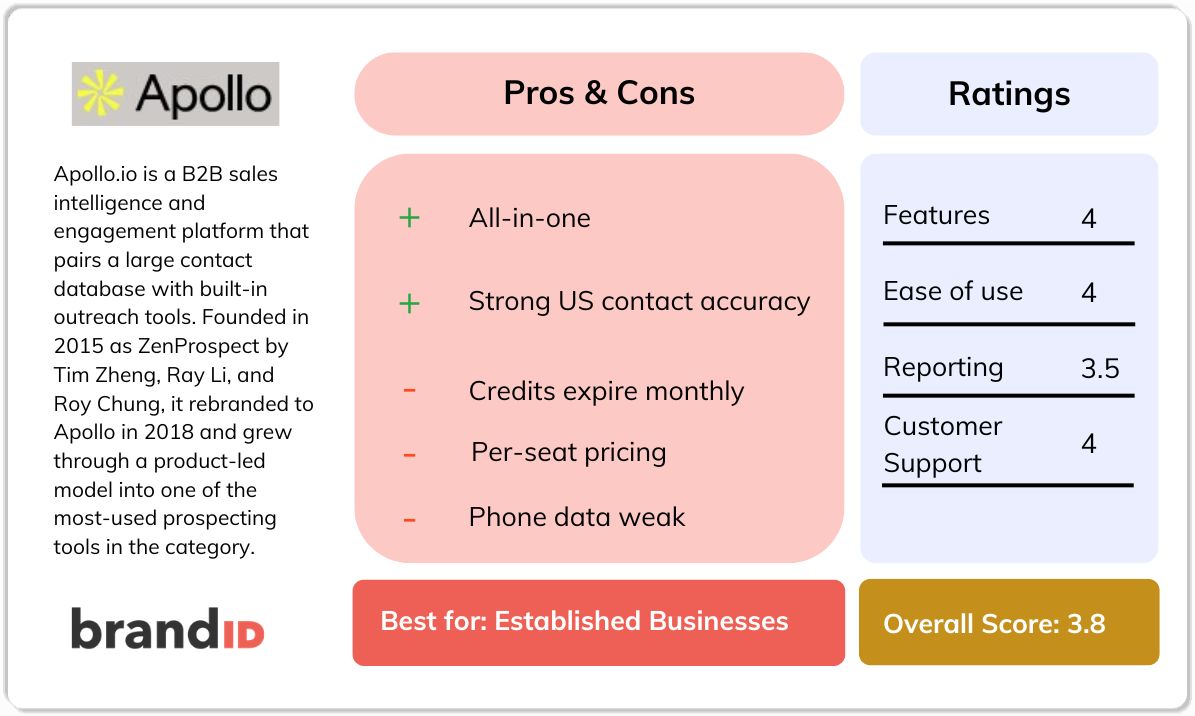
- The bundle is the value, and the risk. Apollo pricing runs $0 free, $49 Basic, $79 Professional, and $119 Organization per user per month on annual billing. One seat replaces a database, sequencer, and dialer, which is why SMBs love it and why the per-seat model stings at 5+ reps.
- Data accuracy is the recurring complaint. Independent tests put real-world email accuracy at 65 to 80 percent with 15 to 35 percent bounce rates, versus the sub-5 percent deliverability experts recommend. US data is strongest; international coverage drops to roughly 60 percent.
- Credits expire monthly. Data, mobile, and export credits reset with no rollover, and phone reveals cost roughly 8x an email reveal. Overages run about $0.20 each with a 250-credit minimum.
- The rating split tells the story. Apollo holds 4.7 on G2 across 9,400+ reviews but 2.9 on Trustpilot. G2 skews toward happy all-in-one users; Trustpilot skews toward billing disputes and bounced-email complaints.
- Match the alternative to the job. contactID for contact form outreach at 100% deliverability, Instantly for unlimited email volume, Saleshandy for bundled data plus sequencing on a tighter budget.
What Is Apollo.io?
Apollo.io is a B2B sales intelligence and engagement platform that pairs a large contact database with built-in outreach tools. Founded in 2015 as ZenProspect by Tim Zheng, Ray Li, and Roy Chung, it rebranded to Apollo in 2018 and grew through a product-led model into one of the most-used prospecting tools in the category.
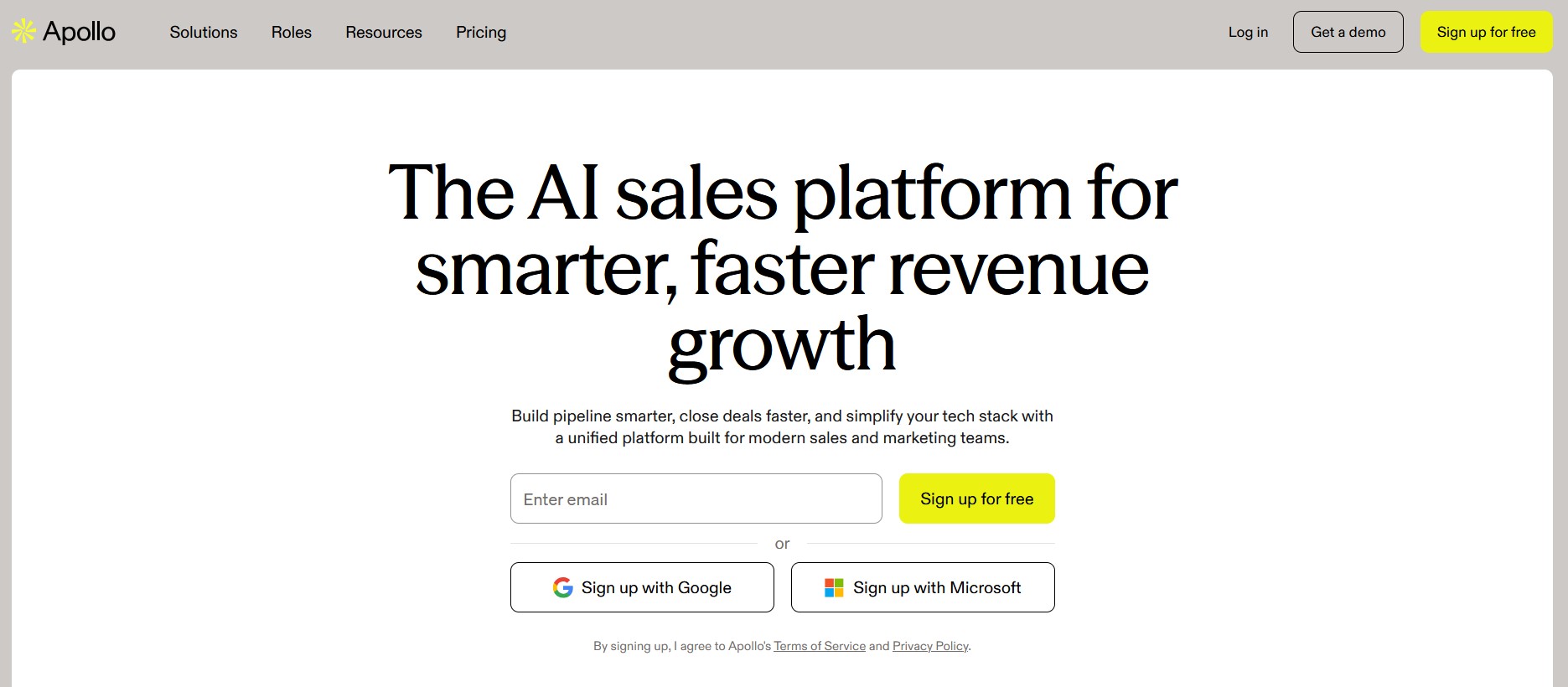
The pitch is consolidation. Instead of buying ZoomInfo for data, Outreach or Salesloft for sequencing, and a separate dialer, Apollo puts prospecting, email sequences, a phone dialer, intent signals, and a light CRM behind one login. That single-tool approach is why it dominates among startups, solo SDRs, and lean sales teams, and it shows up repeatedly in guides on lead generation for technology companies where budget-conscious teams need coverage fast.
What Apollo is not: a deliverability-first cold email platform like Instantly or Smartlead, a flawless data provider (real-world accuracy trails the headline numbers), or a fully autonomous AI SDR despite the 2026 agentic marketing.
Apollo at a Glance
Quick Facts
- Founded in 2015 (as ZenProspect) by Tim Zheng, Ray Li, and Roy Chung. Headquartered in San Francisco.
- Y Combinator W16 graduate. Reached roughly $150M ARR and a $1.6B valuation, with revenue reported up more than fivefold since, as of 2026.
- Four plans: Free, Basic, Professional, Organization. All paid plans are per-seat.
- Credits gate data, mobile lookups, exports, and AI actions. They expire each billing cycle with no rollover.
- G2 rating: 4.7/5 across 9,400+ reviews. Trustpilot: 2.9/5 across 1,000+ reviews. Capterra: 4.5/5 across 380+ reviews.
Apollo Features
Every honest Apollo review lands on the same seven or eight Apollo features. Here is what each one actually does, and where the limits show up in practice.
The 275M+ Contact Database and Filters
This is the reason most people open Apollo. The database advertises 275 million contacts across 73 million companies, filterable by title, seniority, industry, headcount, funding round, tech stack, and 60-plus other attributes. Ease of use is the top praise theme on G2, with reps building targeted lists in minutes instead of hours on LinkedIn. For US-focused SMB outbound, the price-to-database ratio has no real equal.
Email Sequences and Sequencer
The built-in sequencer is Apollo's strongest execution feature and the main reason teams pick it over a standalone database. You build multi-step email cadences with A/B testing, conditional logic based on prospect behavior, and manual task steps. Because the sequencer sits in the same tool as the database, you find a prospect, drop them into a sequence, and the emails go out without exporting to a separate platform. That workflow is genuinely smooth.
Built-In Dialer and Calling
Apollo includes a native dialer with call recording, local presence numbers, and parallel and power dialing on higher tiers. Making calls from the same screen as your contact list removes a real friction point. The US dialer unlocks on Professional; the international dialer requires the Organization plan, which forces global-calling teams straight into the top tier.
Apollo AI Assistant and AI Features
Apollo's AI stack expanded fast through 2025 and 2026. The AI Assistant reached general availability in March 2026, marketed as an agentic GTM layer that runs research, enrichment, sequence drafting, and reporting from natural language. Alongside it sit AI Research (personalized talking points per lead), AI writing for subject lines and copy, AI lead scoring, and meeting intelligence that records calls and generates summaries.
Waterfall Enrichment and Data Enrichment
Historically Apollo enriched from its own database only, which capped coverage in less-indexed markets. In 2026 it added waterfall enrichment that checks third-party sources when its own record falls short, with modes for maximizing accuracy, maximizing coverage, or staying cost-efficient. Apollo's internal numbers claim about 45 percent fewer bounces, which would move its baseline from roughly 20 percent toward 11 percent.
CRM Sync, Chrome Extension, and Integrations
Native connectors push data to HubSpot and Salesforce, with a Chrome extension for capturing prospects while you browse and a Zapier and API layer for the rest. The extension is a big part of how Apollo spread among SDRs and recruiters. Advanced API access, though, is gated to the Organization plan, so RevOps teams on lower tiers often hit a manual wall or an expensive upgrade.
Deliverability Suite and Intent Signals
Apollo's 2026 deliverability suite adds inbox placement tests across major providers and blocklist detection so teams can spot reputation risk before campaigns suffer. Intent data, sourced through partners like Bombora, flags accounts researching a topic. Both are useful additions to the bundle.
Apollo Pricing
Apollo pricing looks simple until you factor in seats, credits, and feature gates. The headline is $0 to $119 per user per month, but the credit system is where the real bill forms. Here is the honest math.
The Four Plans
- Free ($0): Around 100 credits per user per month, 2 active sequences, the Chrome extension, and basic filters. Gmail integration only. Genuinely usable for solo prospecting, but export caps and the 2-sequence ceiling push serious users to pay fast.
- Basic ($49/user/month annual, $59 monthly): Higher credit allocation, unlimited sequences, advanced filters, CRM integration with HubSpot and Salesforce, and email tracking. No dialer, no AI writing. Best for a solo seller or lean team starting to scale.
- Professional ($79/user/month annual, $99 monthly): Everything in Basic plus the US dialer with call recording, AI-assisted email writing, A/B testing, advanced reporting, and multiple mailboxes. This is where most growing teams land.
- Organization ($119/user/month annual, $149 monthly, 3-seat minimum): Everything in Professional plus the international dialer, advanced API access, custom reports, and higher credit ceilings. Global-calling or RevOps teams are effectively forced here.
Hidden Costs That Change the Real Bill
Because bounce rates run high, many teams bolt on a third-party verification tool at $50 to $200 per month to scrub Apollo data before sending. Feature paywalls (intent, international dialing, advanced API, custom reports) push teams to upgrade within months. And auto-renewal with a 60-day cancellation-notice requirement catches teams that assumed they could leave on short notice.
The Real Monthly Cost by Setup
| Setup | Real Monthly Cost |
|---|---|
| Solo prospector, Free plan | $0 (until credits run out in week one) |
| Solo seller, Basic, annual billing | $49 to $120 (with overages and verification) |
| 5-rep team, Professional, annual | $395 to $1,000 ($4,740 to $12,000/year) |
| 5-seat team, Organization, annual | $595+ ($7,140/year minimum before overages) |
| Active team, all-in with verification tools | $150 to $400 per user per month |
Apollo User Reviews: What Real Customers Say
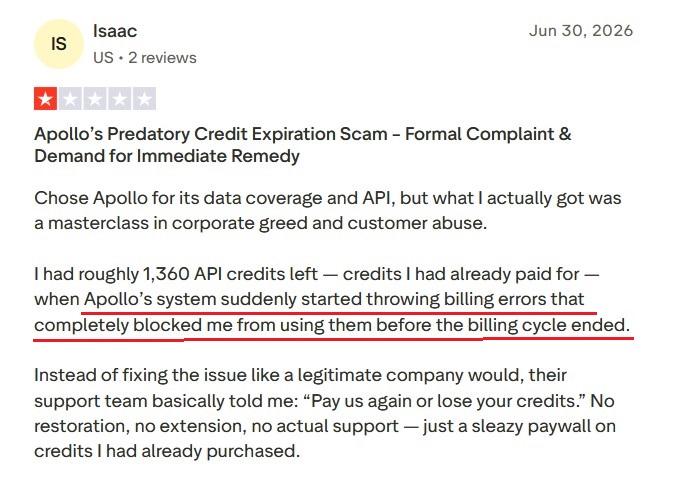
Trustpilot sits at a dismal 2.9, and the reviews driving that score read like warnings: billing disputes, sudden account suspensions, and contact data that falls apart the moment a campaign goes live. The complaints capture what happens after the first invoice and the first bounce report.
The frustration in negative reviews is not about a missing feature. It is about a product that fails at its core promise. The most common issues customers report:
1. Credits That Vanish at Month-End
No rollover, surprise overage charges in subsequent months, and a system many describe as engineered to force plan upgrades.
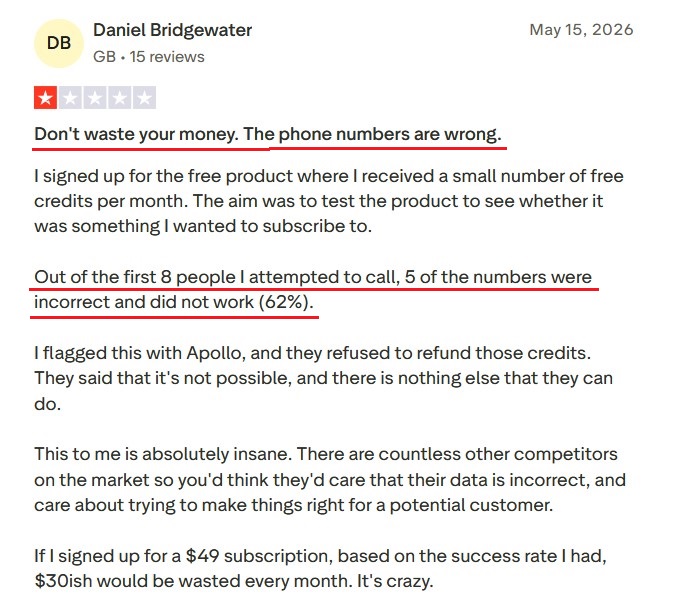
2. Wrong Phone Numbers
Some of the reviews mention that the numbers are wrong and there is no return call or results.
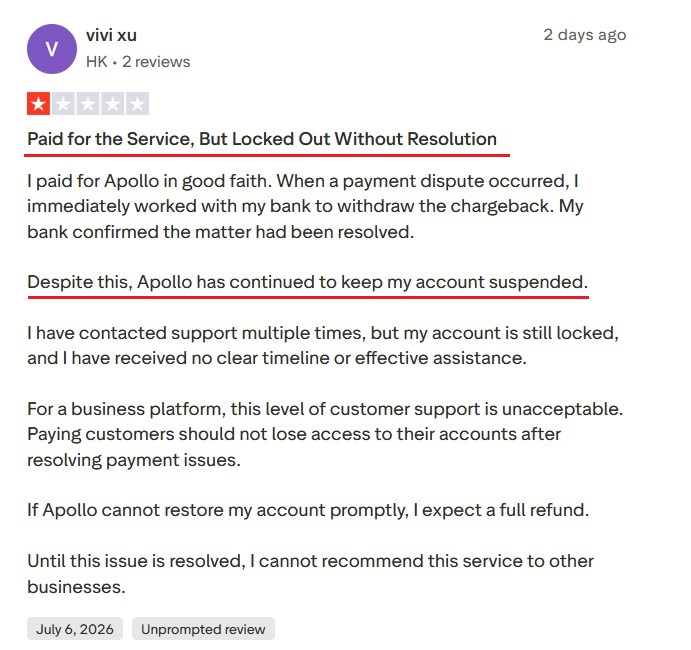
3. Account Suspensions Without Warning
Paying customers report being locked out mid-campaign with slow or unresponsive support afterward.
The pattern is hard to unsee. The complaints are about trust. Speed means little when the list you built in fifteen minutes bounces hard enough to burn your sender reputation, and consolidation loses its appeal when the consolidated bill keeps growing through credit overages you never agreed to.
Apollo Pros and Cons
Rolling up hands-on testing plus verified user reviews across G2 and Trustpilot, here are the Apollo pros and cons that actually matter for a purchase decision.
Apollo Pros
- Best price-to-database ratio in the category
- All-in-one: data + sequencer + dialer + CRM
- Genuinely usable free tier for testing
- Fast, deep filters and easy onboarding
- Strong US contact accuracy (around 88%)
- Active 2026 roadmap (AI, waterfall, deliverability suite)
Apollo Cons
- Real-world accuracy 65 to 80%, bounces 15 to 35%
- Credits expire monthly with no rollover
- Per-seat pricing scales badly past 5 reps
- International data drops to roughly 60%
- Phone data weak; AI is draft-and-approve, not autonomous
- Trustpilot flags billing and cancellation friction
contactID: The Best Apollo Alternative for B2B Outreach
Most Apollo alternatives just swap one contact database for another, so you inherit the same bad-email problem. contactID takes a different path, delivering your message through the one channel every business monitors: the “Contact Us” form on their own website.
contactID (formerly ContactUs AI) is brandID's AI contact form automation platform. You hand it target domains, a sender profile, and a prompt, and the AI finds each form, writes a tailored message, clears the CAPTCHA, and submits, so every successful send reaches a human with no bounce risk. See the brandID guide to AI contact form automation tools for how it compares.
contactID Key Features
contactID is a focused tool, so its feature set maps cleanly onto the outreach job rather than sprawling across a data-plus-sequencer bundle. Here is what it actually ships.
AI Form Detection and Field Mapping
The AI reads each website's contact form, identifies every field, and maps your details to the right place, including custom-coded and multilingual forms other tools choke on.
Automatic CAPTCHA Solving
reCAPTCHA, hCaptcha, and image challenges are cleared automatically at a 99%+ solve rate. You never see a CAPTCHA, and submissions do not stall on them.
Per-Site AI Message Generation
Instead of one templated blast, the AI writes each message from the context of the individual website using your prompt, so every submission reads like it was written for that business.
Bulk Runs up to 400 Domains
Upload a target list and process up to 400 domains per run. No per-seat limits gate volume, so a whole team shares the same throughput.
Sender Profiles and Custom Prompts
Save a reusable sender identity and outreach prompt (including a subject line), then reuse it across campaigns to keep messaging consistent without rewriting each time.
Apollo vs contactID
| Feature | Apollo | contactID |
|---|---|---|
| Starting Price | $49/user/month annual (per seat) | Pay-per-success (free to start) |
| Deliverability | 15 to 35% bounce rate (independent tests) | 100% by design |
| Data accuracy dependency | Yes (65 to 80% real-world) | None (no scraped emails) |
| Per-seat pricing | Yes (every rep is a new subscription) | No (priced per delivered submission) |
| Credit expiration | Monthly, no rollover | No credit system |
| CAPTCHA handling | N/A (email-based) | 99.9% automatic solve rate |
| Bulk submission | Yes (via email volume) | Yes (up to 400 domains/run) |
| Global reach | Strong in US, ~60% outside North America | Global, any language |
Other Apollo Alternatives Worth Considering
If you are staying inside the email and database channels, here are the three strongest Apollo alternatives to shortlist in 2026, each covered in more depth in the brandID roundup of B2B sales tools.
1. Instantly.ai
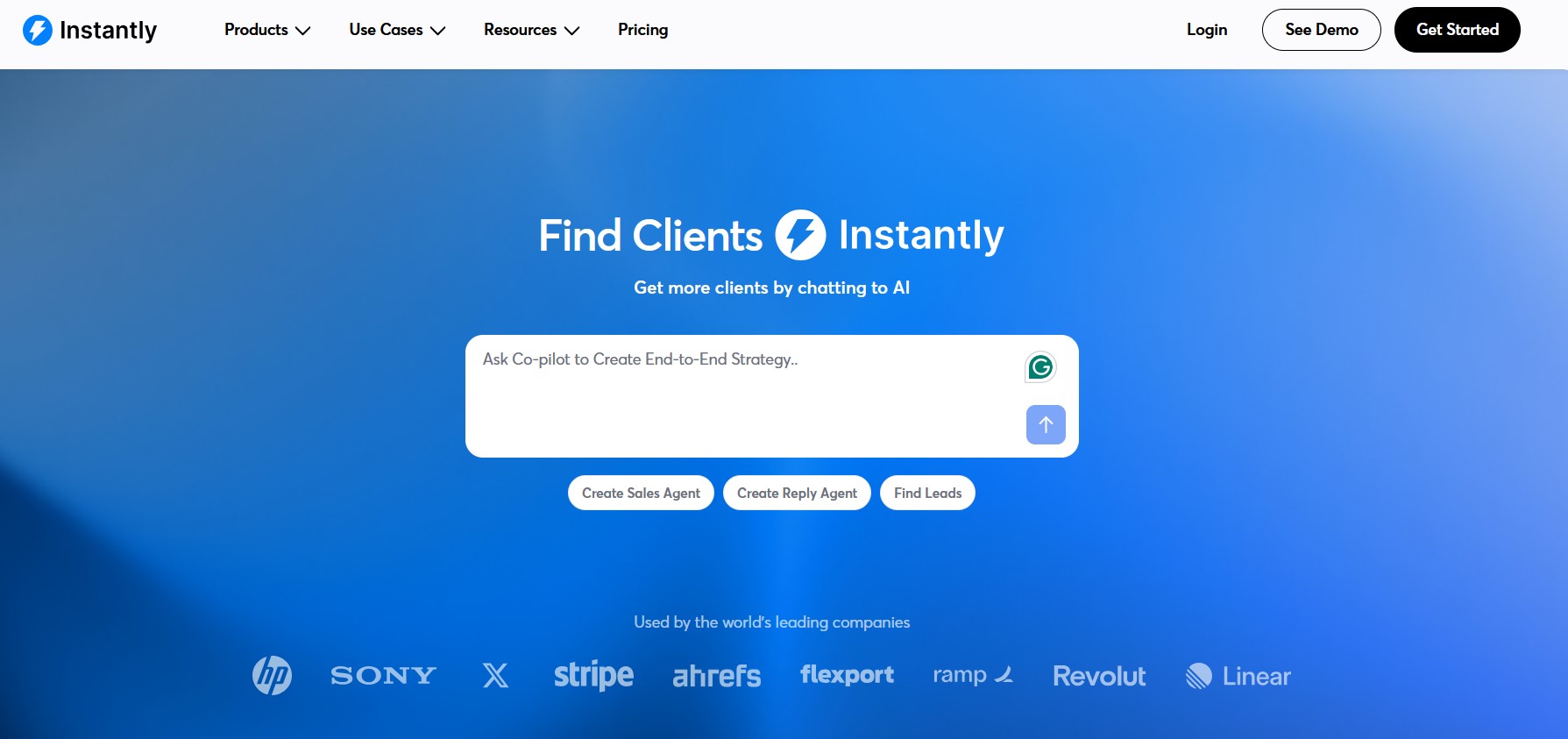
Instantly.ai is the strongest Apollo alternative for teams that want deliverability-first cold email on a flat fee instead of per-seat pricing. It ships unlimited email accounts and unlimited warm-up on every paid plan, plus Unibox for unified replies, which is exactly the deliverability infrastructure Apollo's generalist bundle underinvests in. For high-volume senders tired of Apollo bounces, this is the obvious first test.
- Best For: High-volume email teams scaling across domains without per-rep costs.
- Pricing: Growth from $37.60/month annual, Hyper Growth $77.60/month. A separate Instantly Credits subscription (from $9/month) powers the AI agents and SuperSearch data.
- Trade-off: The contact database is a separate credit line, and the tool is a volume "cannon," not a data-first platform. If you need Apollo\u2019s deep firmographic filtering, this is a narrower tool.
2. Saleshandy
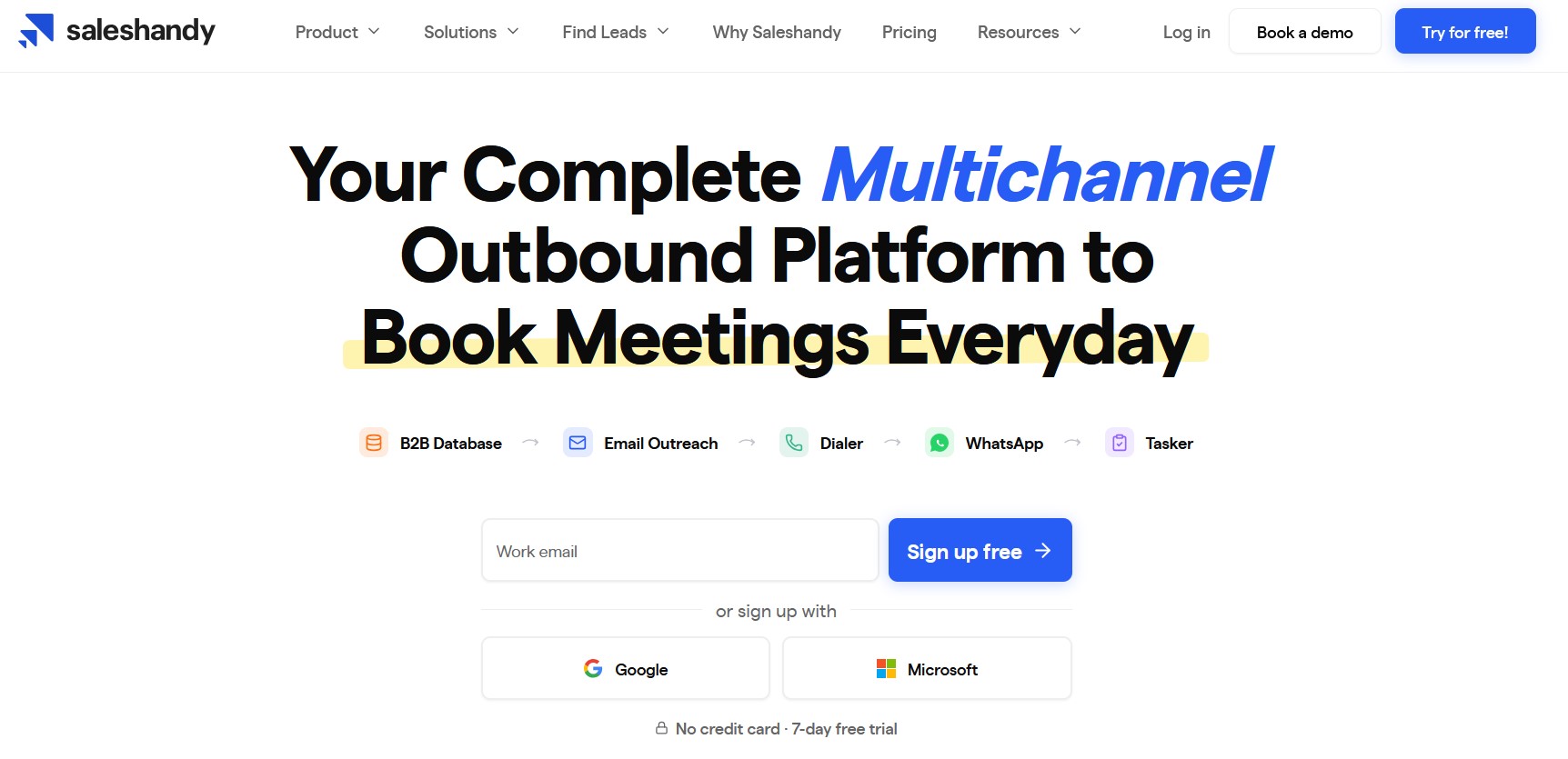
Saleshandy is the closest like-for-like Apollo alternative for teams that want a database plus sequencing bundle at a lower entry point. It ships unlimited email accounts, unlimited warm-up, a large lead database, and an outbound CRM on the base plan, without Apollo's separate metered-credit friction on every send. For solo operators comparing Apollo Basic to a bundled option, the value gap is real.
- Best For: Solo founders and small teams on tight budgets who want everything in one bill.
- Pricing: Starts around $25/month billed annually, with a free trial and starter leads included.
- Trade-off: No native dialer depth or intent signals to match Apollo's Organization tier, and data coverage is narrower than Apollo's 275M database.
3. ZoomInfo
ZoomInfo is the Apollo alternative for enterprise teams where data accuracy outranks price. Its verified contact and intent data typically tests cleaner than Apollo's single-source database, especially for direct dials and larger accounts. Teams that got burned by Apollo bounce rates and can absorb the cost often move up to ZoomInfo for the accuracy alone.
- Best For: Mid-market and enterprise teams that need the highest possible match rate and can budget for it.
- Pricing: Custom, sales-led, typically running into five figures annually, far above Apollo's public tiers.
- Trade-off: Cost is the whole story. It is many times more expensive than Apollo, with annual contracts and less pricing transparency, which is exactly why SMBs chose Apollo in the first place.
Conclusion: Is Apollo Worth It in 2026?
Apollo is a capable, affordable all-in-one platform. The 275M contact database with deep filters, a sequencer, a dialer, and a light CRM under one login is a real advantage for a solo SDR or a lean team that wants to skip managing five tools. For US-focused SMB outbound on a budget, Apollo earns its place on the shortlist, and the free tier makes it low-risk to try.
But the credit system pushes upgrades faster than teams expect, per-seat pricing does not scale kindly past 5 reps, and real-world data accuracy of 65 to 80 percent produces bounce rates that can quietly damage your sender reputation. For most teams asking whether Apollo is worth it in 2026, the honest answer is: yes for cheap US email prospecting, with a verification tool bolted on. If contact form outreach could reach the same prospects at 100 percent deliverability with no bounce risk and no per-seat fee, that is the arithmetic worth running first.