You may have wondered how some trainers earn over $50K per month online, while others struggle to find a single client. The difference is rarely who looks fitter. It comes down to knowing how to sell fitness programs online as a real product, with a clear niche, a strong offer, and a simple system to convert strangers into buyers.
Selling digital products like fitness programs has nothing to do with being more muscular. It is about having:
- A clear niche
- A program packaged as a transformation, not just a list of exercises
- A relatable message and a simple sales system
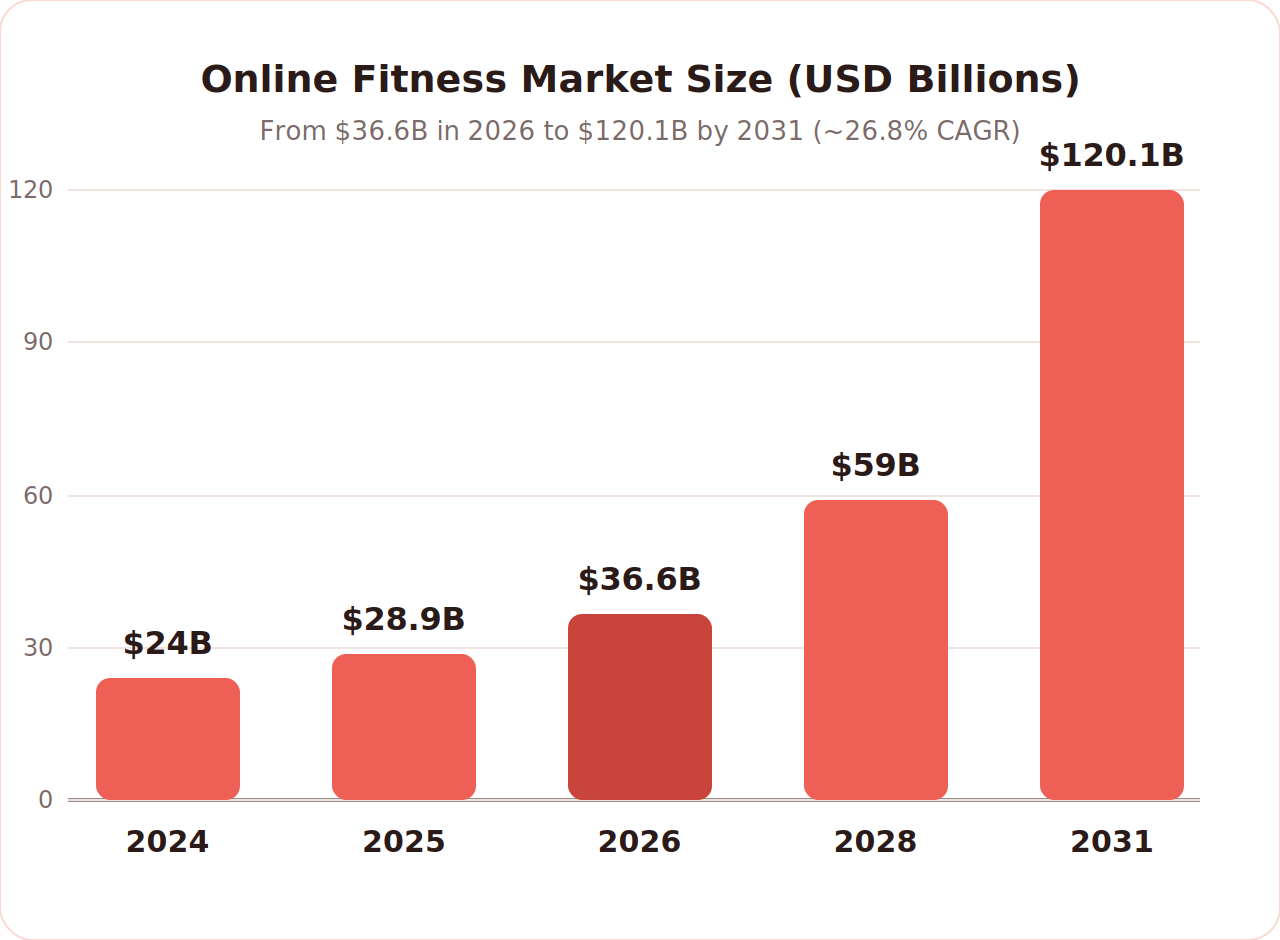
The timing has never been better. The online fitness market is worth USD 36.6 billion in 2026 and is projected to reach USD 120 billion by 2031, growing nearly 27% a year, so demand for well-packaged programs is climbing fast.
In this guide, you will learn exactly how to sell fitness programs online, from choosing a niche and packaging your program to pricing, launching your storefront, marketing it, and turning followers into paying clients.
Key Takeaways
- Sell a transformation, not workouts: Package your program around a clear outcome and timeframe, then price it on value
- Pick a niche and a scalable model: Define a specific audience, choose one-time, membership, or hybrid, and use an easy platform
- Market with free content and a funnel: Attract with SEO and short video, capture emails, nurture, then convert with proof
- Recurring beats one-time: Memberships compound: 200 members at $49 is roughly $9,800 in monthly recurring revenue
The Online Fitness Market in 2026 (Why Now Is the Time)
Before the how-to, look at the opportunity. Online fitness has moved from a pandemic workaround to a permanent, fast-growing industry, which is exactly why now is a smart time to sell fitness programs online.
- The online fitness market is valued at USD 36.6 billion in 2026 and forecast to hit USD 120 billion by 2031, a 26.8% CAGR.
- The broader sector has grown roughly 5X since the pandemic and is projected to reach USD 59 billion by 2027.
- On-demand content is the fastest-growing segment, and monthly subscriptions already drive over half of virtual fitness revenue.
- 86% of Gen Z and 81% of Millennials exercise or want to, and they reach for digital tools first.
What Is an Online Fitness Program?
An online fitness program is a structured workout or training system delivered over the internet, letting people access routines, coaching, and guidance from anywhere. Some are one-size-fits-all; others are highly personalized plans built by a trainer around individual goals. In practice, an online program can be a downloadable PDF, a video course, an app-based membership, or one-on-one coaching over video, and most trainers who sell fitness programs online eventually combine a few of these.
How to Package Your Fitness Program
Here is the mistake that keeps most trainers invisible: they sell "a workout plan" instead of a transformation. People do not buy exercises, they buy an outcome. "12-Week Body Recomp System" sells far better than "Workout Plan," even if the exercises are identical, because the name promises a result.
Before you sell fitness programs online, decide on the format that matches your audience, your skills, and how fast you want to launch. You do not need Hollywood production to start.
| Format | What it includes | Typical price | Reality check |
|---|---|---|---|
| Downloadable PDF or spreadsheet | A 4, 8, or 12-week plan with sets, reps, progressions, and swaps | $27 to $97 | Fastest to create, one-time revenue with no retention |
| Structured video course | Video instruction, progressive programming, and nutrition guidance | $197 to $497 | Sells a full transformation, higher perceived value |
| Membership or subscription | New monthly workouts, community, and live Q&A on an app or portal | $29 to $99/month | Recurring revenue and the most stable income |
| 1-on-1 online coaching | Custom plans, check-ins, and accountability for premium clients | $150 to $600/month | Highest margin per client, but limited by your time |
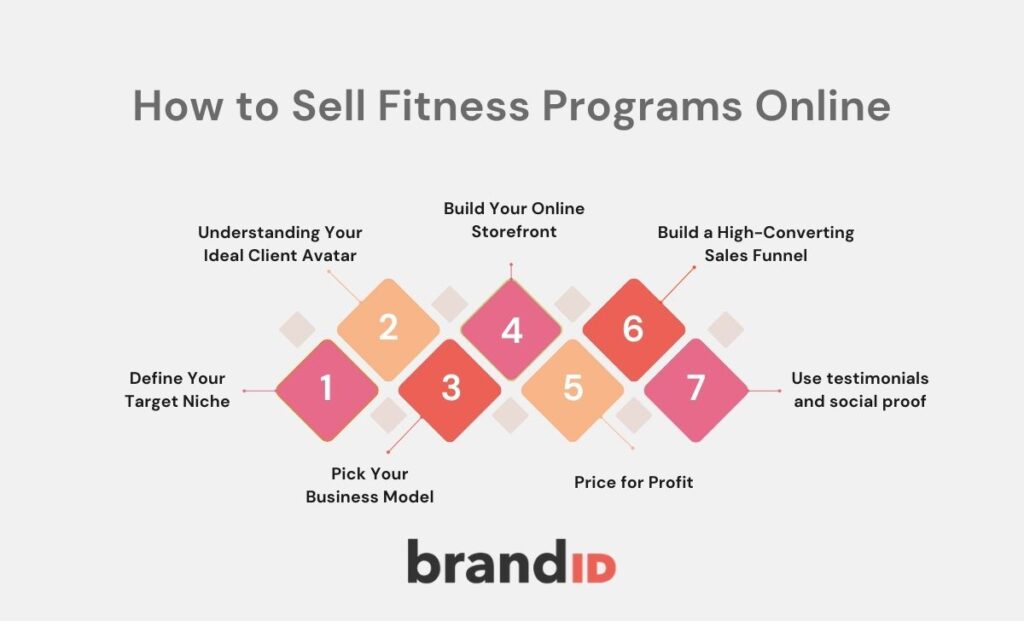
How To Sell Fitness Programs Online in 7 Steps
With your format chosen, here is the step-by-step system to sell fitness programs online, each step with concrete examples you can copy.
1. Define Your Target Niche
Targeting everyone is unrealistic. Instead, narrow your focus to a specific group who share goals and characteristics. Segment your ideal customers by their demographics (age, gender, location, income), psychographics (values and motivations), and behavior (what they have tried and where they get stuck).
A smaller niche is not a smaller opportunity. The trainers who sell the most fitness programs online usually own a narrow lane. Household names prove it: Kayla Itsines built a global business from one downloadable guide (the Bikini Body Guide, which became the Sweat app), and many postnatal and strength coaches quietly earn six figures by serving one audience deeply.
| Niche | Who it serves | How to win it |
|---|---|---|
| Pre and postnatal fitness | New and expecting moms wanting safe, guided workouts | A pre/postnatal certification builds instant trust |
| Strength for over-50s | Older adults focused on mobility, bone density, and independence | Low-impact progressions and clear form cues matter most |
| Injury recovery and rehab | People rebuilding after knee, back, or shoulder injuries | Reference or partner with physical therapy guidance |
| Busy professionals | Time-poor workers who need 20-minute, equipment-light routines | Sell convenience and consistency, not intensity |
| Bodybuilding and hypertrophy | Lifters chasing muscle with progressive overload | Detailed programming justifies premium pricing |
| Marathon and endurance | Runners training for a race on a fixed timeline | Periodized, calendar-based plans sell especially well |
2. Understand Your Ideal Client Avatar
Once you have a niche, get to know that audience deeply. Put yourself in their shoes to understand their pain points and daily challenges. Picture your ideal client avatar as a real person who needs what you offer, and answer five questions: who are they, what do they want, what have they tried, what is stopping them, and what does success look like?
3. Pick Your Business Model
Choose an approach that fits your strengths and your clients. Each model has a different income profile, so start with one and layer on others as you grow.
| Model | What you deliver | Typical price | Reality check |
|---|---|---|---|
| One-time sales | A PDF or video series for a fixed price | $27 to $199 | Easy to start, income resets each month |
| Monthly membership | Ongoing access to new workouts and community | $19 to $79/month | Predictable recurring revenue, needs fresh content |
| 1-on-1 coaching | Custom plans and accountability | $150 to $600/month | Highest margin, capped by your time |
| Hybrid | Group plus self-guided plus limited support | $49 to $299 | Balances scale and income |
A simple growth path: start with a one-time program to prove demand, add a membership or subscription for recurring income, then open a few premium coaching spots. There are also plenty of other online business ideas worth exploring once your program is running.
4. Build Your Online Storefront
Your platform choice can speed up your growth or quietly hold it back. The fastest, simplest way to sell fitness programs online is an all-in-one creator store that handles hosting, payments, memberships, and your link in bio in one place, so you can launch in about a day instead of wrestling with tech for weeks.
brandID
brandID is a free all-in-one creator store built for exactly this. From a single dashboard you can sell digital downloads, video programs, and memberships, collect tips, and turn one link in bio into your entire storefront, with no coding, no plugins, and nothing to pay to start.
- Launch in about 24 hours, with no website or developer needed
- Sell PDFs, courses, video programs, and memberships from one place
- Built-in checkout, so there are no broken payment links or tools to juggle
- One link in bio that sends every follower straight to your offers
5. Price for Profit
Do not sell yourself short. Price on the value you provide, not the hours you spend. Check what others in your niche charge, but never price low just to look affordable, because cheap often reads as low quality in fitness. For 1-on-1 coaching, anything under $100 a month usually stretches you too thin.
Three pricing levers work reliably:
- Tiered pricing: a basic self-guided tier, a premium tier with support, and a group coaching tier.
- Gentle scarcity: "limited enrollment" or "founder's price ends Friday."
- Bonuses: meal plans, check-in calls, or habit trackers that raise value without much extra work.
A Simple Profitability Example
- PDF plan at $37: sell 50 a month and you earn $1,850, but start from zero next month.
- Membership at $49/month: 200 members is roughly $9,800 in monthly recurring revenue that compounds.
- Hybrid: a $37 plan that upsells 20% of buyers into a $49 membership blends quick cash with recurring income.
If you would also like passive income from tools you already use, promoting fitness affiliate programs for creators is a smart add-on once your audience grows.
6. Build a High-Converting Sales Funnel
A funnel is a step-by-step process that guides potential customers toward buying. Think of it like dating: you would not propose on the first date. You build trust, show value, and only then ask for the commitment. Here is what a funnel that helps you sell fitness programs online looks like stage by stage.
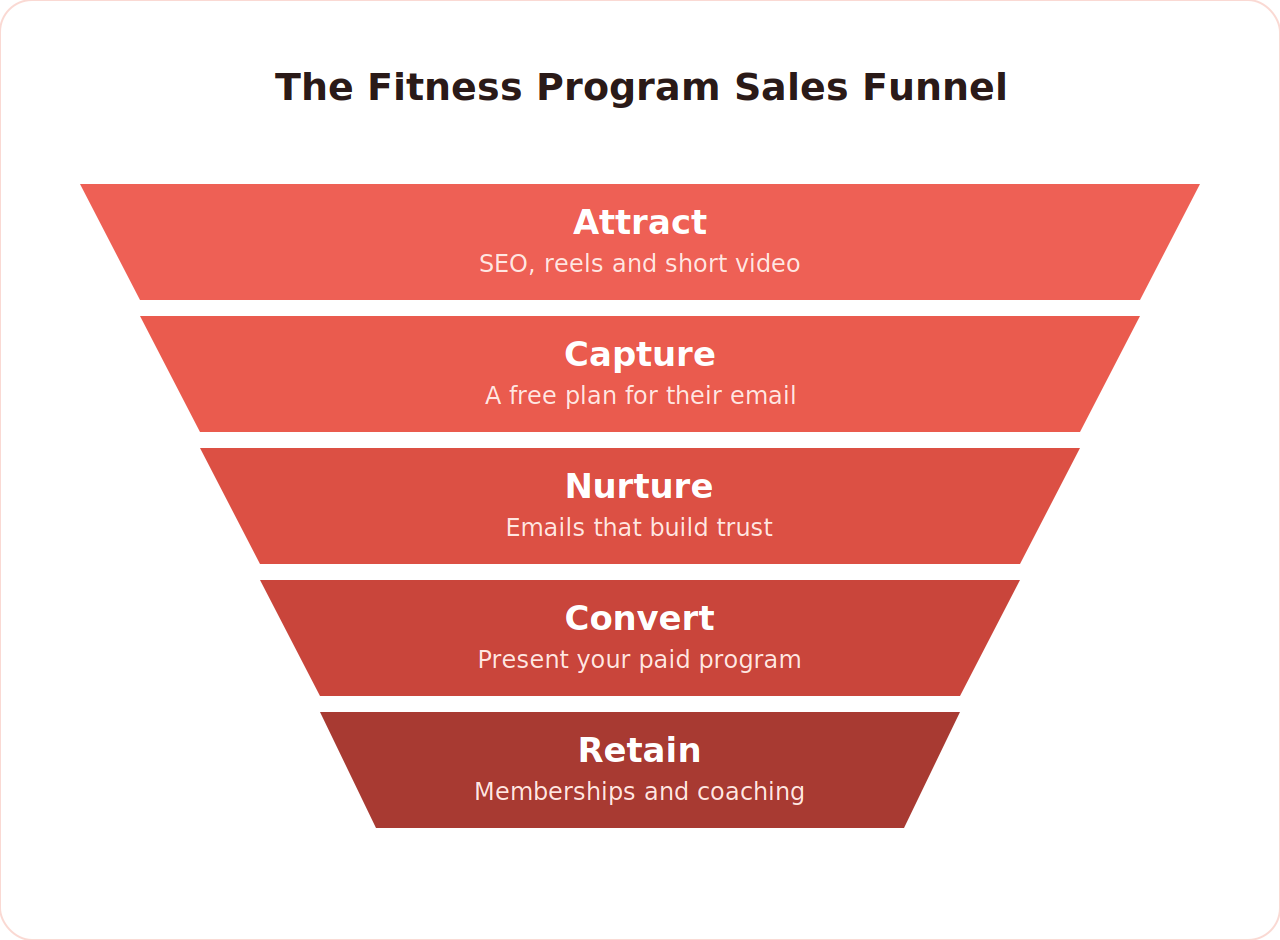
- Attract: SEO posts, reels, and short video that answer real questions.
- Capture: a free lead magnet (a 7-day plan) in exchange for an email.
- Nurture: a short email sequence with quick wins and client stories.
- Convert: a clear sales page with a promise, proof, and easy checkout.
- Retain and upsell: memberships and coaching that keep people paying.
7. Use Testimonials and Social Proof
Nothing sells like success stories. Retention is the industry's biggest challenge, with about 71% of users abandoning generic programs within three months, so visible results set you apart. Collect reviews, before-and-after photos, and short video shout-outs, then share them on landing pages, in emails, and across social media.
- Lead with real client words, not vague praise.
- Highlight specific results, like "Sarah lost 12 lbs in 8 weeks."
- Show numbers and visuals to build trust and urgency.
A simple system: ask every client for a one-line win at their 4-week and 8-week marks, plus a photo or short video if they are comfortable. Within two months you will have a library of proof that turns browsers into buyers.
How to Market and Promote Your Fitness Program
Building the program is half the job; getting eyes on it is the other half. You do not need a huge following to sell fitness programs online, you need consistent, specific content and a clear path to your offer. These channels work best.
- Create free content that builds trust. A helpful fat-loss guide or form-check reel proves your expertise, so the people who want more reach out ready to buy.
- Show up where your niche scrolls. Instagram reels, TikTok, and YouTube tutorials are the top discovery engines for fitness creators. Put your program link in every bio.
- Build an email list. Offer a free 7-day plan for an email, then nurture subscribers toward your paid program. Email consistently outsells social for conversions.
- Offer a free trial or free starter plan. Letting people experience your coaching style for a few days removes risk and warms them up to subscribe.
- Post proof, not just promotion. Before-and-after results and client wins do more selling than any ad.
Once your audience grows, you can turn attention into steady income. Here is how many followers you need to get paid on Instagram, so you know what to aim for.
Real Trainers Who Sell Fitness Programs Online
You do not have to guess whether this works. Some of the biggest names in fitness built their businesses by doing exactly what this guide describes: they packaged their training into a program and sold it online. Here is how three of them did it.
Kayla Itsines: From a PDF Guide to a $400 Million App
Kayla Itsines started as a personal trainer in Adelaide, Australia. In 2014, she and her partner packaged her workouts into a 12-week "Bikini Body Guide" PDF and sold it online. Demand exploded, so they turned the guide into the Sweat app, which grew into one of the largest women's fitness communities in the world. In 2021, they sold Sweat to iFIT for a reported $400 million. Her path, a simple downloadable guide that became an app, is the exact model in this article, just scaled up.
Jeff Nippard: A YouTube Audience Turned Into a Program Business
Jeff Nippard built a science-based bodybuilding channel with more than 8 million YouTube subscribers, then used that free content to funnel viewers into paid products. Through his program store, he sells structured training programs and guides, like his Push/Pull/Legs and body recomposition plans, for roughly $80 to $130 each. Because they are digital, he can sell the same program to thousands of lifters at very high margins. It is a textbook case of free content plus a strong paid offer.
Caroline Girvan: Free Workouts That Feed a Paid Membership
Caroline Girvan, a certified personal trainer from Ireland, began posting free follow-along programs (her EPIC and Iron series) on YouTube in 2020 and grew past a million subscribers. She then launched the CGX app with exclusive programs and nutrition for about $13 a month, or $100 a year, with a free trial. Her free YouTube library does the marketing, while the app captures the people who want more structure. It is the funnel from Step 6 in action.
Common Mistakes to Avoid
Most trainers who fail to sell fitness programs online make the same handful of mistakes. Sidestep these and you are ahead of the pack.
- Selling "workouts" instead of a transformation. Name and sell the outcome, not the exercises.
- Trying to serve everyone. A vague offer speaks to no one, so pick a niche.
- Pricing too low. Cheap signals low quality and forces exhausting volume.
- Skipping email capture. Without a list you rebuild your audience from scratch every launch.
- Ignoring retention. One-time sales reset monthly, so add a membership to compound your income.
Conclusion
Learning how to sell fitness programs online is much more than a side hustle. It is a chance to change lives while building a scalable, profitable business. The market is large and growing, the tools are cheaper and simpler than ever, and buyers are already searching for guidance like yours.
Package your expertise as a clear transformation, pick a niche and a model, price on value, drive traffic with free content and a funnel, and prove results with social proof. Do that consistently and your program becomes a reliable income stream.
Ready to launch instead of just thinking about it? Sign up at brandID and build your online fitness program in hours, not months.
Start Selling on brandID FreeFAQs
Do I Need Certification to Sell Workout Plans Online?
What Platforms Are Best for Selling Online Fitness Programs?
The best platform depends on your skills and needs. All-in-one platforms like brandID suit most trainers because they bundle course hosting, payments, memberships, and link-in-bio in one dashboard, so you can launch fast without stitching tools together.
Transactional or Subscription: Which Model Should I Use?
Both work. One-time sales are great for standalone guides, while subscriptions build steady monthly income. Many trainers use a hybrid: a low-cost entry program that upsells buyers into a recurring membership.
How Much Can You Earn Selling Fitness Programs Online?
Earnings range widely. Beginners often make a few hundred dollars a month from PDF sales, while established coaches earn five figures through memberships and coaching. A $49 membership with 200 members is about $9,800 a month in recurring revenue.
Do I Need a Website to Sell Fitness Programs?
No. You can sell entirely through an all-in-one creator store or a simple checkout link shared from your Instagram, TikTok, or YouTube bio. A full website is optional and mainly useful once you want deeper customization or an SEO blog.
How Do I Get My First Fitness Client Online?
Pick one niche, publish helpful content that answers that audience's questions, and offer a free lead magnet to collect emails. Then invite subscribers to a small, well-priced first program. Your first client usually comes from consistent, specific content plus a clear offer, not a big following.
How Do I Create a Fitness Program Worth Selling?
Package your method into a clear outcome over a set timeframe, like a 12-week plan with weekly workouts, progressions, and simple nutrition guidance. Add demo videos and progress tracking, then validate it with a few beta clients before you scale.
 Summarize this article with: