Ask ten creators how much YouTube pays for 1 million views and you will get ten different answers, from a few hundred dollars to more than thirty thousand. Both can be true. The payout swings on your niche, where your viewers live, and whether those views came from long videos or from Shorts.
Ad money is only the first layer too. The creators who earn the most from a million views add sponsorships, products, and YouTube affiliate programs on top of what AdSense pays them.
Here are the real 2026 numbers: what a million views pays by niche, why two channels with the same view count earn very different money, and how to turn those views into income that does not depend on ad rates at all.
Key Takeaways
- Short answer: how much YouTube pays for 1 million views runs from about $1,500 to $6,000 for most channels, and far more in high-value niches.
- Typical payout: a general long-form channel earns roughly $2,000 to $3,000 per million views, matching a measured median RPM near $2.30.
- Niche is the biggest lever: finance and tech can clear $10,000 to $30,000 per million, while gaming and kids content often land between $1,000 and $8,000.
- RPM is what you keep: creators take 55% of Watch Page ad revenue, so your RPM is always lower than the CPM advertisers pay.
- Audience country decides a lot: mostly US and UK viewers can earn three to five times what the same views earn from lower-rate regions.
- Ads are not the ceiling: the top earners turn a million views into affiliate commissions, products, and sponsorships, all held together on one brandID link.
How Much YouTube Pays for 1 Million Views: Short Answer
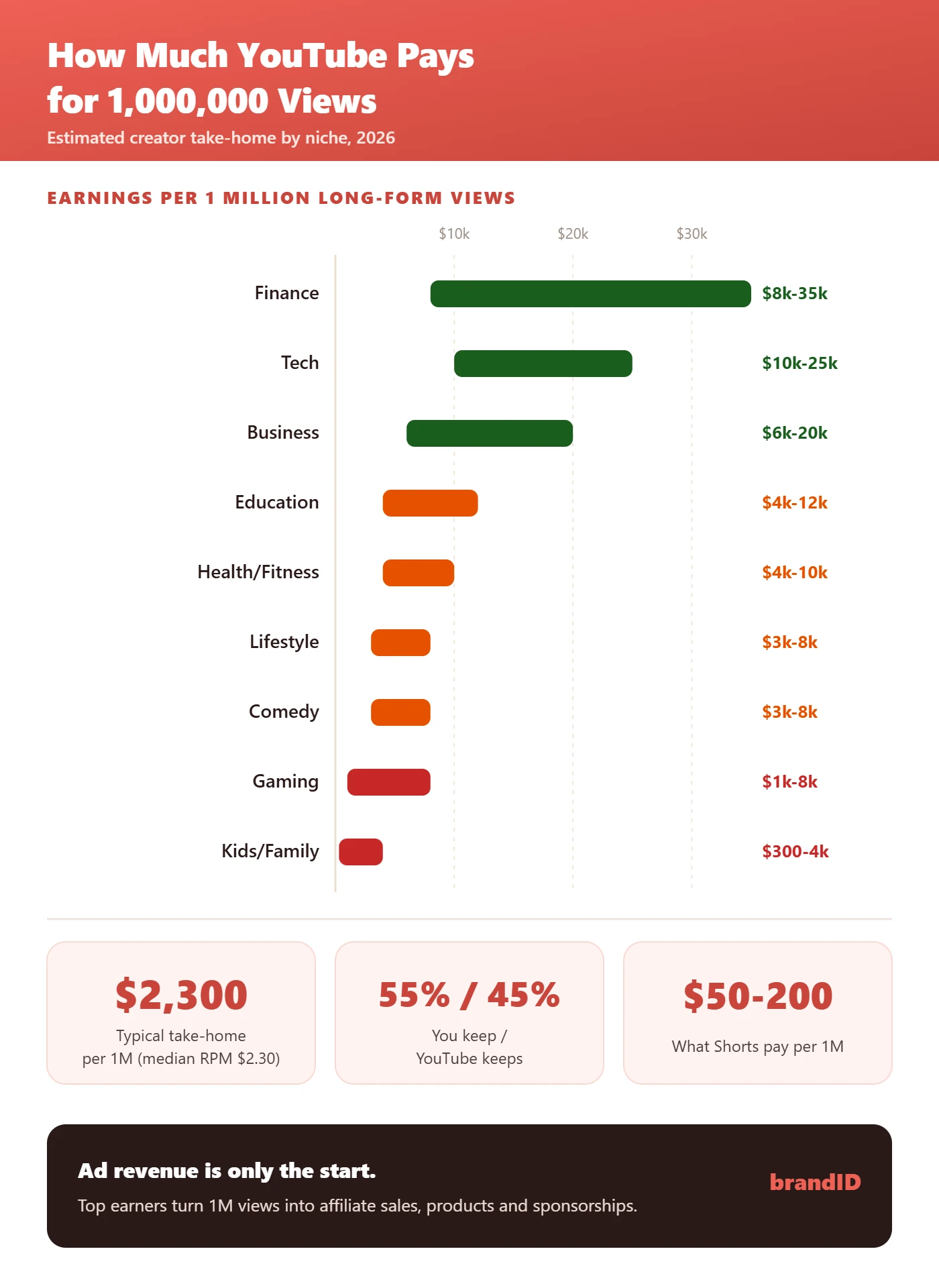
For a general long-form channel, 1 million views pays about $2,000 to $3,000. That lines up with a 2026 analysis of 300 monetized channels that found a median RPM near $2.30, meaning most creators earn roughly $2.30 for every thousand views they keep.
The spread around that number is huge, though. A finance channel with a US audience can earn ten times what a gaming channel with the same views earns. Here is how the payout typically breaks down.
| View Type | What 1 Million Views Typically Pays |
|---|---|
| Long-form, general channel | $2,000 to $3,000 |
| Long-form, high-value niche | $10,000 to $30,000+ |
| Long-form, low-value niche | $300 to $4,000 |
| Shorts | $50 to $200 |
If you want one planning figure to work from, use $2,500 per million for a typical channel, then adjust up or down based on the factors below.
RPM vs CPM: What Actually Sets Your Payout
These two numbers get mixed up constantly, and the difference is where most of the confusion about YouTube pay comes from.
CPM is what advertisers pay per 1,000 ad views. RPM is what you actually keep per 1,000 video views after YouTube takes its share and after you account for the views that never ran an ad at all.
YouTube keeps 45% of Watch Page ad revenue and pays you the other 55%. That 55% split is the one firm, official number in all of this. So a video with a $20 CPM can still leave you with an RPM near $5, because not every view showed an ad and YouTube took its cut of the ones that did.
The number that matters for your bank account is RPM, and it is the figure YouTube Studio already shows you. When a headline says a niche earns a $30 CPM, your take-home is always well below that.
YouTube Payout by Niche for 1 Million Views
Niche is the single biggest reason two creators with the same views take home very different money. The ranges below are creator-reported RPMs for 2026, weighted toward US and UK audiences, which sit at the high end of what is possible.
| Niche | Typical RPM | Est. Per 1 Million Views |
|---|---|---|
| Personal finance and investing | $8 to $35 | $8,000 to $35,000 |
| Tech and software | $10 to $25 | $10,000 to $25,000 |
| Business and marketing | $6 to $20 | $6,000 to $20,000 |
| Education and how-to | $4 to $12 | $4,000 to $12,000 |
| Health and fitness | $4 to $10 | $4,000 to $10,000 |
| Lifestyle and vlogs | $3 to $8 | $3,000 to $8,000 |
| Entertainment and comedy | $3 to $8 | $3,000 to $8,000 |
| Gaming | $1 to $8 | $1,000 to $8,000 |
| Kids and family | $0.30 to $4 | $300 to $4,000 |
One honest caveat: these are ceilings, not averages. The same 300-channel study that found a $2.30 median also found that execution inside a niche matters more than the niche itself. A sharp gaming channel with a US audience can out-earn a sloppy finance channel, so treat the table as a guide, not a promise.
Why Two Channels With 1 Million Views Earn Different Money
Views are not dollars. Five things decide how much of that million turns into real income.
1. Where Your Viewers Live
This is the biggest swing factor of all. Advertisers pay far more to reach viewers in the US, UK, Canada, and Australia. A channel whose audience is mostly in lower-rate regions can see an RPM 60% to 80% below the US baseline for the exact same content.
Here is roughly how the same video’s RPM shifts based on where most of the audience lives.
| Where Most Viewers Are | RPM vs US Baseline |
|---|---|
| United States, UK, Canada, Australia | 1.0x (baseline) |
| Western Europe and Nordics | 0.6x to 0.9x |
| Eastern Europe and Gulf states | 0.4x to 0.7x |
| Latin America and Southeast Asia | 0.2x to 0.4x |
| India and most of Africa | 0.15x to 0.3x |
2. What Advertisers Want to Reach
Topics tied to big purchases pay more because advertisers bid harder for them. A video about credit cards or software sits next to high-paying ads. A video about cartoons for toddlers does not. That is why your niche moves your RPM so sharply.
3. Video Length and Ad Slots
Videos over 8 minutes can run mid-roll ads, not just one ad at the start. More ad slots per view means more revenue per view. A 12-minute video with three mid-rolls can earn double what a 5-minute version of the same topic earns.
4. Long-Form vs Shorts
A million Shorts views and a million long-form views are not the same paycheck. Shorts pay from a shared pool and land around $50 to $200 per million, while long-form Watch Page ads pay the full rates above. Channels that went all-in on Shorts often watch their RPM collapse even as views climb, the same pattern creators saw with the TikTok Creator Fund.
5. Time of Year
Ad rates rise and fall with advertiser budgets. December RPMs can be double January RPMs because brands spend hard before the holidays and pull back in the new year. A million views in Q4 is worth more than a million views in Q1.
What 1 Million Views Earns Beyond Ad Revenue
Here is the part most pay charts skip: for a lot of creators, AdSense is the smallest slice of what a million views is worth. Once you have an audience that size, the money often comes from everything around the ads.
- Sponsorships. A single brand integration on a video with a million views can pay more than a full month of ad revenue, often $5,000 to $20,000 depending on niche.
- Affiliate commissions. Link the products you mention and earn a cut of every sale. On a million views this can quietly out-earn AdSense, especially in tech, beauty, and home.
- Your own products. Presets, templates, courses, and digital downloads sell to the exact people watching, with no revenue share taken by an ad network.
- Memberships and tips. Even 1% of a million-view audience paying a few dollars a month adds up fast and arrives every month, not once.
Worked Example
What a Single 1 Million-View Video Really Paid
Here is a realistic 2026 result for a mid-size finance creator whose video crossed a million views. Ad money is the smallest line on the page.
| Income Source | From 1 Million Views |
|---|---|
| YouTube ads | $2,500 |
| Affiliate links | $1,800 |
| Digital product sales | $1,200 |
| One brand sponsorship | $8,000 |
| Total | ~$13,500 |
Ad revenue is about 18% of the total here. The other 82% came from income the creator owns outright, which is the whole reason the setup below matters so much.
The catch is that all of this lives in different places: your sponsor links, your affiliate links, your shop, your membership page. Most creators scatter them, and viewers click away before finding the one that earns. That scattering is exactly what costs creators the affiliate money below.
brandID affiliate marketplace
Earn Commission on Every Product You Mention
brandID gives you one-click affiliate links to 5 million+ products from 2,000+ brands, with no applications, no approval wait, no follower minimum, and commissions up to 65%.
7 Ways to Earn More Per 1 Million Views
You cannot control what advertisers bid, but you can control most of what sets your take-home. These moves raise what a million views is worth without needing a single extra view.
1. Write Videos Past 8 Minutes
It unlocks mid-roll ads. Place them at natural breaks so they do not annoy viewers, and a longer cut of the same idea can earn noticeably more.
2. Aim at High-Value Topics in Your Niche
Within any niche, some topics pay more. A fitness channel earns more on a video about supplements or gear than on a stretching routine. Point your best effort at the money topics.
3. Add Affiliate Links to Every Description
If you mention a product, link it. This is the easiest income to add, and it earns on views long after the ad revenue for that video has been paid out. Creators who do this at scale organize every pick into a shop my closet page so the links keep working in one place.
4. Price Sponsorships by Your Views
A common starting point is $20 to $50 per thousand views a video reliably gets. On a video that lands a million views, that is real money, and it does not touch your ad revenue at all.
5. Sell Something That Is Yours
A preset pack, a template, a short course. You keep almost all of the price, and a million views is a large shop window for whatever you make.
6. Turn Viewers Into Members
Memberships and tips give you income that repeats every month instead of resetting with each video. It also smooths out the Q1 ad-rate dip.
7. Capture Emails So You Own the Audience
Views are rented from the algorithm. An email list is yours. Send people from a video to a page where they can subscribe, and you can reach them again for free, which matters far more than hitting a certain subscriber count. It is a better goal than chasing the raw number of subscribers you need to feel successful.
Build Your Income Hub in Minutes
Every income stream above needs a home. Scatter them across link shorteners and a messy description and viewers drop off before they reach the one that pays. Put them in one place and the same million views works harder.
That one place is a brandID page: your affiliate shop, digital products, memberships, sponsor links, email capture, and a built-in media kit to pitch brands, all behind the single link in your bio. The AI builder sets the whole thing up from a short description, so you are not fiddling with layouts for an afternoon. It stays free to start, and it is a far cleaner setup than juggling one of the many best link-in-bio tools by hand.
One link for every income stream
Describe your channel and the AI builder assembles your shop, products, memberships, and media kit into one page your viewers can actually navigate. Free to start, yours to keep.
Bottom Line on YouTube Pay for 1 Million Views
How much YouTube pays for 1 million views is a range, not a fixed number. Expect about $2,000 to $3,000 for a general long-form channel, less in gaming and kids content, and well into five figures in finance and tech, with your audience country moving the figure more than anything else.
The creators who do best stop treating ad revenue as the finish line. They write longer videos for mid-rolls, aim at topics advertisers pay for, and turn each million views into affiliate sales, products, and sponsorships. It is the same instinct pushing professionals into the white-collar creator economy: never let one income source be the only one. Control what you can, build income that does not depend on ad rates, and a million views becomes a lot more than a YouTube paycheck.
FAQs
1- Does YouTube pay monthly for views?
Yes. YouTube pays through AdSense once your balance passes $100, around the 21st of each month, for revenue earned the month before. Views earn as they happen, but the payout lands on that monthly cycle.
2- How many views do you need to start earning on YouTube?
You earn from ads only after joining the YouTube Partner Program, which needs 1,000 subscribers plus 4,000 public watch hours in a year, or 1,000 subscribers plus 10 million Shorts views in 90 days. Before that, views pay nothing from ads.
3- Do YouTube Shorts pay as much as long videos?
No. Shorts pay roughly $50 to $200 per million views, while long-form video pays $2,000 to $3,000 for a general channel. Shorts revenue is pooled and split differently from Watch Page ad revenue.
4- Why did my RPM drop even though my views went up?
RPM falls when a bigger share of views comes from Shorts, from countries with lower ad rates, or from months with weaker advertiser demand like January. More views do not raise RPM on their own.
5- Can you make a living from 1 million views a month?
In high-value niches like finance or tech, 1 million long-form views a month can pay $10,000 or more and support a full-time income. In low-RPM niches it may only pay $1,000 to $3,000, so most full-time creators add sponsorships, affiliates, and products.
6- How much do YouTubers keep after YouTube’s cut?
Creators keep 55% of net Watch Page ad revenue and YouTube keeps 45%. RPM already reflects your 55% share, so the figure you see in YouTube Studio is what you take home before tax.
 Summarize this article with: