Every book you review is a potential commission. Every “what should I read next?” comment on a Bookstagram post is a conversion opportunity. Book readers ask for recommendations more than almost any other consumer group and act on those recommendations faster, which is why book affiliate programs quietly outperform their headline commission rates in practice. A 10% cut of a $22 hardcover paid through Bookshop.org beats a 15% cut of a $10 e-book at most other retailers, and a single Book of the Month signup ($9.50) can outearn a full month of Amazon clicks on the same review.
The problem is that most book bloggers default to Amazon Associates and never look beyond it, capping earnings at a fraction of what the vertical actually pays. Ten programs are ranked below by what they realistically pay creators, with a stack strategy for whichever format runs your content: book blog, Bookstagram, BookTube, or newsletter. If you are just getting started, the pillar guide to the best affiliate programs across every niche is a useful companion read.
Key Takeaways
Key Takeaways
- Bookshop.org (10%) and Libro.fm (30% on new memberships) pay the highest commissions in the book vertical while also supporting independent bookstores, which resonates with most book-blog audiences
- Amazon Associates has the widest catalog but the shortest cookie at 24 hours and only 4.5% on physical books, so it works best as a universal fallback rather than a primary program
- Subscription programs pay flat bounties per signup, with Book of the Month at $9.50, Audible at $10 to $15 per free trial, and Everand paying similar rates that stack quickly with a subscription-friendly audience
- Cookie windows cluster around 24 hours to 30 days, with TFAW’s 60-day window standing out as the longest in the vertical for comic book affiliate programs
- Diversify across three or four book affiliate programs to cover physical books, audiobooks, e-books, and subscription boxes, since most book audiences shop across multiple formats
- Content quality matters more than follower count for approvals; most programs accept applicants with a genuine book focus and 10-20 published reviews
Best Book Affiliate Programs at a Glance
All 10 programs at a glance, sorted by category. Use this to shortlist programs that fit your traffic patterns and audience.
| Program | Commission | Cookie | Category |
|---|---|---|---|
| Amazon Associates | 4.5% on books | 24 hours | General retailer |
| Bookshop.org | 10% | 30 days | Indie bookstore |
| Barnes & Noble | 2%–4% | 24 hours | General retailer |
| Blackwell’s | 5% | 30 days | International retailer |
| Audible | $10–$15 per free trial | 24 hours | Audiobooks |
| Libro.fm | 30% new memberships + 10% purchases | 30 days | Indie audiobooks |
| Kobo | 6% on e-books | 24 hours | E-books |
| Everand (Scribd) | $5–$10 per free trial | 30 days | E-books + audio subscription |
| Book of the Month | $9.50 per new member | 15 days | Subscription box |
| Things From Another World | 5% | 60 days | Comics + collectibles |
Top 10 Affiliate Programs for Book Bloggers
The 10 programs below are grouped by category so you can jump to the section that fits your content. Programs within each category are ranked on overall value, factoring in commission rate, brand recognition, cookie duration, and how well each fits typical book blogger and reviewer audiences.
1- General Book Retailer Affiliate Programs
Broad-catalog programs that cover physical books, e-books, audiobooks, and often other formats too. These form the base layer of any book affiliate strategy because they can convert on almost any title you mention.
1- Amazon Associates
Amazon Associates is the largest book affiliate program in the world by catalog size, covering essentially every published title in print, plus Kindle e-books, Audible audiobooks, and used editions. Commission on physical books runs 4.5%, the lowest headline rate on this list, but the sheer conversion power of Amazon’s checkout flow and the site-wide commission (you earn on anything the reader buys in the same session, not just books) closes much of that gap.
The 24-hour cookie is the shortest of any major book program, so Amazon works best on high-intent content where readers click and buy within the same session. Approval is fast, the dashboard is basic but reliable, and the site-wide earnings across an audience that shops broadly on Amazon can turn even lower-traffic book content into steady income. If you have not applied yet, the Amazon Associates walkthrough covers eligibility and setup in detail.
Amazon Associates Commission: 4.5% on physical books, lower on Kindle e-books
Amazon Associates Cookie Duration: 24 hours
Amazon Associates Network: Direct (Amazon Associates)
Best For: Universal fallback link for any book mentioned, plus site-wide earnings on cross-category purchases.
2- Bookshop.org
Bookshop.org is a B Corp online bookstore that directs profits to more than 2,000 independent bookstores, making it the highest-earning ethical alternative to Amazon in the book affiliate space. Affiliates earn 10% commission with a 30-day cookie, one of the strongest combinations in book affiliate marketing programs.
The 10% rate is more than double what Amazon pays on the same books, and the platform’s independent-bookstore mission gives creators a compelling angle in reviews. Bookshop.org is US and UK focused, so international traffic converts poorly, but for creators with predominantly North American or UK audiences it consistently outearns Amazon on per-referral commission.
Bookshop.org Commission: 10% per sale
Bookshop.org Cookie Duration: 30 days
Bookshop.org Network: Direct via bookshop.org/pages/affiliates
Best For: Book bloggers, indie bookstore supporters, and creators whose audiences care about ethical shopping.
3- Barnes & Noble
Barnes & Noble is the largest US brick-and-mortar bookstore chain, with a long-established online affiliate program through CJ. Commissions run 2% to 4% depending on category, with a 24-hour cookie window. The rate is modest, but B&N carries strong brand recognition among US readers, particularly for hardcovers, curated staff picks, and exclusive editions.
Book bloggers often use B&N alongside Amazon and Bookshop.org to give readers a choice of retailer in the same review, which increases conversion rates because different readers have different retailer preferences.
Barnes & Noble Commission: 2% to 4%
Barnes & Noble Cookie Duration: 24 hours
Barnes & Noble Network: CJ
Best For: US-focused book bloggers offering readers a retailer choice, and creators covering hardcover exclusives.
4- Blackwell’s
Blackwell’s is a 145-year-old UK bookseller with free international shipping on most titles, making it the best book affiliate program for creators with UK, European, or Commonwealth audiences. The affiliate program pays 5% commission through Awin with a 30-day cookie window.
For book bloggers whose analytics show meaningful traffic outside North America, Blackwell’s often outperforms Amazon and Bookshop.org because international readers cannot easily buy from those platforms. The strong academic and literary catalog also fits well with more serious book content.
Blackwell’s Commission: 5%
Blackwell’s Cookie Duration: 30 days
Blackwell’s Network: Awin
Best For: International audiences, academic and literary content, and book bloggers with UK or European readerships.
2- Audiobook Affiliate Programs
Audiobooks are the fastest-growing format in publishing, and audiobook programs typically pay higher per-conversion bounties than physical book programs because a single subscription creates ongoing customer value.
5- Audible
Audible is the dominant audiobook platform globally, owned by Amazon and promoted through Amazon Associates. Affiliates earn $10 to $15 per free trial signup, which is a strong flat-fee bounty relative to the low friction of a free trial offer.
The 24-hour cookie is short, so Audible works best on review content where readers click and sign up in the same session. The Amazon-scale brand recognition makes conversions easier than most audiobook platforms, and the free trial offer removes the price barrier that slows other book programs.
Audible Commission: $10 to $15 per free trial signup
Audible Cookie Duration: 24 hours
Audible Network: Amazon Associates
Best For: Podcast creators, commuter-focused blogs, and book reviewers whose audience listens as much as reads.
6- Libro.fm
Libro.fm is the leading Certified B Corp audiobook platform, working with more than 4,500 independent bookshops to share audiobook profits locally. The affiliate program pays some of the highest commissions in the audiobook category: 30% on new monthly memberships, $15 on annual memberships, and 10% on individual audiobook purchases and credit bundles, all tracked through a 30-day cookie window.
For creators whose audiences already care about indie bookstore support, Libro.fm converts exceptionally well because the platform ties every purchase to a local bookstore of the buyer’s choice. The 30% new-membership rate is more than double what most audiobook programs pay.
Libro.fm Commission: 30% on new memberships, $15 on annual, 10% on purchases
Libro.fm Cookie Duration: 30 days
Libro.fm Network: Direct + Awin
Best For: Indie-supporting book bloggers, audiobook reviewers, and creators building recurring audiobook membership income.
3- E-book Affiliate Programs
These programs serve readers who prefer digital delivery. Commission percentages tend to be lower than physical books, but the instant purchase-to-delivery flow removes returns and increases conversion.
7- Kobo
Kobo is the largest global alternative to Amazon Kindle for e-books, popular in Canada, Europe, Australia, and other markets where Kindle share is smaller. As an e book affiliate program, Kobo pays 6% commission on e-book purchases through Rakuten Advertising with a 24-hour cookie window.
Kobo also carries a large audiobook catalog and sells Kobo e-reader devices, which occasionally push per-referral earnings higher when a reader buys hardware alongside e-books. The catalog covers 6 million+ titles across languages, making Kobo particularly strong for creators with international audiences.
Kobo Commission: 6% on e-books
Kobo Cookie Duration: 24 hours
Kobo Network: Rakuten Advertising
Best For: International audiences, Canadian and European book bloggers, and Kobo e-reader owners.
8- Everand (formerly Scribd)
Everand (rebranded from Scribd in 2026) is a subscription platform giving members access to an unlimited catalog of e-books, audiobooks, magazines, and documents for a monthly fee. Its affiliate program pays $5 to $10 per free trial signup, tracked through a 30-day cookie window.
Everand works particularly well on content targeting heavy readers because the subscription model appeals to people who read 5+ books a month, where per-book purchases would cost significantly more. The 30-day cookie is generous for a bounty-based program.
Everand Commission: $5 to $10 per free trial signup
Everand Cookie Duration: 30 days
Everand Network: Impact
Best For: Content aimed at heavy readers, subscription-comparison posts, and multi-format review blogs.
4- Subscription and Comic Book Affiliate Programs
Specialty programs covering monthly subscription boxes and the comics category. Both pay well because the customer relationships they create are longer-term than one-off book purchases.
9- Book of the Month
Book of the Month has been curating hardcover subscription picks since 1926, and its affiliate program is one of the top-paying opportunities for book bloggers today. Affiliates earn $9.50 per new member signup through CJ, with a 15-day cookie window.
The subscription box model creates a strong content angle for reviewers: monthly BOTM selection posts have become a staple format on book blogs and Bookstagram, generating consistent recurring affiliate revenue every time the new month’s picks drop. Combined with promo codes for first-month discounts, Book of the Month often converts at higher rates than any other book program.
Book of the Month Commission: $9.50 per new member signup
Book of the Month Cookie Duration: 15 days
Book of the Month Network: CJ
Best For: Book bloggers, Bookstagrammers, and BookTubers publishing monthly picks content or subscription reviews.
10- Things From Another World (TFAW)
Things From Another World is the leading specialty retailer in the comics space, carrying comics, graphic novels, manga, collectibles, and pop-culture merchandise. The affiliate program pays 5% commissions with a 60-day cookie window, the longest in the book vertical.
The long cookie is especially valuable for comics content because subscription pull-list buyers and collectors often browse for weeks before committing. TFAW is the go-to program for creators covering comics reviews, manga rankings, or graphic novel roundups where Amazon’s shorter cookie and lower rate cost you conversions.
Things From Another World Commission: 5%
Things From Another World Cookie Duration: 60 days
Things From Another World Network: Direct via tfaw.com/affiliates
Best For: Comics reviewers, manga content creators, graphic novel bloggers, and pop-culture podcasters.
Turn Book Traffic Into a Storefront With brandID
Book affiliate programs pay well, but every conversion ends the relationship. Once your reader buys a book through Amazon or joins Book of the Month, you have no way to follow up, no email captured, and no path to promote anything else to them later. That is where brandID changes the math.
Instead of scattering affiliate links across posts and hoping for clicks, brandID lets you build a book storefront that captures your audience, promotes multiple programs from one page, and sells your own digital products alongside affiliate links.
What brandID Gives Book Affiliates
- brandID affiliate marketplace with 5 million+ products. More than 2,000 brands across book-adjacent niches (stationery, e-readers, reading accessories, home decor, tea and coffee) with commission averaging up to 65% and no separate application to each merchant.
- Sell your own digital products. Reading challenges, printable TBR templates, annotation guides, book club discussion packs, or courses on starting a book blog, all delivered instantly with no fulfillment through brandID’s sell digital downloads feature.
- Multi-format support for book creators. Whether you want to sell ebooks, sell audiobooks, or sell PDFs online alongside your affiliate content, the platform handles payment, delivery, and file security automatically.
- Contact capture and CRM. Collect emails from readers so your audience is reachable when the algorithm shifts or a program changes terms.
- Digital Billboards. Rent ad slots on your bio page directly to publishers, book subscription boxes, and reading apps. Advertisers pay 30 days upfront, you set the price and approve each one within 24 hours.
- Weekly payouts with no minimum threshold, so early earnings actually reach you instead of sitting behind a $100 gate.
Creators keep 95% of every sale on the free plan and 100% once they subscribe to any paid plan on their own gateway, with plans starting at $9 a month.
How Book Affiliate Commissions Actually Work
Most book affiliate programs pay through one of three commission structures. Understanding the mechanics matters because the same 100 clicks earn wildly different amounts depending on which model each program uses.
Percentage-Based Commissions
The standard model for physical books and e-books. You earn a fixed percentage of the sale price, calculated on what the customer actually pays (not the list price). If Bookshop.org discounts a $30 hardcover to $22, your 10% commission is $2.20, not $3.00. This model rewards affiliates who steer readers toward higher-priced items: hardcovers, box sets, textbooks, collector editions.
Flat-Rate Bounties for Signups and Trials
The dominant model in subscription-driven book affiliate marketing programs like Audible, Book of the Month, and Everand. Instead of a percentage, you earn a fixed dollar amount every time someone signs up or starts a free trial: $9.50 from Book of the Month, $10 to $15 from Audible, $5 to $10 from Everand. The bounty is the same whether the referred user cancels after one month or stays subscribed for years, so signup volume drives everything.
Tiered Commission Structures
A performance ladder that lifts your commission rate as monthly sales cross thresholds. ThriftBooks affiliates start at 5% and jump to 8% after $10,000 in monthly referral sales. The strategic lesson is to consolidate traffic to fewer programs rather than spread it thin, because sending 100 sales to one retailer earns you a higher tier while sending 25 sales to four retailers leaves you at the bottom rate everywhere.
How to Choose the Right Program for Your Platform
The best book affiliate program depends on what your specific audience reads, where they live, and how long they take to purchase after seeing a recommendation. Four checks before you sign up for anything.
Match Programs to Your Audience’s Reading Format
Physical book audience? Prioritize Bookshop.org, Barnes & Noble, and Blackwell’s. Heavy audiobook listeners? Libro.fm and Audible convert far better than physical retailers on the same content. Kindle-first readers? Amazon Associates and Kobo. A quick Instagram Story poll or a comment audit of your last five book posts tells you exactly which format your audience prefers before you commit to a program.
Check Geographic Restrictions Against Your Traffic
Nothing wastes commissions faster than sending international readers to a US-only retailer. Open your analytics, note your top three traffic countries, then match: Bookshop.org (US/UK only), Barnes & Noble (mostly US), Blackwell’s (global with free international shipping), Kobo (global), Amazon (universal via OneLink or localized links). A creator with 40% UK traffic loses those conversions entirely on a US-only stack.
Evaluate Cookie Duration Against Your Content Type
Short cookies (24 hours on Amazon and Kobo) work fine for impulse-driven content like BookTok recommendations or “deal of the day” emails, where readers click and buy in the same session. Long cookies (30 to 60 days on Bookshop.org, Libro.fm, TFAW) are essential for SEO blog posts and long-form reviews where readers research for weeks before purchasing.
Weigh Commission Rate Against Brand Trust
A 5% commission from a brand your audience already knows almost always outearns a 15% commission from an unknown retailer, because trust converts. That is why Amazon Associates and Barnes & Noble keep working despite modest rates: readers click through more often, buy more often, and abandon carts less often on brands they recognize.
Proven Strategies to Maximize Book Affiliate Earnings
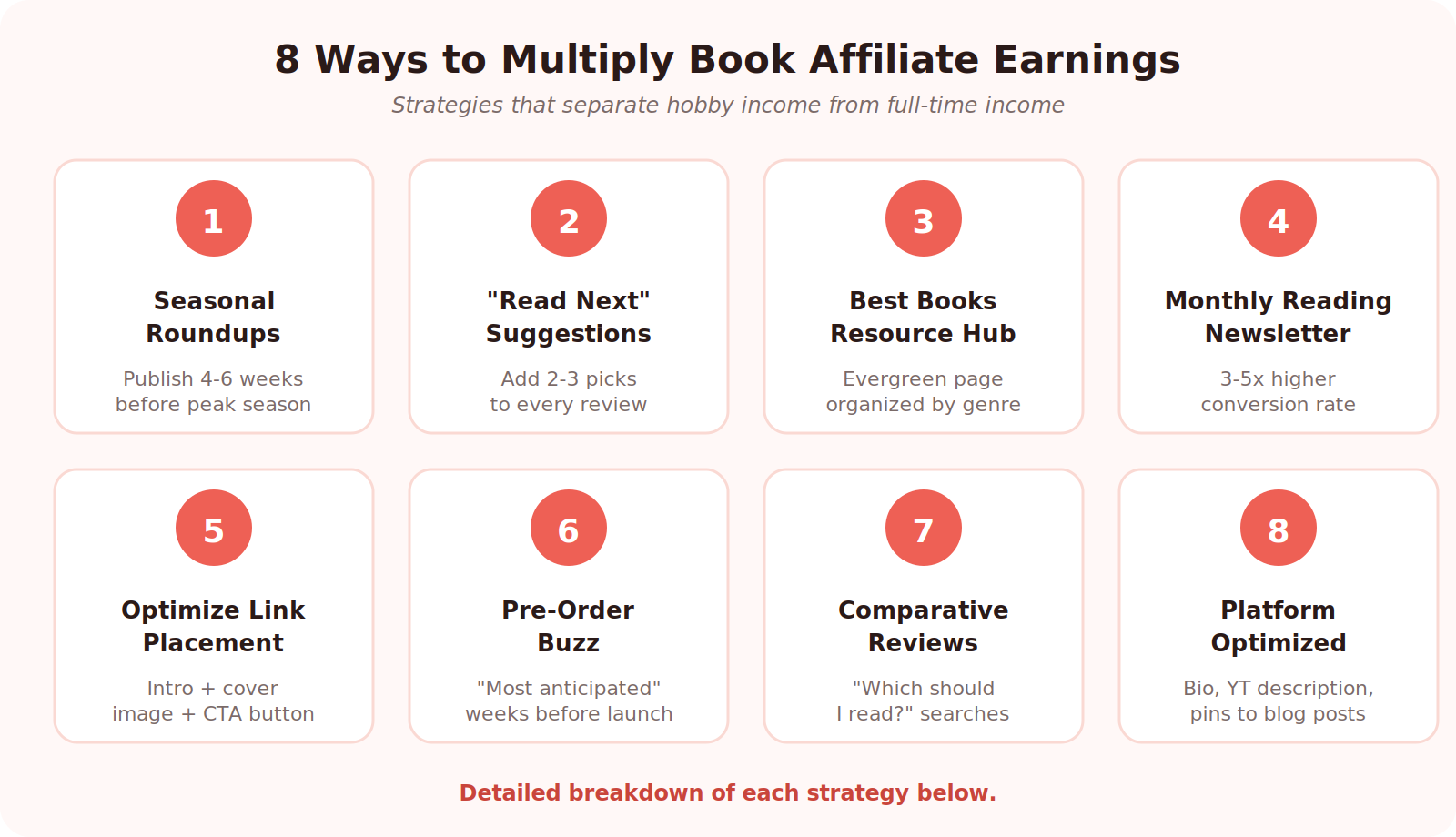
Getting approved for a program is the easy part. These eight strategies separate book bloggers who earn beer money from those who earn full-time income.
1- Publish Seasonal Recommendation Roundups Early
“Best beach reads for summer,” “Books to gift for graduation,” “Cozy fall reading list,” “New Year self-improvement picks”: these roundup formats capture massive search traffic every year. The key is to publish 4 to 6 weeks before the seasonal peak, not the week of, so you catch the early research wave. Keep the same URL every year and just refresh the content, so you preserve SEO authority instead of resetting it annually.
2- Add “Read Next” Suggestions to Every Review
The reader who bought one book on your recommendation is the easiest sale you will ever make for the next one. End every review with a “If you loved this, read these next” section featuring 2 or 3 complementary titles with a one-line hook explaining the connection. This lifts average cart size significantly because programs pay commission on the entire order, not just the book you originally recommended.
3- Build a “Best Books” Resource Hub
A dedicated resource page that organizes your top recommendations by genre, difficulty, or theme captures evergreen search traffic that would otherwise get buried in your blog feed. Keep entries brief (2 to 3 sentence mini-blurbs), link out to full reviews for detail, and update quarterly so the hub stays current. Category filters like “Best for Beginners,” “Quick Weekend Reads,” or “Award Winners” help readers self-serve toward the exact recommendation that fits them. The mechanics of ranking these hub pages sit squarely in the SEO affiliate marketing playbook if you want to go deeper.
4- Run a Monthly Reading Newsletter
Email subscribers convert at 3 to 5 times the rate of casual social followers because they actively asked to hear from you. A single “What I read in [month]” email once a month, featuring 3 to 5 books with personal takes and clear buy buttons, outperforms daily broadcast blasts. Segment your list if you can (fiction vs. non-fiction readers) so you never send a business biography to someone who only reads romance. If you have not started collecting emails yet, here is a walkthrough on how to build an email list without a website.
5- Optimize Link Placement Within Reviews
Most readers never reach the bottom of a 2,000-word post, which is exactly where beginners put their affiliate links. Add a link in the first 300 words for skimmers, make the book cover image itself a clickable affiliate link, and end with a high-contrast “Get this book” button. Use descriptive anchor text (“Check price on Bookshop.org”) instead of generic “click here” phrasing.
6- Capitalize on Pre-Orders and New Release Buzz
Superfans of an author actively search for release dates weeks before a book hits shelves. “Most anticipated books of [season]” posts, published 4 to 8 weeks ahead of launch, catch those pre-order commissions that most creators miss entirely. Most major book affiliate programs credit pre-order sales the same as regular purchases, so this is compounding traffic you can be earning on now.
7- Write Comparative Reviews for “Which Should I Read?” Traffic
“Atomic Habits vs. The Power of Habit,” “Sarah J. Maas reading order,” “Best Colleen Hoover book to start with”: comparative content targets readers already in buying mode who just need the tiebreaker. These posts get lower total traffic than general reviews but convert at multiples of the rate because search intent is razor-sharp. Declare a clear winner, explain the reasoning, and link both books because readers often buy both anyway.
8- Develop Platform-Specific Strategies for Bookstagram, BookTok, and Blog
Instagram and TikTok have no clickable links in captions, so a linktree or bio-link storefront becomes the entire conversion funnel: organize it by “Recent picks,” “October reads,” or theme and refer to it explicitly in every post. YouTube description links should sit in the first two lines so viewers do not need to click “Show more” to find them. Pinterest works best by driving traffic to your blog reviews rather than direct-linking to retailers, which the algorithm often penalizes. If Pinterest is a real channel for you, the dedicated Pinterest affiliate marketing guide covers the pin formats and boarding strategy that actually convert.
Conclusion
Book affiliate programs offer one of the best fits in affiliate marketing between audience trust, content evergreen value, and reliable commission rates. Bookshop.org and Libro.fm lead on ethical positioning plus high commissions. Amazon Associates provides universal coverage that no other program matches. Book of the Month delivers the biggest single per-conversion payouts in the vertical. TFAW owns comics. Kobo and Everand serve digital readers.
The book bloggers who earn most in 2026 combine three or four programs across formats (physical, audiobook, subscription, e-book), publish opinionated review content rather than generic roundups, and build a bio-link or storefront that makes it easy for followers to convert across every program in one place. That layered approach turns any book audience into a durable income source.
FAQs
1- What are book affiliate programs?
2- Which is the best book affiliate program?
3- How much do book affiliates earn?
4- Do you need a large following to join book affiliate programs?
5- What are the best comic book affiliate programs?
6- Are there e-book affiliate programs?
7- What is the cookie duration on book affiliate programs?
8- What are the best affiliate programs for book bloggers?
9- Can you promote book affiliate links on Instagram or TikTok?
10- Do book affiliate programs pay for used books?
 Summarize this article with: