Pricing isn't just a number, it's the story of your product's value. Set it right and you unlock profit, healthy cash flow, and trust. Set it wrong and you either leave money on the table or chase bargain hunters forever.
This guide shows you how to price a product with a simple formula, a free calculator, real examples, and proven strategies, whether you're selling digital products online or physical items.
Let's get started.
Key Takeaways
- Start with cost, finish with value: Add up your costs for a floor price, then adjust up based on what buyers will actually pay
- Know your formula: Selling price = cost per unit ÷ (1 − your target margin as a decimal)
- Margin and markup are not the same: Margin is profit as a share of price; markup is profit as a share of cost, so never mix them up
- Pick a strategy on purpose: Cost-plus, competitive, value-based, premium, penetration, or skimming, each fits a different goal
- Test and revisit: Your first price is a starting point, so review it monthly and after big cost or market changes
What Is Product Pricing?
Your total selling price includes the cost of making or buying the item, shipping, fees, and your desired profit. From there, you check what rivals charge and what customers are willing to pay, then adjust. Good pricing improves cash flow, protects your margins, and shapes how buyers perceive your brand.
At a high level, the process is simple: add your cost of goods and per-sale fees, add a profit margin, compare against the market and the value your buyers expect, adjust for taxes and marketplace fees, apply psychological price points like $19.99, then test and tweak over time.
Product Pricing Calculator
Before the full breakdown, try the numbers yourself. Enter your cost and target margin to see the selling price, profit, and markup update instantly.
Enter your cost per unit and target profit margin to get your selling price, profit, and markup instantly.
Formula: selling price = cost ÷ (1 − margin). Adjust the numbers to see how margin changes your price.
How to Price a Product in 5 Steps
Use this five-step playbook to set a price you can defend and scale.
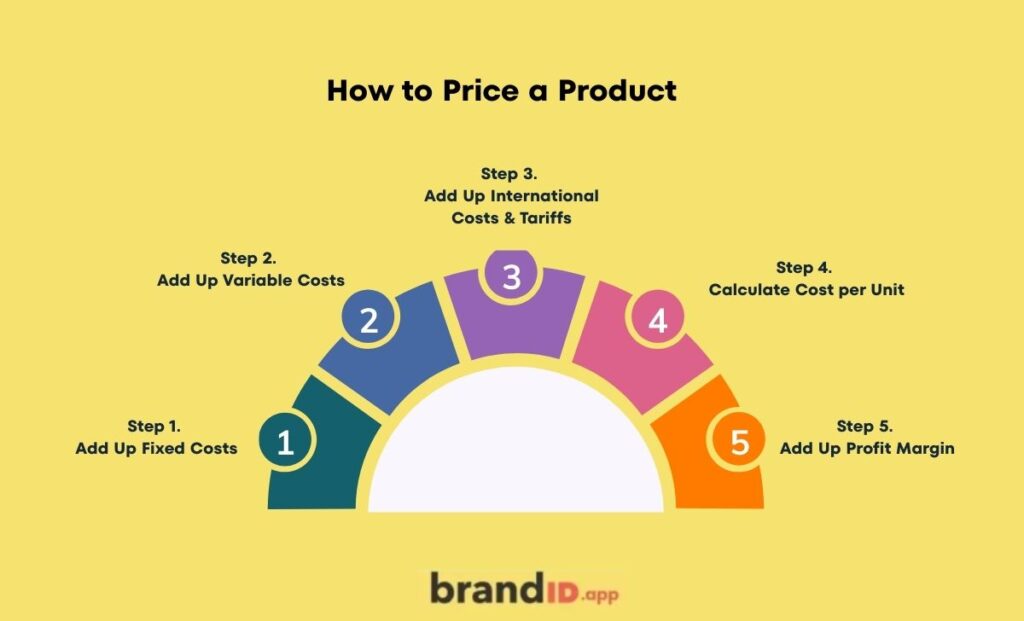
Step 1: Add Up Fixed Costs
Fixed costs stay the same no matter how many units you make or sell. Pick a time period (a month or quarter), list every expense that does not change with sales, and total them. Dividing that total by the units you expect to sell shows how much each item must cover before profit.
Common fixed costs include rent, staff salaries, business insurance, equipment leases, software plans, licenses and permits, base utilities, and ongoing marketing retainers.
Step 2: Add Up Variable Costs
Variable costs rise and fall with how much you produce or sell. Using the same time period, list every per-unit or per-order expense and total it, then divide by units to get your variable cost per unit.
Common variable costs include raw materials and components, packaging, shipping supplies, payment processing fees, sales commissions, marketplace per-sale fees, and per-order fulfillment.
Step 3: Add Up International Costs and Tariffs
If you buy or sell across borders, factor in tariffs, freight, customs, and broker fees. Find the correct HS code, check the duty rate, then add freight, insurance, and per-order fees to your variable cost.
Step 4: Calculate Cost per Unit
Your cost per unit is the average cost to make one item, and it is your lowest safe price. Add your total fixed and variable costs, then divide by the number of units made in that period.
Your selling price must sit above this number to earn a profit. After it, add any fees, shipping, and target profit, then check competitors and perceived value.
Step 5: Add a Profit Margin
Profit margin is the percentage of your selling price you keep as profit. It is a percentage of price, not cost, which is where many sellers slip up.
For example, if your cost per unit is $14.28 and you want a 20% margin, turn 20% into 0.20, subtract from 1 to get 0.80, then divide: $14.28 ÷ 0.80 = $17.85. That $17.85 is the price needed to hit your margin, before taxes, shipping, or marketplace fees.
Markup vs Margin: What's the Difference?
This is one of the most common (and expensive) pricing mistakes. A 50% markup is not a 50% margin.
| Term | Formula | Example (cost $10, price $15) |
|---|---|---|
| Margin | (Price − Cost) ÷ Price | $5 ÷ $15 = 33% |
| Markup | (Price − Cost) ÷ Cost | $5 ÷ $10 = 50% |
Same $5 profit, two very different percentages. When you read a competitor's numbers or plug into a formula, check whether it is talking about margin or markup before you copy it.
How to Calculate Your Break-Even Point
For example, with $2,000 in monthly fixed costs, a $25 price, and $10 in variable cost per unit, you need $2,000 ÷ $15 = 134 units to break even. Every sale after that is profit.
This number is a reality check: if hitting break-even means selling more units than your audience can realistically buy, your price is too low or your costs are too high.
6 Best Product Pricing Strategies
Great prices are chosen from a playbook, not guessed. Here are six proven strategies, when to use each, and quick examples.
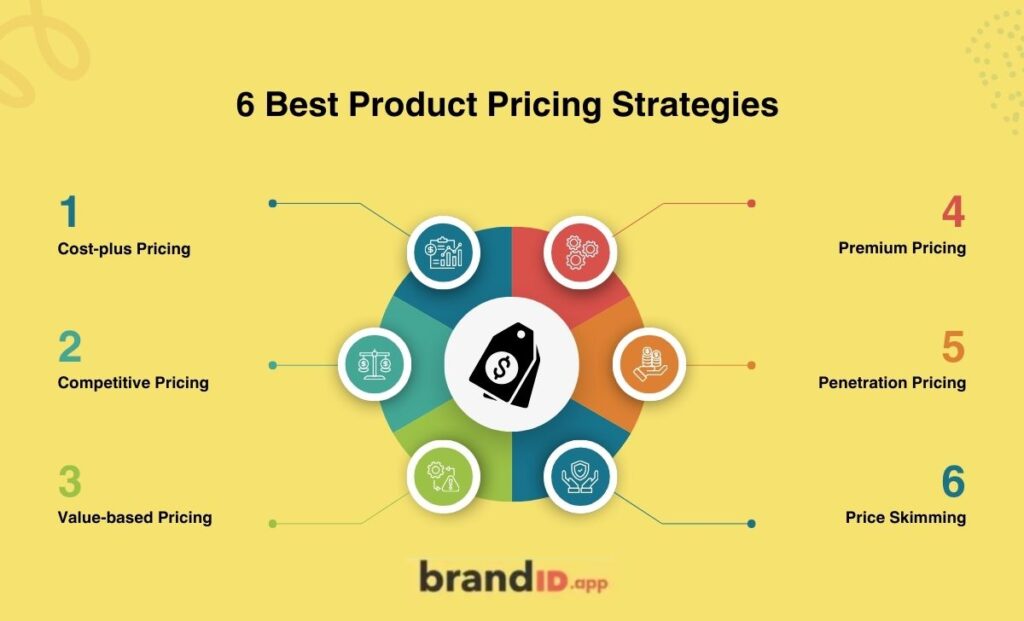
1. Cost-Plus Pricing
Add a profit margin on top of what it costs to make one item. Simple and reliable, it works well for retail and stable costs. If a cutting board costs $20 and you want a 50% markup, the price is $20 × 1.50 = $30. Still check competitors and perceived value before you lock it in.
2. Competitive Pricing
Set your price near what similar products cost, then go a little lower, higher, or match. A brand might price its 16-oz shampoo at $8.49 because rivals sell for $7.99 to $8.99, with research supporting a small premium. It is easy and matches buyer expectations, but it can spark price wars, so back your price with a clear value story instead of racing to the bottom.
3. Value-Based Pricing
Price by what customers think your product is worth, not what it costs to make. As Warren Buffett put it, "Price is what you pay; value is what you get." A bakery charges more for handmade sourdough, and a tool that saves 10 hours a month pays for itself. Value-based pricing rewards what makes you different, but it takes research and proof, so start at your cost floor, map the job your product does, and test two or three tiers.
4. Premium Pricing
Deliberately price high to signal exclusivity and quality, common for luxury and prestige brands. A microbrand watch at $1,200 while rivals sit near $350 is backed by a Swiss movement, lifetime service, and limited production. You keep fat margins and a strong brand, but sell to fewer people and must keep proving quality, so use it only when the product is clearly superior.
5. Penetration Pricing
Start low to win customers fast, then raise prices over time. It suits crowded, price-sensitive markets like streaming and SaaS. A new streaming app might charge €1 for three months, then move to €6. It creates buzz and pulls customers from rivals, but margins are thin at launch and some buyers churn when prices rise, so only use it if you can afford the low price for a while.
6. Price Skimming
The opposite of penetration: launch high to capture early buyers who value it most, then lower the price in planned steps as competition grows. It works best for new, differentiated products with little competition, like new tech or specialty hardware. Plan your price drops, give early buyers perks, and watch for copycats.
How to Price Different Types of Products
| Product type | Best approach | What to watch |
|---|---|---|
| Physical / retail | Cost-plus plus competitive | Shipping, returns, and marketplace fees eat margin |
| Wholesale | Cost-plus at a lower margin | Price so a retailer can still mark it up and profit |
| Digital products | Value-based | Near-zero unit cost, so price on value and the market |
| SaaS / subscriptions | Tiered or per-user | Recurring revenue, so price on value and upgrades |
| Services | Value or project-based | Price on the outcome and expertise, not just hours |
Because the best digital products to sell cost almost nothing to reproduce, they are the clearest case for value-based pricing: a Canva template that saves buyers hours is worth far more than the minutes it took to make.
4 Best Practices for Product Pricing
These habits keep your prices confident and profitable, not guessed.
1. Identify Your Target Audience
Who you sell to changes what you can charge. Pricing a PDF for college students is different from pricing it for faculty. Survey buyers on willingness to pay, and match the value (length, checklists, updates) to what the group needs.
2. Research Competitors and the Average Selling Price
Competitive analysis stops you from guessing. Pick 5 to 10 close rivals and note their regular price, sale price, bundles, and signs of value like ratings and warranties. Work out the average selling price in your market, then set a target band: your floor is cost plus fees, and the market band is the usual range. Test inside that band and review monthly or after big sales.
3. Define Your Unique Value Proposition
Your unique value proposition is the main reason people choose you, and it justifies your price because buyers pay for results, not features. For creators selling clipart and illustrations, a strong UVP might be "theme bundles, instant download, commercial license, clear previews," which supports a price above cheap, generic options.
4. Determine Your Market Positioning
Positioning is how you want buyers to see you against rivals: budget, mid-tier, or premium. Lead with one clear angle, quality, a competitor comparison, a specific benefit, convenience, or novelty, and back it with proof like reviews or guarantees. A basic PDF bundle at $5 and a designer bundle at $25 with extras are two different positions, each priced to match.
5. Use Discounts and Psychological Pricing
Psychological pricing nudges buyers without cutting real profit. Use charm prices ($9.99 instead of $10), anchor a higher list price ($79) next to your offer ($49), sell bundles (three for $19 vs $9 each), and add a decoy tier (Basic $9, Pro $19, Premium $39) so most people pick Pro. Always check your margin first, limit discounts, give a reason and an end date, and do not train shoppers to wait for the next sale.
Common Pricing Mistakes to Avoid
- Pricing on cost alone. Cost sets your floor, but value sets your ceiling, so ignoring what buyers will pay leaves money behind.
- Confusing markup and margin. A 50% markup is only a 33% margin, and mixing them quietly shrinks your profit.
- Racing to the bottom. Undercutting rivals starts price wars and trains buyers to expect cheap, so compete on value instead.
- Forgetting fees and shipping. Payment, marketplace, and shipping fees all come out of your margin, so build them into your cost base.
- Never testing or reviewing. Markets and costs shift, so a price you set once and forget slowly stops working.
- Over-discounting. Constant sales erode your premium image and teach shoppers to wait for the next deal.
- Underpricing out of fear. Charging too little signals low quality and makes a sustainable business much harder to build.
Set Your Price, Then Start Selling
Once your number is locked in, the last step is turning it into sales. That means a storefront that takes payments, delivers the product, and lets you test prices without friction.
brandID is a free-to-start creator store and link in bio where you can sell digital downloads and set your price in minutes, with no coding or design skills.
- Accept payments in multiple currencies with secure checkout and instant file delivery
- Build bundles, coupons, and subscriptions, and run simple A/B price tests
- Track every order and see which price points convert with built-in analytics
Conclusion
Now you know how to price a product with a repeatable system, not a guess. Total your fixed and variable costs, calculate cost per unit, add a target margin, and you have a floor. Then compare six strategies, sense-check against competitors and value, and adjust.
Get it right and pricing becomes a growth lever instead of a source of stress. Lock in your number, put it in front of buyers, and keep testing, because the best price is the one your market keeps confirming.
Frequently Asked Questions
What Profit Margin Should I Aim For When Pricing a Product?
It depends on your industry. A healthy margin is often around 10%, with 20% or higher considered strong. Retail can run as low as 3% to 5%, while software and luxury goods can exceed 20% to 40%. Start with your industry norm, then adjust for your costs and positioning.
How Do Competitor Prices Affect My Product Pricing?
Competitor prices show what customers already expect to pay for similar products. Use them to set a realistic range, then decide whether to match, undercut, or charge a premium based on your value. Never copy a rival's price blindly, since you do not know their costs or quality.
What Is the Easiest Way to Price a Product?
Add up all the costs to make and sell one unit, then add a markup on top. This cost-plus method (Cost + Markup = Selling Price) gives you a quick, defensible baseline, which you then refine against competitor prices and customer value.
What Is the Difference Between Markup and Margin?
Margin is profit as a percentage of the selling price, while markup is profit as a percentage of the cost. For a $10 item sold at $15, the margin is 33% but the markup is 50%. They describe the same $5 profit, so always confirm which one a formula uses.
How Do I Price a Digital Product?
Because digital products cost almost nothing to reproduce, price them on value rather than cost. Research what similar products sell for, set an entry price based on the time or money they save buyers, then test tiers and bundles. A template that saves hours can command far more than its production cost.
How Often Should I Change My Prices?
Review your prices at least quarterly, and whenever your costs, competitors, or demand shift noticeably. Treat your first price as a starting point, test small changes, and let real sales data guide adjustments rather than changing prices randomly.
What Is Psychological Pricing?
Psychological pricing uses buyer perception to lift sales without cutting real profit. Common tactics include charm prices like $9.99, anchoring a higher list price next to your offer, bundling, and adding a decoy tier so the middle option looks like the best deal.
Should I Use Cost-Plus or Value-Based Pricing?
Use cost-plus to set a safe floor, then move toward value-based pricing as you learn what buyers will pay. Cost-plus is fast and reliable, while value-based pricing captures more profit when your product clearly saves time, solves a big problem, or feels premium.
 Summarize this article with: