
Search guest post outreach and you will find roughly two hundred email templates. Twelve here, fourteen there, twenty in the next one. Almost nobody is short of templates.
Yet the average link building outreach campaign still gets an 8.5% reply rate, and polls of working SEOs put the actual conversion to a placed link at 1% to 5%. If templates were the constraint, that number would have moved years ago.
The constraint is somewhere else. It is in which sites you pitch, whether you can reach a human at all, and what happens after the first email goes unanswered.
This guide covers those three, with the templates included where they belong rather than as the whole article. If your outreach problem is broader than links, outbound lead generation covers the same failure at a larger scale.
Key Takeaways
- Personalization moves reply rates from 2-3% to 8-18%, and the first two sentences carry most of that effect
- Nearly half of all acceptances come from follow-ups, not the original email, so campaigns that send once throw away half their results
- 100 well-qualified prospects beat 1,000 random ones, because a site that never publishes guest posts cannot be persuaded by a better subject line
- Pitch two or three topic ideas, never one. Editors almost always pick one rather than replying with a rejection
- Keep pitches under 150 words. Editors scan, and length reads as someone who has not done this before
- Finding the editor is harder than writing the pitch, and many sites publish a form rather than an address on purpose
- Expect 2 to 8 weeks from first contact to a live link, so campaigns judged at two weeks look like failures
What Is Guest Post Outreach?
Guest post outreach is the process of contacting website owners and editors to propose writing an article for their site. You get a byline, exposure to their audience, and usually a link back to your own site. They get a free article they did not have to commission.
It remains one of the few link building methods that is entirely legitimate under search engine guidelines, because the link is editorially given in exchange for content someone actually wanted to publish. That distinction matters: bought links and link schemes carry real risk, while a genuinely useful article on a relevant site does not.
The practical difficulty is that editors of decent sites receive dozens of pitches a day, most of them near-identical. Standing out is less about cleverness than about being obviously relevant and obviously easy to work with.
The Numbers Nobody Puts on the Front Page
Understanding the funnel changes how you plan a campaign, because the drop-off is steeper than most people expect.
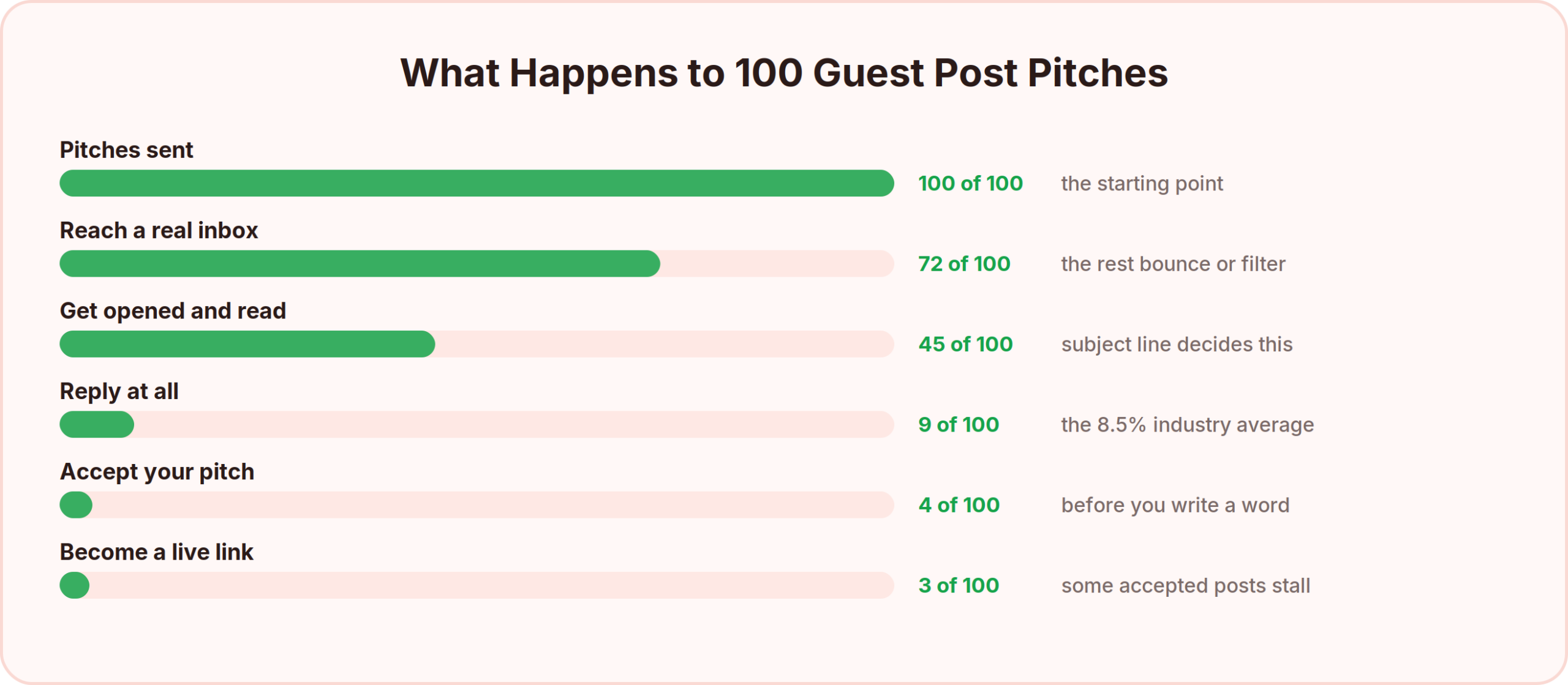
Three things follow from that shape. Volume matters, because three links from a hundred pitches means a hundred pitches is the minimum viable campaign. Deliverability matters more than most SEOs treat it, because roughly a quarter of the loss happens before anyone reads anything. And the gap between reply and live link is real, so counting replies as wins overstates your results.
If you need five links this quarter and you convert at 3%, you need around 170 qualified prospects. Not 170 sites, 170 sites that genuinely accept guest posts. Building that list is most of the work and almost none of the advice.
Step 1: Build a List Worth Pitching
This is where campaigns are won and lost, and it is the step every template article skips. A perfect pitch to a site that does not publish guest content converts at zero, and no amount of personalization changes that.
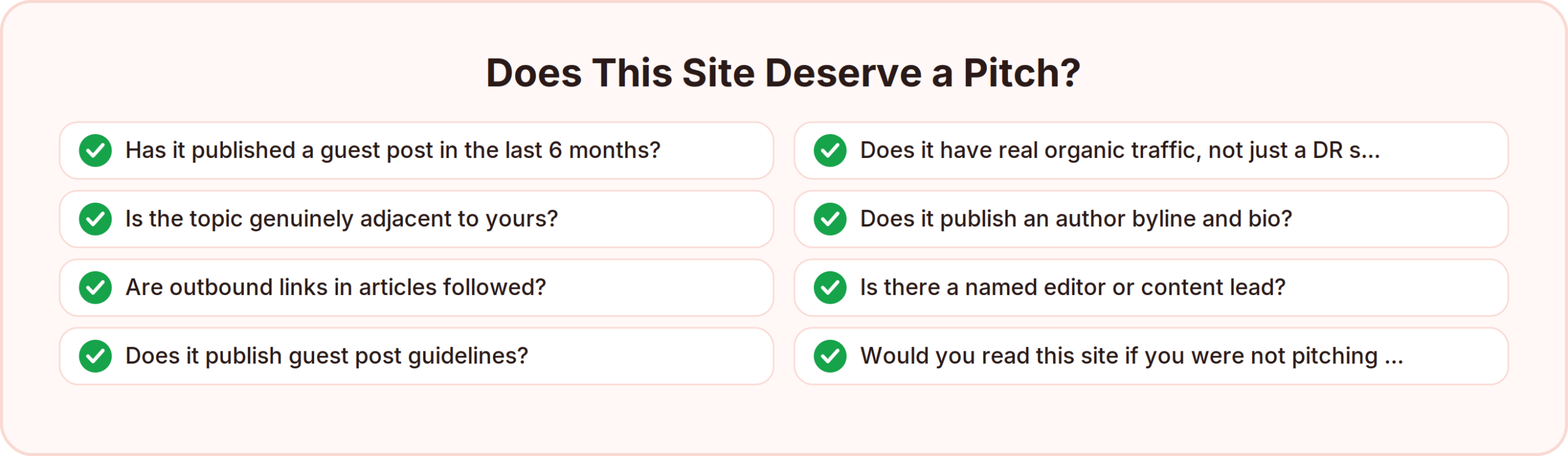
Where to find candidates, in rough order of quality, and the same qualification discipline that makes lead generation tools for SEO agencies worth their cost:
- Sites already linking to your competitors. If they gave a link to someone in your space once, the door is open. Any backlink tool exports this in a few minutes.
- Search operators. Your topic plus write for us, guest post guidelines, or contribute finds sites actively asking.
- Authors who guest post in your niche. Search a prolific contributor’s name and you get a ready-made list of sites that accept outside writers.
- Sites that published on your topic recently. Recency signals an active editor rather than an abandoned blog.
- Resource pages and roundups. These sites link out by design.
The last filter matters most and is the easiest to skip: check that a human published something in the last month. A surprising share of outreach goes to blogs nobody has touched since 2023.
Step 2: Actually Reach the Editor
Here is the problem the template articles never mention. You have a qualified list of 170 sites. Now find 170 email addresses for the person who decides what gets published.
On most sites that person is not listed. Small and mid-sized blogs frequently publish no staff email at all, and larger publications route everything through an editorial address that receives hundreds of pitches. Email finding tools return a guess, a role address, or nothing.
- Guessed addresses bounce, and bounces damage the sending domain you need for the rest of the campaign.
- Role addresses are gatekept. info@ and contact@ are monitored by whoever has time, and pitches are the first thing deprioritized.
- Editors protect their addresses on purpose, precisely because of outreach volume.
- Publisher domains filter aggressively, because they are among the most-pitched inboxes on the internet.
So a meaningful part of your loss happens before the pitch is judged at all, which is a distribution problem rather than a copy problem. It is the same failure that limits cold email in every other context, and it has the same answer.
Contact Forms Are How Blogs Publish Their Route to the Editor
Almost every site that does not publish an editor’s address does publish a contact form. That is not an accident. The form is the route the site chose to offer, it is monitored because it is how collaborations and press inquiries arrive, and submissions land inside the site’s own system rather than in a filtered mailbox.
For guest post outreach specifically, that is useful in a way it is not for most outbound. Your target list is a set of websites rather than a set of named individuals, which is exactly the case where finding personal addresses is slowest and least reliable. You do not need to find the editor if the site publishes a way to reach them.
| Cold email to a guessed address | Contact form submission | |
|---|---|---|
| Reaches the site at all | Bounces or filters frequently | Arrives in the site’s own system |
| Finding the contact | Requires a finder tool and verification | Not required |
| Bounce risk to your domain | Real, and cumulative | None |
| Who sees it | Whoever survives the filter | Whoever monitors submissions |
| Setup | Domain, authentication, warmup | None |
| Personalization | Fully controllable | Fully controllable |
It is not a replacement for email where you have a verified editor address. It is the route into the several dozen sites on every list where you do not, and contact form marketing is the discipline around using it well.
Automate Guest Post Outreach With ContactID
Filling 170 forms by hand is a week nobody repeats, which is why most SEOs simply drop those prospects from the list.
ContactID, formerly ContactUs AI, is a Chrome extension that turns contact form outreach into a repeatable channel. It is built by brandID and runs entirely in your browser rather than through a sending server, which is why it carries none of the deliverability constraints that limit email outreach.
You load your list of target site URLs, write your pitch, and the extension visits each site, finds the contact form, maps your content to the right fields, works through the captcha, and submits. The prospects you would have dropped for lack of an email address stay in the campaign.
For link building that matters more than it does in sales outreach, because your bounce rate directly threatens the sending domain you need for the rest of the quarter. A form submission cannot bounce, so there is no reputation cost to reaching a site you could not verify.
What ContactID Handles
- ContactID form detection: finds and maps the contact form on each site, including the older layouts common on independent blogs
- ContactID captcha handling: works through the challenges that stop most automated submissions
- ContactID list cleaning: strips duplicates and dead URLs before you spend submissions on them
- ContactID AI message personalization: adapts your pitch to each site using what it finds there, so the opening references that publication rather than a merge field
- ContactID message rotation: varies your pitch across submissions so a marketing blog and a SaaS publication do not receive identical text
- ContactID bulk submission: runs the campaign across your whole prospect list from the browser
- ContactID submission dashboard: tracks what was sent, what landed, and what failed, so the channel can be measured like any other
Best For: link builders and content marketers working from a list of websites rather than a list of verified editor addresses.
Add ContactID to ChromeMost link builders already run half the best Chrome extensions for lead generation in the same browser window as their backlink tool. This is the one that handles the prospects where no address exists, which is usually a third of any list.
Step 3: Write a Pitch an Editor Will Answer
Now the templates matter, and the difference between a 2% and an 18% reply rate is smaller than it sounds. Generic pitches reply at 2% to 3%. Personalized ones reply at 8% to 18%, and roughly 80% of that effect lives in the first two sentences.
The Template
Subject: Guest post idea for [Site]: [specific topic]
Hi [Name],
Your piece on [specific article] made the point that [specific detail], which is not something I see said often. It is why I read [Site] rather than the obvious alternatives.
I write about [topic] at [your site], and I noticed you have covered [adjacent thing] but not [gap]. Three ideas your readers might use:
1. [Title] — [one line on the angle]
2. [Title] — [one line on the angle]
3. [Title] — [one line on the angle]
Around 1,500 words, original, with a draft to you within ten days. Happy to work to your guidelines and take edits.
If none of these fit, I am glad to hear what would.
[Name]
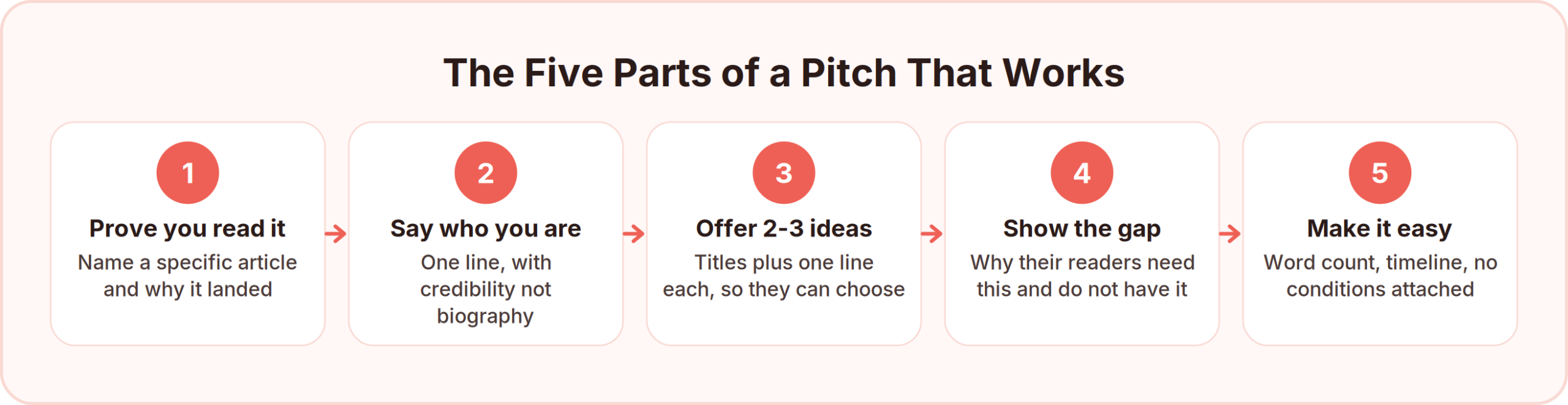
Four things make that work. It proves you read the site before the editor has to decide anything. It names a gap rather than praising them vaguely. It offers a choice, which converts far better than a single idea because the editor picks rather than rejects. And it removes friction by stating length, timeline, and willingness to be edited.
Keep it under 150 words in practice. Editors scan, and a long pitch signals someone who has not done this before.
Subject Lines
| Pattern | Example | Why it works |
|---|---|---|
| Direct offer | Guest post idea for [Site]: [topic] | No mystery, and it filters correctly |
| Gap-naming | You have covered X but not Y | Proves research in five words |
| Article reference | Following up on your [article] piece | Reads as a reply rather than a pitch |
| Question | Do you accept contributor pieces on [topic]? | Low friction, easy to answer yes or no |
Step 4: Follow Up, Because Half the Yeses Live There
This is the highest-return, least-used part of guest post outreach. Nearly half of all acceptances come from follow-ups rather than the original email, which means a campaign that sends once is discarding roughly half its results.
| When | What to send | Why |
|---|---|---|
| Day 5 | Short bump, re-offer the three ideas | Most non-replies are inbox volume, not rejection |
| Day 12 | One new idea, or a different angle | Gives a fresh reason to reply |
| Stop | Nothing further | Two follow-ups is the ceiling with editors |
Hi [Name], bumping this in case it slipped past.
Still glad to write any of the three, or something else entirely if there is a gap you are trying to fill this quarter.
[Name]
Two rules. Never guilt the recipient, because “just following up again” reads as entitlement to an editor who owes you nothing. And stop at two, because a third follow-up converts almost nobody and gets your domain marked by someone who talks to other editors.
Step 5: What to Do After a Yes
Getting accepted is not the same as getting a link, and this is where the funnel loses its last few points.
- Deliver early. Editors remember the contributor who filed before deadline, and that is how a one-off becomes a standing invitation.
- Follow their guidelines exactly, including headings, image sizing, and internal linking conventions.
- Link naturally and sparingly. One contextual link to a genuinely relevant page. Stuffing is the fastest way to be edited out or blacklisted.
- Write for their readers, not your SEO. An article that obviously exists to carry a link gets published once and never again.
- Promote it when it goes live. Editors track whether contributors bring traffic, and the ones who do get asked back.
- Ask about a second piece a fortnight later, when the first has performed. A repeat placement costs no outreach at all.
Repeat relationships are the whole game at scale. Twenty sites that publish you regularly outperform two hundred one-time placements, and they cost nothing after the first pitch.
Guest Post Outreach Mistakes
- Pitching sites that do not publish guest posts. No template overcomes this, and it is most of the wasted effort in a typical campaign.
- Sending one email and stopping. Half the acceptances are in the follow-ups you did not send.
- Offering one idea. A single pitch invites a yes or no. Three invites a choice.
- Praising the site generically. “I love your blog” tells the editor you have not read it.
- Guessing addresses at scale. Bounces compound and damage the domain carrying the whole campaign.
- Judging results at two weeks. Guest post outreach runs 2 to 8 weeks from pitch to live link.
- Chasing DR while ignoring traffic. A DR 60 site with no readers passes less value than a DR 30 site with a real audience.
Conclusion
Guest post outreach fails for three reasons and only one of them is the email. Most campaigns pitch sites that were never going to publish outside writers, lose a quarter of their sends to addresses that do not resolve, and stop after the first message when half the yeses come later.
Fix those in order. Qualify the list properly, so every pitch has somewhere to land. Reach the sites where no address exists rather than dropping them. Then use a pitch that proves you read the site, offers a choice, and makes saying yes easy.
Do that and 8.5% stops being your ceiling. It is roughly what you get when the only variable anyone optimizes is the template.
What Is Guest Post Outreach?
Guest post outreach is contacting website owners and editors to propose writing an article for their site, usually in exchange for a byline and a link back to your own site. It remains one of the few link building methods fully compatible with search engine guidelines, because the link is editorially given in return for content the publisher wanted.
What Is a Good Guest Post Outreach Reply Rate?
The industry average for link building outreach is around 8.5%, with top campaigns reaching 15% to 20%. Generic templated pitches reply at 2% to 3%, while genuinely personalized ones reach 8% to 18%. Conversion from pitch to a live link is lower still, with working SEOs reporting 1% to 5%.
How Many Sites Should I Pitch?
At least 50 to 100 for a meaningful number of placements, and closer to 170 qualified prospects if you need five links and convert at 3%. The word qualified matters: a list of 100 sites that genuinely publish guest posts outperforms 1,000 random sites by a wide margin.
How Do I Find the Editor’s Email Address?
Check the site’s about, team, and write-for-us pages first, then LinkedIn for the content or editorial lead. Many sites publish no staff address at all and route everything through a contact form, which is deliberate. Guessing addresses at scale causes bounces that damage the sending domain you need for the rest of the campaign.
How Long Should a Guest Post Pitch Be?
Under 150 words. Editors scan rather than read, and length signals inexperience. The pitch needs four things only: proof you read the site, one line on who you are, two or three topic ideas with a line each, and the practical terms such as word count and timeline.
Should I Pitch One Idea or Several?
Two or three, always. A single idea invites a yes-or-no decision, while several invite the editor to pick one, which is a far easier reply to send. Editors presented with a choice almost always choose rather than declining outright.
How Many Times Should I Follow Up?
Twice, at around day 5 and day 12, then stop. Nearly half of all acceptances come from follow-ups rather than the first email, so sending once discards half your potential results. A third follow-up converts almost nobody and risks your reputation with an editor who talks to other editors.
How Long Does Guest Post Outreach Take to Show Results?
Typically 2 to 8 weeks from first contact to a live, indexed link, depending on the site’s authority, editorial calendar, and publishing speed. Campaigns judged at two weeks look like failures when they are simply still in progress.
Is Guest Posting Still Effective for SEO?
Yes, when the post is genuinely useful and the site is genuinely relevant. Editorially given links on relevant sites with real readers remain valuable. What does not work is paid link placements, articles written purely to carry an anchor, or high-DR sites with no actual audience.
How Do I Reach Sites That Do Not Publish an Email Address?
Use the contact form they do publish. It is the route the site chose to offer, it is monitored because collaborations and press inquiries arrive that way, and a submission arrives inside the site’s own system rather than in a filtered mailbox. It also cannot bounce, so it carries no risk to your sending domain.
 Summarize this article with: