As a seasoned marketing expert, you’re probably spending thousands on cold email marketing activities and testing tools that promise to help, from inbox warmers to the best Chrome extension for lead generation.
Here’s what nobody tends to tell you: the businesses you’re trying to reach already have a very real digital front door, and you’ve been ignoring it. They check it daily as part of their normal business operations.
It’s their contact form, usually found on the Contact Us or About Us page of their website. And unlike email inboxes, these forms deliver messages directly to decision-makers, with delivery rates approaching 98%.
In this article, we’re going to break down what contact form marketing actually is, how it works in practice, and how you can turn ordinary “Contact Us” pages into a predictable source of qualified leads. And finally, introduce brandID, the system that helps you scale contact form outreach without sounding spammy or losing your brand voice.
What Is Contact Form Marketing?
To put it simply, contact form marketing is the strategy of using website contact forms—both on your own site and on other people’s sites—as intentional, high‑signal touchpoints for generating leads, booking calls, and starting partnerships.
What I’m trying to convey is that, instead of seeing a contact form as “just a way to reach us,” think of it as:
- A mini landing page that sets expectations and sells the next step
- A pre‑qualification tool that filters out time‑wasters
- A warm entry point that feels invited, not intrusive
On the outbound side, contact form marketing is also about submitting thoughtful, targeted messages through other businesses’ contact us or get in touch forms—so you’re reaching them through the channel they chose to receive business enquiries, not ambushing their personal inbox.
Is it technically still “cold”? Yes.
Does it feel much warmer and more welcoming? Absolutely.
Benefits of Contact Form Marketing
Contact form marketing turns outreach from “interrupting people” into “talking to them where they already expect messages.” Instead of battling email spam filters, you use a channel built for real inquiries and replies. Here’s how this switch can boost your outreach:
- Higher Deliverability
- Direct Access to Decision-Makers
- Scalabily
- Better Targeting
1- Higher Deliverability and Response Rates
When it comes to outbound contact form marketing, nothing matters if your message isn’t seen!
In spite of the fact that you’ve written a strong copy, created a perfect offer, and targeted the most promising clients, your message still lands in the spam folder, gets filtered out, or never reaches an intended human being, sounds familiar, right?
This is exactly where contact form marketing shows its true value.
Unlike traditional cold email outreach—where you must survive spam filters, throttling limits, and fierce inbox competition—contact form submissions are routed through the company’s own internal system. That means you’re not fighting Gmail algorithms or any other email provider’s rules. In fact, you’re using the pathway the business intentionally created to receive messages like yours.
Ironically, even when a message is delivered, deliverability is only half the equation. The second and often more important factor is response quality. Contact forms are typically monitored by:
- Business development managers
- Executive assistants
- Founders (especially in smaller companies)
And those inboxes aren’t flooded with newsletters, receipts, and random promotions. They’re designed specifically for legitimate business communication.
2- Direct Access to Decision-Makers
One of the biggest outbound advantages of contact form marketing is how it cuts straight through corporate gatekeepers and lands your message directly where decisions get made.
With contact forms, you’re bypassing the middleman entirely. Most small-to-mid-sized business sites route form submissions directly to the owner or key stakeholders—no layers of approval required. You’re speaking straight to the person who can say “yes” or book the call.
In my experience, this single factor alone can double your qualified opportunities compared to traditional outbound.
3- Scalability
In the early days, contact form marketing was almost entirely manual. What I’m trying to tell you now is that back then, you’d open a website, find the contact page, craft a message, fill out the fields, solve the captcha, hit submit—then move on to the next one.
It worked well, yet there was one major issue that came up early on: it was not scalable at all. By scalability, I mean that if you were supposed to send:
- Fifty submissions? Manageable.
- A hundred? Exhausting and irritating.
- A thousand? Nearly impossible.
As time went by, contact form marketing evolved. Today, with the emergence of contact form automation, it can send thousands in a very short span of time without turning them into spam—which is phenomenal.
4- Better Targeting and Lead Quality
In contrast to a traditional Cold email strategy that is often built on scraped lists and individual addresses. With contact form marketing, your targeting happens at the company/site level:
- You choose specific websites based on niche, offer fit, and relevance.
- Every submission is going to a business that already matches your criteria.
Best Practices for Effective Contact Form Marketing
The best practices below are the ones that consistently move the needle. Follow them, and you’ll turn your contact forms into a quiet but reliable engine for replies, demos, and deals.
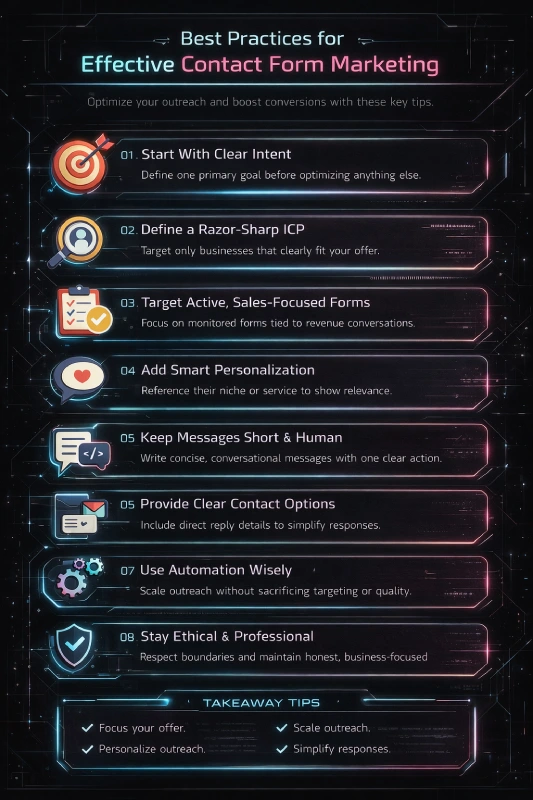
1- Start With Clear Intent
A form without purpose won’t perform. Before changing layouts or button colors, decide what the form is meant to achieve. Is it there to collect demo requests, quotes, or questions? The more specific the goal, the higher your conversion rate will climb.
Once you’ve identified a single primary goal, every other decision falls into place, from the words you use to the fields you include and even your button text.
2- Define a Razor-Sharp Ideal Customer Profile (ICP)
Before you worry about copy or tools, you need to know exactly who you’re trying to reach. “Anyone with a website” is not a strategy; it’s a shortcut to low‑quality replies and wasted submissions. Get specific about industry, company size, offer fit, tech stack, and buying triggers so you only contact businesses that can actually say “yes” to what you sell.
3- Target Only Websites with Active, Monitored Contact Forms
Prior to starting your contact form marketing outreach, there is something I should make absolutely clear: not every contact form deserves your outreach.
- Some are abandoned.
- Some route to dead inboxes.
- Some are used strictly for support tickets that never reach decision-makers.
Based on this, if you keep reaching out through those forms, you’re essentially squandering your time and budget without generating any useful leads.
To see the best possible results, you need to ignore generic “info@” channels and focus on forms that are clearly linked to business conversations. You’ll often see pages titled:
- Work With Us
- Book a Demo
- Request a Proposal
- Sales
More often than not, these are the pages you should target to actually move closer to your desired outcome. The bottom line is simple: if you target the right forms in the right places, you give yourself a much higher chance of starting constructive outreach that leads to appealing results—and none of that happens if you don’t choose the right forms in the first place.
Pro Tip: Don’t waste time checking websites one by one. Our brandID bulk cold outreach Chrome extension does it for you, it removes broken sites, and pages without contact forms. Just upload your list, and you’re done. You get a ready-to-use list of good targets. Simple and fast!
4- Add Smart Personalization
Personalization doesn’t mean writing a brand-new message from scratch for every website; it means adding just enough context to prove you’re not blasting everyone. Use simple, repeatable cues like their niche, a specific service they offer, a recent launch, or the type of customers they serve to anchor your message.
5- Keep Messages Short, Human, and Conversational
Over the course of the last few decades, I have seen many people make a horrendous mistake by keeping their messages convoluted without any specific reason. Nevertheless, keep in mind that just because you are using a form, it does not mean you should paste a full sales pitch.
What you should do instead is write short chunks of copy that:
- Show your expertise
- Explain why you are reaching out
- Give one clear, practical offer or answer a specific question
You should avoid, in 99% of cases, using unnecessary jargon and making promises you cannot keep or deliver. Ultimately, you should always write like a real person talking to another real person and offer useful, concrete advice that genuinely helps them. If your message feels like a copy‑paste template, they will treat it like spam, and you’re more than likely to fail in your mission.
6- Provide Contact Info & Respect Their Time
Remember: you’re asking for their attention, so make it easy for them to decide what happens next. Include a direct reply‑to email, optional calendar link, or website URL so they can choose their preferred response channel.
7- Leverage Automation, Without Losing Control
Automation is what makes contact form marketing scalable, but scale without control quickly turns into spam. Used correctly, automation handles the mechanical work:
- Form discovery
- Field mapping
- Captcha solving
- Bulk submissions
But it is crucial to remember that this kind of strategic approach is only possible when it has been thoughtfully designed by a human in advance. You still control:
- Your ICP
- Your targeting criteria
- Your messaging quality
- Your offer positioning
In the end, automation exists to increase efficiency, not replace your judgment. Keep in mind that your goal is not to send more, it is to send smarter.
How brandID Turns Contact Form Marketing Into A Scalable System
Here’s the catch: knowing that contact form marketing is powerful is one thing. Actually running it at scale—with consistency, tracking, and brand control—is another story.
Most teams start like this:
- Someone builds a form.
- Someone else edits the copy.
- A few people send random submissions through other sites.
Nobody really knows what got sent, where, or whether it worked. Pretty soon, you’ve got chaos, not a channel. That’s exactly where brandID comes in. With brandID’s Bulk Cold Outreach with AI Contact Us Form Submission extension, you can:
- Standardize your outreach style.
Create a clear, reusable brand voice system so every contact form submission sounds like you, not ten different writers on ten different days.
- Optimizes Messages with A/B Testing
Create multiple message templates and sender profiles, then let brandID rotate them across your lists to discover what actually gets responses. No more guessing—see exactly which hook, offer, or tone converts best, then double down on winners.
- Smart Captcha Solving Engine
brandID’s Bulk Cold Outreach extension could solve 100% of captchas automatically mid-submission, keeping campaigns flowing without manual pauses or blocks.
- Personalization Without Losing Scale
With brandID’s bulk cold outreach, you can easily personalize your messages for each list and even for individual websites without writing everything manually. This means you no longer have to send one message to 1,000 businesses—you can adjust your outreach and tone of voice to match each industry’s nature and brand identity.
- Website List Cleaning
One of the most significant benefits that brandID’s bulk cold outreach offers is that it automatically cleans your imported website list by removing invalid domains or sites that do not have a ‘Contact Us’ form.
Watch this quick demo to understand how brandID’s Contact US Form Automation streamlines your outreach.
Pro Tip: Think of brandID as the “brain” behind your contact form marketing: It remembers what works, keeps your messaging sharp, and lets you scale without turning into another faceless spammer.
8- Stay Compliant, Ethical, and Respectful
Contact form marketing works best when it feels like a professional introduction, not a loophole to blast strangers. Stick to honest claims, clearly business‑relevant offers, and avoid anything that looks like manipulation or pressure. If a company states “no solicitations” or similar, respect it and move on—there are plenty of other sites that want to hear from serious partners and vendors.
Common Contact Form Marketing Mistakes to Avoid
Let’s be blunt: most people are doing this wrong. That’s good news for you—because it means the bar is low. Here are the big three mistakes that quietly kill results.
1- Generic Messages That Get Ignored
You’ve seen it. You’ve probably deleted it:
“Dear Sir/Madam, I came across your website and wanted to offer our services…”
If your message could be copy-pasted to any site on the internet, it’s not contact form marketing; it’s lazy broadcasting.
Instead:
- Reference something specific (their niche, a recent launch, the type of clients they serve)
- Make one clear, relevant offer (not your entire service menu)
- Keep it short enough that it fits in the form without feeling like a novel
Your goal is to sound like a real person, not a template machine.
2- Targeting the Wrong Businesses
Another silent killer: “spray and pray.”
If your ideal buyers are B2B SaaS founders and you’re blasting random local plumbers and wedding photographers, the problem isn’t contact forms—it’s targeting.
To fix it:
- Define 1–2 clear ideal segments up front
- Build lists that actually match your product or offer
- Prioritize quality over raw volume
One relevant message to a well‑qualified business will beat twenty messages to “whoever has a contact page” every single time.
3- Ignoring Response Tracking and Analytics
This is where so many teams unknowingly sabotage their contact form campaigns. They submit dozens or hundreds of messages and then never check what actually happened.
Without clear tracking, you’re essentially guessing:
- Which message version resonates most with your audience?
- Which forms generate actual leads, not just “thanks for reaching out” emails?
- Which verticals or industries respond best?
When you don’t measure, you can’t optimize and optimization is the heart of effective outbound strategy. By tracking every submission from sent → replied → booked → closed—you gain real insight into what’s working and what’s not.
The Legal Side: Is Contact Form Marketing Compliant?
Short answer: yes, when done right. With contact form marketing, you’re:
- Sending one‑to‑one messages, not mass email blasts
- Letting them ignore, delete, or respond on their own terms
Still, you should:
- Avoid deceptive or exaggerated claims
- Respect any “do not contact” or similar preferences
- Keep your message relevant to their business context
Be a relationship builder, not a spammer. Lead with honesty and relevance, it’s the smartest and safest way to connect.
Why Contact Form Marketing Crushes Cold Email
To begin with, I should mention cold email isn’t useless by any stretch of imagination, but it’s crowded, filtered, and fatigued. Here’s why contact form marketing often beats it:
- You’re using their preferred channel
They created the form as their chosen way to receive enquiries. That’s already a psychological green light.
- You’re not fighting the same spam filters
You’re sending through their system, so your message isn’t at the mercy of your sending domain’s reputation in the same way.
- Intent is higher and noise is lower
Most people who monitor contact forms are expecting business‑related messages; inboxes, on the other hand, are flooded with everything from receipts to newsletters.
- You feel more like a visitor than an intruder
It’s outreach, but it comes in through a door they opened. That alone changes how your message is perceived.
In other words, cold email is shouting across a crowded room while contact form marketing is walking up to the reception desk and saying, “Hey, quick question about something that can help you.”
Conclusion
Contact form marketing isn’t a hack, a loophole, or a short-lived trend. It’s a return to something far more fundamental: communicating with businesses the way they’ve explicitly asked to be contacted, which makes it especially powerful if you’re trying to start a business with no money and need a low‑cost, permission‑based way to reach decision‑makers.
In a landscape where inboxes are saturated, filters are unforgiving, and attention is scarce, channels that respect intent naturally perform better. When done with clarity, relevance, and restraint, contact form marketing creates conversations that feel appropriate, timely, and worth responding to, not ignored or deleted on sight.
If you want to run contact form marketing at scale, without guesswork, without spam tactics, and without losing your brand voice, brandID gives you the structure to do it right. Install the Bulk Cold Outreach Chrome extension, systemize your outreach, and start conversations that actually go somewhere.
FAQs
The key difference is intent. Cold emails appear unsolicited in a busy inbox, but contact form outreach comes through a space the business specifically created for inbound messages. That’s why it tends to feel more professional and aligned with user expectations.
While performance depends on audience targeting and message quality, contact form marketing consistently achieves higher response rates than traditional cold email. By bypassing spam filters and reaching monitored inboxes, it captures attention more effectively, leading to more qualified and intentional replies.
Definitely! Contact form marketing is effective in most industries, though it really shines in spaces like B2B, services, SaaS, agencies, and creator-led businesses. As long as your potential customers have a website with a Contact Us or Get in Touch form, you’ve got a great channel to start building real connections.
A contact form is a simple page section where visitors can type in details like their name, email, and message so they can reach you without having to copy an email address or open their mail app.
Keep your main form on a visible Contact page, but place smaller, focused forms on pages where action happens — like demos, quotes, or blog post endings — and connect them with your link in bio tools so social traffic can find a clear path from your profiles to your highest‑intent forms.
A website contact form submitter is a tool or software that automatically fills in and sends messages through multiple sites’ contact forms on your behalf. Instead of manually visiting each website and typing the same message over and over, a submitter automates that process—though the real advantage comes when you combine it with smart targeting and non‑spammy, personalized messaging like you’d run with brandID.