
A quiet shift is reshaping work. The fastest-growing part of the white-collar creator economy is not aspiring celebrities. It is consultants, lawyers, engineers, finance pros, and operators turning years of expertise into income they own, instead of trusting it all to one employer.
These are not people chasing millions of followers. They build on credibility, not fame, and often earn well with an audience of a few thousand. The tools finally make it simple: one home base, the kind the best link-in-bio tools give you, that holds their newsletter, products, and a way to book them.
Here is what the white-collar creator economy actually is, why it is exploding in 2026, how these professionals make money, and how to join them without quitting your job on day one.
Key Takeaways
- What it is: the white-collar creator economy is professionals turning expertise into income through content, courses, advisory work, and products, not a single salary.
- Who it is: consultants, finance and legal pros, engineers, and operators building on credibility, not mass fame.
- Why now: layoffs and AI have made a single salary feel risky, and the tools to sell expertise got easy.
- Small audience, real money: because they sell expertise at higher prices, 10,000 engaged followers can out-earn a million casual ones.
- Seven income paths: advisory, courses, paid newsletters, memberships, digital products, speaking, and affiliate income.
- Start small: a free brandID page gives you one home base for all of it, alongside your job.
What a White-Collar Creator Economy Is
The white-collar creator economy is professionals monetizing their expertise directly, instead of only renting it to one employer. A tax lawyer sells a course on business structures. A data engineer runs a paid newsletter on AI tooling. A former VP of marketing takes on advisory clients found through her content. Same expertise, sold on their own terms.
What sets this group apart is that they are not trying to be influencers. They trade on proof of real work, and they sell to a small, relevant audience rather than entertaining a huge one. The difference is sharp.
| Dimension | White-Collar Creator | Traditional Influencer |
|---|---|---|
| Built on | Professional credibility | Personality and reach |
| Audience size | Modest, 10k to 100k | Large, often 500k+ |
| Earns from | Services, courses, products | Sponsorships and ads |
| Content is | Insights and how-to | Lifestyle and entertainment |
| Goal | A business they own | Reach and brand deals |
Why White-Collar Creators Are Everywhere in 2026
This is not a fad. Three forces are pushing professionals to build income outside their jobs, all at once.
A single salary stopped feeling safe. US employers announced more than 1.2 million job cuts in 2025, up 58% from the year before and the highest total since 2020, with over 150,000 in tech alone, according to outplacement firm Challenger, Gray & Christmas. The lesson landed: relying on one employer for all of your income is now the risky choice, not the safe one.
AI raised the value of real expertise. As AI handles routine knowledge work, the premium shifts to people who can judge, synthesize, and advise. Finance, legal, and analytical expertise is exactly the kind that now sells well as content.
The tools got easy. You no longer need a developer or a big budget to sell a course or take bookings. A free page can do it, which removed the last excuse to start.
The shift is already measurable. Upwork’s Research Institute found that 28% of US skilled knowledge workers, more than 20 million people, now work independently, earning a collective $1.5 trillion in 2024, and 36% of full-time knowledge workers say they are considering the move. The fastest-growing slice of creators is this same group: professionals with real expertise and modest audiences, sometimes called the creator middle class.
How White-Collar Creators Make Money
The income rarely comes from one place. Most white-collar creators run a few streams at once, so a slow month in one is covered by another. Here are the seven paths they use most.
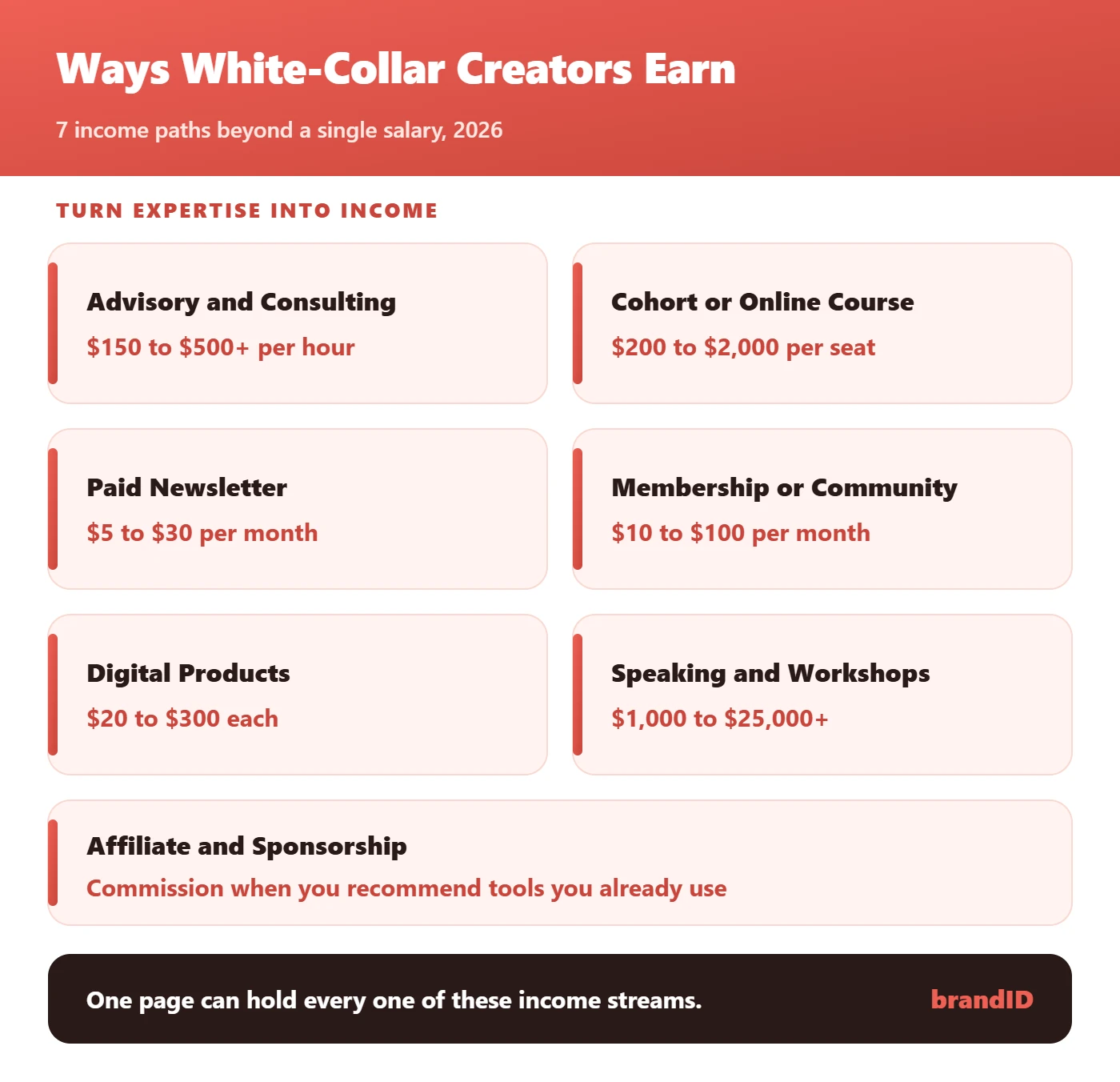
The highest-value path for most professionals is advisory work, because your hourly rate is already high and content simply fills your calendar. Courses and digital products come next, since you build them once and sell them many times. Because you charge for expertise rather than attention, you do not need the audience of subscribers a full-time YouTuber needs to earn real money. It is also steadier than ad income, which rises and falls with what a million YouTube views pays from one month to the next.
Start without a developer
Build Your Professional Home Base in Minutes
Describe what you do and brandID’s AI builder assembles a page with your newsletter signup, products, and a booking link, so you can start selling your expertise today.
How to Join a White-Collar Creator Economy in 5 Steps
You do not need to quit anything to start. Build it on the side, prove it works, and scale when the income is steady.
1. Pick Your Lane
Choose the one topic where you have real proof, not the broadest one. A tax lawyer who narrows to “taxes for freelancers” will out-earn a generic “legal tips” account every time. Depth beats reach here.
2. Build a Home Base
Give people one link that holds everything: who you are, your best content, what you sell, and a way to contact or book you. This is the page your posts point to, and it does the selling when you are not online.
3. Publish Proof Over Hot Takes
Share what you actually know: a breakdown, a framework, a real case from your work with the names removed. Three posts a week of genuine insight builds more trust than daily opinions.
4. Add One Way to Pay You
Do not wait for a big audience. Put one offer live early, a short consult, a simple guide, a paid newsletter, so you learn what people will actually buy while you grow.
5. Add Streams as You Grow
Once one offer sells, layer on the next: a course, a membership, affiliate income from the tools you recommend, which you can see mapped across the highest-paying affiliate programs. A few modest streams add up to a salary.
What Separates Earners From Dabblers
Plenty of professionals post and never earn a dollar. The ones who do share a few habits.
- They sell early. Dabblers wait for a perfect audience. Earners put a small offer up in month one.
- They pick a lane. A narrow, credible topic converts. A little bit of everything converts no one.
- They own their audience. They collect emails so a platform change cannot erase their business overnight.
- They stay consistent. Steady for a year beats a viral week. Trust builds slowly, then pays.
Sell your expertise in one place
brandID gives a professional one free page to do all of it: a newsletter signup, digital products and courses, a booking link for consults, a media kit that proves your track record, email capture to own your audience, and affiliate links for the tools you recommend. No developer, no monthly bill to start.
Bottom Line on a White-Collar Creator Economy
The white-collar creator economy is the smartest hedge a professional has in 2026. You already own the expertise. Turning it into content, products, and advisory income means a layoff is a setback, not a catastrophe, and your value stops depending on one employer’s budget.
You do not have to go viral or go full-time to start. Pick your lane, build one home base, publish real proof, and put a single offer live. A few modest income streams, built on the credibility you already have, is how a career becomes something nobody can lay off.
FAQs
1- What is the white-collar creator economy?
The white-collar creator economy is professionals like consultants, lawyers, engineers, and finance experts turning their expertise into income through content, courses, advisory work, and digital products, instead of relying on a single salary. They build businesses around credibility, not mass fame.
2- Do you need a big audience to be a white-collar creator?
No. This group typically earns with modest audiences of 10,000 to 100,000 followers, sometimes fewer. Because they sell expertise at higher prices rather than ad views, a small, relevant audience can support real income.
3- How do white-collar creators make money?
The main paths are advisory and consulting, cohort courses, paid newsletters, memberships, digital products, paid speaking, and affiliate or sponsorship income. Most combine several so they are not dependent on one.
4- Is the white-collar creator economy a side hustle or a full-time job?
It is both. Many professionals start it alongside a job as a second income and a hedge against layoffs, then some go full-time once the income is stable. Treating it as a portfolio of income streams is what makes it durable.
5- What is the difference between a white-collar creator and an influencer?
An influencer builds on personality and reach and earns mostly from sponsorships and ads. A white-collar creator builds on professional credibility and earns mostly from selling expertise through services, courses, and products to a smaller, higher-value audience.
 Summarize this article with: