Insurance lead generation has changed dramatically over the past few years. Agents who relied on cold-call lists, walk-ins, and Yellow Pages ads are now competing with carriers running eight-figure paid acquisition campaigns, AI-powered comparison engines, and direct-to-consumer platforms that often skip agents entirely. The result: lead costs are climbing, attention spans are shrinking, and the gap between a profitable book of business and one that stalls usually comes down to how predictably you fill the top of the funnel.
This guide breaks down what actually works in 2026, from the channels driving the highest-quality prospects to the conversion tactics top agencies use to turn raw inquiries into bound policies. You will see how to combine inbound traffic, paid acquisition, referrals, and modern outreach (using tools like ContactID cold outreach platform (formerly known as ContactUs AI) for personalized prospecting) into a system that produces qualified insurance sales leads on demand.
Key Takeaways
- Build a multi-channel system. Insurance lead generation in 2026 works best as a multi-channel system, not a single tactic, blending search, referrals, content, and outbound.
- Speed-to-lead wins. The fastest pipeline gains come from contacting web leads in under 5 minutes and tightening follow-up cadence, not from buying more insurance sales leads.
- Exclusive beats shared. Exclusive leads cost 2 to 5 times more than shared leads but often convert at 3 to 8 times the rate, making them cheaper per bound policy.
- Pair vendors with organic. Top insurance lead generation services (EverQuote, QuoteWizard, SmartFinancial) work best when paired with your own organic and referral pipelines.
- Personalize cold outreach. Personalized cold outreach now outperforms generic email blasts by a wide margin, particularly for commercial and life lines of insurance lead generation.
- Track the right metrics. Tracking cost per acquisition, contact rate, and bind rate is non-negotiable. Without these numbers, you cannot optimize.
What Is Insurance Lead Generation?
Insurance lead generation is the process of attracting and capturing contact information from people or businesses who have shown interest in buying an insurance policy. A useful insurance lead is more than a name and email. It includes the coverage type (auto, home, life, commercial), basic risk factors, a stated intent (shopping, renewing, just browsing), and a way to contact the prospect within minutes of capture.
Two models drive results. Inbound leads come through search, content, referrals, or paid ads pointing to your website. Outbound leads come from agent-initiated activity such as cold email, LinkedIn outreach, or list calling. The best-performing agencies blend both, because each model fills a different part of the funnel and protects the business when one channel gets more expensive or saturated.
The State Of Insurance Lead Generation In 2026
Three shifts define insurance marketing in 2026. Paid lead costs have climbed across nearly every line: shared auto leads that sold for $7 to $12 in 2021 now commonly run $14 to $25, and exclusive auto leads can hit $35 to $90 depending on geography and credit tier. Stricter consent rules (one-to-one TCPA compliance) have shrunk the supply of usable contact records, while more agents compete for the same impressions.
Organic search is fragmenting at the same time. Google’s AI Overviews now answer many top-of-funnel insurance questions directly inside the results page, so traditional blog posts attract fewer clicks. Agents still winning organic traffic do so with interactive tools (calculators, quote forms, comparison engines) or bottom-funnel local terms where Google still sends users to a website.
Speed-to-lead has become the deciding factor. Velocify data, reconfirmed in 2025 InsureTech Connect briefings, shows that contacting a web lead within 5 minutes can yield up to 21 times the conversion rate of contacting at 30 minutes. According to Statista’s 2025 insurance industry overview, US carriers and agencies spent over $13 billion on marketing in 2024, a record high, with most routed to digital lead acquisition. Insurance marketing now rewards systems, not single tactics.
How To Generate Insurance Leads: 12 Proven Strategies
Choosing how to generate insurance leads in 2026 depends on your line of business, your geography, and the time and capital you can deploy. The 12 strategies below are ranked by speed to first lead, not by long-term ROI. A new agent typically starts with strategies 1 through 4. A 5+ year agency layers in 5 through 12 for compounding pipeline.
Optimize Your Website For Local SEO And Long-Tail Search
Most homeowners and drivers still start their insurance search on Google. Ranking for “[city] auto insurance,” “[zip] homeowners insurance quote,” and similar local terms drives the highest-intent traffic an agent can get for lead generation for insurance agents. Optimize your Google Business Profile with current hours, real photos, a complete services list, and weekly posts. On your website, build a dedicated page for each line and each city you serve, then earn a steady flow of customer reviews.
Best for: agents serving a defined geographic territory. Long-tail terms like “auto insurance for high-mileage drivers in Phoenix” are easier to rank for than head terms and convert at 3 to 5 times the rate, making this one of the cheapest insurance lead generation channels over a 12-month horizon.
Run Targeted Google Search Ads
Google Ads still produces the fastest, most predictable insurance sales leads available. Target buyer-intent keywords (“auto insurance quote,” “renters insurance [city]”) rather than research keywords. Cost per click for auto insurance terms can run $20 to $80 in 2026, so structure campaigns with tight match types, negative keyword lists, and dedicated landing pages that carry a single call to action.
Pair every ad with click-to-call extensions and a short multi-step quote form rather than one long form. A 12% to 25% landing page conversion rate is realistic for well-optimized campaigns, which makes Google Ads the workhorse of paid insurance marketing in 2026.
Build A Cold Email Outreach Engine
For commercial lines, life, and group benefits, cold email is one of the most cost-effective channels for insurance lead generation per qualified meeting. The trick is personalization at scale: a relevant offer, a specific reference to the prospect’s business, and a short ask. Generic blasts perform poorly and risk deliverability damage.
Modern insurance lead generation platforms find verified contact forms across thousands of business websites and submit personalized messages on your behalf. For agents targeting small businesses, restaurants, contractors, or medical practices, this approach reliably produces 1 to 3 qualified conversations per 100 sites processed, making it one of the most efficient insurance lead generation services for B2B producers.
Activate LinkedIn For B2B Insurance Lead Generation
LinkedIn is the highest-quality channel for B2B insurance lead generation across commercial and group benefits. Build a personal profile that reads like a producer’s page (not a corporate one), and publish twice a week with risk-management tips, anonymized claim examples, and short observations about regulation changes in your verticals.
Send 15 to 25 personalized connection requests per day to decision-makers in your target industries. After 30 to 60 days of consistent activity, inbound DMs usually become the cheapest source of qualified meetings in your pipeline. This is patient lead generation for insurance agents, but it compounds.
Publish Educational Content Marketing
Insurance is confusing, so educational content earns trust faster than almost any other format. Publish answers to the questions your prospects actually ask: “Do I need umbrella coverage if I own rental property?” “What does a BOP not cover?” “Is term or whole life better for a 35-year-old with a mortgage?” Aim for 1,200+ word articles with original examples and clear takeaways.
Pair each post with a relevant lead magnet (a checklist, calculator, or coverage worksheet) and capture email addresses. Content compounds slowly but produces insurance sales leads at near-zero marginal cost after year one, making it one of the highest-margin insurance lead generation services you can build in-house.
Use Lead Magnets And Quote Calculators
Static brochures do not capture leads. Interactive tools do. A simple “How Much Life Insurance Do I Need?” calculator can lift form completions by 200% to 400% versus a generic contact form, because the visitor receives something useful before being asked for their email. This makes calculators one of the most underused tactics in insurance lead generation.
Other proven lead magnets include “Small Business Insurance Cost Calculator,” “Home Insurance Discount Finder,” and “Auto Insurance Switching Savings Estimator.” Build them once, link to them from every relevant page, and use the email captures to feed your nurture sequences for slower-decision prospects.
Launch A Structured Referral Program
Referrals convert at 40% to 70% and renew at 95%+, yet most agencies treat them as accidental. Build a program with clear mechanics: ask every newly bound customer for two introductions within 14 days of policy delivery, send a thoughtful thank you (a gift card, a charity donation in their name, a handwritten note) for every referral, and track referrals as a named pipeline source in your CRM.
A producer writing 30 new policies per month should expect 8 to 15 referral leads per month from a well-run program. This is the highest-margin channel in insurance lead generation, and the only one that gets cheaper as your book grows.
Host Webinars And Local Workshops
For life, retirement, and group benefits, a 40-minute educational webinar (or an in-person workshop co-hosted with a local CPA, estate attorney, or HR consultant) consistently outperforms cold outreach for the same effort. Each session typically produces 20 to 50 registrants and 5 to 15 follow-up meetings.
Record the session once, then republish every quarter with updated examples. Sponsored Facebook events and LinkedIn event invites are the cheapest ways to fill the registration list when you are starting out with this insurance lead generation tactic.
Tap Social Proof Through Reviews And Testimonials
A 2025 BrightLocal consumer review survey found that 87% of consumers read online reviews before contacting a local service business, and roughly half trust reviews as much as personal recommendations. For insurance lead generation, where trust is the entire product, a steady review-generation system is non-negotiable.
Send a one-click review request 5 days after a policy is bound (when satisfaction peaks), respond publicly to every review (positive and negative) within 24 hours, and surface your best three testimonials on every landing page. This single tactic reliably lifts inbound conversion by 15% to 30%.
Buy Qualified Insurance Sales Leads From Vendors
Buying leads is the fastest path when you need volume immediately. The next section breaks down which insurance lead generation companies are worth testing in 2026. Treat purchased leads as a supplement to organic and referral, not a foundation.
Vendors should never represent more than 50% of your total pipeline because price increases and quality drops are routine in this corner of insurance lead generation. Set a strict cost-per-acquisition cap before testing a vendor, and walk away the month you cannot hit it.
Run Geo-Targeted Facebook And Instagram Lead Ads
For auto, home, and life, Meta lead forms produce a high volume of cheap top-of-funnel insurance sales leads ($5 to $18 in 2026 for auto). Quality is lower than Google search, so build a workflow that filters leads by their answer to a qualifying question (current carrier, vehicle year, household income range) inside the form itself.
Speed to lead matters even more on Meta, because intent fades within minutes. Set up automated text-first responses tied to your CRM so a Facebook lead form submission triggers a personalized SMS within 60 seconds. This is one of the fastest paid channels for lead generation for insurance agents in 2026.
Capture Mobile Traffic With A Link-In-Bio Landing Page
Independent agents who post on Instagram, TikTok, or X often send traffic to a generic Linktree, which buries the quote form three taps deep. A purpose-built brandID bio page puts your quote form, calendar booking link, top reviews, and lead magnets one tap away, with mobile-optimized formatting baked in.
For agents posting 3+ times per week on social, this single change typically lifts conversions from social by 30% to 80%, making it one of the highest-ROI insurance lead generation upgrades you can make in an afternoon.
The 12 strategies above fall into four channel types. The infographic below maps each strategy to its category and the 2026 benchmark that matters most, so you can pick a balanced lead generation mix at a glance.
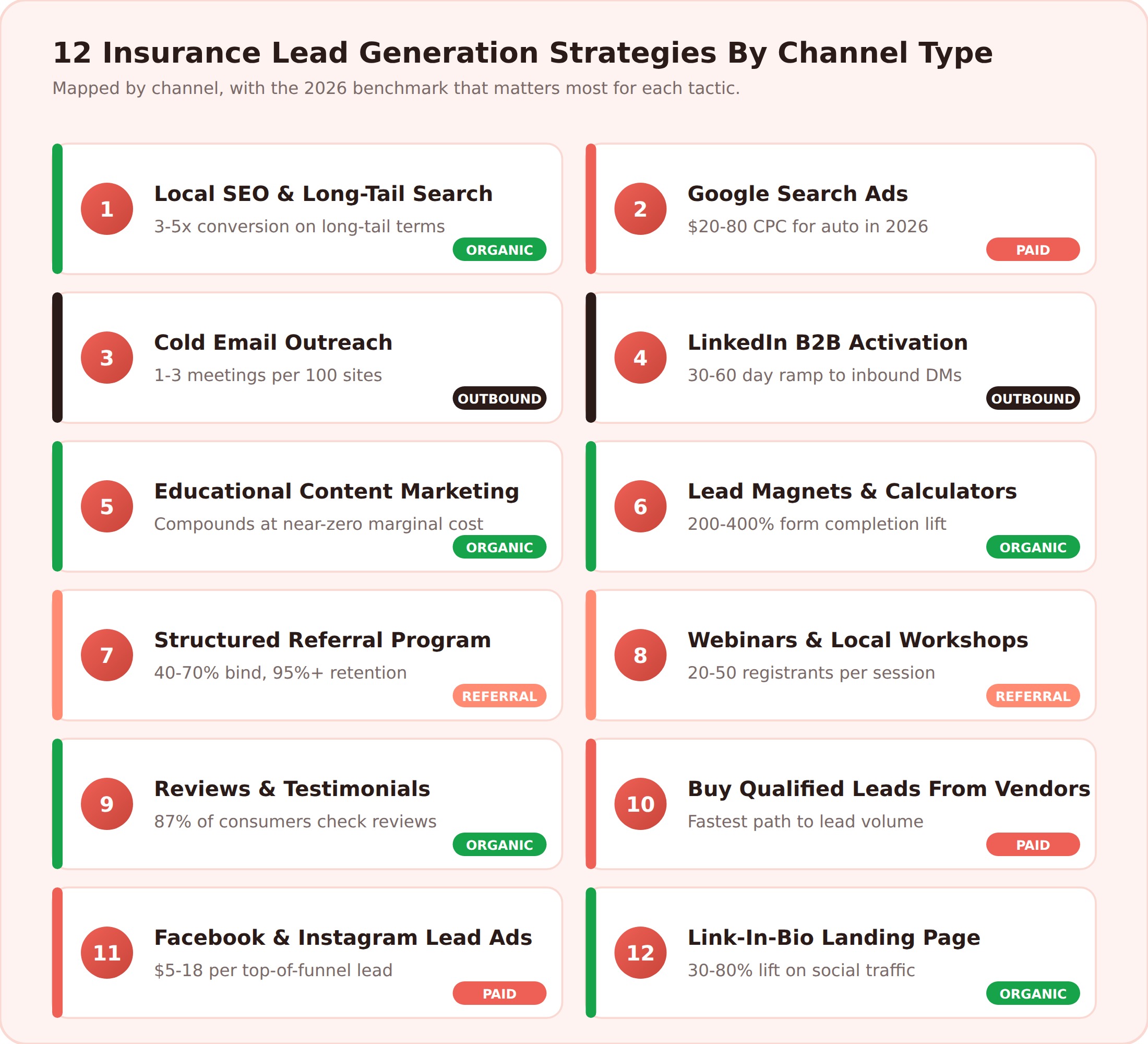
Figure: 12 insurance lead generation strategies grouped by channel type.
Most agencies need at least one strategy from each category for a balanced pipeline. Pure paid channels burn cash without compounding. Pure organic compounds over time but is slow to start. The strongest insurance marketing mixes pair one organic and one paid channel for top-of-funnel volume with one outbound and one referral channel for higher-margin pipeline.
Top Insurance Lead Generation Companies To Compare In 2026
Most agents test 2 to 4 insurance lead generation services before settling on a vendor mix. The platforms below cover both AI-powered outreach tools and established lead-data vendors, ranked by overall fit for modern agencies in 2026. Compare them on a per-line, per-state basis, because performance varies widely by geography.
ContactID
ContactID is an AI-powered cold outreach platform for insurance lead generation. It finds verified contact forms on the business websites you want to reach and submits a personalized message on your behalf. Built for insurance agents and B2B producers, it works especially well for those targeting small business owners across verticals like restaurants, contractors, dental practices, accountants, and retailers. Unlike traditional data vendors that resell consumer inquiry records, ContactID generates first-touch conversations with decision-makers you choose, billed per website processed rather than per submission. For commercial, group benefits, and life producers who want predictable outbound unit economics, this is one of the fastest paths to qualified insurance sales leads in 2026. Learn more about ContactID.
- Predictable flat per-website pricing (no per-submission fees)
- Bypasses email spam filters by going through verified contact forms
- Scales without hiring an SDR or appointment-setting team
- Strong fit for commercial, benefits, and life lines
- Built for B2B outreach (not personal auto or home insurance)
- Requires a target list of businesses you want to reach
- Response quality depends on offer relevance and follow-up cadence
EverQuote
EverQuote is an insurance lead marketplace. It collects consumer quote requests through its own websites and partner traffic, then sells those leads to agents in real time across auto, home, life, and renters. As the largest standalone insurance lead generation platform in the United States in 2026, EverQuote has the deepest inventory in major metros. Its data-driven matching system scores each lead before delivery, which gives experienced agents a measurable lift versus undifferentiated shared lead inventory.
- Largest inventory in the US market
- Strong filter controls and lead scoring
- Transparent return and refund policy
- CRM integrations with EZLynx, AMS360, HubSpot
- Competitive on shared leads (4 to 6 agents per lead)
- Minimum spend commitments on some plans
- Lead quality varies notably by state
QuoteWizard By LendingTree
QuoteWizard is an insurance lead-buying platform owned by LendingTree. It sells consumer inquiries and warm-transfer calls to agents across auto, home, health, and life lines. As one of the oldest insurance lead generation companies in the United States, QuoteWizard benefits from LendingTree’s consumer traffic and has a strong record on call transfers (warm transfers to a live agent).
- Strong call transfer program (one of the best in the industry)
- Broad line coverage across P&C and life
- Established platform with stable inventory
- Shared lead density similar to EverQuote
- Filter limitations on certain product types
- Return policy stricter than smaller vendors
SmartFinancial
SmartFinancial is an insurance lead aggregator that sells phone-verified inquiries to agents. It focuses on intent-verified insurance sales leads with a strong filter set, particularly for auto and home. Agents working in mid-sized metros often report a better quality-to-price ratio here than at the two larger insurance lead generation platforms.
- No long-term contracts
- Strong phone validation reduces dead leads
- Reasonable customer service responsiveness
- Inventory thinner in rural states
- Exclusive volume can be inconsistent month to month
NextGen Leads
NextGen Leads is an insurance lead generation vendor specializing in auto and health insurance. It runs a proprietary traffic engine that sources its own consumer inquiries (rather than buying traffic from third parties), and is known for above-average shared lead conversion in competitive states. Its dashboard reporting is the most agent-friendly in the category.
- Above-average bind rates on shared auto reported by users
- Clean dashboard with traffic source transparency
- Generous return window
- Health insurance leads only available during open enrollment windows
- Limited support for life and commercial lines
Datalot
Datalot is a live-call lead vendor for insurance agents. It routes pre-qualified inbound phone calls to a producer in real time, specializing in auto, home, and Medicare. This makes Datalot one of the few high-intent options in insurance lead generation for agencies that prefer phone over web inquiries.
- High intent, since prospect is already on the phone
- Pre-qualification reduces tire-kicker calls
- Strong for Medicare and senior products
- Higher per-lead cost than internet leads
- Requires producer availability during call hours
- Less volume than EverQuote or QuoteWizard
Common Insurance Marketing Mistakes That Kill Pipeline
Six mistakes show up in nearly every agency that asks for a marketing audit. Fix these before adding new lead generation channels.
Lead spend without a cadence is a refund engine. Build the response and follow-up system before the next purchase order.
A homeowner shopping 60 days before renewal needs different messaging than someone whose policy lapses tomorrow. Segment by intent and policy timeline.
Over 70% of insurance quote searches in 2025 happened on mobile. If your quote form takes more than 90 seconds on a phone, you lose roughly half your traffic to abandonment.
Billboards and reels build memory. Search ads and quote forms produce insurance sales leads. Mixing budgets without separating goals leads to vague results and no clear ROI.
A 5% lift in retention typically produces a 25% to 95% lift in profit (Bain & Company research). Many agencies overspend on new acquisition and underspend on policy reviews and cross-sell.
Most agencies say they ask for referrals. Almost none do it systematically. Without a triggered ask within 14 days of binding, the referral pipeline stays accidental, and you forfeit the cheapest lead source you have access to.
Key Metrics For Lead Generation For Insurance Agents
What you measure determines what you can improve. The table below shows the minimum metric set every agency running lead generation for insurance agents should track weekly.
| Metric | Definition | 2026 Benchmark | Why It Matters |
|---|---|---|---|
| Cost Per Lead (CPL) | Acquisition spend / leads generated | $8 to $90 by line | Channel efficiency at the top of funnel |
| Contact Rate | % of leads reached within 24 hours | 70%+ | Biggest single predictor of bind rate |
| Quote Rate | % of contacts who receive a quote | 55% to 70% | Reveals script and qualification quality |
| Bind Rate | % of quoted prospects who buy | 18% to 35% | The conversion KPI that determines profit |
| Cost Per Acquisition | CPL / bind rate | $200 to $1,200 | The number that actually matters |
| LTV / CAC Ratio | Lifetime value divided by CPA | 4:1 minimum | Tells you the channel is scalable |
| Speed To Lead | Avg minutes from form to first contact | Under 5 min | Most controllable lever in the funnel |
Track these metrics by channel (Google Ads, EverQuote, referrals, cold outreach) rather than rolling them up. The agency average hides the truth that one channel often subsidizes another with no one realizing it until renewals come due.
Conclusion
Insurance lead generation in 2026 rewards systems thinking. The agencies pulling ahead are not the ones with the biggest ad budgets. They are the ones who combine 3 or 4 channels (search, referrals, content, and outbound), respond to inquiries in minutes instead of hours, and treat every bound policy as the start of a referral loop rather than the end of a sale.
Start by fixing the leaks in your current funnel before adding new channels. Cut your speed-to-lead, structure your follow-up cadence, and build a referral ask into your binding workflow. Then add paid channels that produce insurance sales leads at a cost per acquisition your renewals can comfortably support.
ContactID finds verified contact forms across the businesses you want to reach, submits a personalized outreach message on your behalf, and bills by website processed instead of per submission. The result: predictable unit economics across any scale, from 500 small businesses up to 50,000.
- ContactID for AI-personalized cold outreach to thousands of business websites.
- brandID Affiliate Marketplace for agencies adding referral-driven revenue from financial and lifestyle partners.
Frequently Asked Questions
What is insurance lead generation?
How much do insurance leads cost in 2026?
What is the best insurance lead generation service?
How do I generate insurance leads without buying them?
 Summarize this article with: