Since B2B SaaS marketing shares surface traits with traditional marketing, it’s frequently misunderstood as standard B2C marketing. However, its purpose moves beyond common habits, creating leads or producing endless content. Interestingly, methods that thrive in B2C or e-commerce don’t always work in the B2B realm.
Today, marketers need a more iconoclastic mindset than ever to fully grasp how marketing and sales—which are closely interconnected and mutually influential—must work together across modern b2b sales channels.
A clear understanding of this principle enables effective lead progression from MQLs to SQLs, ensuring conversion efficiency and long-term client retention, all while managing CAC and CPL within target ranges.
In this comprehensive guide, we’ll break down the real meaning of B2B SaaS marketing and uncover strategies designed to fuel sustainable, scalable growth, so you can build a structured B2B SaaS marketing plan that actually drives revenue.
What Is B2B SaaS Marketing?
Prior to jumping into what B2B SaaS marketing really is, I believe it’s quite crucial to get familiar with some key aspects of it, although it may sound self-explanatory. Let’s break this down piece by piece.
- B2B: It stands for “Business to Business.” This is when one company sells to another company, not to individual consumers like you and me.
- SaaS: “SaaS” means “Software as a Service.” Instead of buying and installing software on your computer like in the old days, you simply subscribe and use it online, usually paying a monthly or yearly fee.
In simple terms, B2B SaaS marketing means finding the right companies, showing them how you solve their problems, and making it obvious that your product is the perfect fit.
In other words, instead of screaming “look at our features,” B2B SaaS marketing is about:
- Clearly defining who you serve and the specific pains you solve
- Attracting the right decision‑makers and users into your world
- Nurturing trust across a longer buying cycle
- Turning customers into long‑term, profitable relationships
Essentially, it’s not just about generating sign‑ups. It’s about orchestrating the entire journey.
The Core B2B SaaS Marketing Funnel For 2026
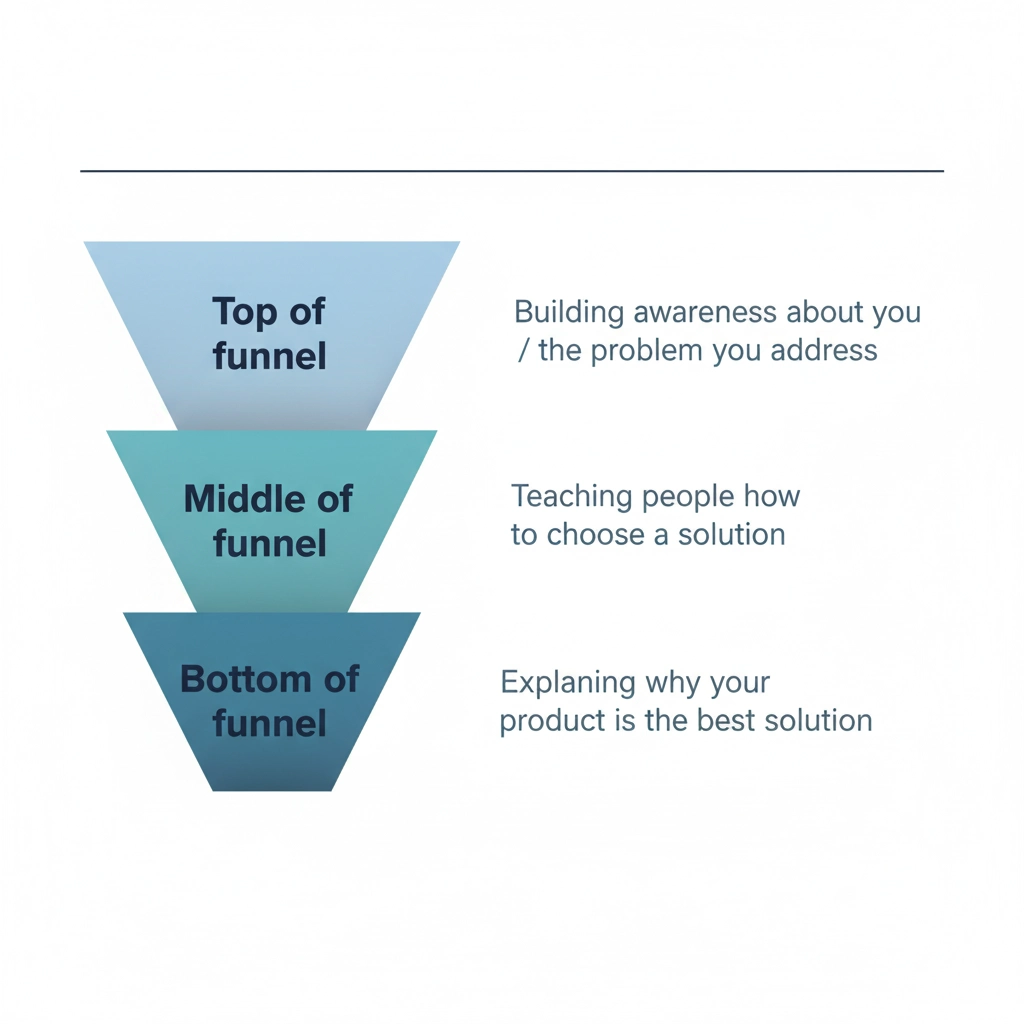
Here’s the deal: whether you map it or not, your buyers already move through a funnel. The smart teams simply design it on purpose. At a high level, your funnel in 2026 will revolve around three main stages:
- Awareness (TOFU): They discover you exist.
- Consideration (MOFU): They actively evaluate you.
- Decision (BOFU): They choose you.
Here’s a closer look at how each stage actually works.
1- Awareness (TOFU)
At the top of the funnel, your job is to get on the radar of the right accounts. Not just any clicks, the right roles, industries, and problems. This is where channels like SEO, LinkedIn, Reddit, cold outreach, and paid discovery campaigns do the heavy lifting. You’re not closing deals here; you’re:
- Naming the problem better than anyone else,
- Showing that you understand their world,
- Giving them a reason to remember your brand.
Think of TOFU as planting flags in their brain: “When this hurts enough, we’re the obvious call.”
2- Consideration (MOFU)
In the middle of the funnel, the energy shifts. Now prospects are asking:
- Is this tool worth the hassle of implementing?
- Will my team actually use it?
- How does it compare to what we’re already doing?
Here, you nurture with in‑depth content, demos, webinars, case studies, and email sequences. Your job is to make it ridiculously easy for them to understand how your product works in their context and what outcomes they can expect; This is a core part of B2B SaaS product marketing, and where you can win or lose deals without even realizing it.
3- Decision (BOFO)
At the bottom of the funnel, risk and politics show up in full force. Someone has to justify:
- The budget
- The time investment
- The internal change
Here’s where tight sales enablement, tailored demos, pilots, proof of concept offers, and strong social proof matter.
By aligning these efforts with B2B SaaS growth marketing principles, you’re easing internal fears and helping champions look smart when they say, “We should go with this.” Get this stage right, and BOFO becomes less about “convincing” and more about removing the final excuses.
The 10 B2B SaaS Marketing Strategies Generating Real Results in 2026
Now let’s move from theory to practice. These are the 10 strategies you’ll see again and again in SaaS companies that are actually growing.
1- Contact Form Outreach
Most B2B teams still overlook contact form marketing because it doesn’t feel scalable. It’s quieter, slower, less flashy than blasting 1,000 cold emails before lunch.
That assumption is outdated.
In 2026, contact form outreach works precisely because it aligns with how companies want to be approached. A contact form isn’t an obstacle; it’s an explicit invitation. When a business publishes a “Contact Us” page, they’re defining their preferred path for inbound communication, an approach that mirrors how B2B SaaS inbound marketing builds trust and relevance. Using that path immediately puts your message on more respectful—and more effective—ground.
There are two structural advantages most teams miss:
- Forms are intentional gates.
Unlike inboxes, which are cluttered with unsolicited pitches, contact forms exist to filter and route legitimate inquiries. When you submit one, your message enters a workflow designed to be read, evaluated, and often forwarded internally.
- Deliverability is built in.
You’re not battling spam filters, sender reputation, or warming schedules. You’re using the company’s own system to deliver your message exactly where it’s meant to go.
Is contact form outreach still a type of cold outreach? Technically, yes.
But when they are implemented, they are two fundamentally different stories. Think about it for a second: in contact form outreach, you are not appearing in a crowded inbox. Quite the contrary, your message arrives through a path the company has intentionally created for business inquiries, which makes it far warmer compared to traditional cold email.
2- Clarify Your Value Proposition
If your homepage headline could sit on 10 other SaaS sites and still make sense, we’ve found your bottleneck. A razor‑sharp value proposition answers:
- Who it’s for
- What they get
- How their world improves
Instead of “All‑in‑one platform for modern teams,” think more along the lines of:
“Close deals 30% faster by giving your sales team a single workspace for proposals, approvals, and signatures.” See the difference? One is wallpaper. The other hits a nerve.
3- SEO & Content Marketing
Although the rise of LLM systems has significantly changed how people interact with technology, search is far from disappearing. If anything, it remains a critical pillar of discovery. That’s why neglecting SEO in 2026 as part of your b2b software marketing strategies means overlooking one of the highest-ROI channels available to SaaS companies.
Nearly 70% of website traffic still begins with a search engine query, and your target audience is actively looking for solutions to the pain points holding them back. Their searches often include:
- “best alternative to [X]”
- “[X] vs [Y]”
- “[X] pricing”
- “[X] reviews”
These are not casual searches; they signal strong buying intent. At this stage, prospects are comparing options, evaluating value, and narrowing their choices in the middle of the funnel, making visibility in search a decisive competitive advantage.
4- Reddit Marketing
Based on current trends, it’s no exaggeration to say that Reddit has become one of the most predominant—and, at the same time, most influential—research hubs for B2B buyers over the past decade. Interestingly, according to Reddit’s own business insights, around 70% of B2B leaders use Reddit conversations to confirm their purchasing decisions, which is truly impressive.
There is an influx of decision-makers on Reddit, and the platform acts as a catalyst for validation in complex purchasing choices. That being said, the platform can easily perplex newcomers due to its complexity, causing them to get lost or drift into irrelevant threads.
Nevertheless, it is completely safe to claim that Reddit has become a watershed for B2B research. So, if you want to gain the trust of your ideal customers, there is no better place than Reddit to start—provided that your effort is continual.
Done right, Reddit marketing lets you:
- Listen to real pain points in uncensored language,
- Spot the objections and confusions that never show up on sales calls,
- Answer questions as a helpful expert, not a walking logo,
- Subtly introduce your product when it’s genuinely relevant.
Approach Reddit like you’re joining a community, not raiding it. Help first, mention your product second.
5- LinkedIn Marketing
LinkedIn remains the default social platform for B2B SaaS, and for good reason. Around 40% of B2B marketers say LinkedIn delivers their highest-quality leads, and nearly 9 in 10 B2B marketers use it for lead generation, according to LinkedIn’s lead generation data.
Essentially, LinkedIn marketing today is less about corporate updates and more about:
- Consistent posts from founders, marketers, and product leaders
- Stories, frameworks, opinions, and behind‑the‑scenes lessons
- Customer wins, use‑case breakdowns, and mini case studies
- DMs and comment threads that turn into actual opportunities
Treat LinkedIn as your ongoing conference keynote: you show up, share what you’re learning, and let the right people come closer.
6- Email Marketing
Email is where you turn attention into action. Once someone joins your list—from a demo, a trial, a lead magnet, or a webinar—you have an ongoing, low‑cost channel to:
- Onboard them properly,
- Teach them how to get value faster,
- Nurture them toward a stronger commitment,
- Win them back if they drift away.
7- Affiliate & Referral Programs
Here’s a secret: your happiest users, best consultants, and favorite partners can often sell you better than your ads can. Affiliate and referral programs help you:
- Reward customers who bring in other teams or companies,
- Encourage agencies and consultants to recommend your product,
- Turn niche creators into scalable acquisition channels.
When you make referrals easy and clearly worth it, word of mouth stops being “nice when it happens” and starts becoming a channel you can rely on.
8- Conversion Rate Optimization (CRO)
The majority of B2B SaaS websites leave money on the table simply because they never seriously optimize for conversion. CRO is the process of turning your existing traffic into more:
- Demos booked
- Trials started
- Proposals requested
Where to Focus Your Efforts For Conversion Rate Optimization
Start by focusing on:
- Homepage
- Pricing page
- Primary landing pages
Having spent close to ten years in digital marketing, I’ve found that great CRO results come down to asking the right questions. If you’re serious about improving conversions in B2B SaaS digital marketing, here are the key ones every expert should be thinking about:
- Is the value proposition instantly clear?
- Does the page address the biggest fears and objections?
- Is there one obvious CTA or three competing ones?
- Is the form as short and simple as it can be?
You may not believe it, but statistically speaking, it has been proven that even small changes in conversion rates across key pages compound into major revenue gains over time.
9- Paid Channels
It’s important to understand that weak positioning or an inefficient funnel doesn’t get fixed by spending more on paid traffic; it just scales inefficiency. Once your copy and conversion paths are optimized, though, paid media such as Google Ads and Meta Ads can serve as high-leverage B2B SaaS marketing tools for driving qualified growth and can:
- Accelerate testing of new audiences and offers,
- Put you in front of high‑intent searches,
- Keep you visible to warm accounts via retargeting.
Common B2B SaaS paid plays include:
- Search ads for bottom‑of‑funnel keywords
- LinkedIn ads targeting specific roles and firmographics
- Retargeting visitors who viewed key pages
Start small, test ruthlessly, then scale what proves it can bring customers—not just clicks.
10- Retention Marketing
Up until right now, all we have discussed was merely centralized around marketing acquisition channels, but what about returning old users who successfully at least once purchased from us?
One of the biggest mistakes B2B SaaS companies inadvertently make is treating “customer won” as the finish line. In reality, that’s where the most profitable marketing begins. Retention marketing focuses on:
- Onboarding users so they reach value fast,
- Educating them on advanced features and use cases,
- Keeping engagement high so churn stays low.
In simple terms: the more consistently you help customers succeed, the more your LTV climbs—and the more aggressive you can be with acquisition.
Conclusion
As we have deeply articulated, B2B SaaS marketing in 2026 is far more than following trends or a collection of tactics. To be precise, one could legitimately allege that it is a data-driven approach that encapsulates various kinds of strategies aimed at a single, well-defined goal. Additionally, one important element of B2B SaaS that should under no circumstances be neglected is defining your target audience persona and analyzing their behavior at every stage of the funnel, from awareness to decision and even retention.
Ultimately, by knowing who they are, what they want, and how you can provide value to them, you can leverage various tactics—from organic to paid channels—to generate high-quality leads that can potentially lead to conversions and turn your MQLs into SQLs and loyal advocates.
If contact form outreach is part of your strategy, don’t run it manually. Install brandID’s Bulk Cold Outreach with AI Contact Us Form Submission Extension and turn high-intent contact forms into a scalable, consistent revenue channel—without sounding like spam.
FAQs
Industry data shows that most SaaS companies allocate 10–30% of their annual recurring revenue to marketing efforts. For startups or high-growth ventures, marketing budgets can rise to 20–50% to maximize customer acquisition.
Stop hunting for a perfect CAC score. Shoot for LTV:CAC ≥3 with payback zipping under a year, measured raw against deal sizes, sales marathons, and lifetime value. This mirror shows if you’re scaling smart or just spending wild.
Think of your marketing goals as a reverse-engineering exercise. Start with the revenue number leadership wants to hit, figure out how much new ARR that means for you, and then work backward through your funnel, from closed deals all the way up to the leads required. Use your funnel conversion rates and average deal size to spot what’s realistic. Be sure every goal is SMART, and keep CAC, LTV, and spend efficiency front and center.
Content/SEO, LinkedIn outreach and ads, email nurturing, smart PPC/search, and partner referrals rise to the top most times. Select only those hitting your ideal audience, flowing them toward buys, and tracking real revenue—focus hard, and the rest falls into place.
Generative AI is transforming B2B SaaS marketing by enabling faster content creation, hyper-personalized campaigns, and smarter audience targeting based on real-time data. It also improves lead scoring, automates customer interactions, and helps teams optimize performance with predictive insights.