
How much do real estate agents make? The honest answer is that the median agent earns about $56,320 a year, and that number tells you almost nothing about what you would earn.
Real estate income is not a salary. It is a scoreboard tied to one thing: closed transactions. Two agents with the same license in the same city can earn $18,000 and $180,000 in the same twelve months, and the gap is rarely talent.
This guide covers what agents actually earn per year, per sale, and per hour, how commission works now that the 2024 NAR settlement has rewritten the rules, what a brokerage split really costs, and what you keep after expenses and self-employment tax.
It ends with the levers that move income fastest. Keeping a pipeline full drives all of them, which is why real estate lead generation ideas do more for your income than any certification.
Key Takeaways
- The median real estate agent earns about $56,320 a year per Bureau of Labor Statistics data, with the middle half between roughly $42,000 and $89,000 and the top 10% above $125,000
- Commission rates are negotiable and no longer posted in the MLS. Redfin put the average buyer’s agent commission at 2.42% of sale price in Q3 2025, well below the old 3% norm
- On a $500,000 sale at 2.5%, the agent side earns $12,500, which becomes about $8,750 after a 70/30 brokerage split and roughly $6,000 after tax and expenses
- First-year agents typically earn $30,000 to $50,000, and NAR data has shown median gross income near $8,100 for members with two years of experience or less
- Your brokerage split matters less than your training in year one. A great split on no mentorship usually nets less than a worse split with real support
- Location drives income more than skill, because the same 2.5% fee on a $900,000 home and a $200,000 home is the same work for a very different check
- Transaction count is the whole scoreboard, so the fastest route to a higher income is a lead pipeline that produces steadily rather than seasonally
Real Estate Agent Income at a Glance
The short answers, with the detail in the sections that follow.
| Question | Quick answer |
|---|---|
| How much do real estate agents make a year? | A median of about $56,320, with the middle half earning roughly $42,000 to $89,000 (BLS) |
| How much per sale? | About $8,750 on a $500,000 home at a 2.5% fee after a 70/30 brokerage split, before tax |
| How much in the first year? | Usually $30,000 to $50,000, and often far less while the pipeline builds |
| How much per hour? | Roughly $41 an hour on average, though agents are paid per closing rather than per hour |
| What is the typical commission? | Negotiable. Redfin measured an average 2.42% buyer’s agent commission in Q3 2025 |
| Do top agents earn six figures? | Yes. The top 10% clear $125,000+ and high-volume or luxury agents earn several times that |
| Is any of it salaried? | Almost never. Agents are independent contractors paid only when a transaction closes |
How Much Do Real Estate Agents Make a Year?
The Bureau of Labor Statistics puts the median annual wage for real estate sales agents at about $56,320 in its May 2024 data. The distribution around that median matters more than the median itself:
- Median: about $56,320 a year
- Middle half, 25th to 75th percentile: roughly $42,000 to $89,000
- Top 10%: more than $125,000, before brokerage splits and business expenses
- Bottom quartile: under $42,000, which includes a large number of part-time and first-year agents
You will also see much higher averages quoted, and both sets of numbers are accurate. They measure different populations.
| Source | Reported figure | What it actually measures |
|---|---|---|
| Bureau of Labor Statistics | $56,320 median | Wage data across all licensed sales agents, including part-timers |
| ZipRecruiter | About $85,800 a year, $41.25 an hour | Job-posting and self-reported data, weighted toward active full-time agents |
| Indeed | About $101,000 a year | Self-reported salaries, skewed toward agents motivated to report strong numbers |
| NAR Member Profile | About $58,100 average for REALTORS | Association members only, who tend to be more established than the licensee population |
The practical read: if you work full time, prospect consistently, and stay in the business past year two, the $80,000 to $100,000 range is realistic. If you treat the license as a side project, the median is optimistic.
How Much Do Real Estate Agents Make Per Sale?
This is the question most people actually mean, and the math runs in four steps. Every step takes a cut before you see anything.
- Step 1, the gross fee. Sale price multiplied by your negotiated rate. On a $500,000 home at 2.5%, that is $12,500.
- Step 2, the brokerage split. Your broker takes an agreed share. At 70/30 you keep $8,750.
- Step 3, team and referral splits. If you are on a team or the lead came from a referral partner, another 25% to 50% can come off before you.
- Step 4, tax and expenses. Self-employment tax, marketing, MLS dues, and insurance come out of what is left.
A useful rule for new agents: plan on keeping roughly half of your gross commission income once splits, tax, and expenses are all paid.
| Sale price | Agent-side fee at 2.5% | After 70/30 split | Rough take-home after tax and costs |
|---|---|---|---|
| $200,000 | $5,000 | $3,500 | About $2,400 |
| $350,000 | $8,750 | $6,125 | About $4,200 |
| $500,000 | $12,500 | $8,750 | About $6,000 |
| $750,000 | $18,750 | $13,125 | About $9,000 |
| $1,000,000 | $25,000 | $17,500 | About $12,000 |
| $2,000,000 | $50,000 | $35,000 | About $24,000 |
Two things this table makes obvious. Price point does more for your income than effort does, and the brokerage split is the single largest deduction you have any control over.
How Real Estate Commission Works After the NAR Settlement
If you are reading older salary articles, treat their commission sections with caution. The rules changed in August 2024 and a lot of published guidance was never updated.
What Changed
The National Association of REALTORS settlement removed compensation offers from the MLS and required written buyer agreements. In practice:
- Buyer’s agent compensation is no longer advertised in the MLS, so a buyer’s agent cannot assume a fee is waiting on the listing side
- Buyers must sign a written representation agreement before touring homes, stating what their agent will be paid and by whom
- Commission is explicitly negotiable, and no law, board, or association sets a standard rate
- Sellers may still offer to cover the buyer’s agent fee, but it is now negotiated deal by deal rather than assumed
What Commissions Actually Look Like Now
The old shorthand of 6% split evenly into two 3% sides is no longer a safe assumption. Redfin reported the average U.S. buyer’s agent commission at 2.42% of sale price for homes sold in Q3 2025.
Total commissions in many markets now land between 4.5% and 5.5% rather than the 5% to 6% that was standard for decades, and the spread between markets is wider than it used to be.
Fee conversations now happen before you show a single property. Agents who can explain their value in specific terms hold their rate. Agents who cannot are discovering how negotiable commission always was.
Commission Splits: What Your Brokerage Actually Costs
Every agent works under a broker, and the broker is paid before you are. The split model you choose changes your annual income more than most agents realize.
| Brokerage model | How it works | Best suited to |
|---|---|---|
| Traditional split | 50/50 to 70/30 in the agent’s favor, rising with production | New agents who need training, leads, and supervision |
| Graduated or cap model | Split improves as you hit volume targets, then caps for the year | Growing agents with steady, predictable production |
| 100% commission plus desk fee | You keep the full fee and pay a flat monthly or per-transaction charge | High-volume agents whose fees far exceed the desk cost |
| Team split | The team leader takes a share, often 25% to 50%, in exchange for leads | New agents who would rather trade margin for a filled pipeline |
| Referral split | The referring agent takes 20% to 35% of your side | Relocation and out-of-area business |
The trap is chasing the best split too early. A 90/10 split on ten deals you close alone earns less than a 60/40 split on twenty-five deals with mentorship, lead flow, and a broker who answers the phone at 9pm on a Sunday.
How Much Do New Real Estate Agents Make in Their First Year?
Most first-year agents earn between $30,000 and $50,000, and a meaningful share earn close to nothing. NAR member data has reported median gross income around $8,100 for members with two years of experience or less, which shows how steep the early ramp really is.
The first year is also the only year where money reliably flows outward before it flows in. Typical startup costs:
| Cost | Typical range | Notes |
|---|---|---|
| Pre-licensing course and exam | $300 to $1,000 | Varies widely by state |
| License application and fingerprinting | $150 to $400 | Renewed every one to four years |
| Association and MLS dues | $600 to $1,500 a year | Local, state, and national dues stack |
| Errors and omissions insurance | $300 to $1,000 a year | Sometimes covered by the brokerage |
| Marketing, signage, and photography | $200 to $1,000 a month | The largest variable cost and the one that drives pipeline |
| CRM and website tools | $30 to $200 a month | Where most agents overspend before they have leads |
Budget for six months of living expenses before your first closing lands. The transaction that pays in March was usually prospected in December.
Real Estate Agent Salary by Experience
Income in this industry tracks production rather than tenure, but experience is a reasonable proxy because production compounds. Referrals from past clients cost nothing to acquire and close faster than any lead you buy.
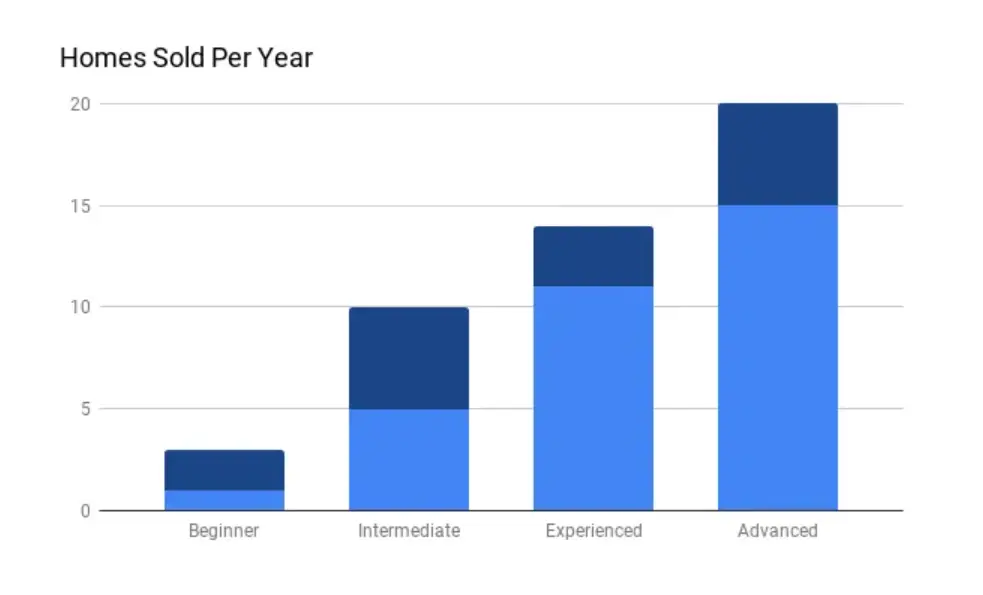
| Experience | Typical deals per year | Typical income range |
|---|---|---|
| Year 1 | 1 to 3 | $0 to $50,000 |
| Years 2 to 3 | 4 to 8 | $45,000 to $75,000 |
| Years 4 to 6 | 8 to 14 | $75,000 to $120,000 |
| Years 7 to 15 | 12 to 25 | $100,000 to $200,000 |
| 16+ years | 20+ | $150,000 and up, with NAR reporting about $78,900 average for this group |
Note the gap between the averages and the ranges. NAR reports roughly $78,900 for members with 16 or more years, which is far below what a high-volume veteran earns. Averages in this industry are dragged down by a long tail of part-time licensees who close one or two deals a year.
How Much Do Real Estate Agents Make Per Hour and Per Month?
Agents are not paid hourly, but the arithmetic is useful for comparing the career against a salaried alternative. ZipRecruiter puts the U.S. average at about $41.25 an hour as of July 2026, which works out near $85,800 a year on a full-time schedule.
Monthly income is where the reality of the job shows up. A $90,000 year is rarely $7,500 twelve times. It is more often two months near zero, a month at $22,000 when three deals close together, and the rest scattered in between.
- Closings cluster, because contracts written in the same fortnight tend to settle in the same fortnight
- Seasons swing volume, with spring and early summer carrying a disproportionate share of transactions in most markets
- Deals collapse late, so income you counted on can vanish a week before settlement
Agents who survive the first two years almost all do the same thing: they run the business on a rolling three-month cash buffer rather than on this month’s expected closings.
Real Estate Agent Salary by State
Where you work moves your income more than almost any other single factor, because commission is a percentage of local home prices. These are ZipRecruiter’s state averages as of mid-2026.
| State | Average agent salary |
|---|---|
| Washington | $97,169 |
| District of Columbia | $96,948 |
| New York | $93,860 |
| Massachusetts | $93,696 |
| Alaska | $92,394 |
| Vermont | $91,219 |
| North Dakota | $90,776 |
| Oregon | $90,707 |
| Colorado | $90,213 |
| Hawaii | $89,135 |
| Nevada | $87,363 |
| New Jersey | $87,100 |
| Wisconsin | $86,595 |
| Pennsylvania | $85,999 |
| Delaware | $85,867 |
| South Dakota | $85,793 |
| Virginia | $85,057 |
| California | $84,669 |
| Minnesota | $84,026 |
| Rhode Island | $84,018 |
| New Hampshire | $83,434 |
| Maryland | $83,265 |
| New Mexico | $83,139 |
| Illinois | $83,135 |
| Maine | $83,064 |
| Wyoming | $82,466 |
| Nebraska | $81,799 |
| Indiana | $81,637 |
| Connecticut | $81,613 |
| Ohio | $81,563 |
| Mississippi | $81,252 |
| Idaho | $80,722 |
| Iowa | $80,582 |
| Missouri | $80,474 |
| Arizona | $79,949 |
| Texas | $79,929 |
| South Carolina | $79,612 |
| Oklahoma | $79,215 |
| Montana | $78,745 |
| Utah | $78,103 |
| North Carolina | $77,969 |
| Tennessee | $77,867 |
| Alabama | $77,762 |
| Kansas | $76,514 |
| Michigan | $74,777 |
| Kentucky | $74,513 |
| Louisiana | $73,363 |
| Georgia | $72,442 |
| Arkansas | $70,942 |
| West Virginia | $66,418 |
| Florida | $64,112 |
Read these as market-price signals rather than pay scales. Florida sits at the bottom of the table despite a busy housing market, largely because the state has an unusually high number of licensed agents competing for the same transactions.
What Agents Actually Keep After Expenses and Tax
Almost every salary article stops at gross commission. That is the number that gets quoted at dinner parties and the number that bankrupts new agents.
You are an independent contractor. Nothing is withheld, nobody matches your payroll tax, and every business cost is yours. On a $100,000 gross commission year, a realistic accounting looks like this:
| Line item | Typical amount | Running total |
|---|---|---|
| Gross commission income | $100,000 | $100,000 |
| Brokerage split, 70/30 before cap | Minus $30,000 | $70,000 |
| Self-employment and income tax | Minus $17,500 | $52,500 |
| Marketing, signage, and photography | Minus $7,000 | $45,500 |
| Dues, MLS, licensing, insurance | Minus $3,000 | $42,500 |
| CRM, website, and software | Minus $1,800 | $40,700 |
| Vehicle, fuel, and client costs | Minus $4,500 | $36,200 |
This is why experienced agents talk about gross commission income rather than salary, and why the honest answer to what agents make is always two numbers. Set aside 25% to 30% of every commission check for tax the day it lands, and pay quarterly estimates.
Agent vs. Broker vs. REALTOR Income
These three titles get used interchangeably and they pay differently.
- Real estate agent: holds a salesperson license and must work under a broker. Earns a split of each commission.
- Real estate broker: holds a higher license, can operate independently, and can employ agents. National data shows brokers typically earning over $10,000 more per year than agents, plus a share of every agent’s production if they run a brokerage.
- REALTOR: an agent or broker who belongs to the National Association of REALTORS and follows its code of ethics. Membership costs dues and buys credibility and referral access rather than a higher rate.
Upgrading to a broker license is the clearest structural income increase available in this industry, because it lets you keep the brokerage share of your own deals and eventually earn from other agents’ production.
What Determines How Much a Real Estate Agent Makes
Five variables move income more than everything else combined.
- Transaction count. The entire scoreboard. Every other factor exists to increase it.
- Local price point. The same work earns two or three times more in a high-price market.
- Brokerage split and fees. Worth thousands per deal once volume is established.
- Lead generation habits. Consistent prospecting decides next quarter’s income, not this quarter’s effort.
- Specialization. Luxury, commercial, and investor niches carry larger average checks for agents who commit.
Market conditions sit underneath all five. Interest rates and inventory swing transaction volume industry-wide, which is why agents who add rental, referral, or property management income keep eating in slow years.
Geography compounds with all of it. Agents who dominate one zip code rather than chasing an entire metro tend to earn more per hour worked, which is the core argument behind local lead generation as a strategy.
How to Earn More as a Real Estate Agent
Income rises two ways: close more transactions, or keep more of each one. These are the levers in rough order of how quickly they pay off.
1- Build a Lead Pipeline That Runs Without You
Referrals and repeat clients are the cheapest transactions you will ever close, and they arrive only if you stay in contact. An email list of past clients and local contacts turns every market update into a chance at the next listing.
If you are starting from nothing, our guide on how to build an email list without a website covers the minimum viable version, and real estate lead generation software compares the tools that automate the follow-up.
2- Convert the Social Traffic You Already Have
Most agents post listings on Instagram and TikTok and send every viewer to a single link that goes nowhere useful. That traffic is already qualified. It is people who chose to look at homes in your market.
Fixing it is mostly a tooling problem. Compare the category in our roundup of the best link in bio tools, or the direct Linktree alternatives if you already use one and it is not converting.
This is the gap brandID fills. It turns the one link in your bio into a mobile landing page holding your current listings, photo galleries and video tours, a lead capture form, booking, and every way to contact you, all editable in minutes when a listing goes under contract.

Key brandID Features for Real Estate Agents
- Realtor-focused templates: layouts built for listings rather than generic link lists, with drag-and-drop editing and no design work required
- Listing showcases: photos, carousels, and video tours with links through to the full listing page for each property
- Lead capture and contact options: enquiry forms, call and message buttons, and booking and scheduling so a viewing gets booked without a phone tag exchange
- Built-in analytics: GA4 and Facebook Pixel support, so you can see which listings drive taps and retarget the visitors who did not enquire
- One hub for everything: website, listings, reviews, social profiles, and market reports behind a single link you never have to change
- Free to start: the free plan covers the page, and paid tiers begin at $9 a month if you want custom branding and unlimited content
Best For: agents whose listings get views on social but whose enquiries do not match the attention, and anyone tired of editing their bio link every time a property sells.
Create Your Free brandID Real Estate Page3- Make the Bio Itself Do Some Work
The link is only half of it. The two lines above it decide whether anyone taps at all, and most agent bios read like a business card: name, brokerage, license number. Say which market you serve and who you help, then point at the link.
Our roundups of Instagram bio ideas and how to add a link to your TikTok bio cover both halves, and social media management tools handle the posting schedule that keeps listings in front of people.
4- Move Up in Price Point
Working a market where the median home costs $700,000 rather than $300,000 more than doubles your income at identical effort and identical deal count. Luxury takes time to break into, and it is the single largest structural raise available to a residential agent.
5- Add Commercial and Lease Income
Commercial deals are slower and larger, and many carry recurring fee structures through leases rather than a single closing payment. Lease commissions on the residential side are smaller, usually one month’s rent or a percentage of the annual lease, but they close in days and turn renters into future buyers.
6- Take BPO and Valuation Work
Banks and lenders pay licensed agents a flat fee for a Broker Price Opinion: a short valuation report based on recent comparable sales. Each one is modest, they fill slow weeks with cash flow, and they keep you sharp on local pricing.
7- Specialize Where Nobody Local Has
Short sales, probate, relocation, seniors, new construction, and investor clients all carry certifications and all reduce the number of agents you compete against. Specialization works because it shrinks the field, not because the class teaches you something magical.
8- Renegotiate Your Split Once You Have Volume
Splits are negotiable and most brokers would rather improve yours than lose you. If you closed twenty deals last year on a 70/30, you are worth more than that arrangement. This is the fastest income increase on the list because it requires no additional work.
Part-Time vs. Full-Time Real Estate Income
A large share of license holders work part time, and they are the main reason median income figures look low. The economics are unforgiving in a way that surprises people.
| Factor | Part-time agent | Full-time agent |
|---|---|---|
| Typical deals per year | 1 to 4 | 8 to 25 |
| Typical gross income | $5,000 to $35,000 | $60,000 to $150,000+ |
| Fixed costs | Identical dues, MLS, and insurance | Identical dues, MLS, and insurance |
| Response speed | Hours or days, often after work | Minutes, which wins the lead |
| Referral flow | Rarely compounds | Compounds after year three |
The fixed-cost row is the important one. Dues, MLS access, and insurance cost the same whether you close two deals or twenty, so part-time agents surrender a much larger share of their gross income before anything else happens.
Part time works as an on-ramp while you build a pipeline and keep another income. It rarely works as a destination, because response speed decides who wins a new lead and salaried work makes speed impossible.
Real Estate Income by Specialization
Not all licenses earn the same. Rough national ranges by niche:
| Specialization | Typical income range | Why it differs |
|---|---|---|
| Residential sales | $50,000 to $120,000 | The default path, with the most competition |
| Luxury residential | $100,000 to $500,000+ | Same transaction count, much larger checks |
| Commercial | $85,000 to $200,000+ | Longer cycles, larger deals, lease income |
| Property management | $45,000 to $90,000 | Lower ceiling but genuinely recurring revenue |
| New construction | $60,000 to $150,000 | Volume from builder relationships rather than individual listings |
| Investor and multifamily | $80,000 to $250,000 | Repeat clients who transact several times a year |
The investor niche deserves a specific mention. One active investor client can produce more transactions in a year than fifteen owner-occupier clients, and they never need convincing that a market exists.
Conclusion
There is no single answer to how much real estate agents make, because the license sets no floor and no ceiling. The median sits near $56,320, the top decile clears $125,000, and the difference is closed transactions rather than years served.
What has changed for 2026 is the commission conversation. Fees are negotiated in writing before you show a property, they are no longer visible in the MLS, and the average buyer’s agent commission has drifted below 2.5%. Agents who can articulate their value hold their rate. Everyone else discovers how negotiable it always was.
The lever that moves income fastest is still the least glamorous one: a pipeline that produces steadily instead of seasonally, a follow-up habit that outlasts your enthusiasm, and a way to turn the attention your listings already get into enquiries you can answer.
FAQs
How Much Do Real Estate Agents Make a Year?
The Bureau of Labor Statistics puts the median at about $56,320 a year, with the middle half of agents earning roughly $42,000 to $89,000 and the top 10% above $125,000. Job-board sources such as ZipRecruiter report higher averages near $85,800 because they weight toward active full-time agents rather than every licensee.
How Much Do Real Estate Agents Make Per Sale?
On a $500,000 home at a negotiated 2.5% fee, the agent’s side earns $12,500. After a typical 70/30 brokerage split that becomes $8,750, and after self-employment tax and business expenses the agent keeps roughly $6,000. A reliable rule is that you keep about half of gross commission income.
How Much Do Real Estate Agents Make in Their First Year?
Most first-year agents earn $30,000 to $50,000, and many earn considerably less. NAR data has shown median gross income near $8,100 for members with two years of experience or less. Licensing, dues, MLS access, and marketing are all paid up front, before the first commission arrives.
Do Real Estate Agents Make Good Money?
They can, but income follows production rather than seniority. The top 10% earn more than $125,000 and high-volume or luxury agents earn several times that. The same structure that removes the ceiling also removes the floor, so a slow quarter pays nothing at all.
How Much Do Real Estate Agents Make Per Hour?
ZipRecruiter puts the U.S. average near $41.25 an hour as of July 2026, which annualises to roughly $85,800. The figure is a useful comparison rather than a real pay structure, since agents are paid only when a transaction closes and unpaid hours go into prospecting and showings.
What Is the Average Real Estate Commission in 2026?
Commission is negotiable and no association sets a rate. Redfin measured the average U.S. buyer’s agent commission at 2.42% of sale price in Q3 2025, below the 3% that was standard for decades. Total commissions in many markets now land between 4.5% and 5.5% rather than 5% to 6%.
How Did the NAR Settlement Change Agent Pay?
Since August 2024, compensation offers no longer appear in the MLS and buyers must sign a written representation agreement before touring homes, stating what their agent will be paid and by whom. Sellers can still offer to cover the buyer’s agent fee, but it is negotiated deal by deal rather than assumed.
Which States Pay Real Estate Agents the Most?
Washington, Washington D.C., New York, Massachusetts, and Alaska lead with averages between roughly $92,000 and $97,000. Florida and West Virginia sit at the bottom in the mid-$60,000s. The spread reflects local home prices and agent density more than skill.
How Much Do Real Estate Agents Make in California?
ZipRecruiter puts the California average near $84,669, though the range within the state is enormous. Agents in the Bay Area, Los Angeles, and Orange County working higher price points regularly clear $150,000 to $300,000, while agents in lower-priced inland markets earn closer to the national median.
How Can Real Estate Agents Increase Their Income?
Close more transactions or keep more of each one. In practice that means a consistent lead pipeline and referral habit, moving up in price point, adding commercial or lease income, specializing in a niche with fewer competing agents, and renegotiating your brokerage split once your volume justifies it.
 Summarize this article with: